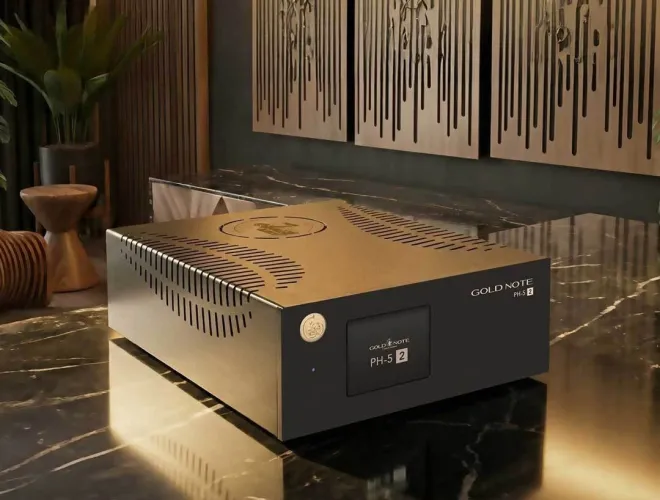

Gold Note PH-5.2 – MM/MC Phono Stage with Multiple Equalization Options

26.02.2026 07:42 | ~3 minutes read
The Italian company Gold Note has introduced the new Gold Note PH-5.2 phono stage, capable of working with both moving magnet (MM) and moving coil (MC) cartridges. The new model is an evolution of the previous PH-5 and embodies the concept that Gold Note has promoted for many years in the world of analog audio: high fidelity is not a matter of taste or sonic character, but a responsibility toward the original recording.
According to the manufacturer, the Gold Note PH-5.2 project focuses on what truly matters: mechanical construction, power supply, user interface, and the equalization system, with the goal of reducing interference, improving sonic coherence, and conveying even more of the musical nuances contained in the recording.
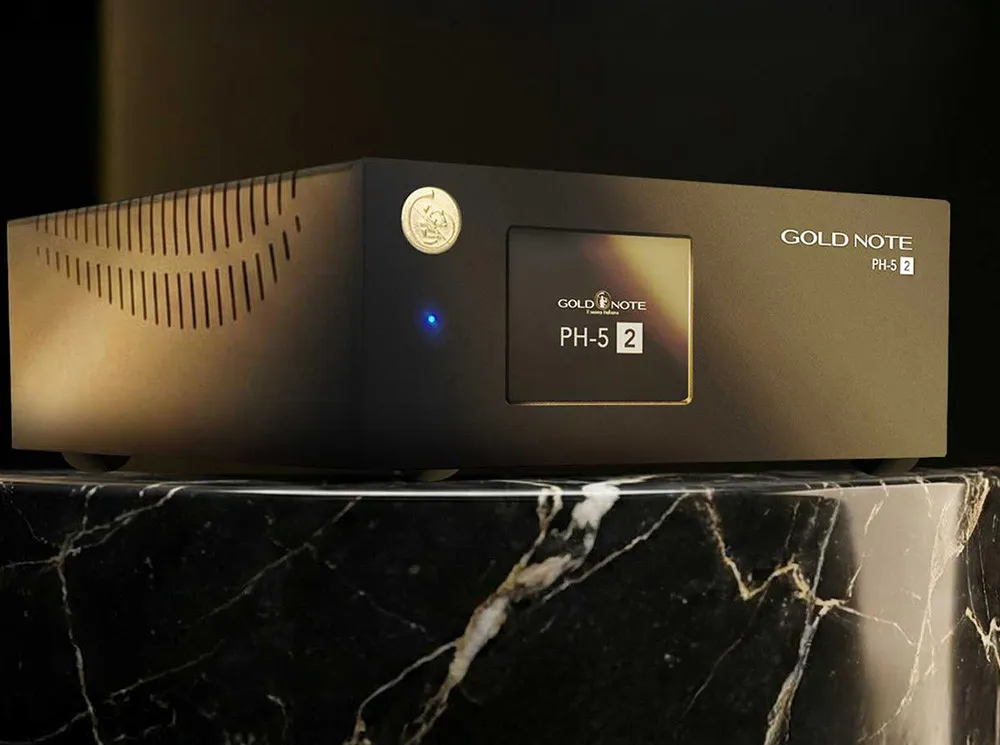
In addition, the Gold Note PH-5.2 adopts the new 5.2 Series design language, already introduced in the Gold Note HP-5.2 and Gold Note CD-5.2 models. The design has become more minimalistic, refined, and easily recognizable compared to the previous generation. However, the new aesthetics are not merely a stylistic decision. In the world of phono stages, where extremely weak signals are processed, every structural detail directly affects sound quality.
The PH-5.2 features a new anodized aluminum chassis, selected for its extremely low interaction with magnetic fields. Aluminum provides a more stable electrical and mechanical environment, reducing micro-interference that contributes to background noise. The benefit is not theoretical but clearly audible: a quieter background, improved detail retrieval, and more natural musical reproduction.
Particular attention was paid to the power supply during development – according to the manufacturer, it is not a secondary element but the foundation upon which a significant part of the design is built. The Gold Note PH-5.2 incorporates an upgraded power supply circuit designed to deliver greater stability and control under real operating conditions. This allows the circuitry to operate without strain and maintain sonic coherence even in the most complex and dynamically demanding musical passages. The result is a more authoritative presentation, better-controlled bass, and a cleaner, calmer high-frequency range.
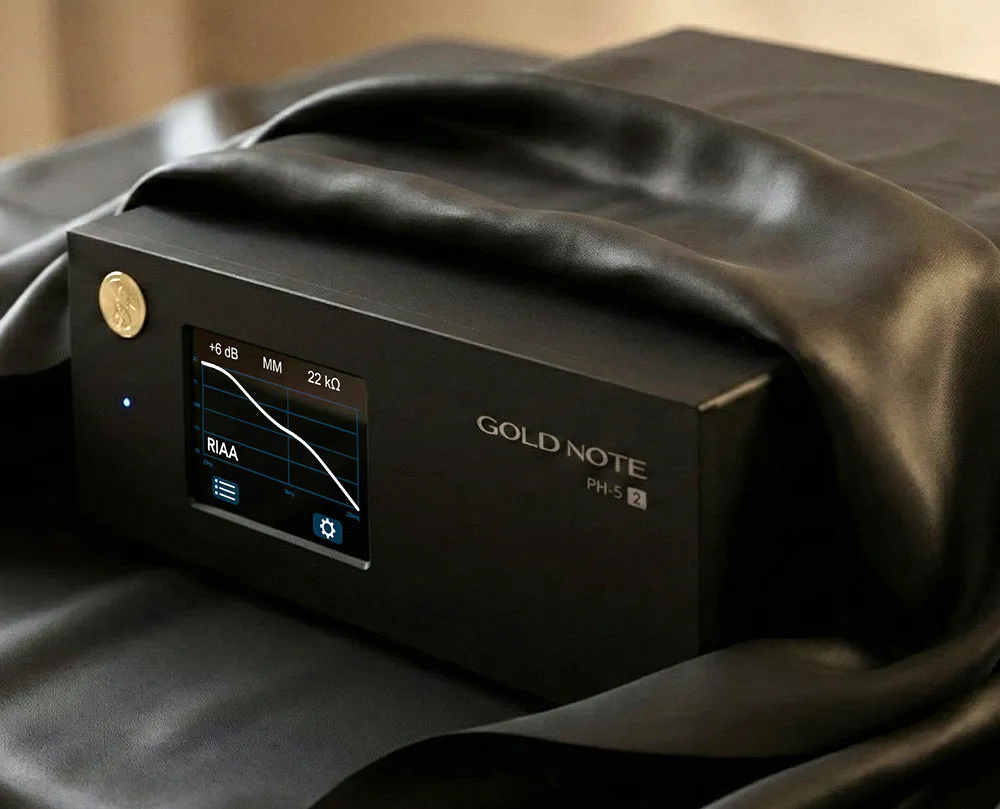
The Gold Note PH-5.2 is also equipped with an updated control system designed to make interaction more intuitive and direct. Display readability has been improved, navigation is faster, and parameters can be adjusted more easily and precisely. This aspect is far from secondary: in an analog system, proper setup is an integral part of sound quality. Precise adjustment of loading and gain allows the cartridge to operate under optimal conditions, avoiding compromises that inevitably affect the listening experience.
The conceptual core of the Gold Note PH-5.2 lies in its approach to equalization. For Gold Note, equalization curves are not tools for “enhancing” or “correcting” the sound, but a means of recreating the true recording context. Although the RIAA curve is considered today’s standard, historically it was not the only one. Many archival recordings were made using different equalization curves, depending on the era, the studio, and the recording technologies employed at the time.
Using an incorrect curve alters tonal balance, dynamics, and the overall character of the recording. The wrong choice can significantly distort playback quality. Following the same principle that, according to the developers, made the Gold Note PH-1000 and Gold Note PH-10 benchmarks in their segment, the Gold Note PH-5.2 places equalization in service of the truth of the recording rather than its interpretation.
Specifications
Model name
PH-5.2
Inputs (balanced)
N/A
Inputs (single-ended)
N/A
MC current-sensing input impedance (Ω)
N/A
MM/MC voltage input impedance (Ω)
N/A
Output impedance (Ω)
50
Gain (dB)
40 - 60
Playback EQ curves accuracy (dB)
N/A
Frequency response low +/- 3dB (Hz)
20
Frequency response high +/- 3dB (Hz)
50000
Total Harmonic Distortion + Noise (%)
0.05
Dimensions (mm)
200 × 80 × 260
Weight (kg)
1.2
Official link