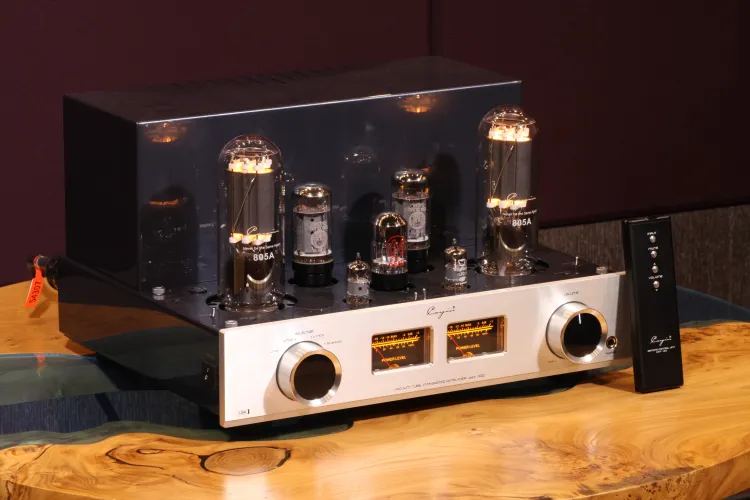

Cayin Jazz 100 - a Single-Ended Amplifier with 46 Watts on Tap
Integrated Tube Amplifier Review

The Cayin Jazz 100 integrated tube amplifier currently sells for under three thousand euros. Yes, really: for a tenth of what many rivals charge, you get a single-ended design built on 805A directly heated triodes, pure Class A operation and an impressive 2 x 46 W of output power. A bargain this generous naturally invites skepticism - so we spent enough time with the Cayin Jazz 100 to bring you a detailed review of the model. With all its strengths and weaknesses.
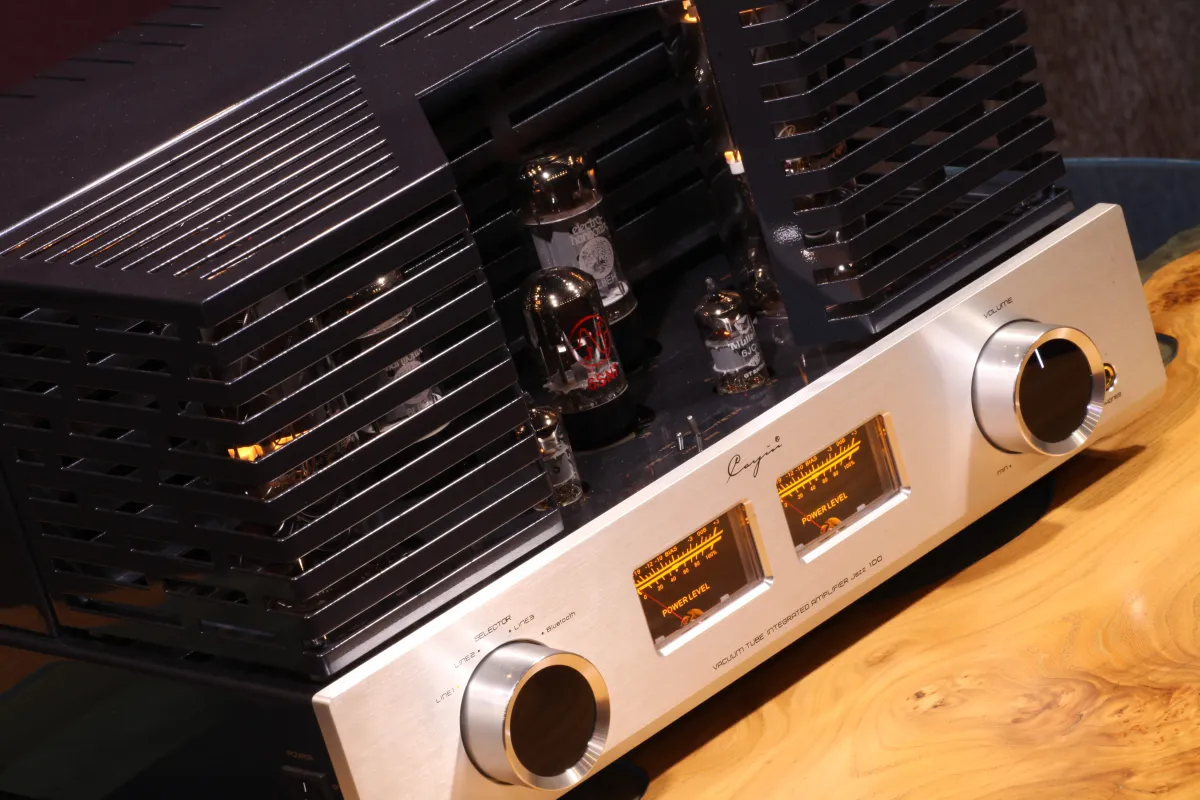
Brand Background
Zhuhai Spark Electronic Equipment has been building audio gear under the Cayin brand since 1993. Today the catalog covers nearly every component category - from tube amplifiers and loudspeakers to digital audio players and headphones. The parent firm belongs to Aviation Industry Corporation of China, a major aerospace holding - which secures deep manufacturing resources and competent engineering. Along with aviation-grade build quality.
Within the company's Jazz line of integrated tube amplifiers, the Cayin Jazz 100 holds the top spot. Below it sit the Jazz 80 and Jazz 90 (push-pull output stages in Class AB, switchable between triode and ultralinear modes).
Design
Judged by its spec sheet, the Cayin Jazz 100 ticks nearly every box on the seasoned audiophile's wish list - all in one stroke. There is the classic single-ended circuit, which should deliver that magical midrange, a generous 46 watts per channel (which means real flexibility when matching speakers), and solid, dependable engineering.
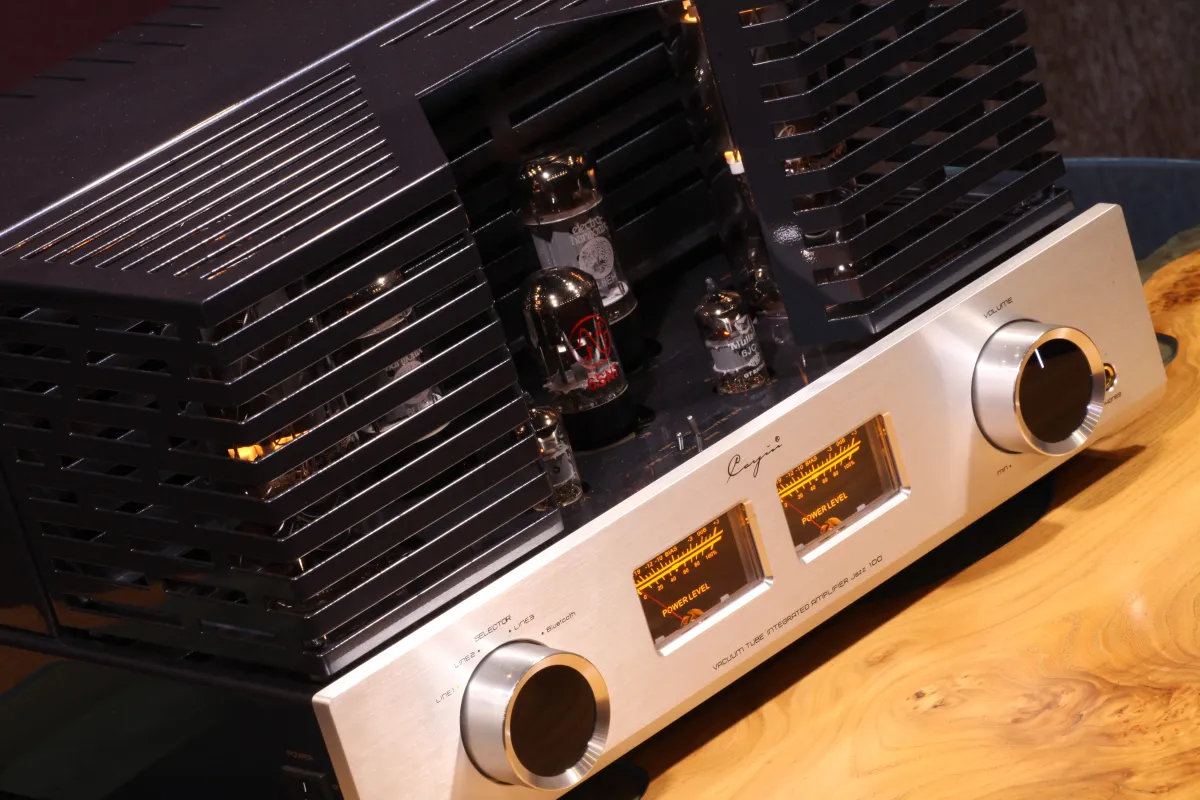
Voltage amplification is handled by NOS Mullard 6JC6 tubes and a Slovak JJ 6SN7. The driver stage of our test sample ran Electro-Harmonix 6L6EH tubes. Tube rolling is fully sanctioned - EL34, 6CA7, 5881, 6550, KT88 and KT90 all fit, so the amplifier's sonic signature can be tailored to taste. The output stage runs Cayin's own branded 805A directly heated triodes. EI-core output transformers realize the tubes' potential, while a toroidal transformer handles the power supply (maximum consumption reaches 410 W).
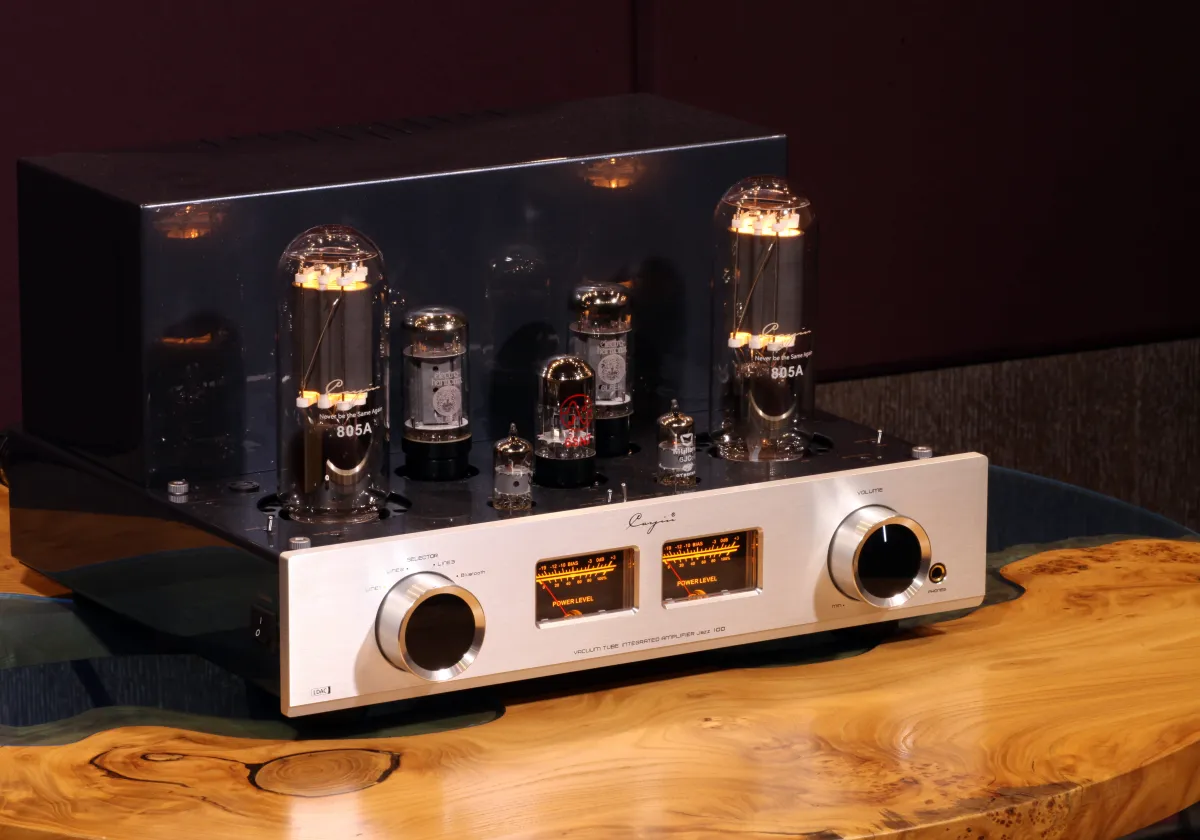
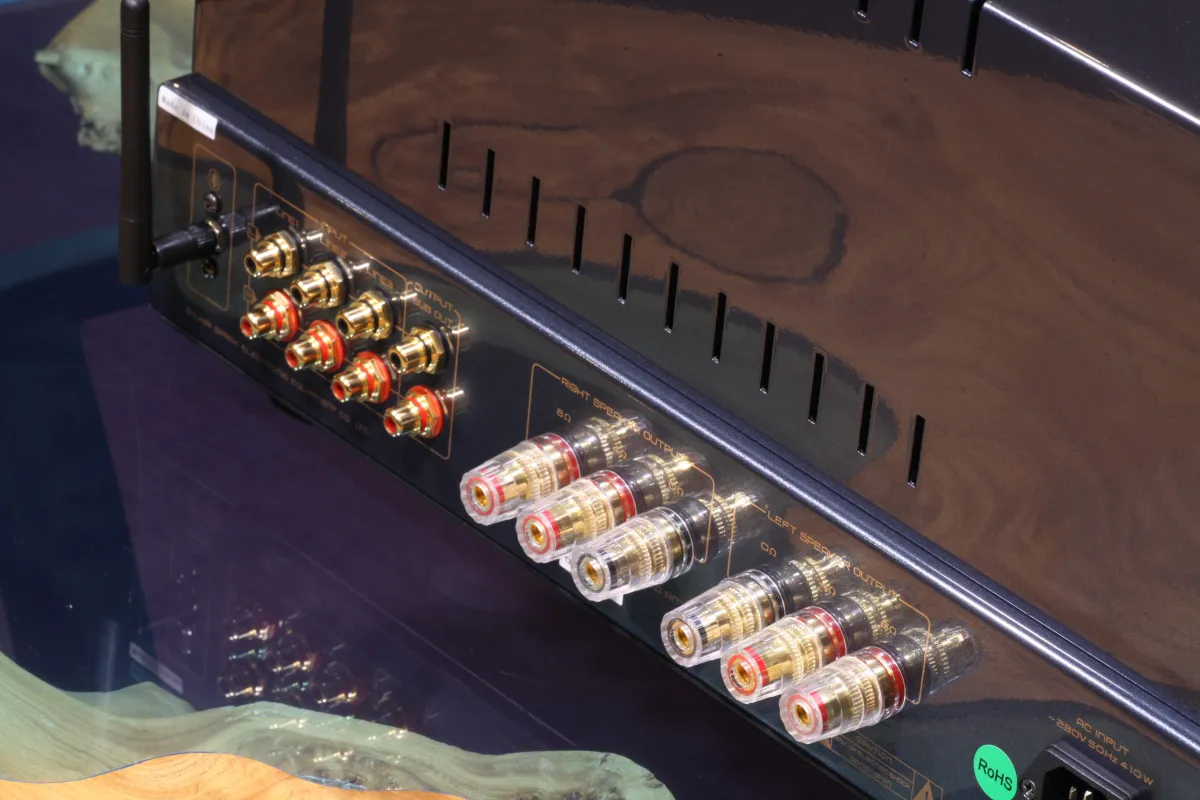
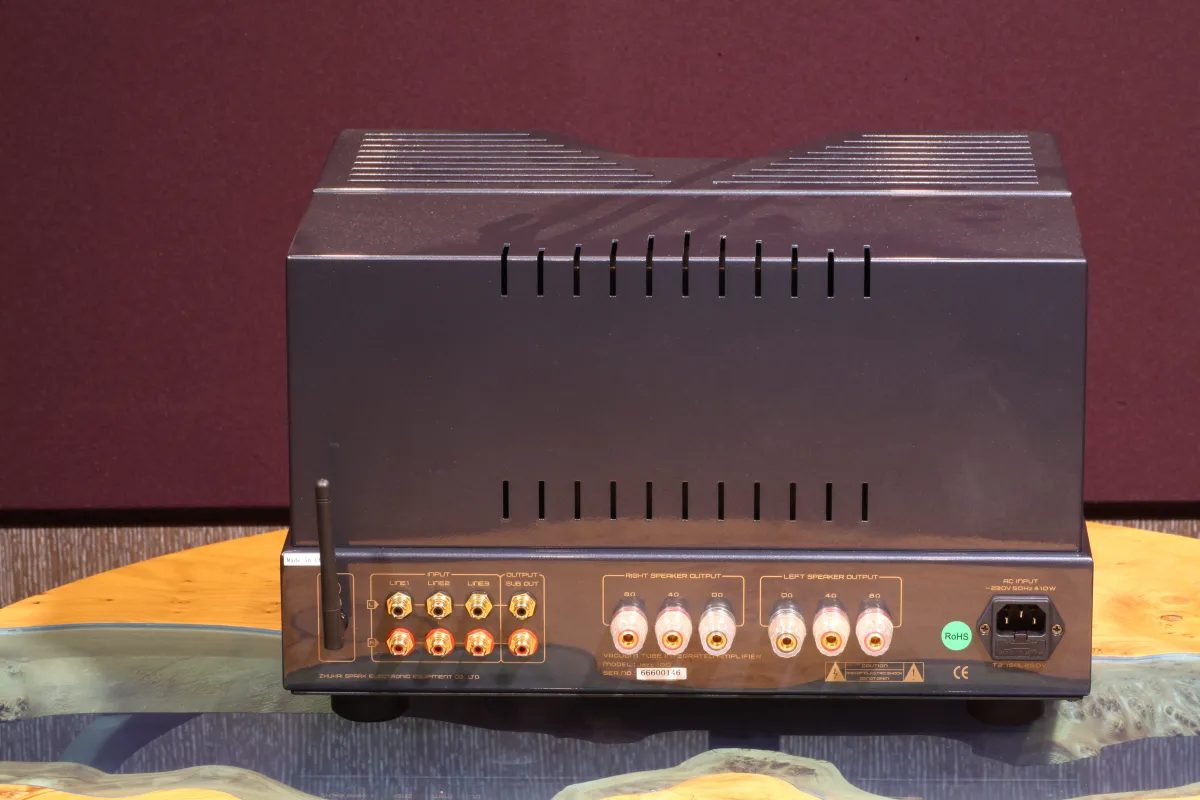
Despite the analog signal path, there is a cherry on top: a Bluetooth 5.0 wireless module with LDAC, aptX HD and aptX Low Latency codecs plus a DAC based on the ESS Technology ES9018K2M chip - none of it a mere checkbox feature. Analog sources get three RCA line inputs with 320 mV sensitivity and 100 kOhm input impedance. The high impedance goes easy on a source's output stage, but if the source itself is noisy (vinyl, magnetic tape), the system's overall hum level can rise. To address this, the amplifier carries a hum-balancing circuit on the top plate. Next to it sits another toggle - a negative feedback level selector. A 6.35 mm headphone output has not been forgotten either.
Speakers connect to separate terminal pairs for 4-ohm and 8-ohm loads. A compact metal-bodied remote covers input selection, volume adjustment and mute.
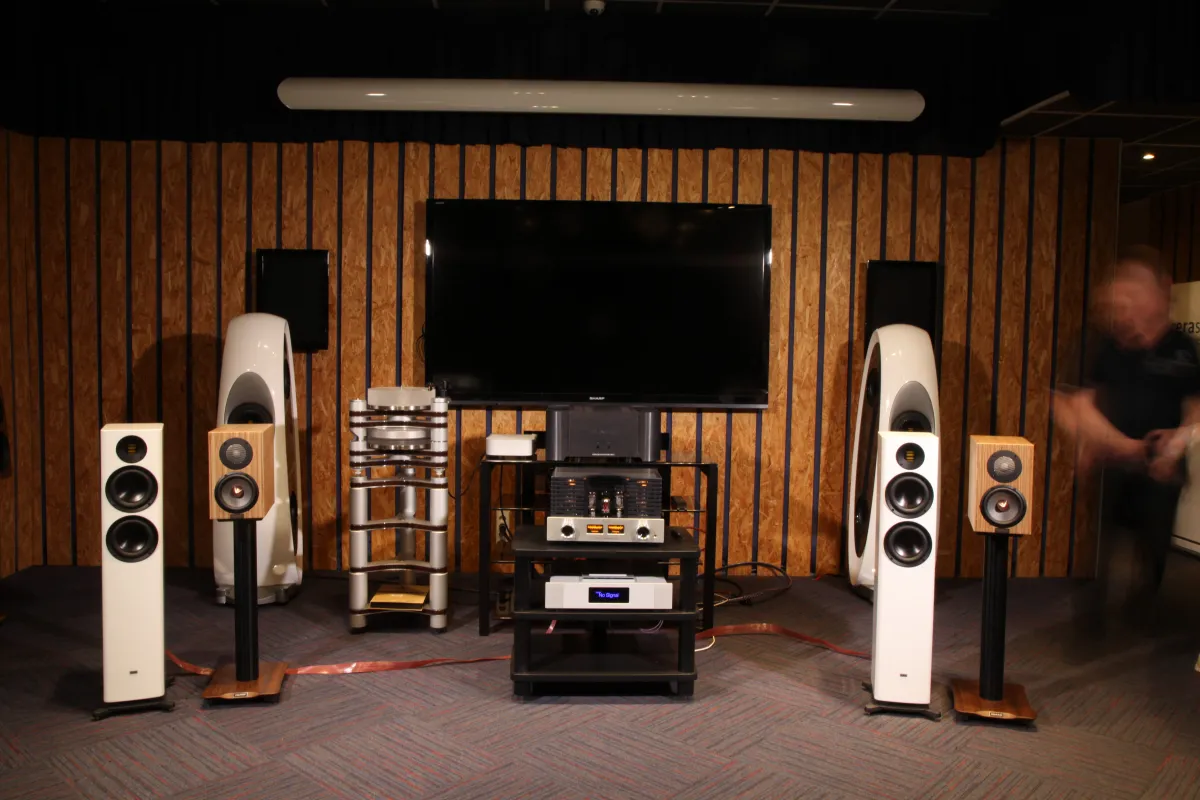
The System
We used a fully burned-in unit (200 hours) paired with a Metronome Le Player 4 digital source and two pairs of speakers: ELAC Solano FS 287 and Penaudio Cenya Diamond.
Sound
When judging how the Cayin Jazz 100 performs, keep in mind not only the initial burn-in of a new unit but also the warm-up needed after each power-on to reach optimal operating condition. From a cold start, the Cayin Jazz 100 needs at least an hour before the sound gains that signature density, weight and crystalline clarity.
From that point the integrated's sonic character reads instantly - it throws open a wide window into the music, full-bodied, dimensional and airy. Broad staging is, to one degree or another, a family trait of single-ended tube amplifiers (it is why we love them), but within its price bracket and even well above it, the Cayin Jazz 100 simply stuns with its delivery - the sonic images stand at genuinely full height.
And the tonal picture? Timbres are saturated and rich in shading. A violin never gains the weight of a cello, and in pizzicato passages you can make out not just every pluck but its force. Microdynamic attack impresses - so we were eager to move on to the real stress test and probe the Cayin Jazz 100's macrodynamics.
True, the cannon volleys in Tchaikovsky's 1812 Overture lost a little of their attack, but switching to AC/DC's Big Gun settled the matter - the sound stayed controlled and coherent. Where the Cayin Jazz 100 truly reached for the stars, though, was on jazz material. Total immersion in the club atmosphere of Stan Getz, Oscar Peterson and the other giants of the genre is guaranteed. Jazz lovers have no reason to look for anything better in this price category.
Verdict
Pay no attention to the name - the Cayin Jazz 100 was built for far more than jazz, and it will satisfy nearly any listener. An excellent amplifier.
Evaluations
Stage
95%
Detailing
90%
Macrodynamics
89%
Microdynamics
92%
Bass extension
90%
Timbral authenticity
94%
Genre versatility
90%
Overall
%
Particular qualities
Cayin's own branded 805A directly heated triodes
Tube rolling is fully sanctioned
DAC based on the ESS Technology ES9018K2M chip
2 x 46 W
Specifications
Model name
Jazz 100
Type
single-ended tube integrated amplifier with DAC
Analog inputs (balanced)
N/A
Analog inputs (single-ended)
3
Input sensitivity (mV)
320
Input impedance (balanced) (Ω)
N/A
Input impedance (single-ended) (Ω)
100000
Output impedance (balanced) (Ω)
N/A
Output impedance (single-ended) (Ω)
N/A
D/A conversion
N/A
Phono MM/MC current-sensing input impedance (Ω)
N/A
Output power (8Ω) (W)
N/A
Output power (4Ω) (W)
N/A
Gain (dBu)
N/A
Frequency response low +/- 3dB (Hz)
12
Frequency response high +/- 3dB (Hz)
33000
Signal to Noise Ratio (dB)
N/A
Total Harmonic Distortion + Noise (%)
N/A
Damping factor
N/A
Dimensions (mm)
420 × 389 × 248
Weight (kg)
35
Official link