
How to Choose a Listening Room When You Move House
A checklist for music lovers

12.08.2026 13:38 | ~4 minutes read
The listening room accounts for more than half of what your system sounds like. Optimising the sound of a room you already live in is far harder than getting things right in a new one from the start, so we have put together a full guide and checklist for choosing a listening room. It will help if you are house-hunting: follow it, and even entry-level Hi-Fi will take an audible step up in quality.
Room geometry matters most
At low frequencies a room introduces deviations of 15-20 dB into the frequency response, and no component will correct that. Digital room correction can even make matters worse. For comparison, the difference between two competently engineered amplifiers of the same class is measured in single decibels at worst.
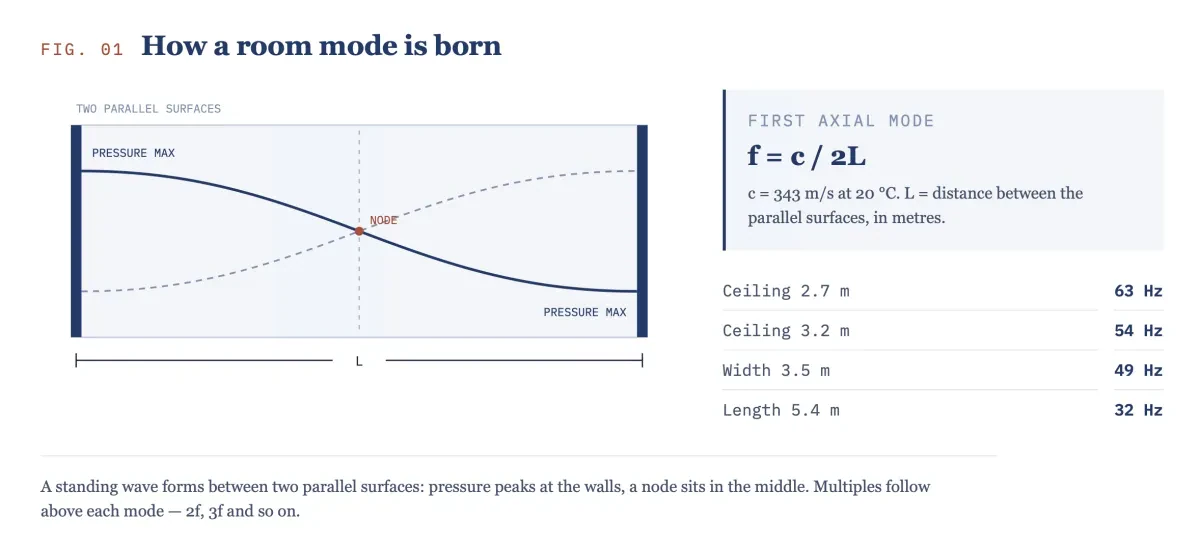
The cause is eigenmodes, or room modes. A standing wave forms between two parallel surfaces, and its frequency is set by the distance between them.
Frequency of the first axial mode:
f = c / (2L), where c is the speed of sound (roughly 343 m/s at 20 degrees Celsius) and L is the distance between the parallel surfaces in metres.
A 2.7 m ceiling guarantees a mode at around 63 Hz. A 3.2 m ceiling puts it near 54 Hz. A room width of 3.5 m gives about 49 Hz. A length of 5.4 m gives about 32 Hz. Multiples follow above each of them: 2f, 3f and so on.
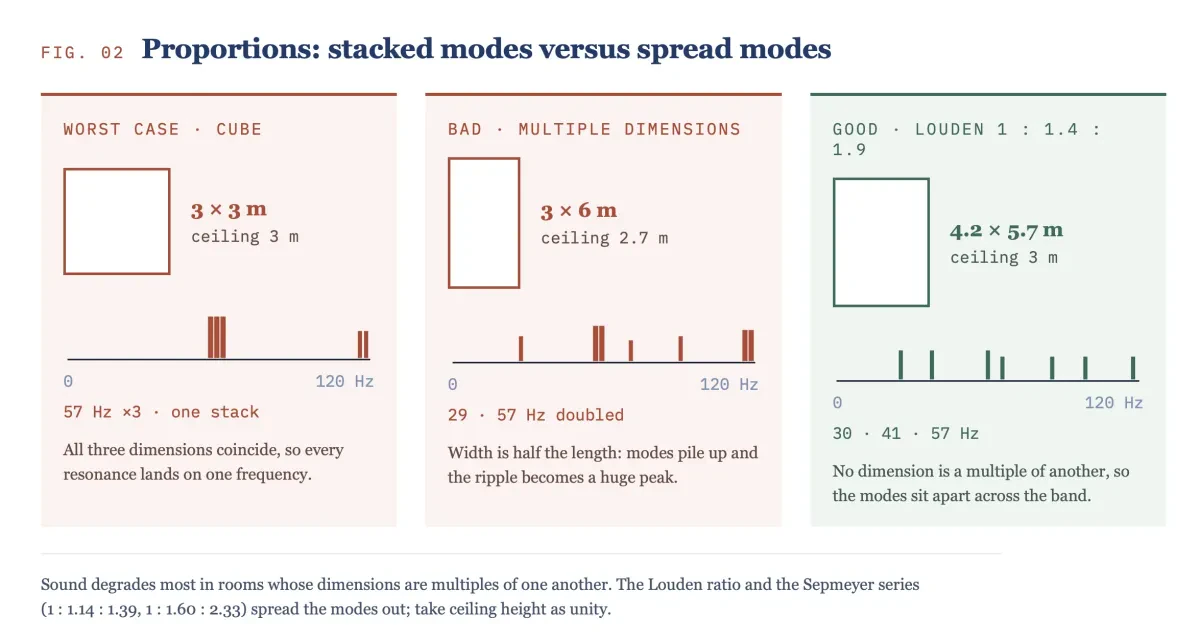
The conclusion - sound degrades most in rooms whose dimensions are multiples of one another. If the width is half the length, modes stack on top of each other and instead of a gentle ripple you get huge peaks. The worst case of all is a cubic room, where all three dimensions coincide and every resonance lands on the same frequency. A 3 by 3 meter room with a 3 meter ceiling is, acoustically speaking, the stuff of nightmares.
There are also proportions that yield well-behaved modes: the Louden ratio (1 : 1.4 : 1.9) and the Sepmeyer series (1 : 1.14 : 1.39 or 1 : 1.60 : 2.33, for example), with ceiling height taken as unity. With a 3 metre ceiling, Louden works out at roughly 4.2 by 5.7 metres. That is the benchmark to use when picking a listening room in your flat or house.
Ideally you would measure the modes before you buy, using room correction software such as Dirac plus an external USB-microphone. Modern calculators, though, will predict modes from the floor plan with reasonable accuracy once you know what the walls are made of.
Symmetry is the second priority
After proportions, the most significant factor is symmetry at the listening position. The stereo panorama depends on signals reaching the listener's left and right ear with the correct differences in time and level. That means the speakers must stand at equal distances from the walls, and you cannot have a situation where one of them fires into a doorway. Otherwise the picture turns murky and the soundstage smears.
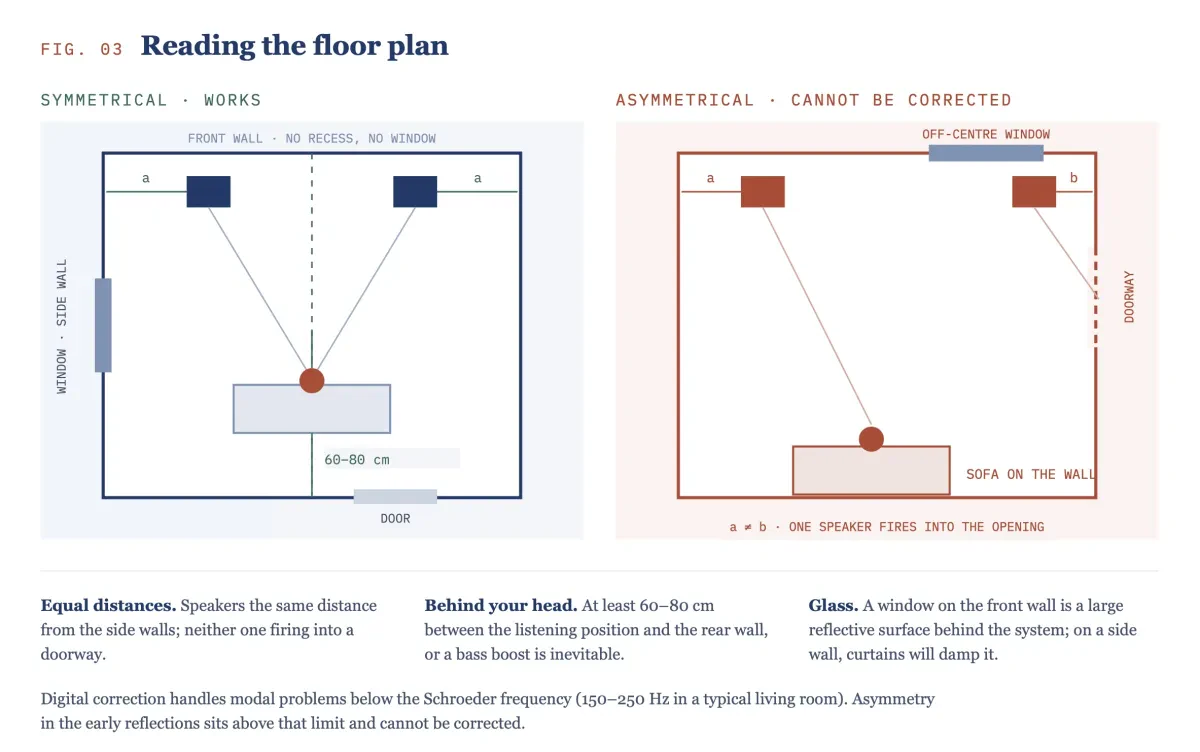
Digital room correction copes with modal problems below the Schroeder frequency (up to 150-250 Hz in a typical living room), but asymmetry in the early reflections sits above that limit and cannot be corrected.
What to look for in the floor plan
Room aspect ratio. Avoid squares and multiple dimensions (3 by 6, 2.7 by 5.4).
Ceiling height. Every additional 20 centimetre's shifts the vertical mode downwards and unloads the mid bass.
Symmetry of the front wall. A recess, a projection or an off-centre window on that wall is a problem for the sound.
Window position. A window on the front wall between the speakers means a large reflective surface behind the system, and curtains are less effective there. A window on a side wall can be damped with curtains.
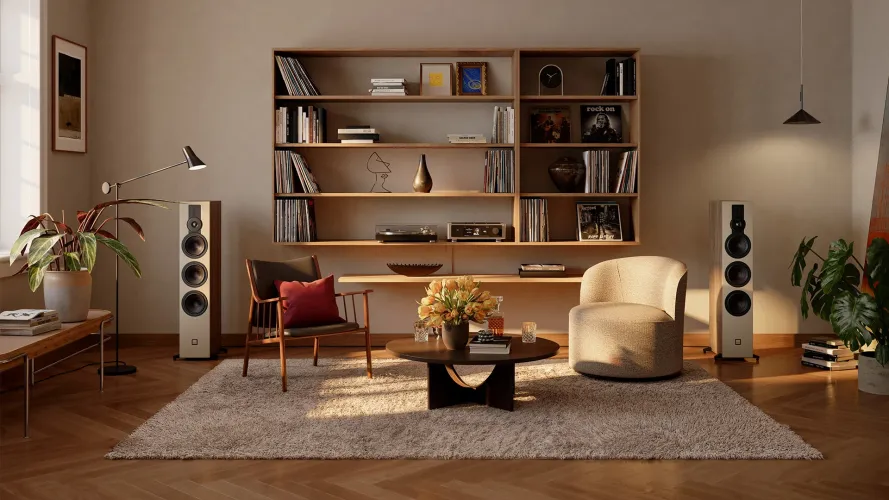
Space for the sofa. You need at least 60-80 centimetre's between your head and the rear wall, otherwise a low-frequency boost is inevitable. Sofa pushed flat against the wall is a mistake.
Doorways. An opening in a side wall opposite a speaker creates asymmetry that cannot be compensated for.
Acoustic treatment
Framed acoustic insulation on the walls and good double glazing with different glass thicknesses within the unit are the basic minimum, where they are possible at all. There is no upper limit to how far you can take this, and it deserves an article of its own. Do not overdo it, though: lining every wall with absorption leaves the room dead and lifeless, with reverberation time falling to unnaturally low values.
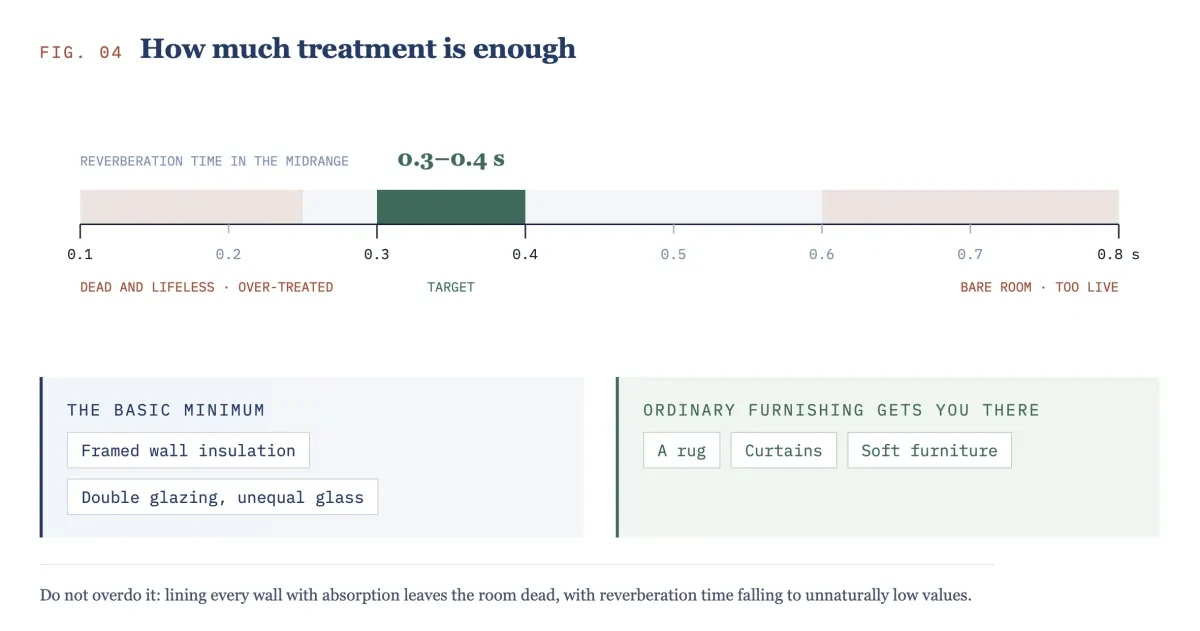
A sensible target is a reverberation time of around 0.3-0.4 seconds in the midrange. Ordinary domestic furnishing gets you there: a rug, curtains, soft furniture.