
Все

Напольная акустика — Magico M7
Описание, изображения, технические характеристики и спецификации
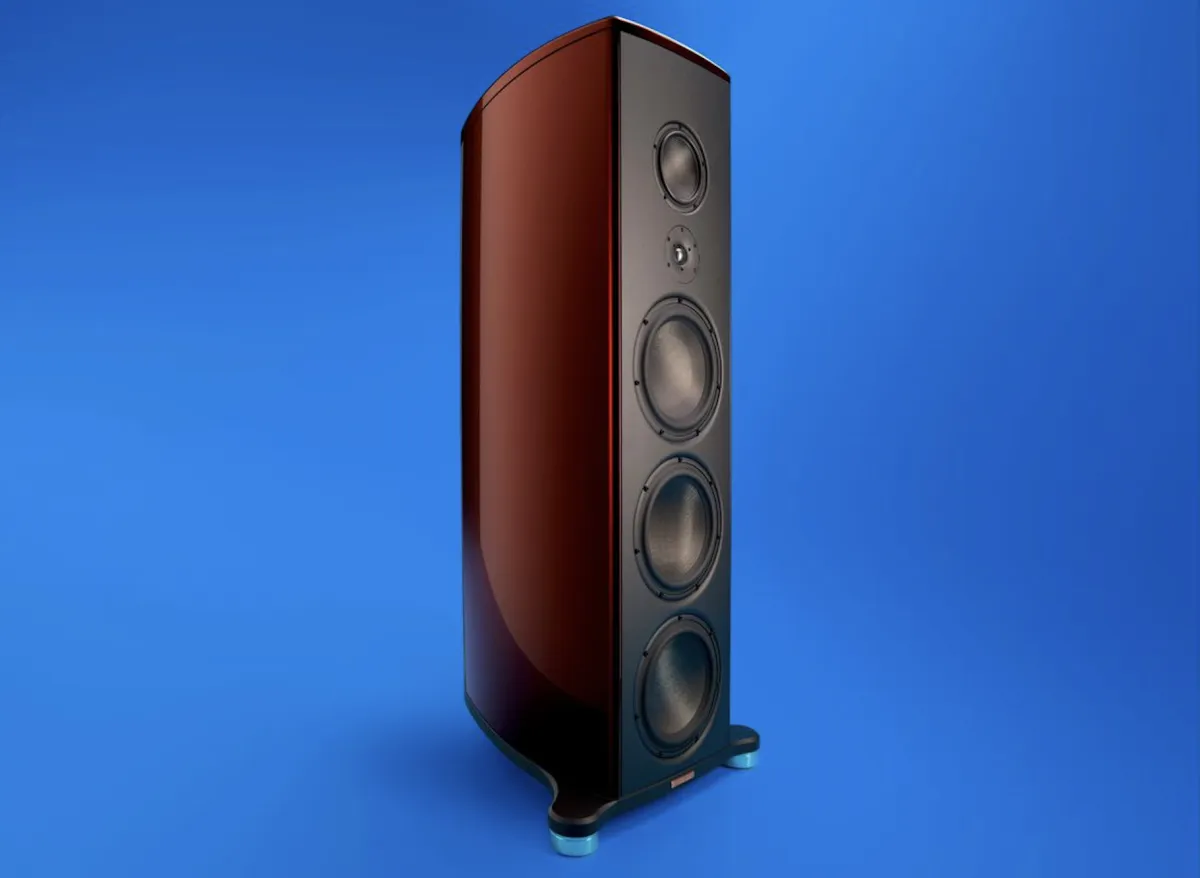
Magico M7
Источник изображения — © Magico
Within the M-Series, the M7 is a four-way tower from Magico, the California maker known for its aluminium and carbon-fibre cabinets. It uses six drivers per cabinet and draws on the brand's latest drive-unit technology, housed in an organically shaped enclosure that combines a carbon-fibre shell with an aluminium front baffle.
Key specs that matter
The M7 is rated from 18 Hz to 50 kHz, a sensitivity of 92 dB and a nominal impedance of 4 ohm. Magico lists 50 W as the minimum amplifier power and 2000 W as the maximum. The quoted footprint is 163 x 73 x 49 cm, and one cabinet weighs 239 kg. The driver line-up consists of a 28 mm beryllium tweeter with a diamond coating, a single 5 inch midrange, two 9 inch midbass units and two 12 inch bass drivers.
Engineering and use context
Magico makes the tweeter diaphragm from beryllium with an optimised geometry, coated with diamond by a chemical vapour deposition process. All cones belong to the Gen 8 Nano-Tec family. In the midrange this means an aluminium honeycomb core sandwiched between inner and outer skins of graphene-infused carbon fibre. The motor systems use underhung neodymium magnets with copper pole caps. The enclosure starts as a monocoque carbon-fibre shell designed with Finite Element Analysis modelling, and the front is a multi-layer baffle of 6061-T6 aluminium with constrained-layer damping. The Elliptical Symmetry Crossover, which Magico abbreviates as ESXO, appears here with parts sourced from Mundorf and Duelund. The midrange cone is a pure midrange driver, which means the band below it is left entirely to the four larger cones, split between the midbass and bass pairs. Each driver type has its own motor built around the same underhung principle, so voice coil travel stays inside the magnetic gap over the working stroke. With six drivers and a quarter-tonne cabinet, the M7 is a speaker for a large dedicated room where the owner can plan delivery and final placement in advance.
Pairing
The high sensitivity lets a moderate amplifier drive the M7 to usable levels, while the broad power range also accepts big transistor stereo or monoblock designs able to hold a low impedance load with the current reserve that the bass section can ask for. Floors and access routes should be checked for the combined weight of a pair.
Alternatives
The Magico M9 sits above the M7 in the M-Series as a semi-active floorstanding design.
Key specs that matter
The M7 is rated from 18 Hz to 50 kHz, a sensitivity of 92 dB and a nominal impedance of 4 ohm. Magico lists 50 W as the minimum amplifier power and 2000 W as the maximum. The quoted footprint is 163 x 73 x 49 cm, and one cabinet weighs 239 kg. The driver line-up consists of a 28 mm beryllium tweeter with a diamond coating, a single 5 inch midrange, two 9 inch midbass units and two 12 inch bass drivers.
Engineering and use context
Magico makes the tweeter diaphragm from beryllium with an optimised geometry, coated with diamond by a chemical vapour deposition process. All cones belong to the Gen 8 Nano-Tec family. In the midrange this means an aluminium honeycomb core sandwiched between inner and outer skins of graphene-infused carbon fibre. The motor systems use underhung neodymium magnets with copper pole caps. The enclosure starts as a monocoque carbon-fibre shell designed with Finite Element Analysis modelling, and the front is a multi-layer baffle of 6061-T6 aluminium with constrained-layer damping. The Elliptical Symmetry Crossover, which Magico abbreviates as ESXO, appears here with parts sourced from Mundorf and Duelund. The midrange cone is a pure midrange driver, which means the band below it is left entirely to the four larger cones, split between the midbass and bass pairs. Each driver type has its own motor built around the same underhung principle, so voice coil travel stays inside the magnetic gap over the working stroke. With six drivers and a quarter-tonne cabinet, the M7 is a speaker for a large dedicated room where the owner can plan delivery and final placement in advance.
Pairing
The high sensitivity lets a moderate amplifier drive the M7 to usable levels, while the broad power range also accepts big transistor stereo or monoblock designs able to hold a low impedance load with the current reserve that the bass section can ask for. Floors and access routes should be checked for the combined weight of a pair.
Alternatives
The Magico M9 sits above the M7 in the M-Series as a semi-active floorstanding design.
Характеристики
Название модели
M7
Нижняя граница частотного диапазона +/- 3дБ (Hz)
18
Верхняя граница частотного диапазона +/- 3дБ (Hz)
50000
Чувствительность (dB at 1 W/1m)
92
Импеданс (Ohms)
4
Требования к усилителю мощности (W)
50 - 2000
Наличие встроенного усилителя
Н/д
Мощность встроенного усилителя (W)
N/A
Размер (sm)
163 × 73 × 49
Вес (kg)
239
Официальная ссылка
Связанные материалы
Другие компоненты
Напольная акустика
Magico S7 2026
Напольная акустика
Magico S2 2025

Напольная акустика
Magico A5
Напольная акустика
Magico A3
Напольная акустика
Magico S2