
All

Floorstanding loudspeakers — Audio Physic CODEX
Description, images, technical data and specifications
Audio Physic CODEX
Image source - (c) Audio Physic
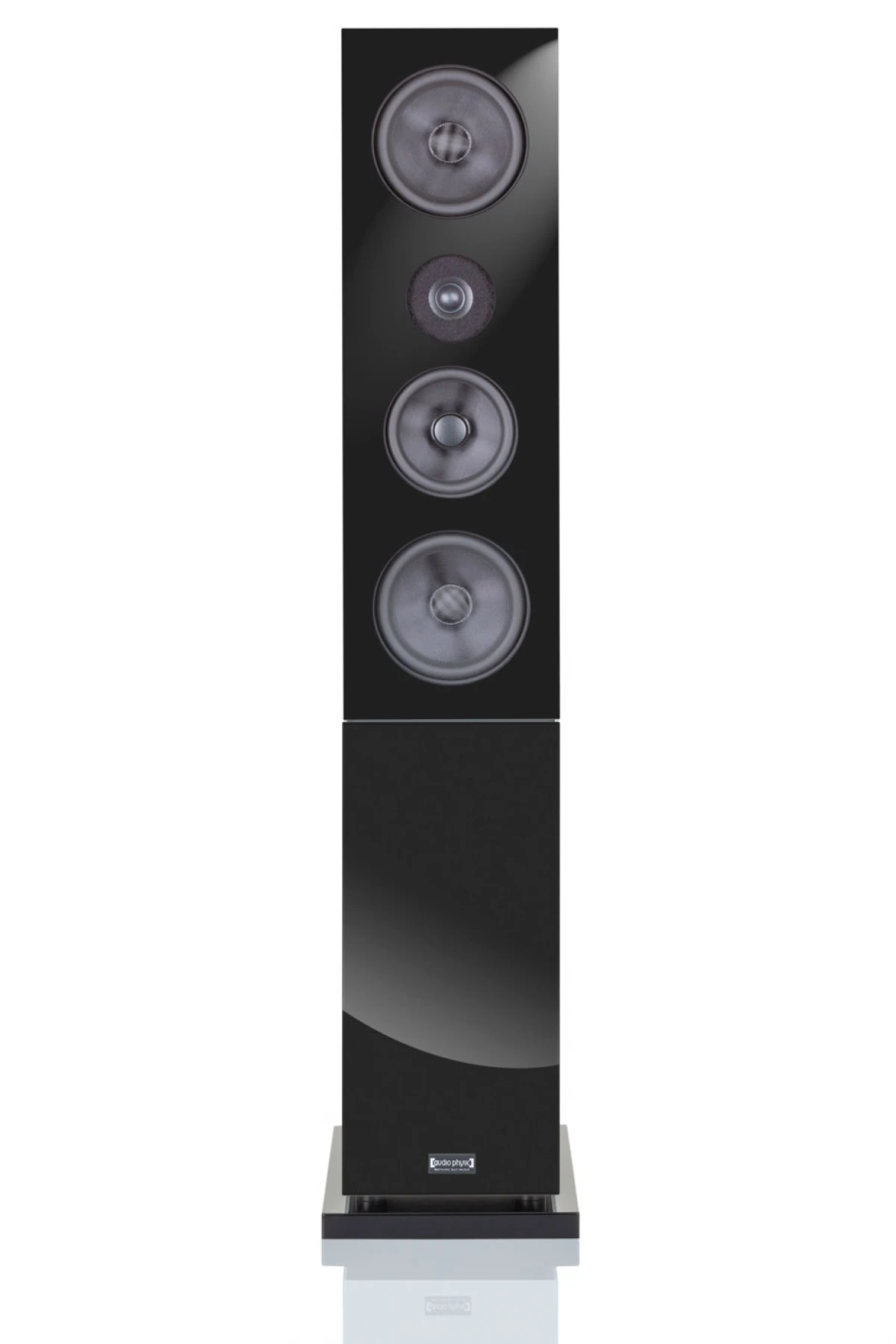
The CODEX is a four-way floorstanding loudspeaker from Audio Physic of Germany with a slim baffle and the company's PowerTrain technology. In its current version Audio Physic combines PowerTrain with fifth-generation drivers, the HHCT V tweeter and the HHCM V SL midrange, while the minimalist design of the cabinet remains unchanged. High-gloss glass finishes are offered in Black, White and Anthracite. Black Ebony and Rosewood high-gloss veneers are currently not available.
Key specs that matter
Frequency range is 28 Hz - 40 kHz, sensitivity is 89 dB and impedance is 4 ohms, with a recommended amplifier power of 40 - 250 W. Four drivers are used - a 39 mm (1.5 in.) HHCT V tweeter, a 150 mm (5.9 in.) HHCM V SL midrange, a 180 mm (7 in.) double-surround midwoofer and a 280 mm (11 in.) aluminium-cone woofer inside the cabinet. Dimensions are 1195 x 202 x 370 mm (H x W x D). Weight is approx. 38 kg in wood veneer and 44 kg in glass. A black glass grille and a spike set are included, and bi-wiring is available on request.
Engineering and use context
Numerous internal braces and very stiff open-pore ceramic foam elements stiffen the cabinet without noticeably reducing its internal volume. Its sandwich construction has a permanently elastic intermediate bonding layer that damps resonances of the enclosure walls.
Inside the enclosure, the long-throw woofer operates in its own tuned chamber. From 100 Hz upward it hands over to the 180 mm driver in the front baffle. Every other driver also has a dedicated chamber to eliminate interaction via the internal air volume. None of the drivers has direct contact with the baffle, and Audio Physic states that this mounting reduces micro-vibrations and partial oscillations.
Both the HHCM V SL diaphragm and the HHCT V cone are made of RECOTec, a carbon fibre mesh embedded in a polypropylene matrix that combines stiffness with internal damping. A special surround design lets the midrange work without a conventional spider, so the structure behind the diaphragm is more open to airflow and compression effects are prevented.
Crossover parts are distributed across multiple levels and placed close to their respective drivers. On the terminal panel sit WBT nextgen binding posts, and the terminal itself is mechanically decoupled from the cabinet.
Pairing
An amplifier stable into 4 ohms is required. The bi-wiring option allows passive bi-amping with two amplifier channels per speaker.
Alternatives
The CODEX RQ is the newer version, with RECOTec diaphragms also on the mid/bass driver and Audio Physic's Q-SET technology.
Specifications
Model name
CODEX
Frequency Response low +/- 3dB (Hz)
28
Frequency Response high +/- 3dB (Hz)
40 000
Sensitivity (dB at 1 W/1m)
89
Impedance (Ohms)
4
Power amplifier requirements (W)
40 - 250
Has internal amplification
N/A
Internal amplification power (W)
N/A
Size (sm)
119.5 × 20.2 × 37.0
Weight (kg)
38 (Wood), 44 (Glass)
Official link
More components
Floorstanding loudspeakers
Audio Physic CLASSIC 25 40TH ANNIVERSARY EDITION
Floorstanding loudspeakers
Audio Physic CLASSIC 8
Floorstanding loudspeakers
Audio Physic CLASSIC 15
Floorstanding loudspeakers
Audio Physic CLASSIC 25
Floorstanding loudspeakers
Audio Physic CLASSIC 35