
Все

Напольная акустика — Acapella APOLLON
Описание, изображения, технические характеристики и спецификации
Acapella APOLLON
Источник изображения — © Acapella
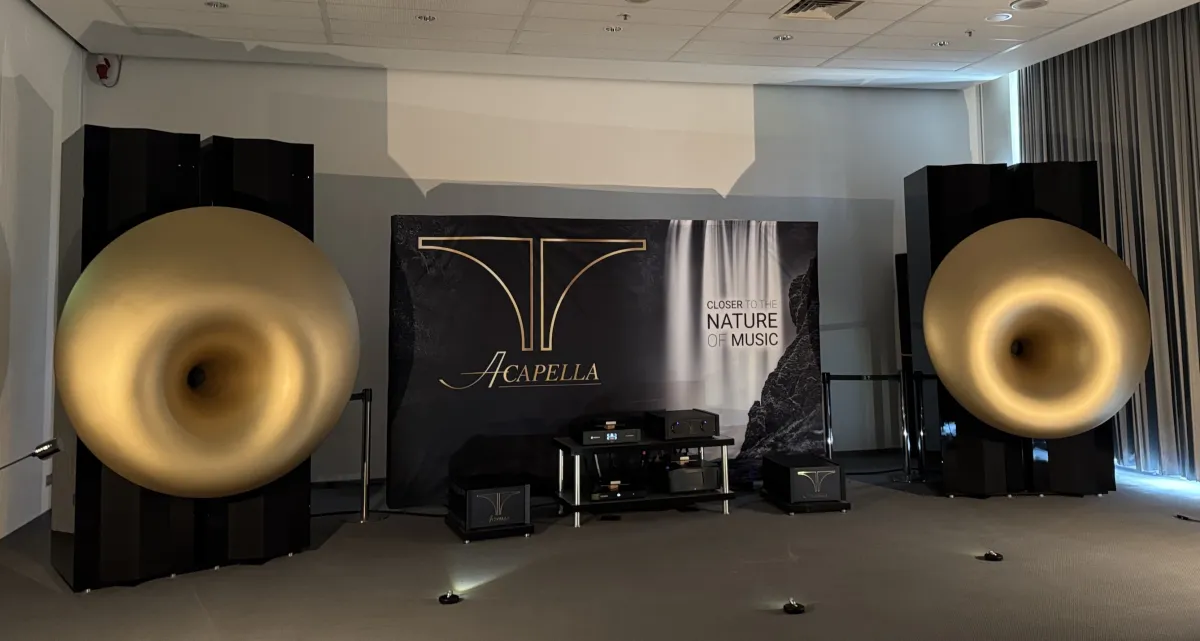
The Apollon is a floor-to-ceiling horn loudspeaker from Acapella Audio Arts, the company founded in 1978 by Alfred Rudolph and Herman Winters in Duisburg, Germany. Acapella calls it the room-height column of its 780 horn series, and it was the first model, together with the Poseydon, to use the large hyperspherical midrange horn later adopted for the smaller Atlas. The current version is the Apollon MK II. The US price of the original model was USD 150,000 per pair.
Key specs that matter
Acapella configures the Apollon as a three-way. Bass comes from six 10-inch drivers - four on the front of the column and two more loaded inside the cabinet as sub-bass - covering 20 Hz to 350 Hz. A 2-inch compression driver feeds the 780 mm hyperspherical horn from 350 Hz to 6,000 Hz, a span of more than four octaves. Above 6 kHz an ion plasma tweeter with its own spherical horn runs up to 40 kHz. Acapella lists the overall range as 20 Hz to 40 kHz and the efficiency as about 99 dB at 1 W and 1 m, while the MK II data gives 25 Hz to 40 kHz and 96 dB. Impedance is 6 to 8 ohm, and the load rating is 100 W continuous and 1,000 W for 10 ms pulses. The tweeter draws 15 W from the mains. Without the horn the column is 2,300 mm tall, 380 mm wide and 810 mm deep, and with the horn fitted the width grows to 780 mm and the depth to 1,000 mm. Each speaker weighs about 320 kg.
Engineering and use context
The ion tweeter creates sound from a plasma discharge in the air and so has no diaphragm and no moving mass. Acapella claims to have originated the spherical horn in 1978, and the hyperspherical profile of the 780 horn is its extension of that geometry. Side panels of about 16 kg each are bolted to the column to stiffen the structure. The ion tweeter and the midrange horn unit can both be fine-tuned in level to suit the installation. Internal wiring uses ceramic-insulated silver. The body comes in black or white acrylic, and any RAL shade can be specified for the horn without surcharge.
Pairing
With efficiency in the upper 90s, even a low-powered amplifier drives the Apollon to high levels, and Acapella builds a matching amplifier of its own, the La Musika integrated. The moderate impedance suits both valve and transistor designs. A floor that can take over 300 kg on a small footprint and a ceiling height above 2.3 m are practical prerequisites, and the ion tweeter needs a mains socket near each speaker.
Alternatives
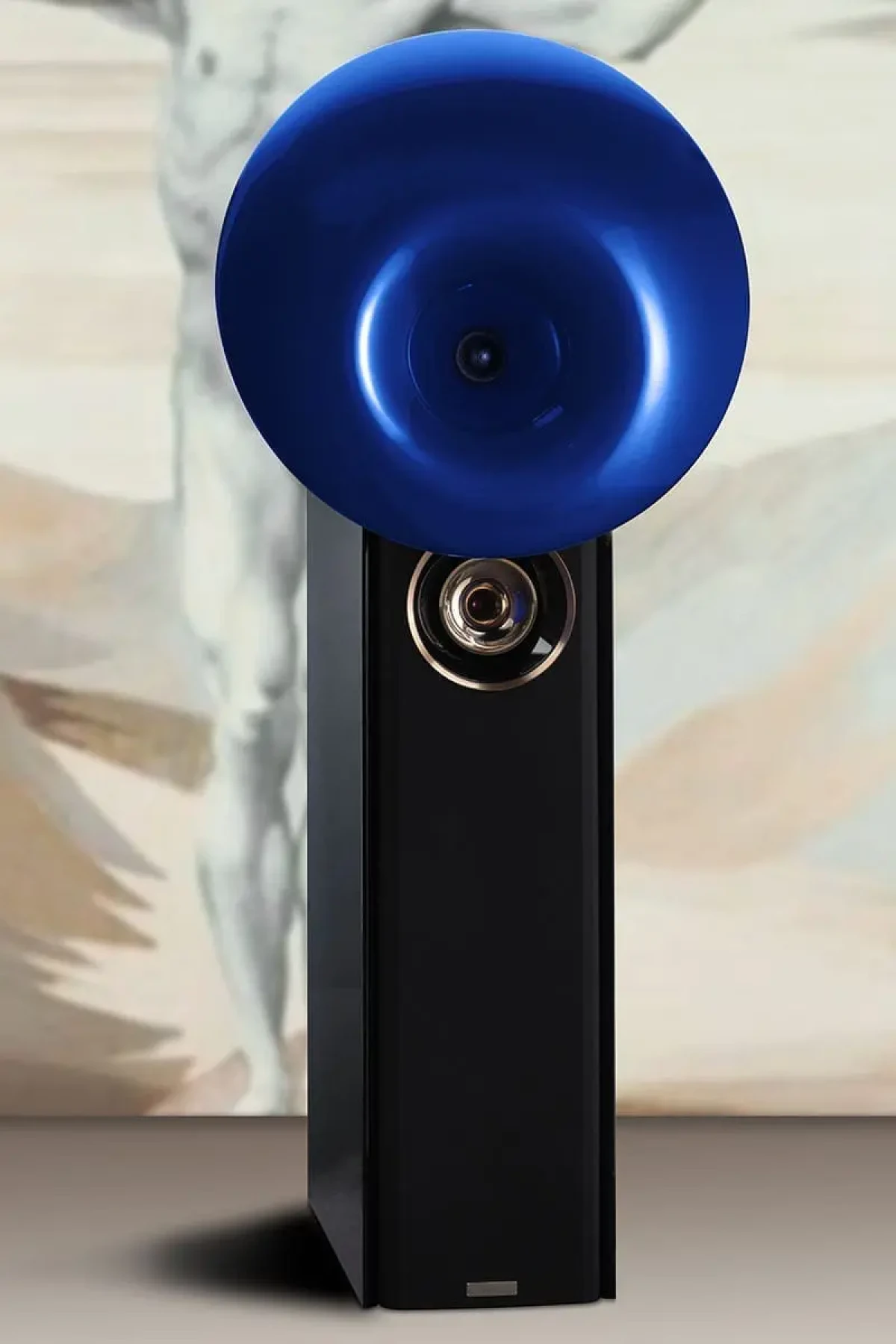
The Acapella Atlas uses the same hyperspherical horn and ion tweeter above a shorter cabinet with three 10-inch woofers.
Key specs that matter
Acapella configures the Apollon as a three-way. Bass comes from six 10-inch drivers - four on the front of the column and two more loaded inside the cabinet as sub-bass - covering 20 Hz to 350 Hz. A 2-inch compression driver feeds the 780 mm hyperspherical horn from 350 Hz to 6,000 Hz, a span of more than four octaves. Above 6 kHz an ion plasma tweeter with its own spherical horn runs up to 40 kHz. Acapella lists the overall range as 20 Hz to 40 kHz and the efficiency as about 99 dB at 1 W and 1 m, while the MK II data gives 25 Hz to 40 kHz and 96 dB. Impedance is 6 to 8 ohm, and the load rating is 100 W continuous and 1,000 W for 10 ms pulses. The tweeter draws 15 W from the mains. Without the horn the column is 2,300 mm tall, 380 mm wide and 810 mm deep, and with the horn fitted the width grows to 780 mm and the depth to 1,000 mm. Each speaker weighs about 320 kg.
Engineering and use context
The ion tweeter creates sound from a plasma discharge in the air and so has no diaphragm and no moving mass. Acapella claims to have originated the spherical horn in 1978, and the hyperspherical profile of the 780 horn is its extension of that geometry. Side panels of about 16 kg each are bolted to the column to stiffen the structure. The ion tweeter and the midrange horn unit can both be fine-tuned in level to suit the installation. Internal wiring uses ceramic-insulated silver. The body comes in black or white acrylic, and any RAL shade can be specified for the horn without surcharge.
Pairing
With efficiency in the upper 90s, even a low-powered amplifier drives the Apollon to high levels, and Acapella builds a matching amplifier of its own, the La Musika integrated. The moderate impedance suits both valve and transistor designs. A floor that can take over 300 kg on a small footprint and a ceiling height above 2.3 m are practical prerequisites, and the ion tweeter needs a mains socket near each speaker.
Alternatives
The Acapella Atlas uses the same hyperspherical horn and ion tweeter above a shorter cabinet with three 10-inch woofers.
Характеристики
Название модели
APOLLON
Нижняя граница частотного диапазона +/- 3дБ (Hz)
25
Верхняя граница частотного диапазона +/- 3дБ (Hz)
40 000
Чувствительность (dB at 1 W/1m)
N/A
Импеданс (Ohms)
6 - 8
Требования к усилителю мощности (W)
100 - 1000
Наличие встроенного усилителя
Н/д
Мощность встроенного усилителя (W)
N/A
Размер (sm)
230.0 x 78.0 x 100.0
Вес (kg)
320
Официальная ссылка
Другие компоненты
Напольная акустика
Acapella HYPERSPHERE
Напольная акустика
Acapella Hyperion

Напольная акустика
Acapella SPHÄRON EXCALIBUR

Напольная акустика
Acapella TRIOLON EXCALIBUR
Напольная акустика
Acapella ATLAS