
All

Floorstanding loudspeakers — German Physiks Unicorn MK II
Description, images, technical data and specifications
German Physiks Unicorn MK II
Image source — © German Physiks
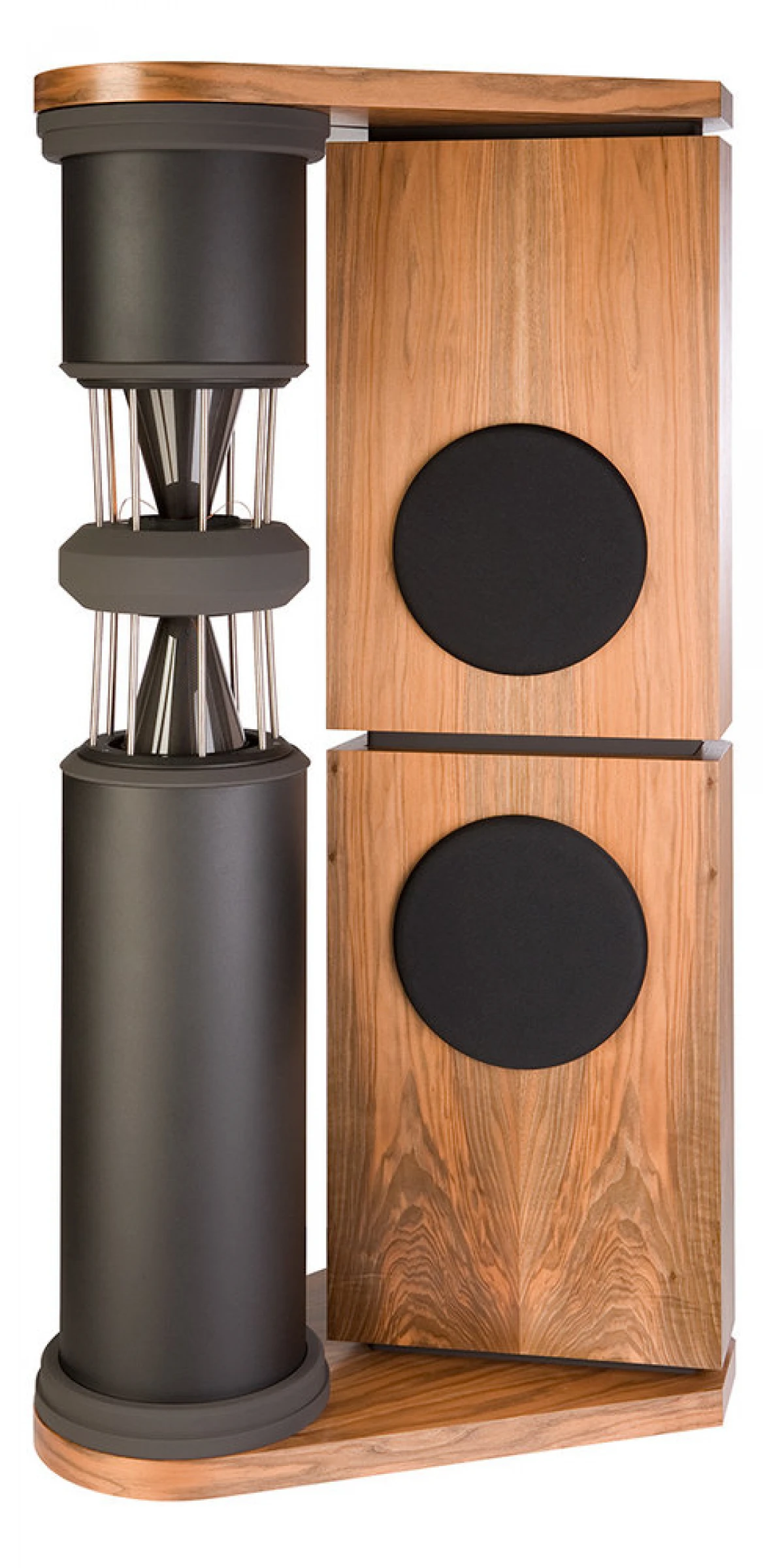
The Unicorn MK II is the only German Physiks loudspeaker built around a single driver. One carbon fibre DDD driver covers the full range from 40 Hz to 24 kHz, radiating directly above about 200 Hz and feeding a horn system below that point.
Key specs that matter
Frequency response runs from 40 Hz to 24 kHz, sensitivity is 88 dB and impedance is 4 ohms. German Physiks lists amplifier power from 4 W to 60 W, the narrowest range in its catalogue, reflecting the absence of a separate woofer. The cabinet measures 550 mm wide, 1241 mm high and 460 mm deep and weighs 56 kg.
Engineering and use context
Mounted at the top of the enclosure, the DDD points its carbon fibre cone vertically, so it radiates evenly through 360 degrees. Above roughly 200 Hz, the outside of the cone radiates into the room as in every other German Physiks model. Below that point, the energy radiated from beneath the driver is coupled into a horn inside the cabinet and leaves through an opening at the bottom, extending the response below 40 Hz without any crossover or second driver. German Physiks describes the driver as working in bending-wave mode when radiating directly and in piston mode when feeding the horn. The horn is a high-gain design coupled with a tuned bass trap. The trap keeps midrange energy out of the horn, which would otherwise arrive late relative to the driver's direct output and cause smearing as well as a bump in the midrange response. During development, the designers found that the Unicorn performed better when certain cabinet panels were not made fully rigid, and this finding dictated the unusual shape of the enclosure. Each DDD driver is hand-built by a technician, pre-aged at high level and matched into pairs, and its carbon fibre cone is only 0.15 mm thick. With no crossover anywhere in the signal path, the amplifier connects straight to the one driver. The driver's moving mass is under three grams, and German Physiks states that it withstands being touched without damage. The original Unicorn dates back to the late 1990s.
Pairing
The specified power range points to quality amplifiers of modest power, including valve designs, and the single-driver load avoids crossover interactions. Because the driver radiates omnidirectionally and the horn mouth sits at the base, the speaker needs space around it, and German Physiks recommends rooms of about 8 to 45 m2.
Alternatives
German Physiks' HRS-130 is the compact DDD model with a downward-firing 10 in woofer and Helmholtz resonator.
Key specs that matter
Frequency response runs from 40 Hz to 24 kHz, sensitivity is 88 dB and impedance is 4 ohms. German Physiks lists amplifier power from 4 W to 60 W, the narrowest range in its catalogue, reflecting the absence of a separate woofer. The cabinet measures 550 mm wide, 1241 mm high and 460 mm deep and weighs 56 kg.
Engineering and use context
Mounted at the top of the enclosure, the DDD points its carbon fibre cone vertically, so it radiates evenly through 360 degrees. Above roughly 200 Hz, the outside of the cone radiates into the room as in every other German Physiks model. Below that point, the energy radiated from beneath the driver is coupled into a horn inside the cabinet and leaves through an opening at the bottom, extending the response below 40 Hz without any crossover or second driver. German Physiks describes the driver as working in bending-wave mode when radiating directly and in piston mode when feeding the horn. The horn is a high-gain design coupled with a tuned bass trap. The trap keeps midrange energy out of the horn, which would otherwise arrive late relative to the driver's direct output and cause smearing as well as a bump in the midrange response. During development, the designers found that the Unicorn performed better when certain cabinet panels were not made fully rigid, and this finding dictated the unusual shape of the enclosure. Each DDD driver is hand-built by a technician, pre-aged at high level and matched into pairs, and its carbon fibre cone is only 0.15 mm thick. With no crossover anywhere in the signal path, the amplifier connects straight to the one driver. The driver's moving mass is under three grams, and German Physiks states that it withstands being touched without damage. The original Unicorn dates back to the late 1990s.
Pairing
The specified power range points to quality amplifiers of modest power, including valve designs, and the single-driver load avoids crossover interactions. Because the driver radiates omnidirectionally and the horn mouth sits at the base, the speaker needs space around it, and German Physiks recommends rooms of about 8 to 45 m2.
Alternatives
German Physiks' HRS-130 is the compact DDD model with a downward-firing 10 in woofer and Helmholtz resonator.
Specifications
Model name
Unicorn MK II
Frequency Response low +/- 3dB (Hz)
40
Frequency Response high +/- 3dB (Hz)
24 000
Sensitivity (dB at 1 W/1m)
88
Impedance (Ohms)
4
Power amplifier requirements (W)
4 - 60
Has internal amplification
N/A
Internal amplification power (W)
N/A
Size (sm)
55.0 x 124.1 x 46.0
Weight (kg)
56
Official link
More components

Floorstanding loudspeakers
German Physiks Emperor MK II

Floorstanding loudspeakers
German Physiks Loreley MK III

Floorstanding loudspeakers
German Physiks PQS-402
Floorstanding loudspeakers
German Physiks PQS-302

Floorstanding loudspeakers
German Physiks PQS-100