
All

Power amplifiers stereo — Analog Domain The Artemis
Description, images, technical data and specifications
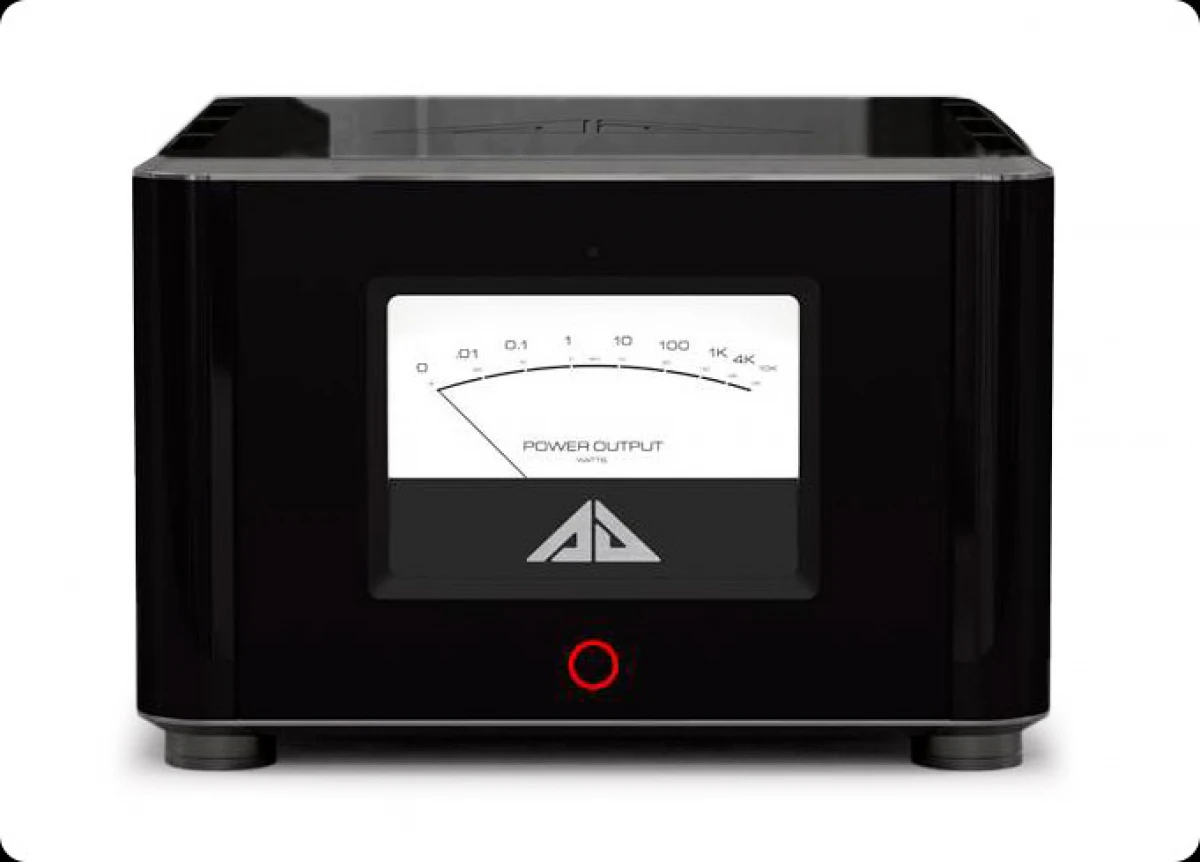
Analog Domain The Artemis
Image source — © Analog Domain
The Artemis is a two-channel power amplifier belonging to the DX9 family from Analog Domain Audio GmbH, a series that also includes the Apollo, Athene, Calysto and Isis amplifiers. The maker describes it as usable either as a standalone full-range amplifier or as the mid and high frequency section of a split system, and its front panel matches the Apollo and Athene so the units stack neatly on top of one another.
Key specs that matter
Analog Domain gives a peak power rating of 1,000 W into 8 ohm and 2,000 W into 4 ohm, with a minimum rated load of 4 ohm. The output stage uses 52 audio-grade power transistors whose combined peak current capacity is 360 A. A switch sets voltage gain to either +35 dB or +26 dB. The frequency range runs from 1 Hz to 100 kHz, THD+N is quoted below -92 dB (0.0025 percent), dynamic range is greater than 126 dB linear, and the damping factor is over 1000. Inputs are provided on XLR balanced and RCA unbalanced connectors. Idle power draw is 150 W, and the amplifier weighs approximately 65 kg.
Engineering and use context
Every Analog Domain amplifier is built as a fully symmetrical bridged design, with hand-matched transistors held inside their linear operating region so that demanding speaker loads can be driven reliably. The whole signal path uses discrete parts in proprietary circuits, and the company deliberately leaves out operational amplifiers, which it says limit dynamic range and can impose a sonic signature. Control and drive functions in the power stages run through the DX901 hybrid chip with DXDrive technology, a part developed in-house over nine design iterations to reduce distortion and keep performance consistent from unit to unit. Chassis parts are machined from solid aluminium blocks and fit together into a nearly airtight enclosure. Protection is split into two groups - self-resetting faults such as thermal throttling, and non-resetting faults such as an output short circuit, which need manual intervention before the amplifier will run again. Power arrives through large toroidal mains transformers of the company's own design, with long-life capacitors providing storage and smoothing, and a soft-start stage restricts inrush current when the unit is switched on. The same protection set guards against mains over- and under-voltage, input overdrive, output DC offset and too much HF or RF energy.
Pairing
In a split arrangement the Artemis can take the upper frequencies while a larger DX9 model handles the low channel, and in a full-range role it drives a stereo pair on its own.
Alternatives
A more powerful choice is the Analog Domain Apollo, a stereo model in the DX9 series with a larger output stage.
Key specs that matter
Analog Domain gives a peak power rating of 1,000 W into 8 ohm and 2,000 W into 4 ohm, with a minimum rated load of 4 ohm. The output stage uses 52 audio-grade power transistors whose combined peak current capacity is 360 A. A switch sets voltage gain to either +35 dB or +26 dB. The frequency range runs from 1 Hz to 100 kHz, THD+N is quoted below -92 dB (0.0025 percent), dynamic range is greater than 126 dB linear, and the damping factor is over 1000. Inputs are provided on XLR balanced and RCA unbalanced connectors. Idle power draw is 150 W, and the amplifier weighs approximately 65 kg.
Engineering and use context
Every Analog Domain amplifier is built as a fully symmetrical bridged design, with hand-matched transistors held inside their linear operating region so that demanding speaker loads can be driven reliably. The whole signal path uses discrete parts in proprietary circuits, and the company deliberately leaves out operational amplifiers, which it says limit dynamic range and can impose a sonic signature. Control and drive functions in the power stages run through the DX901 hybrid chip with DXDrive technology, a part developed in-house over nine design iterations to reduce distortion and keep performance consistent from unit to unit. Chassis parts are machined from solid aluminium blocks and fit together into a nearly airtight enclosure. Protection is split into two groups - self-resetting faults such as thermal throttling, and non-resetting faults such as an output short circuit, which need manual intervention before the amplifier will run again. Power arrives through large toroidal mains transformers of the company's own design, with long-life capacitors providing storage and smoothing, and a soft-start stage restricts inrush current when the unit is switched on. The same protection set guards against mains over- and under-voltage, input overdrive, output DC offset and too much HF or RF energy.
Pairing
In a split arrangement the Artemis can take the upper frequencies while a larger DX9 model handles the low channel, and in a full-range role it drives a stereo pair on its own.
Alternatives
A more powerful choice is the Analog Domain Apollo, a stereo model in the DX9 series with a larger output stage.
Specifications
Model name
The Artemis
Input sensitivity (mV)
1550
Input impedance (balanced) (Ω)
10 000
Input impedance (single-ended) (Ω)
10 000
Output impedance (balanced) (Ω)
N/A
Output impedance (single-ended) (Ω)
N/A
Max current (A)
N/A
Output power (8Ω) (W)
1000
Output power (4Ω) (W)
2000
Gain (dBu)
35
Frequency response low +/- 3dB (Hz)
1
Frequency response high +/- 3dB (Hz)
100 000
Signal to Noise Ratio (dB)
N/A
Total Harmonic Distortion + Noise (0% global feedback) (%)
N/A
Total Harmonic Distortion + Noise (100% global feedback) (%)
0.0025
Max power consumption (W)
N/A
Damping factor
>1000
Dimensions (mm)
440 x 254 x 545
Weight (kg)
65
Official link
More components

Power amplifiers stereo
Analog Domain The Isis M75P

Power amplifiers stereo
Analog Domain The Isis M75D

Power amplifiers stereo
Analog Domain The Apollo
Power amplifiers stereo
Analog Domain The Athene

Power amplifiers stereo
Analog Domain The Calysto