
All

Integrated amplifiers — Audionet HUMBOLDT
Description, images, technical data and specifications
Audionet HUMBOLDT
Image source - (c) Audionet
The HUMBOLDT is an analogue integrated stereo amplifier in the Scientist Series from Audionet of Germany. Its styling comes from designer Hartmut Esslinger, and the name honours the naturalist Alexander von Humboldt. It premiered in May 2019 during the Munich High End event, and Audionet describes it as bringing the qualities of the STERN preamplifier and HEISENBERG monoblocks into one integrated case. The chassis uses 9 mm aluminium body panels in silver or black, paired with a light or dark colour TFT display that also shows input names, power supply monitoring and adjustment menus.
Key specs that matter
Audionet rates the output at 2 x 320 W into 8 ohm and 2 x 460 W into 4 ohm. Bandwidth runs from 0 Hz to 700,000 Hz at the -3 dB points, THD+N stays below -100 dB at 1 kHz, noise lies more than 120 dB down A-weighted, and channel separation exceeds 140 dB across 20 Hz to 20 kHz. Input impedance is 50 kohm on RCA and 35 kohm on XLR. The case measures 450 x 320 x 505 mm and the amplifier weighs 61 kg. Maximum draw from the mains reaches 1800 W, with standby below 0.5 W.
Engineering and use context
The circuit follows a double mono layout and is DC coupled, so no capacitors or coils sit in the signal path. Opto couplers keep the analogue sections galvanically separate from the rest of the unit. Power comes from four separate supplies, fed by two 100 VA and two 850 VA encapsulated toroidal transformers mounted on stainless steel, with 400,000 uF of total capacitance. The boards follow the Air Flow Design principle, and the Floating Pane Design mounts resonance-optimised panels on an aluminium frame to limit microphonic effects and keep temperatures stable. Magnetic and capacitive paths were optimised by avoiding ferromagnetic materials. Volume is set with a knob riding on a double ball-bearing shaft with a magnetic ratchet and optical sensing. Input names can be edited, input levels adjusted, and a DC level removal function is provided, along with a rhodium fuse and a separately powered microprocessor.
Pairing
Connection options include four pairs of Furutech rhodium RCA inputs and two pairs of Neutrik XLR inputs. Outputs comprise two RCA pairs, one inverted RCA pair and two XLR pairs as pre-outs for extra power amplifiers, plus two Audionet Link optical ports that switch other Ultimate Series units. For home cinema integration a by-pass mode passes the front channels straight to the power stage, and control arrives through a D-Sub 9 serial port or a WLAN antenna socket.
Alternatives
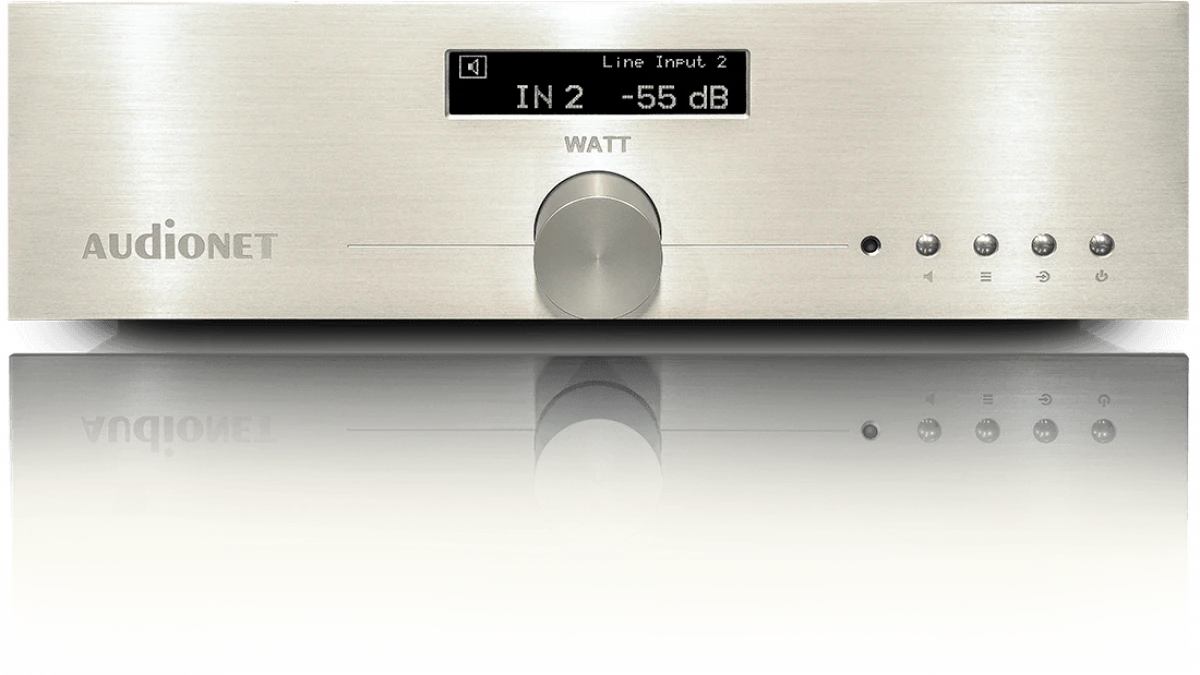
The Audionet WATT is a further Audionet integrated model, developed as the successor to the earlier SAM amplifier.
Specifications
Model name
HUMBOLDT
Type
Integrated Amplifier
Analog inputs (balanced)
N/A
Analog inputs (single-ended)
N/A
Input sensitivity (mV)
N/A
Input impedance (balanced) (Ω)
50 000
Input impedance (single-ended) (Ω)
35 000
Output impedance (balanced) (Ω)
N/A
Output impedance (single-ended) (Ω)
N/A
D/A conversion
N/A
Phono MM/MC current-sensing input impedance (Ω)
N/A
Output power (8Ω) (W)
320
Output power (4Ω) (W)
460
Gain (dBu)
N/A
Frequency response low +/- 3dB (Hz)
0
Frequency response high +/- 3dB (Hz)
700 000
Signal to Noise Ratio (dB)
>120
Total Harmonic Distortion + Noise (%)
N/A
Damping factor
N/A
Dimensions (mm)
450 × 320 × 505
Weight (kg)
61
Official link
More components
Integrated amplifiers
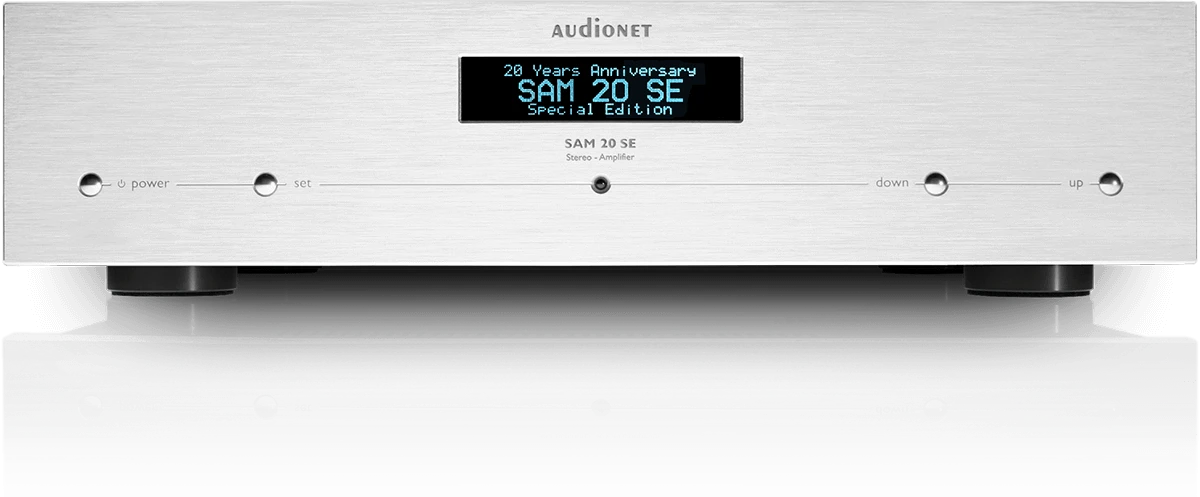
Audionet SAM 20 SE
Integrated amplifiers
Audionet WATT