

Top 12 Loudspeakers That Changed the World
From Klipschorn to Devialet Phantom

21.10.2026 11:34 | ~16 min read
Eight decades of audio industry history, Hi-Fi and High End - all of it can be told through twelve loudspeakers. Each of them did more than reproduce music beautifully. It changed what people believed speakers could do at home.
Paul Klipsch's corner horn proved that the dynamics of a live orchestra could be brought into the living room. Edgar Villchur's acoustic suspension fitted serious bass into a compact cabinet. Peter Walker's electrostat, Harold Leak's sandwich cone, the BBC monitor, the Nautilus "snail shell", the French chic of Devialet Phantom and Acapella's 1700 mm hyperspherical horn - each of these designs did more than open a new frontier, it rewrote the rules for the entire industry. We chose these loudspeakers carefully, not by units sold, not by price and not by our own idea of "good sound", but by their influence on the industry. The list is chronological, starting in 1946 and ending today.
1. Klipsch Klipschorn (1946) - the room as an extension of the horn
Paul Wilbur Klipsch received a patent for his corner horn design in 1945, and in 1946 he registered Klipsch & Associates in the small town of Hope, Arkansas. Until 1948 he built every speaker himself, and only then hired his first employee. The Klipschorn name came about by chance - customers who had heard of "Klipsch's corner horn" coined it.
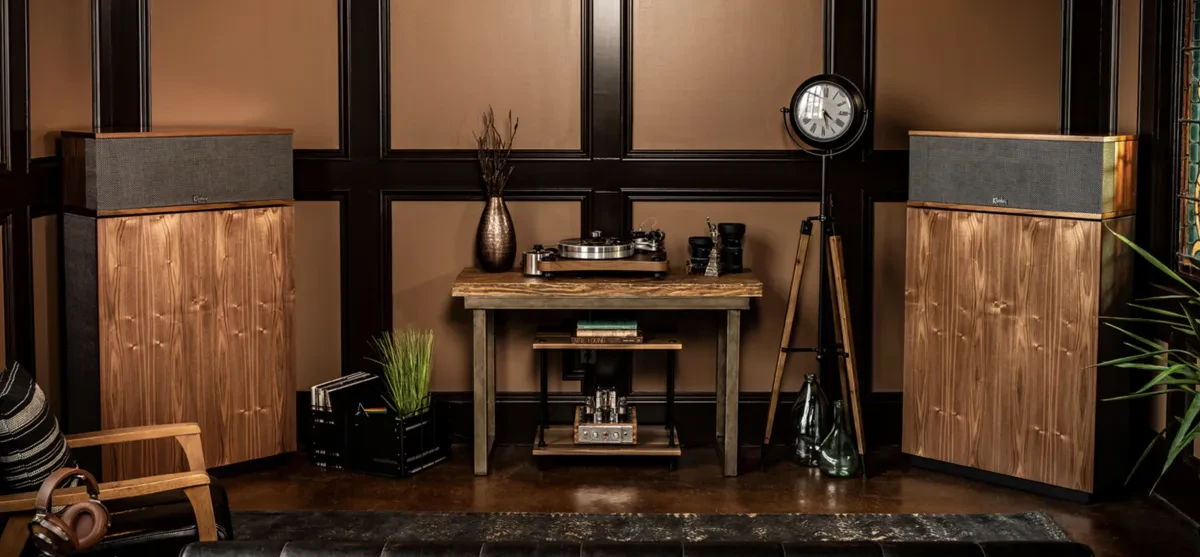
The idea was at once radical and pragmatic. For a horn to load a woofer down to the lowest octaves, it needs great length and an enormous mouth, which is impossible in a living room, even allowing for the size of American homes. So Klipsch folded the bass horn inside the cabinet and made corner placement mandatory, turning two walls and the floor into the final sections of the horn. In engineering terms this is a trihedral exponential horn, in which the room boundaries radiate on equal terms with the panels of the cabinet itself. The midrange and treble drivers are horn-loaded as well, which makes the Klipschorn a fully horn-loaded three-way system.
The result is a sensitivity that direct-radiating designs cannot match. The current Klipschorn AK7 (it no longer demands "perfect" placement tight into the corners - the bass horn enclosure, closed at the back and vented for the first time, allows more freedom, although the speaker still wants to stand close to the corners) reaches 103 dB at 2.83 V/1 m, covers 34 Hz to 19 kHz within ±4 dB and delivers a maximum SPL of 120 dB. The bass section is a 15-inch (38.1 cm) K-33-E woofer in a folded trihedral horn, the crossover points are 380 Hz and 2.9 kHz, and each speaker weighs about 118 kg. The Klipschorn delivers concert-level dynamics from just 1 W per channel.
The Klipschorn has been in continuous production at the Hope factory since 1946 - one of the longest production runs in loudspeaker history. In the 1950s dozens of American companies licensed Klipsch's folded horn patents, and kits for building such cabinets at home became a widespread hobby. But above all, the Klipschorn established high sensitivity as an independent path to concert-hall dynamics at home. Today the whole culture of low-power tube amplifiers, including single-ended 300B triode designs, rests on that approach.
Specifications
Model name
Klipschorn AK7 2025 model
Frequency Response low +/- 3dB (Hz)
34
Frequency Response high +/- 3dB (Hz)
19 000
Sensitivity (dB at 1 W/1m)
103
Impedance (Ohms)
8
Power amplifier requirements (W)
N/A
Has internal amplification
N/A
Internal amplification power (W)
400
Size (sm)
135,25 × 80 × 71,5
Weight (kg)
118
Official link
2. Acoustic Research AR-3 (1958-1959) - bass on a bookshelf
In 1954 New York University lecturer Edgar Villchur showed the AR-1 at a New York audio show. Its woofer had a very compliant suspension, and the restoring force came from the air trapped in a small sealed cabinet. That is how a closed box of modest volume gained deep, clean bass that previously required "wardrobes" at home. Villchur received US patent 2,775,309 in 1956.
The AR-3 brought together two innovations - the 12-inch (about 300 mm) AR-1 woofer and another Villchur invention, the dome midrange and tweeter. These were the first production domes in domestic loudspeakers! Villchur described the principle in a 1958 technical paper and received US patent 3,033,945 for the direct-radiator dome tweeter in 1962. The small diaphragm gave wide dispersion at high frequencies, something the cone tweeters of the era could not achieve.
In the early 1960s the company held "live versus recorded" demonstrations, in which a string quartet alternated with playback of its own recording through a pair of AR-3s. Late in the decade the model was replaced by the AR-3a with updated domes. An AR-3 is held in the collection of the Smithsonian Institution. According to industry statistics, by 1966 Acoustic Research held more than 32 percent of the US loudspeaker market - a genuine breakthrough. Over the next two decades virtually every major manufacturer moved from mechanical to acoustic suspension. And the dome tweeter became so universal that today it is the industry standard.
3. Quad Electrostatic Loudspeaker (1957) - real air
In 1955 Peter Walker, founder of the Acoustical Manufacturing Co (the future Quad), published technical articles on the principles of a wide-range electrostatic loudspeaker and showed prototypes the same year. In 1956 the full-range version was demonstrated at the London Audio Fair, and in 1957 series production began. Thus the world's first production full-range electrostatic loudspeaker was born, designed by Walker and engineer Theo Williamson.
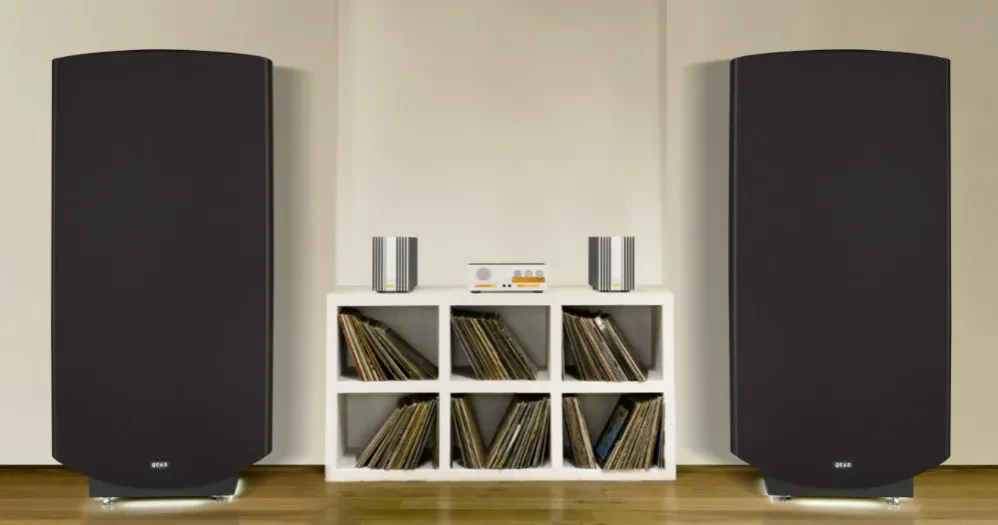
The electrostatic principle is fundamentally different from a dynamic driver. An ultra-thin film diaphragm sits in the field between perforated electrodes and is driven across its entire area at once. The moving mass is negligible, and the bending modes of a cone simply do not exist. In the original Quad two bass panels flank a central treble panel, and the radiation is dipolar. Frequency response is 45 Hz to 18 kHz, horizontal dispersion about 70 degrees, vertical about 15 degrees, dimensions 800 × 875 × 267 mm, weight about 16 kg.
A curious detail - the "ESL-57" designation is unofficial. The factory called the model simply the Quad Electrostatic Loudspeaker, and the numbers appeared later to distinguish it from the 1981 ESL-63. The speaker was originally designed for mono, and only after the first 500 units were built were the panels revised for stereo.
The speakers were made from 1957 to 1985, and about 54,000 units were sold. In the 1960s Germany's Braun built them under Quad licence as the LE1. What matters more is that Quad set a benchmark for midrange transparency that dynamic loudspeakers still cannot match. Almost any discussion of air, detail, "black" backgrounds and freedom from cabinet coloration starts, one way or another, from this electrostat. The limitations are many too - a narrow listening window, modest maximum SPL and demanding placement (no closer than 60 cm to the walls). The model's current heir is the ESL 2912X.
Specifications
Model name
ESL 2912X
Frequency Response low +/- 3dB (Hz)
32
Frequency Response high +/- 3dB (Hz)
21000
Sensitivity (dB at 1 W/1m)
86
Impedance (Ohms)
8
Power amplifier requirements (W)
N/A
Has internal amplification
N/A
Internal amplification power (W)
N/A
Size (sm)
147 x 69 x 38
Weight (kg)
44
Official link
4. LEAK Sandwich (1961) - an aerospace composite in the cone
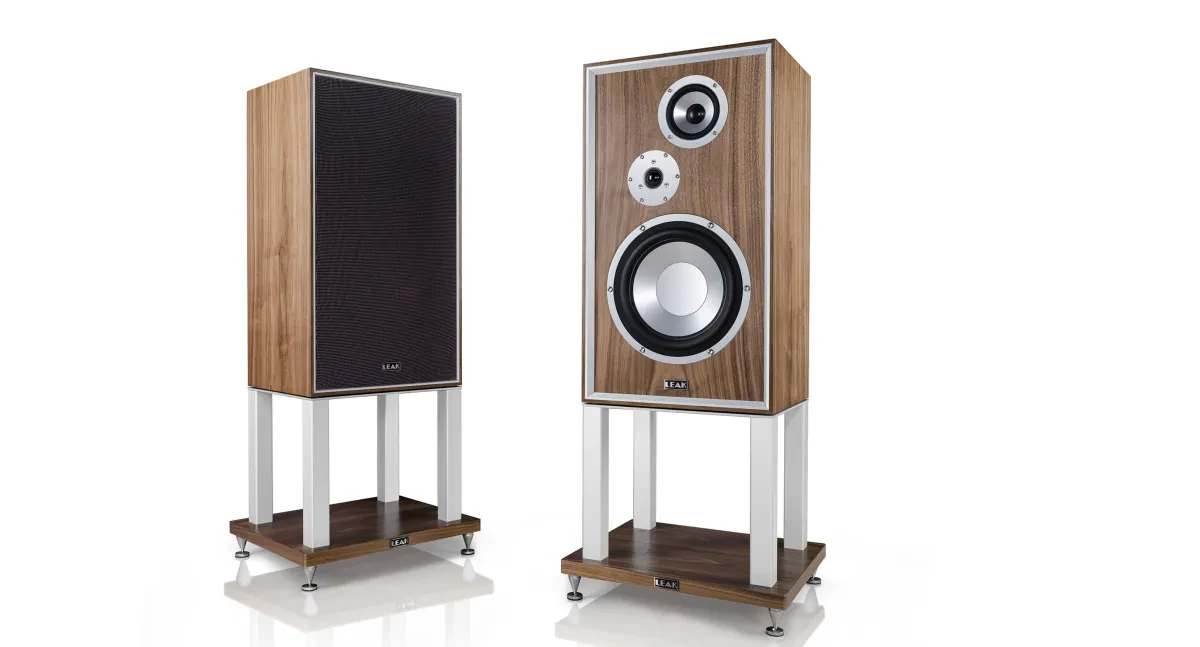
Britain's H. J. Leak & Co was known above all for amplifiers, but in 1961 it released a loudspeaker that rewrote the approach to drivers and cones. Harold Leak brought in Don Barlow from the aluminium industry's research laboratory in Banbury. Barlow proposed applying the aerospace sandwich-panel principle to a loudspeaker - a thick, light core of expanded polystyrene about 10 mm thick clamped between two skins of aluminium foil. The skins take the main stresses, so the cone is both light and extremely stiff and behaves as a piston over a far wider band than a paper cone.
To demonstrate the stiffness, the company issued a publicity photograph of Harold Leak himself standing on a sandwich cone. The original system was a large two-way design with a 330 mm sandwich woofer, a cambric roll surround and a cast aluminium chassis. Inside the cabinet a massive wooden block connected the woofer magnet to the rear panel - a brace that other manufacturers later adopted. The more compact Sandwich 200, with a 200 mm sandwich driver and two 60 mm units with Mylar cones, was a major commercial success, and the sandwich woofer was later used in the three-way 2060.
The speakers were produced almost unchanged for about ten years and were also used in professional recording. And the principle of a composite cone with stiff skins and a light core became one of the main directions of driver engineering. The honeycomb, foam and multilayer diaphragms of modern woofers are direct descendants of Barlow's idea. In 2024 the revived LEAK brand brought the name back with the Sandwich 150 and Sandwich 250, whose cores are made of Rohacell polymethacrylimide structural foam between aluminium skins.
Specifications
Model name
Leak Sandwich 250
Frequency Response low +/- 3dB (Hz)
42
Frequency Response high +/- 3dB (Hz)
26000
Sensitivity (dB at 1 W/1m)
88.5
Impedance (Ohms)
6
Power amplifier requirements (W)
25 - 250
Has internal amplification
N/A
Internal amplification power (W)
N/A
Size (sm)
65.5 x 37 x 30+3
Weight (kg)
27.3
Official link
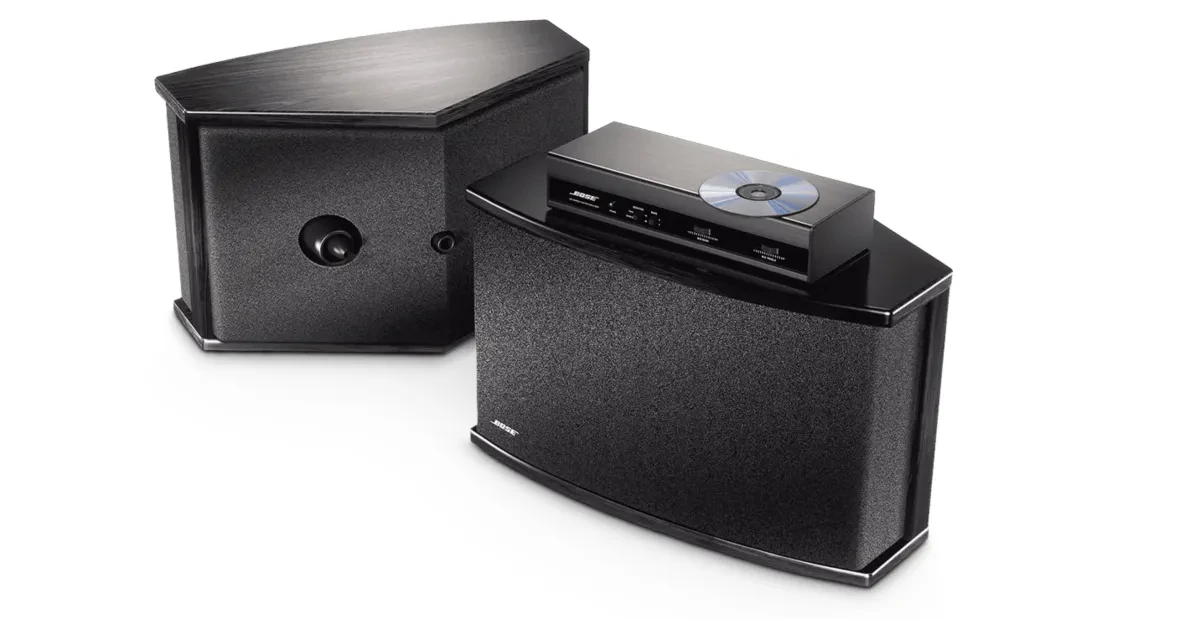
5. Bose 901 (1968) - the equalizer becomes part of the speaker
Amar Bose, a professor at the Massachusetts Institute of Technology, founded his company in 1964 and four years later introduced a system unlike anything that existed. The pentagonal 901 cabinet carried nine identical small full-range drivers. Eight faced backwards, toward the wall behind the speaker, and only one fired straight at the listener. Bose drew on his own research into concert hall psychoacoustics, where the listener receives mostly reflected sound. The ratio of direct to reflected sound became the central parameter of the design.
The second radical step was a mandatory external active equalizer, inserted between the preamplifier and the power amplifier or into the tape monitor loop. It compensated for treble losses on reflection from the wall and flattened the bass response. Without the equalizer the 901 formally works, but it does not meet its design response. There is no crossover, and all nine drivers run full range.
Early sales were not successful, but over time the 901 became one of the most commercially successful loudspeakers in history and went through several generations, up to Series VI. And although the model always divided audiophiles, its influence is hard to overstate. The first mass-market home loudspeaker in which electronic correction was not an option but an integral part of the design became the ancestor of today's active speakers with DSP processing. And the idea of shaping spatial impression through reflected sound has returned in modern soundbars. The latest version of the model is called the 901 Series VI speaker system v2 (2010 - 2016).
Specifications
Model name
901 Series VI speaker system v2
Frequency Response low +/- 3dB (Hz)
N/A
Frequency Response high +/- 3dB (Hz)
N/A
Sensitivity (dB at 1 W/1m)
N/A
Impedance (Ohms)
8
Power amplifier requirements (W)
10 - 450
Has internal amplification
N/A
Internal amplification power (W)
N/A
Size (sm)
53.3 x 32.0 x 33.0
Weight (kg)
16.0
Official link
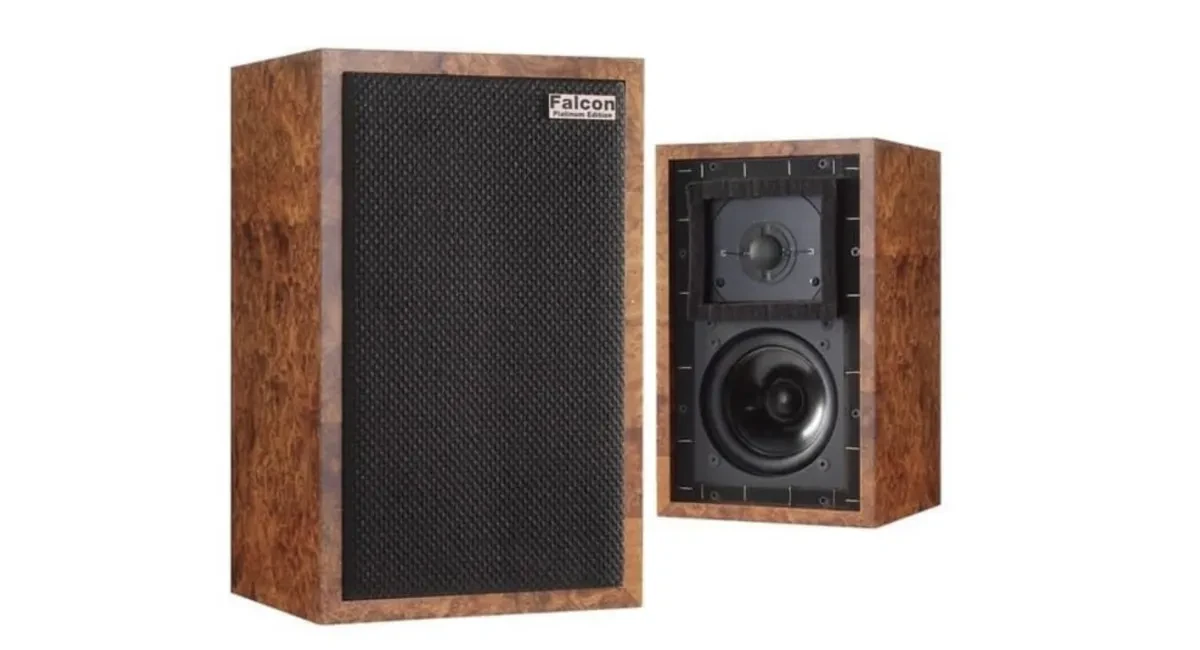
6. BBC LS3/5a (1975) - small but mighty
In the early 1970s the BBC Research Department needed a compact monitor for outside broadcast vans, where there was simply no room for full-size speakers. The first version, the LS3/5, used KEF drivers - the 110 mm B110 woofer with a Bextrene cone and the T27 dome tweeter with a Melinex diaphragm - and about 20 units were built in-house. When KEF switched to modified versions of the same drivers, the BBC had to recalculate the crossover and protect the tweeter with a grille. That is how the LS3/5a came about - a sealed two-way near-field monitor.
The BBC's key decision was organizational rather than technical. The corporation did not build the monitor itself but licensed it to several British companies. Series production began in 1975. Licensed LS3/5a speakers were made by Rogers, Spendor, Harbeth, Chartwell, Goodmans and KEF itself, among others, and every unit had to match the reference by measurement in the BBC laboratory. Total production is estimated at 60,000 to 100,000 pairs.
The LS3/5a created a whole school of British monitors and made the compact sealed box a recognized domestic reference. The model proved that a small cabinet with limited bass and moderate loudness can offer outstanding midrange tonal accuracy and excellent imaging. Series production ended in the late 1990s, when KEF discontinued the original drivers. But the story did not end there - today Falcon Acoustics has recreated the original drive units from the workbooks of their designer Malcolm Jones and builds the LS3/5a to the original BBC specification.
Specifications
Model name
PLATINUM LIMITED EDITION BBC LS3/5a
Frequency Response low +/- 3dB (Hz)
80
Frequency Response high +/- 3dB (Hz)
20 000
Sensitivity (dB at 1 W/1m)
83
Impedance (Ohms)
15
Power amplifier requirements (W)
N/A
Has internal amplification
N/A
Internal amplification power (W)
N/A
Size (sm)
N/A
Weight (kg)
5.35
Official link
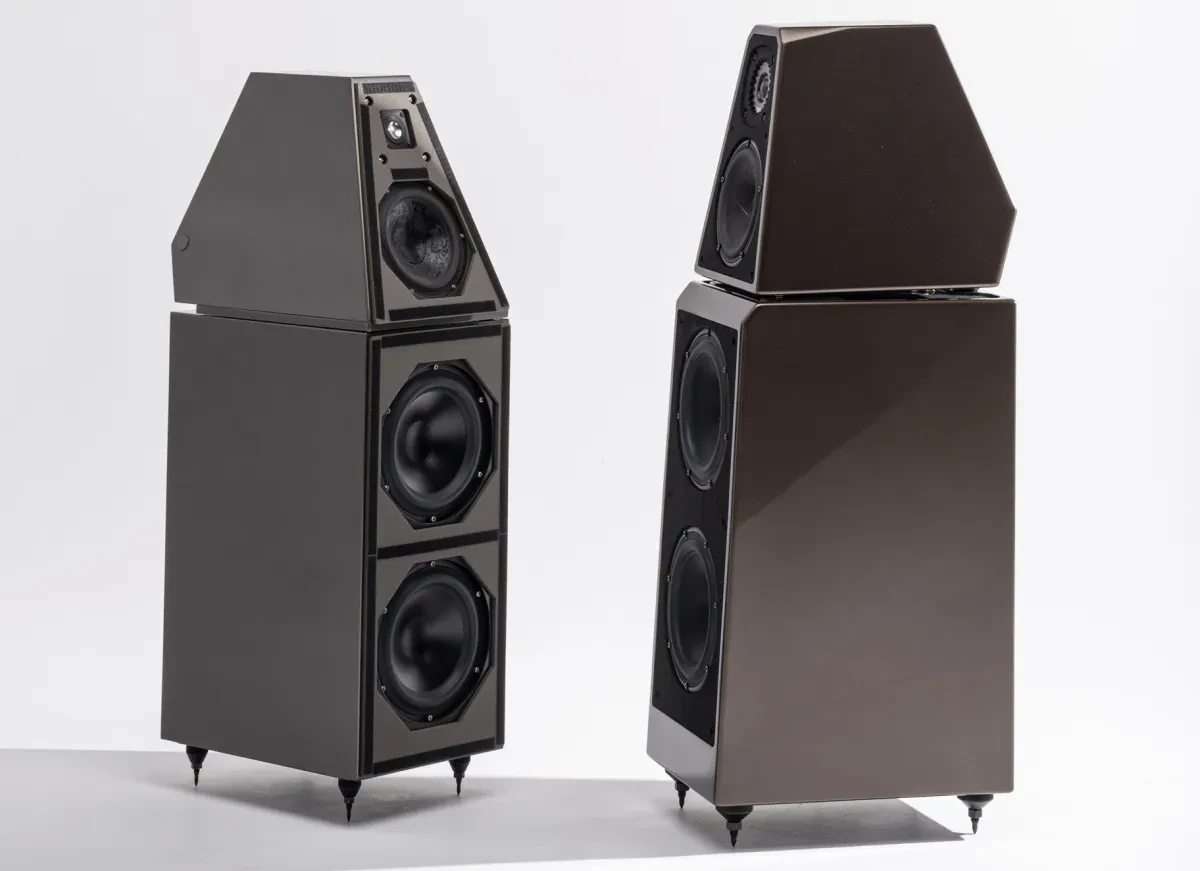
7. Wilson Audio WATT/Puppy (1986) - modular speakers on the march
Wilson Audio began in 1974 as the record label of David and Sheryl Lee Wilson. For location sessions Wilson needed a portable monitor that matched his studio standards, and in 1985 he built the WATT - Wilson Audio Tiny Tot - for himself. The truncated pyramid cabinet with a sloped front baffle aligned the drivers' acoustic centres by the arrival time of the signal at the listener. The approach grew out of the research Wilson had been doing all along and his patented time-alignment measurement method. The commercial WATT debuted at CES in January 1986.
The limited bass of the compact monitor was compensated by a separate bass module that the Wilsons named the Puppy. The WATT sat on top and was tilted so that its output converged with the bass at the listening position. With the Puppy the system became a full three-way floorstanding loudspeaker with bass from 40 Hz. Series 5 of 1994 introduced Wilson's X-material composite in the bass module's front panels.
The WATT/Puppy became the best-selling high-end loudspeaker in history. The model lived for about 25 years and eight major revisions, was replaced by the Sasha line in 2011, and for the company's 50th anniversary in 2024 Wilson released a new The WATT/Puppy. Yet it is the architecture that proved most durable. A separate midrange and treble module with adjustable tilt above the bass cabinet, time alignment tuned to a specific room, composite materials instead of MDF - dozens of manufacturers reproduce this standard today. Wilson's own most ambitious systems, which we covered in our article on the Autobiography, are direct descendants of the WATT/Puppy.
Specifications
Model name
The WATT/Puppy
Frequency Response low +/- 3dB (Hz)
26
Frequency Response high +/- 3dB (Hz)
30000
Sensitivity (dB at 1 W/1m)
89
Impedance (Ohms)
4
Power amplifier requirements (W)
>25
Has internal amplification
N/A
Internal amplification power (W)
N/A
Size (sm)
105 × 30.48 × 47.44
Weight (kg)
72.57
Official link

8. Bowers & Wilkins Nautilus (1993) - no cabinet resonances
In 1987 Bowers & Wilkins founder John Bowers set his engineers a task that sounded almost impossible - a loudspeaker without cabinet coloration. The project was led by Laurence Dickie of the company's Steyning research centre, creator of the earlier Matrix cellular structure for suppressing resonances. The work took about five years and was completed in 1993.
Dickie abandoned the rectangular box altogether. Each driver here is loaded by an exponentially tapering tube that gradually absorbs the energy of the cone's rear radiation, preventing it from reflecting back and colouring the sound. The bass tube is coiled into a spiral reminiscent of a nautilus shell, hence the name. The narrow, minimalist front is optimized for even dispersion. The principle was recognized with a British state award for innovation.
The Nautilus is still built by hand in Worthing, England, using the 1993 process. Far more important, though, is how its ideas spread across the industry. Tapered tubes behind the tweeters and separate head modules became the signature of the flagship 800 Series, which brought the Steyning developments to a much wider audience. Dickie himself later co-founded Vivid Audio and continues to develop the tapered-tube principle there. Most broadly, the Nautilus changed the industry's attitude to cabinet shape - after it, sculptural, flowing loudspeakers stopped being seen as a designer's whim.
Specifications
Model name
Nautilus
Frequency Response low +/- 3dB (Hz)
10 (+/- 6dB)
Frequency Response high +/- 3dB (Hz)
25000 (+/- 6dB)
Sensitivity (dB at 1 W/1m)
93
Impedance (Ohms)
8
Power amplifier requirements (W)
100 - 300
Has internal amplification
N/A
Internal amplification power (W)
N/A
Size (sm)
121.0 × 43.0 × 110.5
Weight (kg)
86.5
Official link
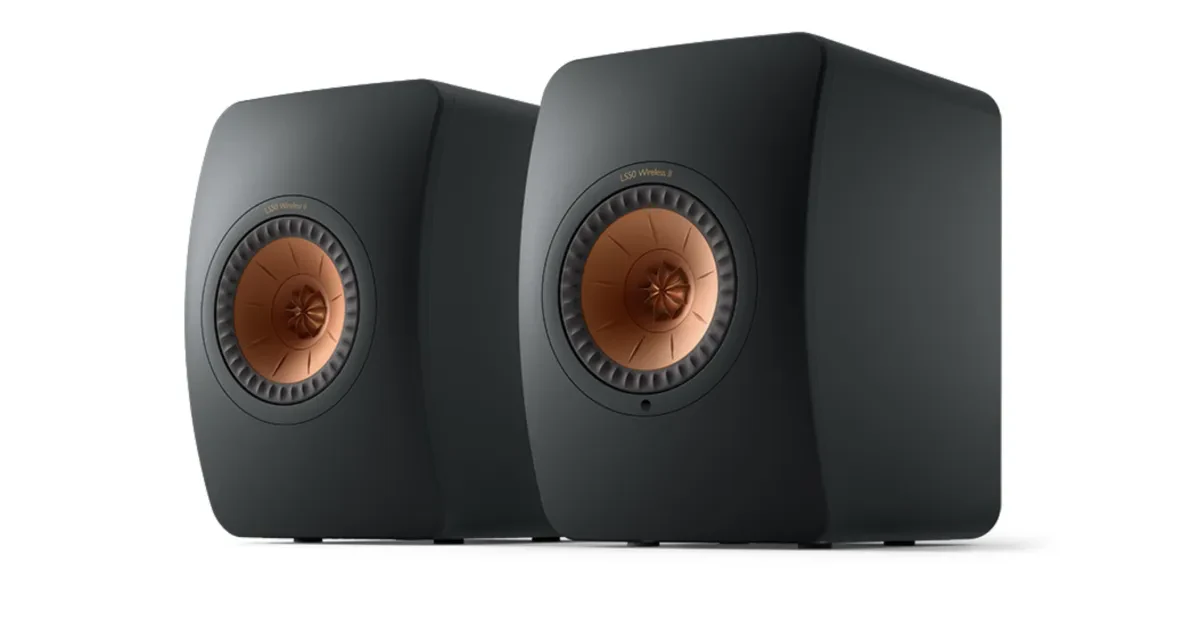
9. KEF LS50 (2012) - a point source of sound
For its 50th anniversary in 2012 KEF released a compact monitor that the company openly described as inspired by the LS3/5a - the very speaker it had once made drivers for. The brief ignored the usual product ranges - build the best small enclosure that technology allows. At its heart was the Uni-Q coaxial driver developed for the flagship Blade. A 25 mm aluminium dome tweeter with a vented rear chamber sits at the centre of a damped magnesium-aluminium alloy bass/midrange cone, and a segmented waveguide evens out its dispersion.
The coaxial layout turns the system into an almost ideal point source, with all frequencies radiating from a single acoustic centre. Hence the LS50's characteristic focus and stable off-axis stereo image. Claimed frequency response is 47 Hz to 45 kHz.
The LS50 was the first to bring a flagship-grade coaxial driver to a relatively affordable compact bookshelf format. The model spawned a whole platform - an active wireless version and, in 2020, the LS50 Meta with metamaterial-based absorption of the tweeter's rear radiation. For the mass market the main effect is that after the LS50 the coaxial layout stopped being exotic.
Specifications
Model name
LS50 Wireless II
Frequency Response low +/- 3dB (Hz)
45
Frequency Response high +/- 3dB (Hz)
28000
Sensitivity (dB at 1 W/1m)
N/A
Impedance (Ohms)
N/A
Power amplifier requirements (W)
N/A
Has internal amplification
Yes
Internal amplification power (W)
100 + 280
Size (sm)
30.5 × 20.0 × 31.1
Weight (kg)
10.1 + 10.0
Official link
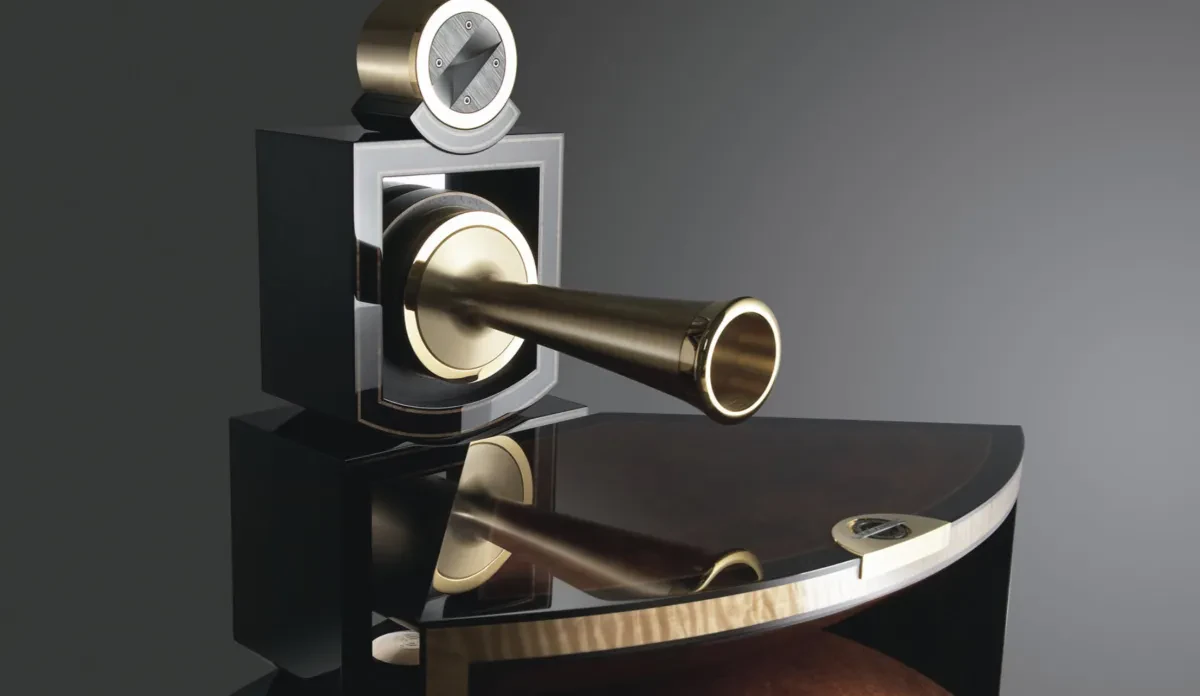
10. Living Voice Vox Olympian (2013) - the horn as a work of art
Living Voice was founded by Kevin Scott in Derbyshire, England. Its history is closely tied to Vitavox, the British firm that had made professional loudspeakers since the 1930s. The name Living Voice itself is a translation of the Latin "vita vox", a tribute to that heritage. The brand's first system was the fully horn-loaded three-way Air Partner with 105 dB/W sensitivity, while wide recognition came with the more compact Avatar and Auditorium series designed for low-power tube amplifiers.
Development of the Vox Olympian began in 2005 as an exploration of what was possible without commercial constraints. The system first appeared at the Monaco Yacht Show in 2012 and had its public premiere at High End Munich in 2013. It is a four-way fully horn-loaded loudspeaker covering 70 Hz to 40 kHz, plus the horn-loaded Vox Elysian subwoofer, responsible for the band from 20 to 70 Hz. The design uses Vitavox drivers modified to Scott's requirements, a TAD compression driver and a bronze treble horn. The proportions of the horns are based on the golden ratio and the Fibonacci sequence, the internal wiring is Kondo SPZ silver cable, and building the cabinets for one pair takes about 2,400 man-hours.
The Vox Olympian restored the British horn school's status as a reference and became a benchmark for a whole class of "no compromise" systems. After it, horn speakers stopped being seen as vintage exotica or a niche passion of single-ended amplifier enthusiasts.
Specifications
Model name
Vox Olympian
Frequency Response low +/- 3dB (Hz)
70
Frequency Response high +/- 3dB (Hz)
45 000
Sensitivity (dB at 1 W/1m)
105
Impedance (Ohms)
8
Power amplifier requirements (W)
100
Has internal amplification
N/A
Internal amplification power (W)
N/A
Size (sm)
68.0 × 62.0 × 160.0
Weight (kg)
210
Official link
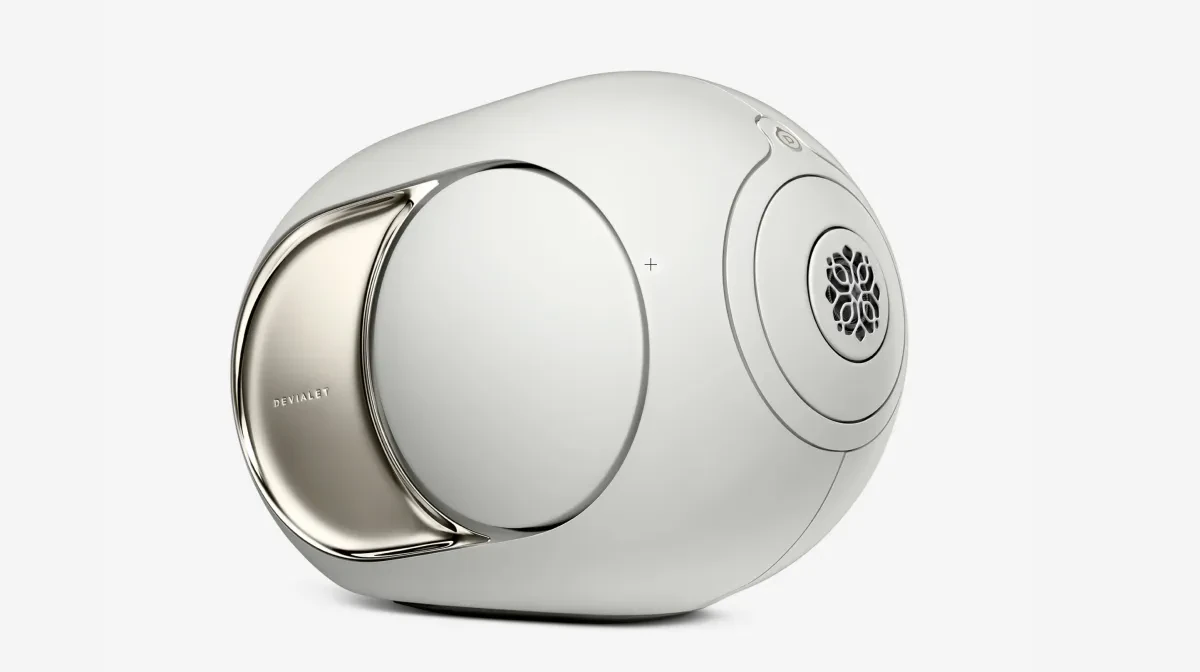
11. Devialet Phantom (2014) - butterfly wings
Devialet was founded in Paris in 2007 by engineer Pierre-Emmanuel Calmel, Quentin Sannié and Emmanuel Nardin. The company is built on Calmel's 2004 invention - the ADH hybrid amplification topology, in which a class A amplifier sets the output voltage and a parallel class D stage supplies the current. The technology first worked in the company's D-Premier amplifier, and at the end of 2014 Devialet introduced its first loudspeaker.
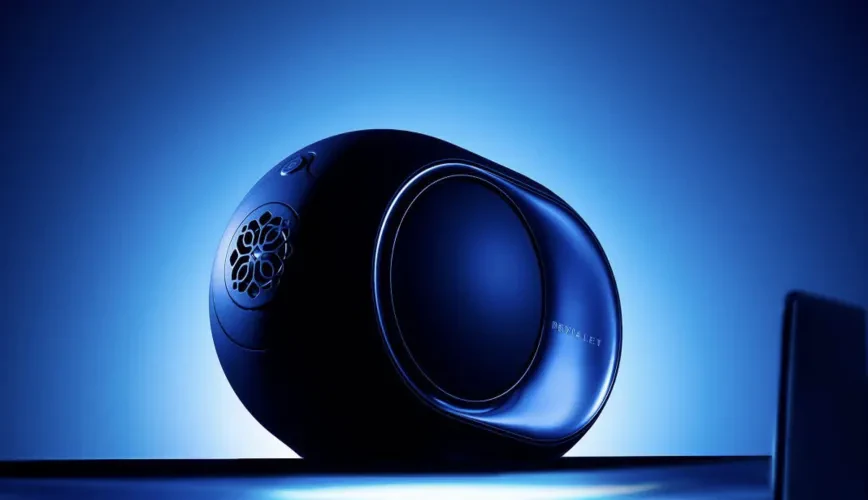
The Phantom is a sphere with two long-throw woofers mounted opposite each other in a push-push arrangement. Their mechanical forces cancel, the enclosure does not vibrate, and cone excursion reaches one inch peak to peak. Devialet called this arrangement Heart Bass Implosion (HBI) - the side cones flutter like butterfly wings and literally blur in the air as they work. Midrange and treble are reproduced by a coaxial pair of drivers. Each driver gets its own ADH channel, DAC and SAM processing, which tailors the signal to the characteristics of that specific driver. The manufacturer's claimed frequency response runs from an incredible 16 Hz to 25 kHz within ±2 dB. The base version delivers 750 W peak and 99 dB SPL at 1 m, the Silver Phantom 3,000 W and 105 dB. The system was entirely designed and assembled in France.
The Phantom won CES awards, and from 2016 it was sold in Apple Stores, something that had never happened to any product from the high-end world. The Gold Phantom and the compact Phantom Reactor followed. The model's fundamental contribution is that the Phantom broke down the wall between audiophile engineering and the wireless lifestyle speaker market. It showed that an all-in-one system with a streaming input can carry innovative engineering rather than being a compromise for the sake of convenience. The trend toward fully active wireless systems, which virtually every major brand now follows, largely began with this sphere.
Specifications
Model name
Phantom Ultimate 108 dB
Frequency Response low +/- 3dB (Hz)
14
Frequency Response high +/- 3dB (Hz)
35000
Sensitivity (dB at 1 W/1m)
N/A
Impedance (Ohms)
N/A
Power amplifier requirements (W)
N/A
Has internal amplification
Yes
Internal amplification power (W)
1100
Size (sm)
24.6 x 34.2 x 25.5
Weight (kg)
11.1
Official link
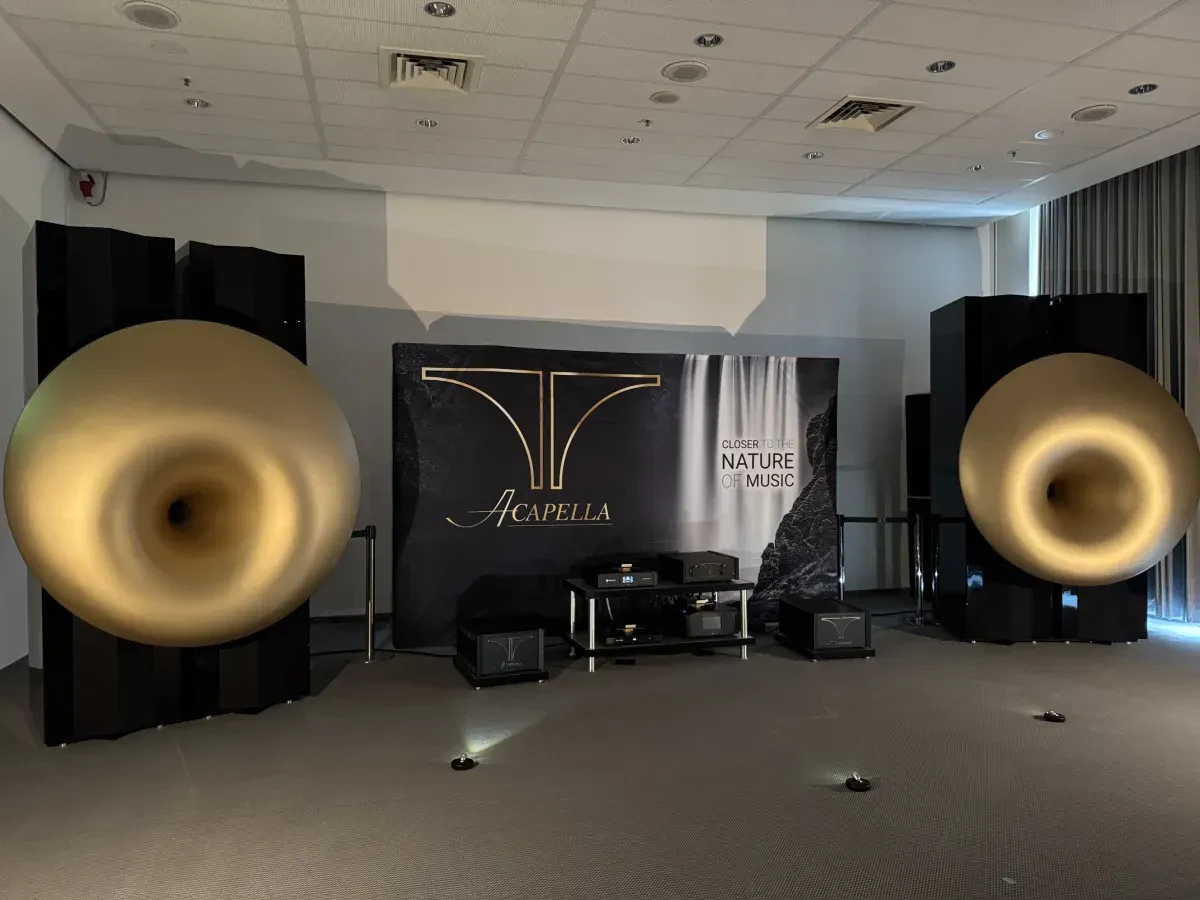
12. Acapella Hypersphere (2025) - the horn of the 21st century
Acapella Audio Arts was founded in Duisburg in 1978 by Alfred Rudolph and Hermann Winters. The brand's two signature technologies are spherical and hyperspherical midrange horns and the ION TW 1 S ionic (plasma) tweeter. Instead of a diaphragm it uses an electrical discharge, a plasma that excites the air directly and has no moving mass. The company first used a hyperspherical horn in the Poseydon and then carried it over to the Apollon, Cellini and other systems.
The Acapella Audio Arts Hypersphere was first shown at High End Munich in May 2025, and the Hifiverse editorial team attended the presentation. To say we were impressed would be an understatement - the sound proved truly hyperrealistic. The heart of the system is a new 1700 mm horn with an ultra-light 1.7-inch driver that covers seven octaves on its own. Bass comes from eight 15-inch woofers per channel, assembled in two towers that are also horn-loaded. The specifications are reference-grade - 18 Hz to 40 kHz, 103 dB sensitivity, 4 to 8 ohm impedance, a height of 2.7 m and about 960 kg per channel. An optional subsonic bass horn about 5 m tall is offered, adjusted to the height of the room, and when installed against a wall it makes the listening area itself part of the horn. This is the kind of loudspeaker that can erase the line between reproduction and the real sound of instruments - it has proved that a single horn driver can cover seven octaves without a crossover in the band where hearing is most sensitive, and it marks the limit of what is achievable in home audio at all.
Our list comes full circle. In 1946 Paul Klipsch made the walls of a room an extension of the horn, and in 2025 Alfred Rudolph once again turned the room into part of the horn, only on a scale an order of magnitude larger.
Specifications
Model name
HYPERSPHERE
Frequency Response low +/- 3dB (Hz)
18
Frequency Response high +/- 3dB (Hz)
40000
Sensitivity (dB at 1 W/1m)
103
Impedance (Ohms)
4 - 8
Power amplifier requirements (W)
N/A
Has internal amplification
N/A
Internal amplification power (W)
N/A
Size (sm)
270 x 170 x 130 (horns)
Weight (kg)
960
Official link
FAQ
Which loudspeaker has been in production the longest?
Klipsch Klipschorn. The model has been made since 1946 at the factory in Hope, Arkansas. The current version is the Klipschorn AK7.
Who invented the dome tweeter?
Edgar Villchur, founder of Acoustic Research. The first production dome midrange and tweeter units appeared in the AR-3 in the late 1950s, and Villchur received his patent for the direct-radiator dome tweeter in 1962.
How does acoustic suspension differ from a bass reflex design?
In an acoustic suspension (sealed) design, a woofer with a very compliant suspension works in an airtight cabinet, and the compressed air inside provides the restoring force for the cone. A bass reflex design, by contrast, uses a port through which the rear radiation reinforces the bass around the tuning frequency. The first approach gives a smoother bass roll-off, the second more output at low frequencies.
Why is the LS3/5a still made if classic production ended in the 1990s?
Because demand for the reference British monitor never went away. Falcon Acoustics has recreated the original KEF B110 and T27 drivers from the original documentation and builds the system to the BBC specification. Licensed versions from other manufacturers also exist.