

High-Sensitivity Loudspeakers for Low-Power Tube Amplifiers
When 8 Watts Is Enough

21.09.2026 19:56 | ~7 minutes read
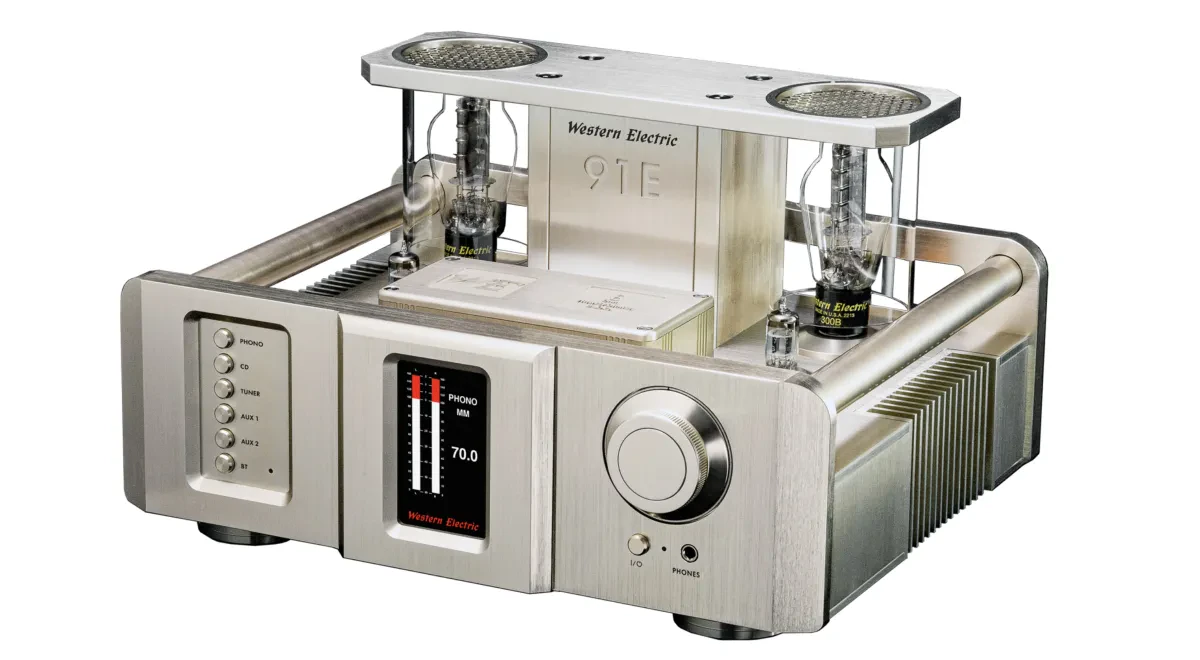
Typical tube amplification means 2 × 8 W, or perhaps 2 × 15 - 20 W. Yes, more powerful models exist, but the genre’s classics built around the 300B and similar tubes deliver exactly this range. That said, such figures can hardly be called “low”, because what always matters is the pairing of a loudspeaker with amplification properly matched to it. Choose the speakers correctly, and even 2 × 8 W can deliver a reference-grade sonic canvas. So let’s go through it in detail: how to read sensitivity specs, why the numbers mean different things under different conditions, and which speakers will come alive on as little as 1 watt.

The main trap - loudspeaker sensitivity is measured in different ways
Loudspeaker sensitivity is published in two incompatible formats - and manufacturers often don’t state which one they use.
dB/W/m - the level produced by one watt of input, measured at a distance of one metre. This is sensitivity in the strict sense of the word.
dB/2.83 V/m - the level produced by an input of 2.83 V. This is voltage sensitivity, and it is what independent labs measure, because an amplifier behaves as a voltage source.
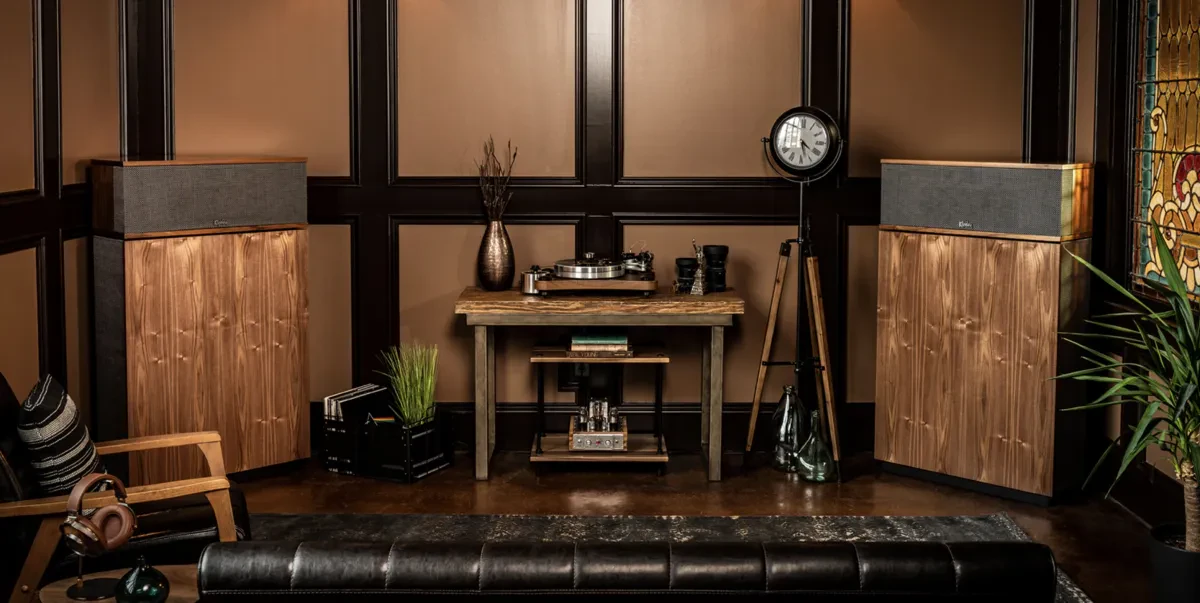
Into an 8-ohm load, 2.83 V delivers exactly one watt, and the two figures coincide. At any other impedance they diverge.
The formula
The power delivered at 2.83 V equals 8 divided by Z, where Z is the impedance in ohms.
Correction in dB = 10 · log10 (8 / Z).
4-ohm impedance: plus 3 dB. 8-ohm impedance: zero. 10-ohm impedance: minus 1 dB. 16-ohm impedance: minus 3 dB.
So, a system rated at 96 dB/W/m with a nominal impedance of 10 ohms will measure around 95 dB by the voltage method. Independent measurements of such a system, averaged across the band, come out lower still - around 91–94 dB - because the published figure is usually taken at the peak rather than as an average.
The practical takeaway - if you plan to use a tube amplifier, allow a 3–4 dB margin below the rated sensitivity. If the calculation only just works on paper, it won’t be enough in reality.
Speaker impedance matters more than sensitivity
A single-ended tube amplifier has an output impedance of around 1–3 ohms, while a push-pull design with moderate feedback sits at around 0.5–1.5 ohms. The damping factor ranges from 3 to 15. Such an amplifier behaves partly as a current source, and the speaker’s impedance curve translates directly into deviations in frequency response.
Another formula - the deviation equals 20 times the base-10 logarithm of the ratio of Z to the sum of Z and the amplifier’s output impedance. Calculate it at the impedance minimum and maximum; the difference between the two is the colouration.
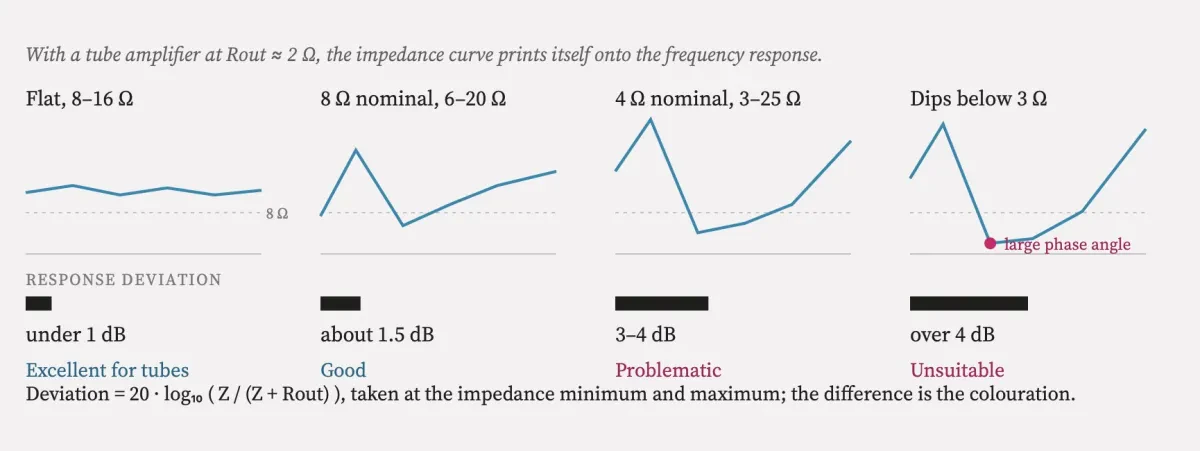
This leads to another rule of system matching: high sensitivity with an unstable impedance is worse than moderate sensitivity with a flat one. The former delivers high volume with a distorted tonal balance; the latter delivers a correct balance with slightly less headroom.
Three high-sensitivity loudspeaker designs
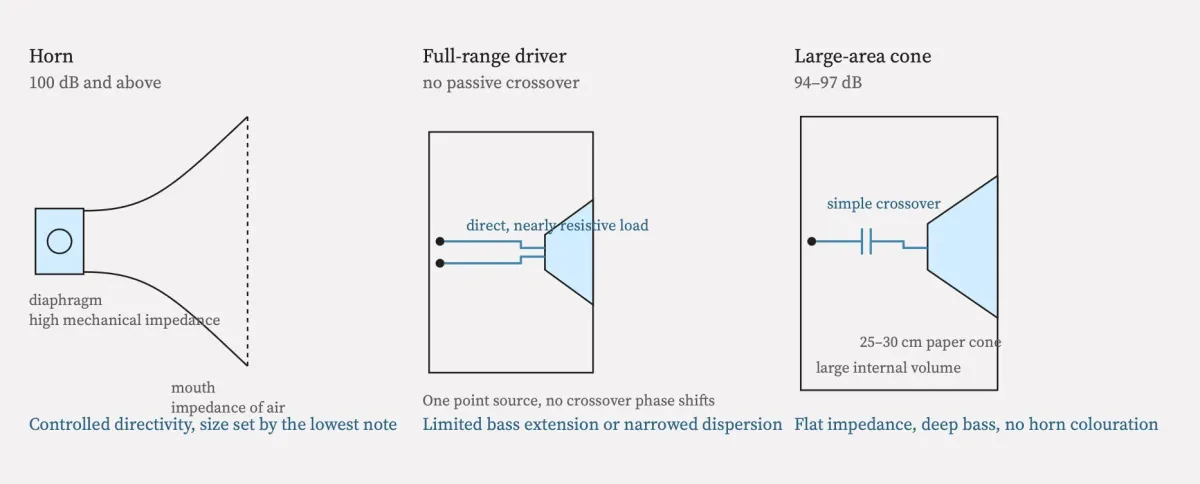
1 - Horns
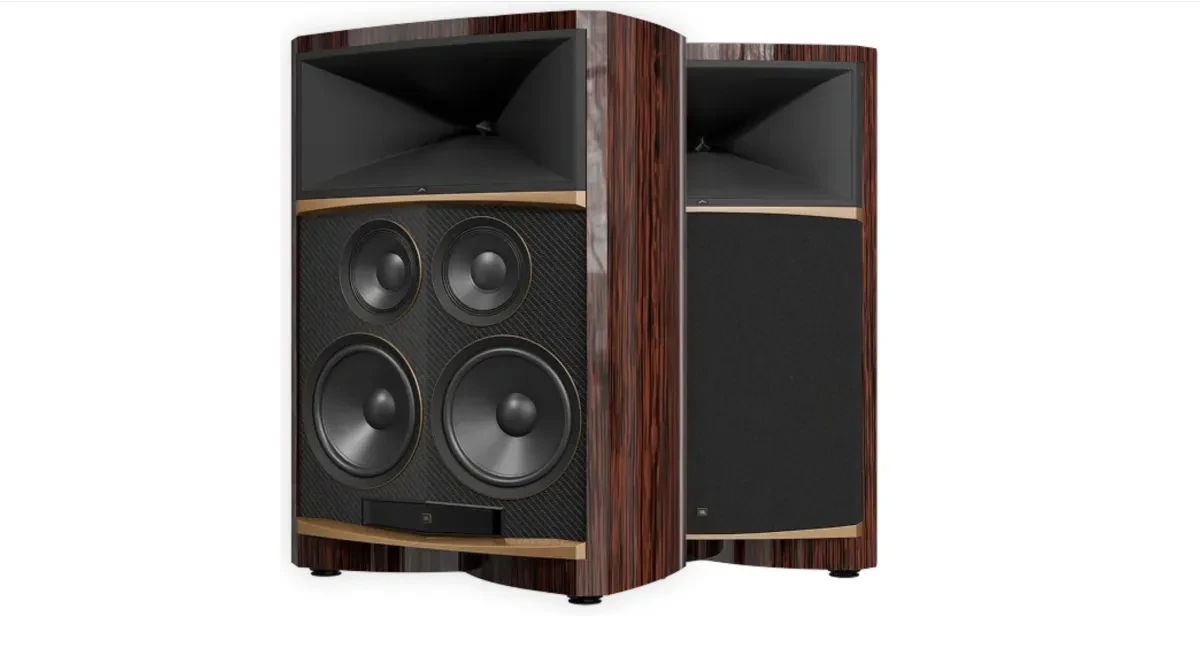
A horn is an acoustic transformer that matches the high mechanical impedance of the diaphragm to the low impedance of the air. Efficiency rises several-fold, hence sensitivity of 100 dB and above.
Strengths - maximum sensitivity, very small diaphragm excursion at high levels, low distortion at volume, controlled directivity that reduces the influence of the side walls.
Limitations - size, since horn dimensions are dictated by the lowest operating frequency; the difficulty of integrating the bands at the crossover points; and extremely stringent demands on the precision of horn design and manufacture - otherwise the horn’s own resonances will colour the sound.
Best for - listeners who need real dynamic headroom from low power and have plenty of space to place the speakers.
2 - Full-range driver without a crossover
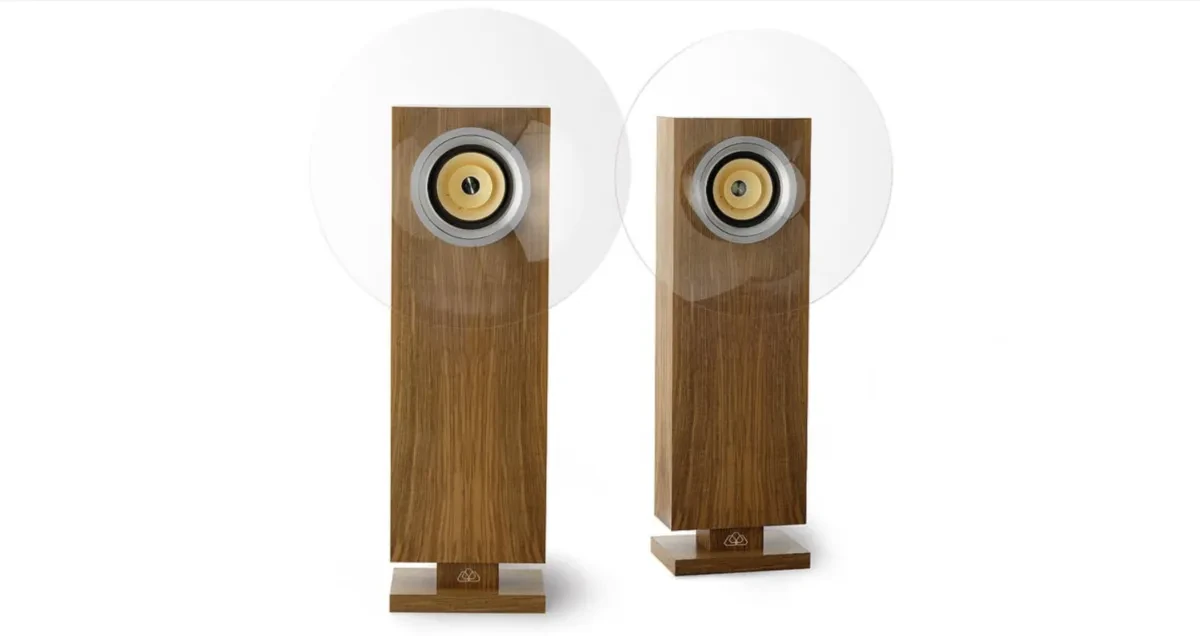
A single driver reproduces the entire range; there is no passive crossover, or it is reduced to a single component. Doing without a crossover eliminates its losses and simplifies the load to an almost purely resistive one.
Strengths - a point source and, as a result, outstanding coherence and imaging precision; an extremely easy load; no phase shifts at crossover points.
Limitations - it is physically impossible to cover the entire range with a single diaphragm without compromise, so either the bass extension will be limited or the high-frequency dispersion will narrow.
Best for - lovers of vocals, small ensembles and chamber music, for whom coherence matters more than frequency-response extension.
3 - Large-area cone driver in a large enclosure
The classic approach: a 25–30 cm driver with a light paper cone and a powerful magnet system in a large-volume cabinet. Sensitivity of 94–97 dB is achieved without a horn.
Strengths - no colouration, natural timbral presentation, flat impedance thanks to a simple crossover, deep bass.
Limitations - size and weight, plus a lower sensitivity ceiling than a horn - and a sizeable room is still required.
Best for - this is the universal solution for most audiophiles, a well-balanced compromise.
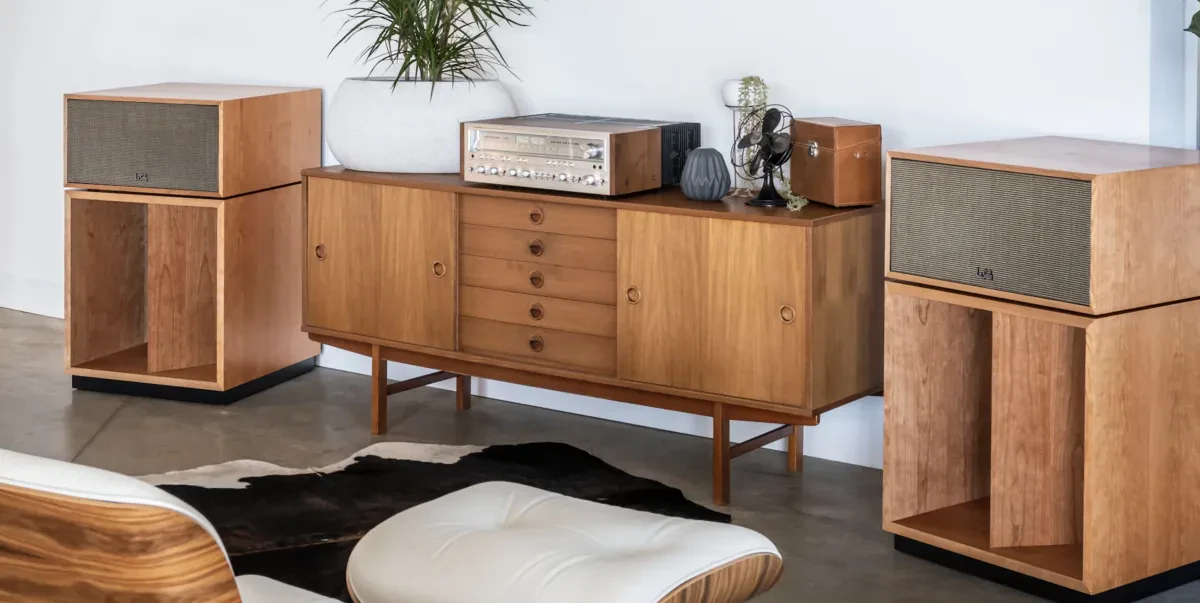
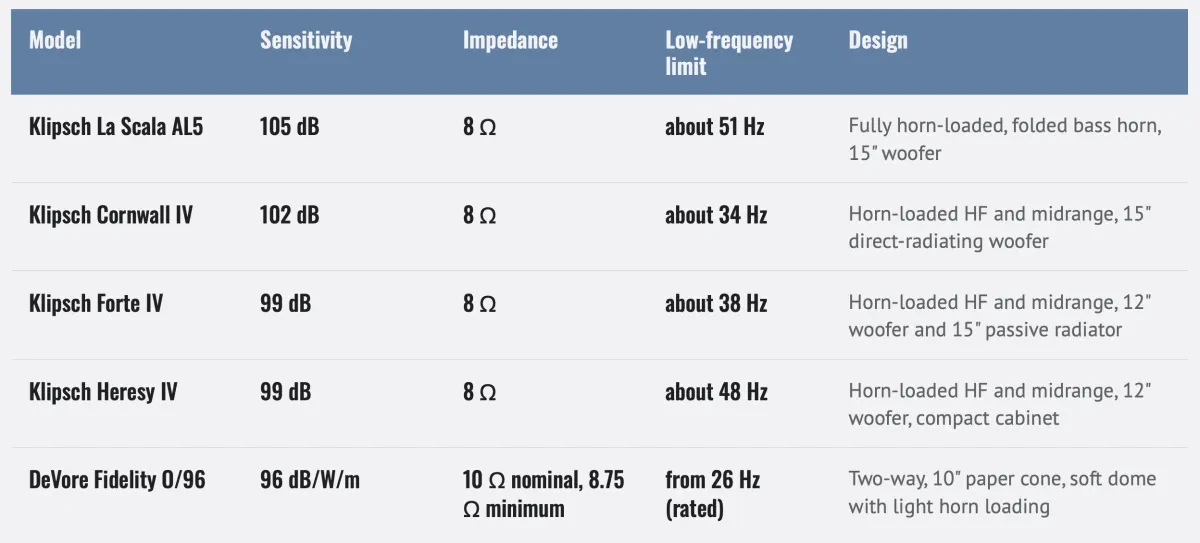
Classic loudspeaker examples
The calculation - how many watts do you really need?
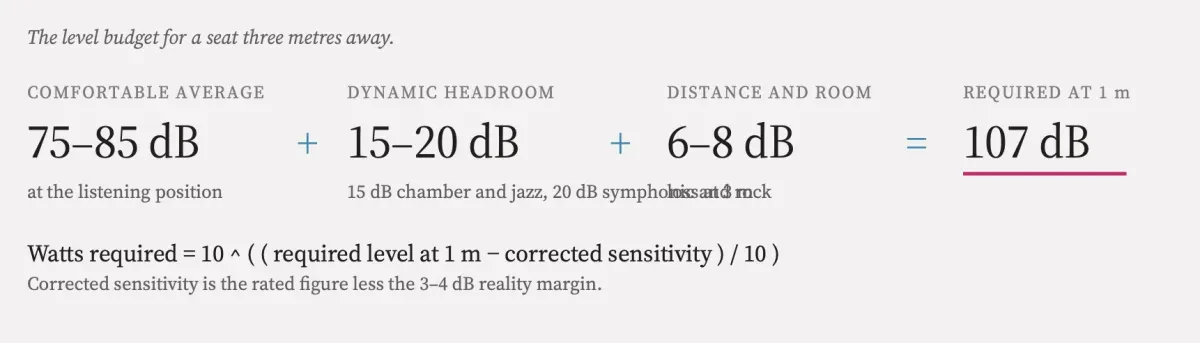
Determine your comfortable average level. For most listeners this is 75–85 dB at the listening position.
Add dynamic headroom. For chamber music and jazz, 15 dB is enough. For symphonic music and rock, allow 20 dB. The result is your required peak level.
Account for the distance to the listening position. At three metres in a typical living room, taking reverberation into account, allow for losses of around 6–8 dB relative to the one-metre measurement.
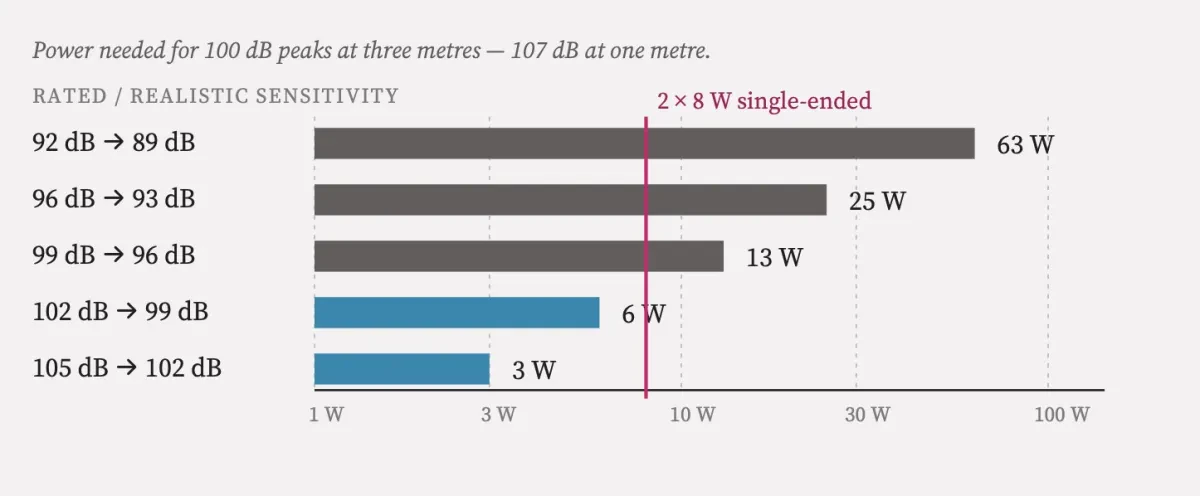
The table shows that for full 100 dB peaks at 3 m, an 8-watt single-ended tube amplifier needs speakers rated at around 101 - 102 dB. Lower the target peak by 5 dB - still ample for chamber music, jazz and vocals at moderate listening levels - and the required power drops roughly threefold: from about 99 dB rated sensitivity an 8-watt SET works superbly, while below 96 dB it starts to run short of headroom. The same logic explains why speakers rated at 92 dB call for a push-pull tube amplifier of at least 30 W even at moderate levels, and around 60 W for full 100 dB peaks.
The flip side of high sensitivity
There are downsides too - and they are often forgotten.
Amplifier noise may become audible
An amplifier whose noise floor is inaudible through an 87 dB speaker may produce audible hum and hiss during pauses through a 102 dB horn. A 15 dB difference in sensitivity means exactly 15 dB more audible noise.
The system becomes highly revealing of recording quality
High-sensitivity designs, especially horns and full-range drivers, offer high resolution in the midrange. A poorly mixed recording can sound genuinely bad here.
Horn systems have pronounced directivity, so precise aiming at the listener is critical - an offset of 15 centimetres is already audible. Full-range drivers narrow dispersion and restrict the comfortable listening zone.
Scenarios
A - 2 × 8 W single-ended amplifier, 20–25 m² room
Target speaker sensitivity of 99 dB or higher, 8-ohm impedance with a flat curve. Mid-sized horn speakers work in this zone. The compromise you’ll have to accept is a low-frequency limit of around 38–48 Hz. If you want deeper bass, add a subwoofer crossed over at 60–70 Hz.
B - 2 × 10 W amplifier, room up to 16 m²
Large horn speakers are too big for the room. Look for horn speakers with sensitivity of around 99 dB, or for full-range designs. A low-frequency limit of around 48 Hz is close to the first room mode in a space like this and is a sensible benchmark.
C - 2 × 30–50 W push-pull tube amplifier (or a powerful single-ended design of the same class)
A sensitivity of 92–95 dB is sufficient, and the choice broadens: designs with large-area drivers and none of the horn-specific traits become available. For many listeners this is the optimal sweet spot.
D - you already own speakers with 88–90 dB sensitivity
The options are few: a push-pull tube amplifier of 50 W or more, and checking the impedance curve is mandatory.
Checklist
Find out in which format your speakers’ sensitivity is specified - dB/W/m or dB/2.83 V/m.
Recalculate using the formula if the nominal impedance differs from 8 ohms.
Subtract a 3–4 dB correction from the rated value.
Find the impedance curve. Flatness matters more here than the absolute sensitivity figure.
Calculate the power you need based on your listening level, distance and repertoire.
For speakers rated at 100 dB or more, check the amplifier’s measured noise level.
Check the dimensions and wall-clearance requirements. Horn systems usually need at least 60–90 cm from the front wall.
Make the final decision after listening.
Conclusion
Matching speakers to a tube amplifier is not about chasing the highest sensitivity figure, but about finding the right combination of three properties: sensitivity, flat impedance and tonal character. Neglecting the second of these accounts for most of the disappointments in this category - the system plays loud, but sounds “off” and fails to move you emotionally.