
Alle

DACs - Chord HUGO TT 2
Beschreibung, Bilder, technische Daten und Spezifikationen
Chord HUGO TT 2
Bildquelle - (c) Chord
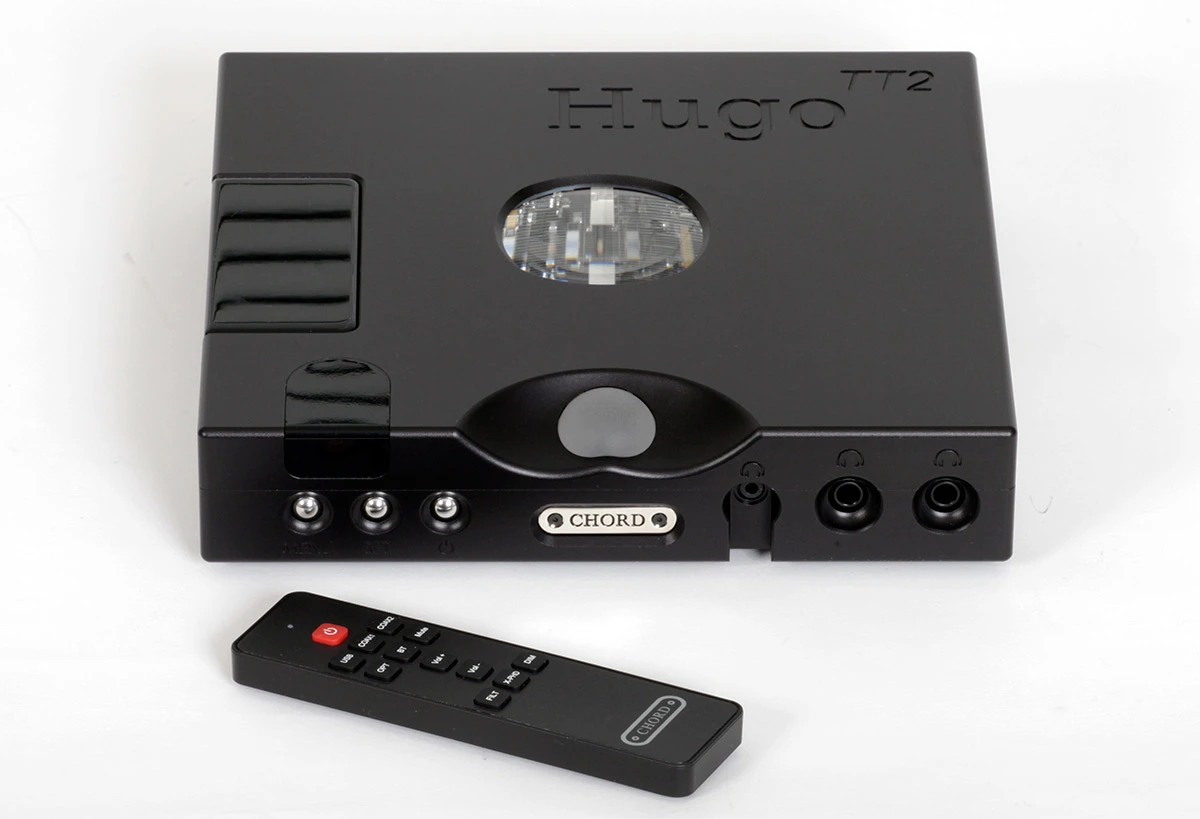
Hugo TT 2 is a table-top DAC, preamplifier and headphone amplifier from Chord Electronics. Its Xilinx Artix 7 FPGA is custom-coded by Rob Watts, and Chord quotes double the processing power of the transportable Hugo 2 and five times that of the original Hugo TT. The internal Li-Po battery of the original is replaced by a supercapacitor supply. An optional M Scaler with a 1M-tap upscaling filter can be added later.
Key specs that matter
The filter is a 98,304-tap 16FS WTA1 with a 10-element design, up from the 4-element design. Inputs are one USB Type-B, two coaxial BNC and two optical, and PCM is accepted from 44.1 to 768 kHz at 16 - 32-bit, with DSD64 to DSD512 via DoP (native DSD on Windows). Outputs are stereo XLR and RCA, two 6.5 mm and one 3.5 mm headphone socket and two DX BNC expansion outputs. Dynamic range is 127 dB (A-weighted), and noise is 4 µV in high gain and 1.7 µV in low gain (A-weighted). THD is 0.00008% at 2.5 V into 300 ohms and 0.00016% at 6 W into 8 ohms. Output power at 1% THD is 288 mW RMS into 300 ohms and 7.3 W RMS into 8 ohms unbalanced, or 1.15 W RMS into 300 ohms and 18 W RMS into 8 ohms balanced. Output impedance is 0.042 ohms, and stereo separation is -138 dB (9 V RMS, 300 ohms). Power consumption is 30 W at full power and 10 W in standby. Dimensions are 52 x 235 x 238 mm (H x W x D), and weight is 2.53 kg.
Engineering and use context
Inside the FPGA, 86 cores run in parallel at 208 MHz. Power comes from an external 15 V, 4 A switching supply, and six supercapacitors deliver up to 5 A at 9.3 V RMS. Four filter stages and three digital crossfeed stages are user-selectable. Volume is digital, and line-level mode is engaged in the menu.
The casing is precision-machined aluminium in silver or satin black, with steel ball-bearing buttons, an acrylic signal window, a glass viewing portal and a dot-matrix display. Each unit comes with an IR remote control, a USB cable, an optical cable and two AAA batteries, and the warranty runs 3 years. USB playback is driverless on macOS and Linux, while Windows requires a driver.
Pairing
The balanced XLR outputs connect to a power amplifier with XLR inputs, and the RCA outputs to any line-level input. Headphones connect to the 6.5 mm or 3.5 mm sockets.
Alternatives
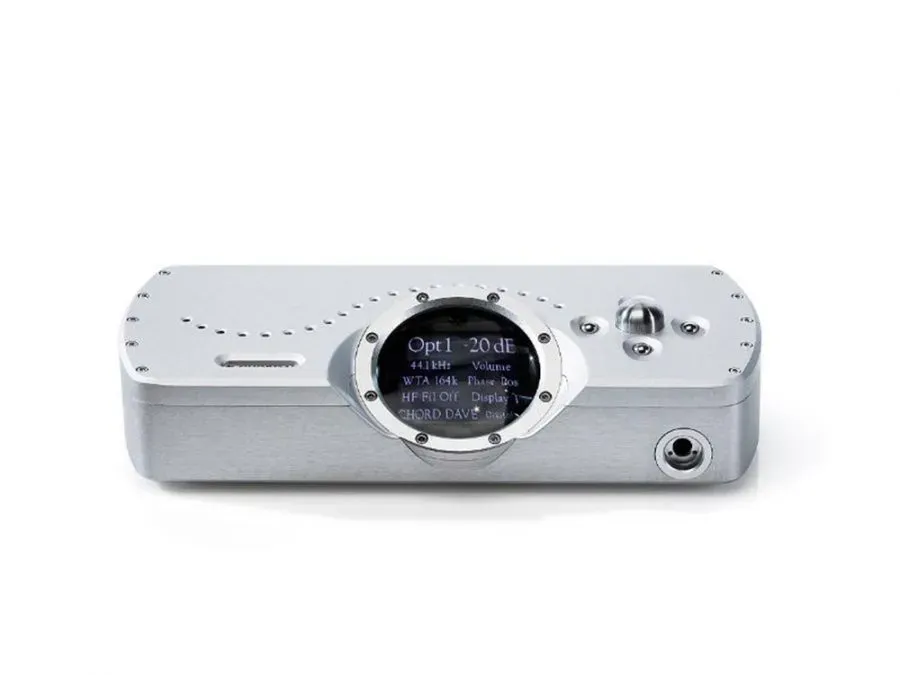
The DAVE is the larger desktop DAC, preamplifier and headphone amplifier from Chord.
Spezifikationen
Modellbezeichnung
HUGO TT 2
Wandlungstyp
N/A
Wandlerchip
N/A
DSD-Kompatibilität
k. A.
Parameter
N/A
Untere Grenzfrequenz +/- 3dB (Hz)
N/A
Obere Grenzfrequenz +/- 3dB (Hz)
N/A
Verstärkung (dBu)
N/A
Ausgangspegel (symmetrisch) (V)
N/A
Ausgangspegel (unsymmetrisch) (V)
N/A
Eingangsimpedanz (symmetrisch) (Ω)
N/A
Eingangsimpedanz (unsymmetrisch) (Ω)
N/A
Ausgangsimpedanz (symmetrisch) (Ω)
N/A
Ausgangsimpedanz (unsymmetrisch) (Ω)
0.042
Analogausgänge
N/A
Signal-Rausch-Abstand (dB)
N/A
Klirrfaktor + Rauschen (% at 22 kHz)
0.00008
Abmessungen (mm)
52 x 235 x 238
Gewicht (kg)
N/A
Offizieller Link
Weitere Komponenten
DACs
Chord Mojo 2
DACs
Chord DAVE

DACs
Chord QUTEST
DACs
Chord HUGO 2
DACs
Chord Hugo TT2