Все

Тонармы — Dohmann Audio REED 5T
Описание, изображения, технические характеристики и спецификации
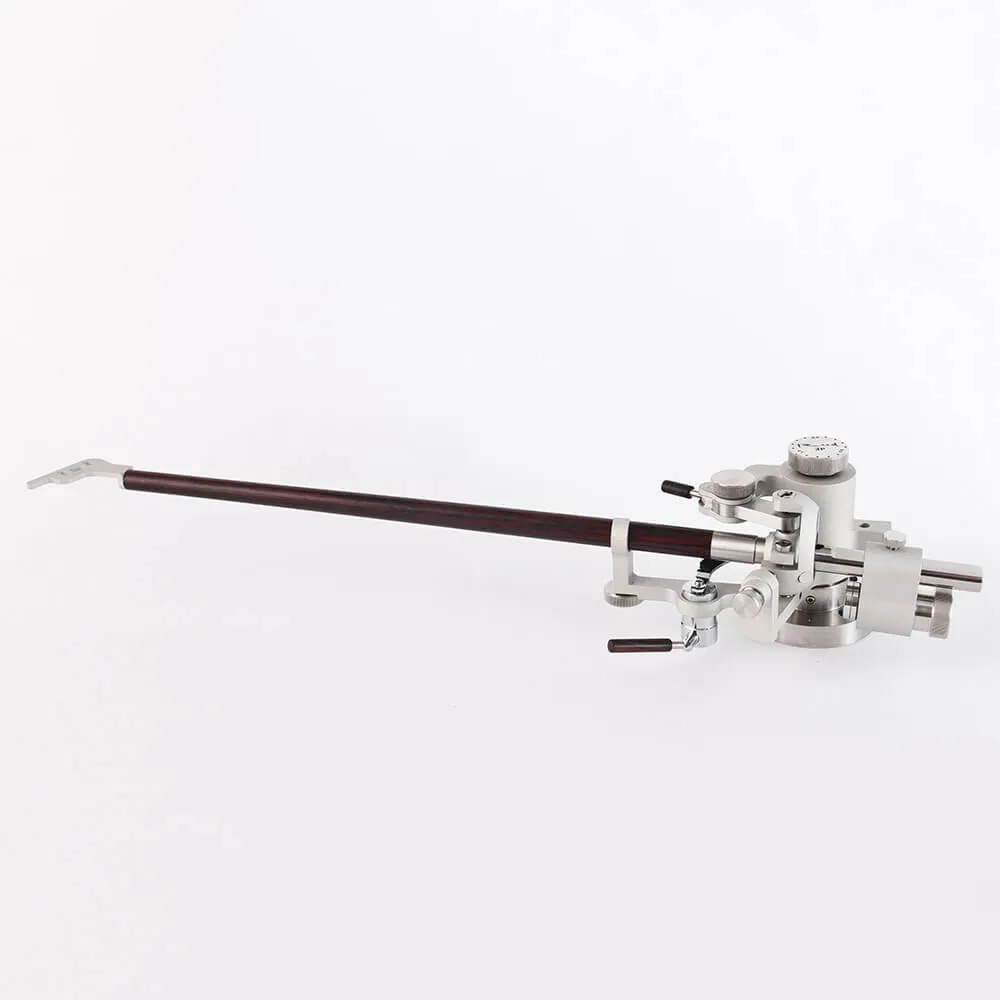
Dohmann Audio REED 5T
Источник изображения — © Dohmann Audio
The Reed 5T was the first tangential tonearm from Reed, the Lithuanian maker based near Kaunas and owned by Vidmantas Triukas, a radio engineer who presented his first Reed arm in 2008 after a year of research and prototyping. Each arm ships together with a battery supply.
Key specs that matter
The 5T is a tangentially tracking pivoted arm, and its maximum tracking error stays within 5 minutes of angle, where Reed says pivoted arms usually reach up to 1.5 degrees. The mounting distance is 251 mm, which suits platters up to 330 mm across, and the height range covers platters 26 to 46 mm high. VTA adjusts with a precision of 0.2 mm and azimuth by up to 8 degrees either way. Downforce spans 10 to 30 mN, for cartridges of 5.5 to 19.5 g, with an extended range of 4 to 25 g. Depending on the armwand material, the effective mass runs from 8 to 16 g. Finishes are Seashell white, Gold matte and Black.
Engineering and use context
The working principle rests on Thales' theorem about right angles inscribed in a semicircle, combined with the rule that only one circle can pass through three points that are not on one line. A laser beam and a linear sensor array read the arm position, and a limited rotation sectional torque motor, designed and built by Reed, turns the arm to keep it tangent to the groove. The arm tube suspension follows the Reed 2G, and the rotating part turns on a thrust-sleeve bearing chosen for low noise. Beyond tracking accuracy, Reed lists two gains over a normal pivoted arm - a lower moment of inertia and no need for anti-skating. Against other tangential designs it claims a moment of inertia several times lower, no air compressor or other extra devices, and effective mass that is similar in the vertical and horizontal planes. Reed also states that its tonearm wiring comes from Stereo-Lux and runs without soldering points.
Pairing
The drive needs 12 V DC from a battery source. The current BS-12V unit is fully automatic and can power a 5T and a Reed turntable at the same time, so one supply serves both. For matching a cartridge, the target Reed gives is a resonance of the arm with the cartridge near 10 Hz, acceptable between 8 and 12 Hz, and because the armwand is user-replaceable, the owner can move the effective mass to reach that window.
Alternatives
The Reed 5A is the maker's later tangential pivoted arm, which uses a Double Birch and Thales linkage with a tracking error of 4 minutes of angle and needs no motor or electronic controller.
Key specs that matter
The 5T is a tangentially tracking pivoted arm, and its maximum tracking error stays within 5 minutes of angle, where Reed says pivoted arms usually reach up to 1.5 degrees. The mounting distance is 251 mm, which suits platters up to 330 mm across, and the height range covers platters 26 to 46 mm high. VTA adjusts with a precision of 0.2 mm and azimuth by up to 8 degrees either way. Downforce spans 10 to 30 mN, for cartridges of 5.5 to 19.5 g, with an extended range of 4 to 25 g. Depending on the armwand material, the effective mass runs from 8 to 16 g. Finishes are Seashell white, Gold matte and Black.
Engineering and use context
The working principle rests on Thales' theorem about right angles inscribed in a semicircle, combined with the rule that only one circle can pass through three points that are not on one line. A laser beam and a linear sensor array read the arm position, and a limited rotation sectional torque motor, designed and built by Reed, turns the arm to keep it tangent to the groove. The arm tube suspension follows the Reed 2G, and the rotating part turns on a thrust-sleeve bearing chosen for low noise. Beyond tracking accuracy, Reed lists two gains over a normal pivoted arm - a lower moment of inertia and no need for anti-skating. Against other tangential designs it claims a moment of inertia several times lower, no air compressor or other extra devices, and effective mass that is similar in the vertical and horizontal planes. Reed also states that its tonearm wiring comes from Stereo-Lux and runs without soldering points.
Pairing
The drive needs 12 V DC from a battery source. The current BS-12V unit is fully automatic and can power a 5T and a Reed turntable at the same time, so one supply serves both. For matching a cartridge, the target Reed gives is a resonance of the arm with the cartridge near 10 Hz, acceptable between 8 and 12 Hz, and because the armwand is user-replaceable, the owner can move the effective mass to reach that window.
Alternatives
The Reed 5A is the maker's later tangential pivoted arm, which uses a Double Birch and Thales linkage with a tracking error of 4 minutes of angle and needs no motor or electronic controller.
Характеристики
Название модели
REED 5T
Тип
Tangential
Эффективная масса (g)
Wenge: 10-14g, Makassar Ebony: 10-14g, Cocobolo: 12-18g, Teak Light: 8-14g, Teak Dark: 8-14g
Эффективная длина (mm)
N/A
Диапазон регулировки баланса каналов (g)
N/A
Угол смещения (deg)
N/A
Свес иглы (mm)
N/A
Вес (g)
N/A
Официальная ссылка
Другие компоненты
Тонармы
Dohmann Audio SCHRÖDER CB-11
Тонармы
Dohmann Audio SCHRÖDER CB-9
Тонармы
Dohmann Audio REED 5A
Тонармы
Dohmann Audio REED 3P 12"