
Все

Тонармы — Reed REED 2G 9.5"
Описание, изображения, технические характеристики и спецификации
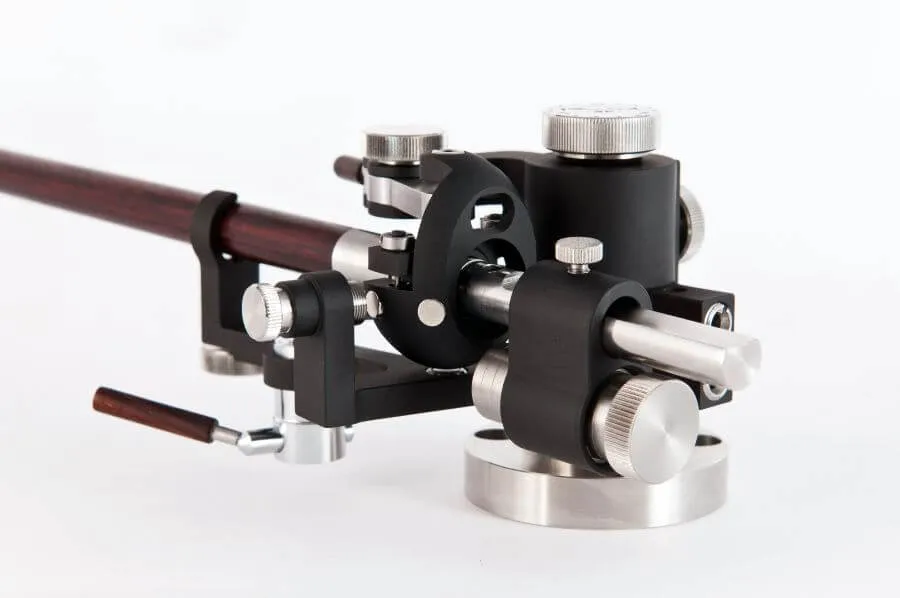
Reed REED 2G 9.5"
Источник изображения — © Reed
The REED 2G 9.5-inch is the shortest of three lengths in the 2G range, a gimbal-bearing tonearm designed by Vidmantas Triukas, whose earlier work spanned acoustic engineering and some aerospace projects before he founded Reed in Lithuania. Reed presents the 2G as a blend of its older 2A and 3Q arms with new functions added on top. The American list price for this length is USD 5,395.
Key specs that matter
Reed quotes 223 mm from pivot to platter spindle, while the base is positioned at 205.5 mm when the arm is drilled in. Offset is 22.9 degrees and overhang 17 mm. Wand weight follows the wood chosen - the maker lists roughly 8 g for light or dark teak, 10 g for wenge and 12 g for Macassar ebony or cocobolo at this length, and gives 14 to 22 g as the range for the 2G family once headshell material is counted. The mounting pillar allows 28 to 48 mm of height, and VTA moves in increments of 0.2 mm.
Engineering and use context
Motion is split between two bearing types inside a cardanic yoke. Up and down movement is carried by thrust rotation bearings, while sideways rotation runs on thrust pivot bearings, an arrangement Reed uses to keep the moving parts free of wobble. A LEMO plug locks the wand to the bearing housing, so an owner can later fit a wand of a different mass or length without opening the wiring. The headshell detaches as well, and azimuth is set through a mechanism developed for this model. Bias correction is magnetic, borrowed from the 3P. As an extra, a calibrated laser kit helps with VTA and azimuth alignment. Signal exits either through a Finewire C37 lead or through a 5-pin DIN socket, and a 1.25 m cryogenically treated Finewire cable with Kiel RCA plugs is one factory choice. Metalwork is offered in seashell white, black or palladium, and there are two gold options, one matte and one polished. Reed builds its wiring without solder joints, using conductors supplied by Stereo-Lux Musikanlagen.
Pairing
The maker's target for the resonance of arm plus cartridge is about 10 Hz and treats 8 to 12 Hz as acceptable, so the teak wand suits high-compliance designs while ebony or cocobolo move the combined mass up for stiffer moving coil cartridges. The short pivot distance matches decks prepared for a 9-inch class arm, and the tall pillar range covers most plinth heights with or without an adapter board.
Alternatives
The Reed 1H in 9.5-inch length shares this geometry but pairs the cardanic bearing with a damped carbon fibre wand weighing about 12 g.
Key specs that matter
Reed quotes 223 mm from pivot to platter spindle, while the base is positioned at 205.5 mm when the arm is drilled in. Offset is 22.9 degrees and overhang 17 mm. Wand weight follows the wood chosen - the maker lists roughly 8 g for light or dark teak, 10 g for wenge and 12 g for Macassar ebony or cocobolo at this length, and gives 14 to 22 g as the range for the 2G family once headshell material is counted. The mounting pillar allows 28 to 48 mm of height, and VTA moves in increments of 0.2 mm.
Engineering and use context
Motion is split between two bearing types inside a cardanic yoke. Up and down movement is carried by thrust rotation bearings, while sideways rotation runs on thrust pivot bearings, an arrangement Reed uses to keep the moving parts free of wobble. A LEMO plug locks the wand to the bearing housing, so an owner can later fit a wand of a different mass or length without opening the wiring. The headshell detaches as well, and azimuth is set through a mechanism developed for this model. Bias correction is magnetic, borrowed from the 3P. As an extra, a calibrated laser kit helps with VTA and azimuth alignment. Signal exits either through a Finewire C37 lead or through a 5-pin DIN socket, and a 1.25 m cryogenically treated Finewire cable with Kiel RCA plugs is one factory choice. Metalwork is offered in seashell white, black or palladium, and there are two gold options, one matte and one polished. Reed builds its wiring without solder joints, using conductors supplied by Stereo-Lux Musikanlagen.
Pairing
The maker's target for the resonance of arm plus cartridge is about 10 Hz and treats 8 to 12 Hz as acceptable, so the teak wand suits high-compliance designs while ebony or cocobolo move the combined mass up for stiffer moving coil cartridges. The short pivot distance matches decks prepared for a 9-inch class arm, and the tall pillar range covers most plinth heights with or without an adapter board.
Alternatives
The Reed 1H in 9.5-inch length shares this geometry but pairs the cardanic bearing with a damped carbon fibre wand weighing about 12 g.
Характеристики
Название модели
REED 2G 9.5"
Тип
Unipivot
Эффективная масса (g)
N/A
Эффективная длина (mm)
8, 10, 12
Диапазон регулировки баланса каналов (g)
N/A
Угол смещения (deg)
22.9
Свес иглы (mm)
17
Вес (g)
N/A
Официальная ссылка
Другие компоненты
Тонармы
Reed REED 5T
Тонармы
Reed REED 2G 10.5"
Тонармы
Reed REED 2G 12"
Тонармы
Reed Reed 3P 9.5"
Тонармы
Reed REED 3P 10.5"