
Все

ЦАПы — Soulnote D-3
Описание, изображения, технические характеристики и спецификации
Soulnote D-3
Источник изображения — © Soulnote
The D-3 is the top D/A converter of the 3 Series from Soulnote, the Japanese brand whose design team works without negative feedback in its analogue stages. Its dual mono construction carries four ESS ES9038PRO chips, two per channel, and it needs an external 10 MHz clock such as the Soulnote X-3 to operate. A non-oversampling mode removes the pre- and post-echoes of FIR oversampling filters.
Key specs that matter
Digital inputs are ZERO LINK, two USB Type B ports, coaxial S/PDIF and AES/EBU, plus an SMA socket at 50 ohms for the external clock. Through ZERO LINK and USB the D-3 accepts PCM up to 768 kHz at 16, 24 or 32 bit and DSD up to 22.6 MHz. Coaxial and AES/EBU are limited to 192 kHz PCM at 16 or 24 bit and DSD64 via DoP v1.1. Analogue outputs are one XLR pair at 5.6 Vrms and one RCA pair at 2.8 Vrms. Frequency response spans 2 Hz to 120 kHz within +0/-1 dB, signal to noise ratio is 110 dB and distortion is 0.008 percent measured in NOS mode at 176.4 kHz. The case measures 454 x 174 x 407 mm and weighs 28 kg, with power draw of 48 W.
Engineering and use context
Each channel's pair of ES9038PRO chips delivers a current output of 120 mA, which feeds a discrete amplifier with no negative feedback built on Soulnote's Type-R circuit. Clocking comes from a Texas Instruments LMX2594 synthesiser used as a DDS, with jitter of 45 femtoseconds, which allows the ES9038PRO to run in its non-DPLL mode. Each channel gets its own terminals, Type-R circuits, supply lines, power transformers and relay drive with relay power supplies. Soulnote uses its own RSR-2-12D relays and naked foil resistors in the signal path. ZERO LINK is Soulnote's proprietary connection that keeps the source synchronised with the DAC clock, generating a master clock at each track's sample rate with no PLL or sample rate converter, and a mechanical relay selector routes it straight to the DAC chips. Three separate transformers, one digital and one for each analogue channel, are mounted vertically to limit leakage flux. The aluminium sandwich base uses titanium spacers and grounds through spikes. Rectification uses 52 SiC diodes, and the unit holds 152 electrolytic capacitors.
Pairing
The balanced output level of 5.6 Vrms is higher than usual, so an amplifier with adjustable input sensitivity or a passive attenuator suits it well. A computer or network player connects over USB for the highest sample rates, and a Soulnote transport can use ZERO LINK.
Alternatives
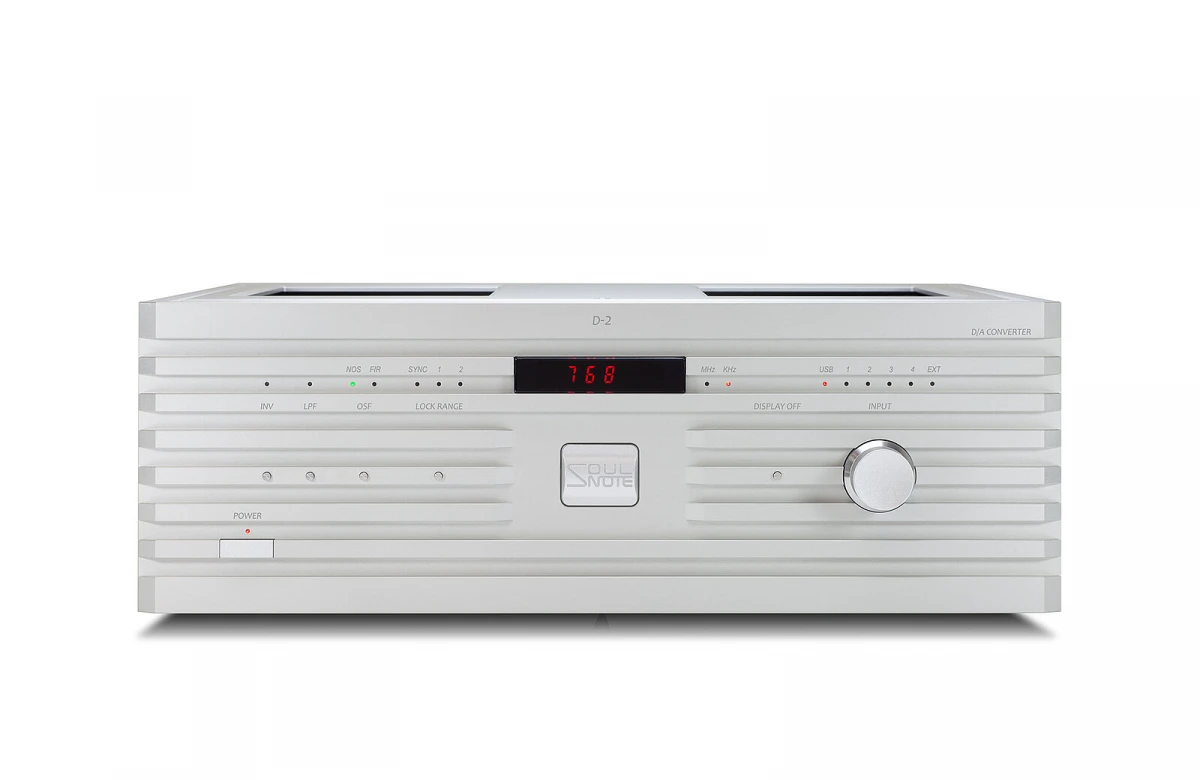
The Soulnote D-2 ver.2 is the 2 Series converter that shares the LMX2594 clock and twin mono discrete output stage in a lower-priced chassis.
Key specs that matter
Digital inputs are ZERO LINK, two USB Type B ports, coaxial S/PDIF and AES/EBU, plus an SMA socket at 50 ohms for the external clock. Through ZERO LINK and USB the D-3 accepts PCM up to 768 kHz at 16, 24 or 32 bit and DSD up to 22.6 MHz. Coaxial and AES/EBU are limited to 192 kHz PCM at 16 or 24 bit and DSD64 via DoP v1.1. Analogue outputs are one XLR pair at 5.6 Vrms and one RCA pair at 2.8 Vrms. Frequency response spans 2 Hz to 120 kHz within +0/-1 dB, signal to noise ratio is 110 dB and distortion is 0.008 percent measured in NOS mode at 176.4 kHz. The case measures 454 x 174 x 407 mm and weighs 28 kg, with power draw of 48 W.
Engineering and use context
Each channel's pair of ES9038PRO chips delivers a current output of 120 mA, which feeds a discrete amplifier with no negative feedback built on Soulnote's Type-R circuit. Clocking comes from a Texas Instruments LMX2594 synthesiser used as a DDS, with jitter of 45 femtoseconds, which allows the ES9038PRO to run in its non-DPLL mode. Each channel gets its own terminals, Type-R circuits, supply lines, power transformers and relay drive with relay power supplies. Soulnote uses its own RSR-2-12D relays and naked foil resistors in the signal path. ZERO LINK is Soulnote's proprietary connection that keeps the source synchronised with the DAC clock, generating a master clock at each track's sample rate with no PLL or sample rate converter, and a mechanical relay selector routes it straight to the DAC chips. Three separate transformers, one digital and one for each analogue channel, are mounted vertically to limit leakage flux. The aluminium sandwich base uses titanium spacers and grounds through spikes. Rectification uses 52 SiC diodes, and the unit holds 152 electrolytic capacitors.
Pairing
The balanced output level of 5.6 Vrms is higher than usual, so an amplifier with adjustable input sensitivity or a passive attenuator suits it well. A computer or network player connects over USB for the highest sample rates, and a Soulnote transport can use ZERO LINK.
Alternatives
The Soulnote D-2 ver.2 is the 2 Series converter that shares the LMX2594 clock and twin mono discrete output stage in a lower-priced chassis.
Характеристики
Название модели
D-3
Тип преобразования
N/A
Чип преобразования
ES9038PRO
Совместимость с DSD
Да
Параметры
up to 32 bit / 768 kHz and DSD512
Нижняя граница частотного диапазона +/- 3дБ (Hz)
2
Верхняя граница частотного диапазона +/- 3дБ (Hz)
120 000
Усиление (dBu)
N/A
Уровень выхода (балансный) (V)
N/A
Уровень выхода (небалансный) (V)
N/A
Входное сопротивление (балансное) (Ω)
N/A
Входное сопротивление (небалансное) (Ω)
N/A
Выходное сопротивление (балансное) (Ω)
N/A
Выходное сопротивление (небалансное) (Ω)
N/A
Аналоговые выходы
N/A
Отношение сигнал/шум (dB)
110
Коэффициент гармонических искажений + шум (% at 22 kHz)
0.008
Габариты (mm)
454 × 174 × 407
Вес (kg)
28
Официальная ссылка
Другие компоненты
ЦАПы
Soulnote D-2
ЦАПы
Soulnote D-1N