
Все

ЦАПы — Soulnote D-2
Описание, изображения, технические характеристики и спецификации
Soulnote D-2
Источник изображения — © Soulnote
The D-2 is a D/A converter from Soulnote of Japan, offered in silver as the D-2SE and in black as the D-2BE. It uses four ES9038PRO chips in a fully symmetric discrete circuit without negative feedback, and Soulnote describes it as the first converter to use this many of these chips. The maker now lists it among its discontinued models released after 2016, and the D-2 ver.2 continues the design in the current range.
Key specs that matter
Over USB the D-2 accepts PCM up to 768 kHz at 16, 24 or 32 bits and DSD up to 22.6 MHz via DoP v1.1 or native ASIO. Two coaxial inputs and two AES/EBU inputs handle PCM up to 192 kHz at 16 or 24 bits and DSD64 by DoP. A 10 MHz external clock input uses a 50 ohm BNC socket. Output level is 5.6 Vrms from the XLR pair and 2.8 Vrms from the RCA pair. The response extends from 2 Hz to 120 kHz within +0/-1 dB, signal-to-noise ratio is 110 dB, and total harmonic distortion is quoted as 0.008% in NOS mode at 176.4 kHz. Power draw is 56 W, and the case measures 430 x 160 x 405 mm and weighs 17 kg.
Engineering and use context
The master clock is recreated by a DDS based on the Texas Instruments LMX2594 RF synthesizer, a part developed for radar and measurement gear with a jitter figure of 45 fs. The internal reference is a TCXO with phase noise of -121 dB at 10 Hz offset, switched against the external clock by a mechanical relay, and its supply is cut when an external clock is in use so the two cannot interfere. Two ES9038PRO chips per channel drive the upper and lower halves of a complementary differential stage, and IV conversion is done with a single resistor, avoiding the TIM distortion of feedback IV circuits. The layout is dual mono including rectification, with no signal or supply cables between boards. A 400 VA bifilar-wound toroidal transformer with eight secondary windings sits over a spike that drains its vibration, and the four circuit boards are wrapped in 70 micron copper foil instead of relying on ferrite filters. The digital board is a separate module intended for later upgrades. STEREO, MONO Lch and MONO Rch modes let two units run as a dual mono converter, stopping the opposite-channel chips to double the power margin. NOS mode is available for PCM only, and USB can use Bulk Pet transfer with a dedicated driver.
Pairing
The Soulnote X-3 clock generator can feed the BNC input through a conversion plug, a step the later ver.2 removed by moving to an SMA socket. Owners going further can buy a second D-2 and set each unit to one channel, and the balanced output suits preamplifiers with XLR inputs.
Alternatives
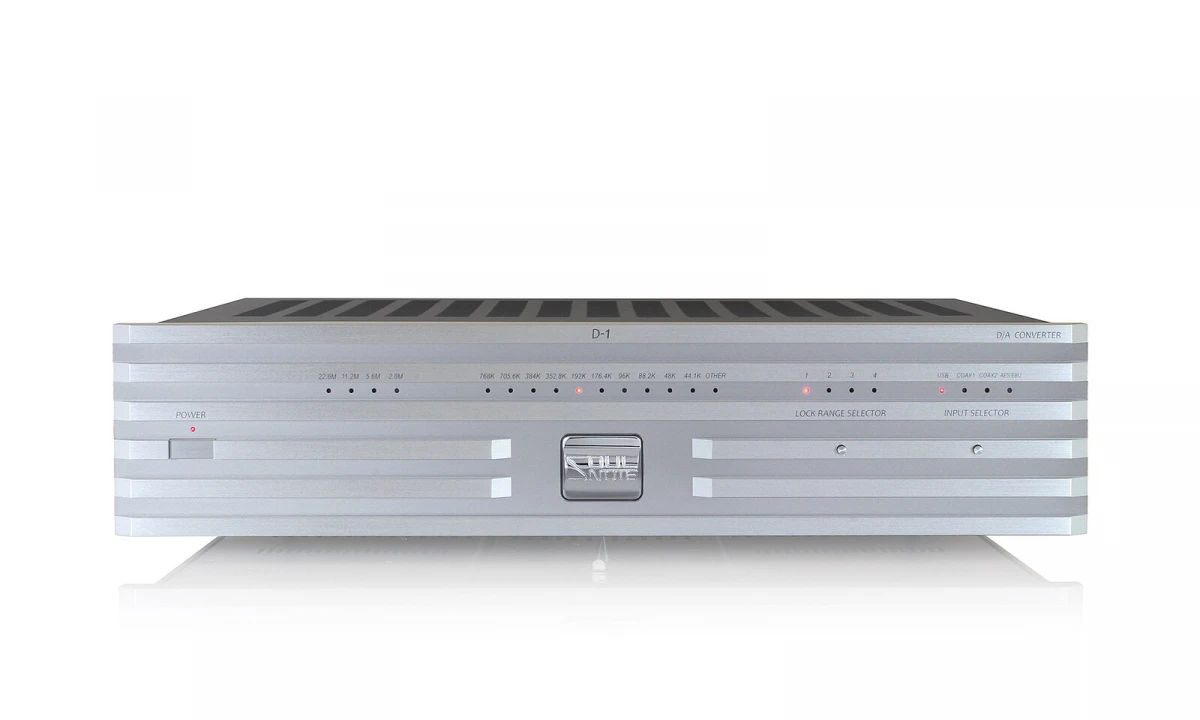
The Soulnote D-1N is the smaller converter of the same generation, with one ES9038PRO per channel and no external clock input in a 10 kg case.
Key specs that matter
Over USB the D-2 accepts PCM up to 768 kHz at 16, 24 or 32 bits and DSD up to 22.6 MHz via DoP v1.1 or native ASIO. Two coaxial inputs and two AES/EBU inputs handle PCM up to 192 kHz at 16 or 24 bits and DSD64 by DoP. A 10 MHz external clock input uses a 50 ohm BNC socket. Output level is 5.6 Vrms from the XLR pair and 2.8 Vrms from the RCA pair. The response extends from 2 Hz to 120 kHz within +0/-1 dB, signal-to-noise ratio is 110 dB, and total harmonic distortion is quoted as 0.008% in NOS mode at 176.4 kHz. Power draw is 56 W, and the case measures 430 x 160 x 405 mm and weighs 17 kg.
Engineering and use context
The master clock is recreated by a DDS based on the Texas Instruments LMX2594 RF synthesizer, a part developed for radar and measurement gear with a jitter figure of 45 fs. The internal reference is a TCXO with phase noise of -121 dB at 10 Hz offset, switched against the external clock by a mechanical relay, and its supply is cut when an external clock is in use so the two cannot interfere. Two ES9038PRO chips per channel drive the upper and lower halves of a complementary differential stage, and IV conversion is done with a single resistor, avoiding the TIM distortion of feedback IV circuits. The layout is dual mono including rectification, with no signal or supply cables between boards. A 400 VA bifilar-wound toroidal transformer with eight secondary windings sits over a spike that drains its vibration, and the four circuit boards are wrapped in 70 micron copper foil instead of relying on ferrite filters. The digital board is a separate module intended for later upgrades. STEREO, MONO Lch and MONO Rch modes let two units run as a dual mono converter, stopping the opposite-channel chips to double the power margin. NOS mode is available for PCM only, and USB can use Bulk Pet transfer with a dedicated driver.
Pairing
The Soulnote X-3 clock generator can feed the BNC input through a conversion plug, a step the later ver.2 removed by moving to an SMA socket. Owners going further can buy a second D-2 and set each unit to one channel, and the balanced output suits preamplifiers with XLR inputs.
Alternatives
The Soulnote D-1N is the smaller converter of the same generation, with one ES9038PRO per channel and no external clock input in a 10 kg case.
Характеристики
Название модели
D-2
Тип преобразования
N/A
Чип преобразования
ES9038PRO
Совместимость с DSD
Да
Параметры
up to 32 bit / 768 kHz and DSD512
Нижняя граница частотного диапазона +/- 3дБ (Hz)
2
Верхняя граница частотного диапазона +/- 3дБ (Hz)
120 000
Усиление (dBu)
N/A
Уровень выхода (балансный) (V)
N/A
Уровень выхода (небалансный) (V)
N/A
Входное сопротивление (балансное) (Ω)
N/A
Входное сопротивление (небалансное) (Ω)
N/A
Выходное сопротивление (балансное) (Ω)
N/A
Выходное сопротивление (небалансное) (Ω)
N/A
Аналоговые выходы
N/A
Отношение сигнал/шум (dB)
110
Коэффициент гармонических искажений + шум (% at 22 kHz)
0.008
Габариты (mm)
430 × 160 × 405
Вес (kg)
17
Официальная ссылка
Другие компоненты
ЦАПы
Soulnote D-3
ЦАПы
Soulnote D-1N