
Все

ЦАПы — Soulnote D-1N
Описание, изображения, технические характеристики и спецификации
Soulnote D-1N
Источник изображения — © Soulnote
The D-1N is a stereo D/A converter from Soulnote, the Japanese audio company based in Sagamihara, Kanagawa. It was sold in platinum silver as the D-1NSE and in black as the D-1NBE, and it now sits on the maker's list of discontinued models released after 2016, with the D-1 ver.2 taking its place in the range. Soulnote describes it as a fully balanced discrete converter without negative feedback that adds a non-oversampling mode.
Key specs that matter
Through USB the converter takes PCM up to 768 kHz at 16, 24 or 32 bits and DSD up to 22.6 MHz (DSD512) through DoP v1.1 or ASIO. Two coaxial inputs and one AES/EBU input take PCM up to 192 kHz at 16 or 24 bits and DSD64 by DoP. Outputs are one XLR pair at 5.6 Vrms and one RCA pair at 2.8 Vrms. Frequency response runs from 2 Hz to 120 kHz within +0/-1 dB, signal-to-noise ratio is 110 dB and total harmonic distortion is 0.003%. The analogue filter is a passive second-order type. The unit draws 40 W, measures 430 x 109 x 379 mm and weighs 10 kg.
Engineering and use context
One ES9038PRO, the 32-bit top chip from ESS, is assigned to each channel in mono mode. Its current output of up to 120 mA feeds a discrete amplifier with no feedback that extends into the MHz region, derived from the circuit used in the Soulnote E-1 phono stage. With no feedback-type IV converter, the design avoids the TIM distortion such stages can produce. Crystals with phase jitter below 1 ps sit as close to the DAC chips as the layout allows. A 260 VA toroidal transformer supplies the analogue stage from rails of plus and minus 43 V, and eight separate supplies built on Soulnote discrete regulators feed the left and right analogue and digital sections, the crystals, USB, logic and the S/PDIF receiver. Three spikes support the case, one at the front and two at the back, so a spike stands directly under the transformer and carries its vibration out of the chassis. The NOS mode removes the pre- and post-echo of an FIR filter from the impulse response but cannot be used with DSD. It is chosen with the lock range button, which steps through four lock range levels to match the clock accuracy of the source and then switches to NOS. USB transfer can use the Bulk Pet method from Interface Corporation, which needs a dedicated driver on the computer.
Pairing
A computer with the Bulk Pet driver installed is the most direct source, while a CD transport or streamer can connect over coaxial or AES/EBU. The XLR output suits a preamplifier with balanced inputs such as the Soulnote P-3, and the RCA pair covers amplifiers without XLR sockets.
Alternatives
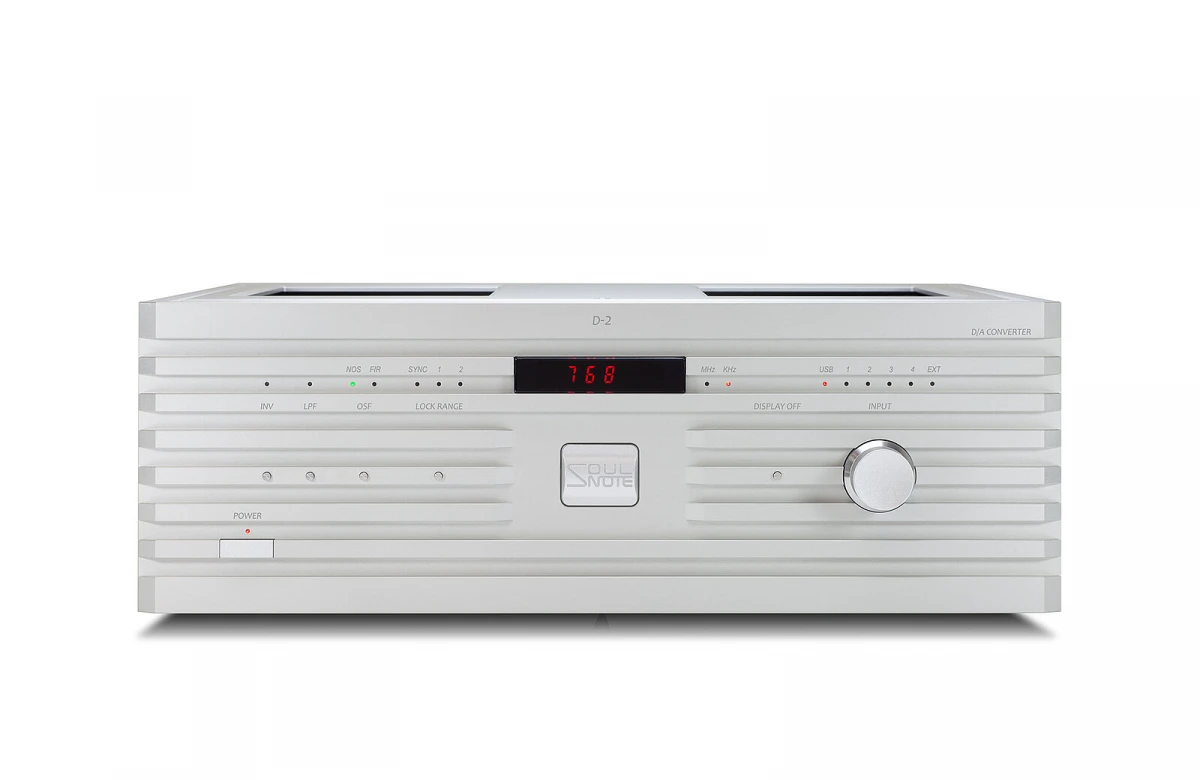
The Soulnote D-2 is the larger converter of the same generation, using two ES9038PRO chips per channel and a 10 MHz external clock input in a 17 kg chassis.
Key specs that matter
Through USB the converter takes PCM up to 768 kHz at 16, 24 or 32 bits and DSD up to 22.6 MHz (DSD512) through DoP v1.1 or ASIO. Two coaxial inputs and one AES/EBU input take PCM up to 192 kHz at 16 or 24 bits and DSD64 by DoP. Outputs are one XLR pair at 5.6 Vrms and one RCA pair at 2.8 Vrms. Frequency response runs from 2 Hz to 120 kHz within +0/-1 dB, signal-to-noise ratio is 110 dB and total harmonic distortion is 0.003%. The analogue filter is a passive second-order type. The unit draws 40 W, measures 430 x 109 x 379 mm and weighs 10 kg.
Engineering and use context
One ES9038PRO, the 32-bit top chip from ESS, is assigned to each channel in mono mode. Its current output of up to 120 mA feeds a discrete amplifier with no feedback that extends into the MHz region, derived from the circuit used in the Soulnote E-1 phono stage. With no feedback-type IV converter, the design avoids the TIM distortion such stages can produce. Crystals with phase jitter below 1 ps sit as close to the DAC chips as the layout allows. A 260 VA toroidal transformer supplies the analogue stage from rails of plus and minus 43 V, and eight separate supplies built on Soulnote discrete regulators feed the left and right analogue and digital sections, the crystals, USB, logic and the S/PDIF receiver. Three spikes support the case, one at the front and two at the back, so a spike stands directly under the transformer and carries its vibration out of the chassis. The NOS mode removes the pre- and post-echo of an FIR filter from the impulse response but cannot be used with DSD. It is chosen with the lock range button, which steps through four lock range levels to match the clock accuracy of the source and then switches to NOS. USB transfer can use the Bulk Pet method from Interface Corporation, which needs a dedicated driver on the computer.
Pairing
A computer with the Bulk Pet driver installed is the most direct source, while a CD transport or streamer can connect over coaxial or AES/EBU. The XLR output suits a preamplifier with balanced inputs such as the Soulnote P-3, and the RCA pair covers amplifiers without XLR sockets.
Alternatives
The Soulnote D-2 is the larger converter of the same generation, using two ES9038PRO chips per channel and a 10 MHz external clock input in a 17 kg chassis.
Характеристики
Название модели
D-1N
Тип преобразования
N/A
Чип преобразования
N/A
Совместимость с DSD
Да
Параметры
up to 32-bit/768 kHz PCM and 22.6 MHz DSD
Нижняя граница частотного диапазона +/- 3дБ (Hz)
2
Верхняя граница частотного диапазона +/- 3дБ (Hz)
120 000
Усиление (dBu)
N/A
Уровень выхода (балансный) (V)
N/A
Уровень выхода (небалансный) (V)
N/A
Входное сопротивление (балансное) (Ω)
N/A
Входное сопротивление (небалансное) (Ω)
N/A
Выходное сопротивление (балансное) (Ω)
N/A
Выходное сопротивление (небалансное) (Ω)
N/A
Аналоговые выходы
N/A
Отношение сигнал/шум (dB)
110
Коэффициент гармонических искажений + шум (% at 22 kHz)
0.003
Габариты (mm)
456 × 109 ×379
Вес (kg)
11
Официальная ссылка
Другие компоненты
ЦАПы
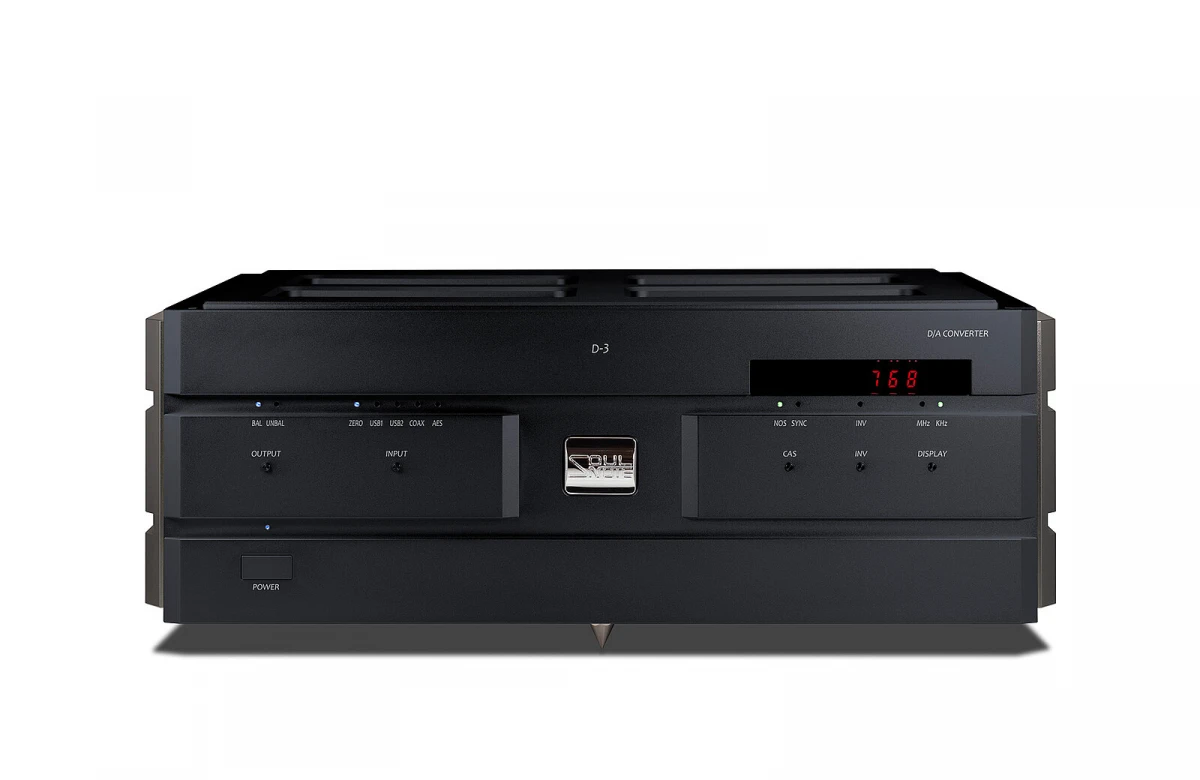
Soulnote D-3
ЦАПы
Soulnote D-2