

CD / SACD players and transports — Pro-Ject CD Box S3
Description, images, technical data and specifications
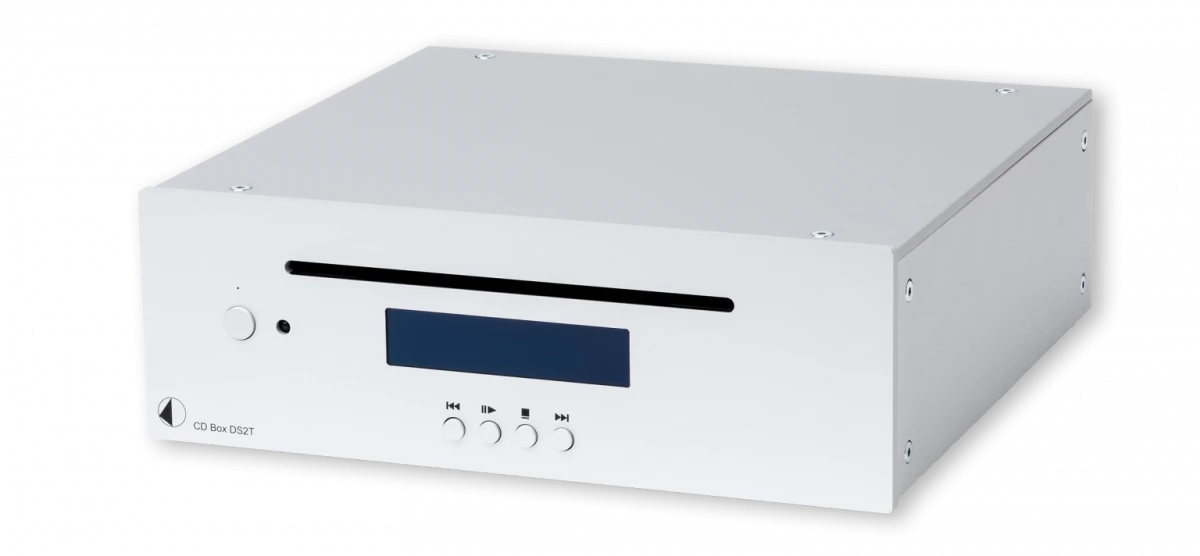
Pro-Ject CD Box S3
Image source — © Pro-Ject
Position in line
It sits above the CD Box E in the same chassis format, replacing that model's simpler DAC section with the PCM5102 engine, which is what drops distortion from 0.04% to 0.005% at the same rated bandwidth - the improvement is entirely in the conversion stage, since the transport mechanism itself is unchanged between the two models.
Key specs that matter
Rated response is 20 Hz to 20 kHz, standard for the format. Output level is 2 V single-ended, higher than the CD Box E's 1.8 V, giving slightly more drive margin into a passive preamplifier, which matters most in a system where the volume pot otherwise needs to run near the top of its range on quiet recordings. Distortion of 0.005% is an order of magnitude below the entry model, a genuine measured improvement rather than a marketing rounding. Dimensions match the CD Box E at 206 x 55 x 153 mm and 1.33 kg, so the two are interchangeable in the same shelf space without any rearrangement of the rack.
Sound and use context
Expect a clean, low-coloration presentation consistent with the newer conversion chip - the improvement over the entry model shows up as a quieter noise floor rather than a change in tonal character, so listeners expecting a warmer or more overtly voiced sound from the upgrade should recalibrate that expectation.
Pairing
The 2 V output gives a bit more headroom into passive preamplifiers than the CD Box E, though an active preamplifier remains the safer match for most systems, especially where the source is one of several inputs at differing levels.
Alternatives
The CD Box E covers the same footprint and mechanism at a lower price with a simpler DAC stage - the S3 is the version to choose when disc playback needs to compete with a separate digital source rather than sit alongside one, since the lower distortion figure narrows the gap to a good streaming DAC.
A further point worth noting is that the improved conversion chip does nothing to change the transport mechanism shared with the CD Box E, so mechanical reliability and disc-loading behaviour should be identical between the two models over time.
Specifications
Model name
CD Box S3
Transport
Yes
Player
Yes
SACD support
N/A
Engine
PCM5102
Frequency response low +/- 3dB (for CD) (Hz)
20
Frequency response high +/- 3dB (for CD) (Hz)
20 000
Frequency response low +/- 3dB (for SACD) (Hz)
N/A
Frequency response high +/- 3dB (for SACD) (Hz)
N/A
Gain (dBu)
N/A
Output Level (balanced) (V)
N/A
Output Level (single-ended) (V)
2
Input Impedance (balanced) (Ω)
N/A
Input Impedance (single-ended) (Ω)
N/A
Output Impedance (balanced) (Ω)
N/A
Output Impedance (single-ended) (Ω)
N/A
Dynamic range (for CD) (dB)
N/A
Dynamic range (for SACD) (dB)
N/A
Signal to Noise Ratio (for CD) (dB)
N/A
Signal to Noise Ratio (for SACD) (dB)
N/A
Total Harmonic Distortion + Noise (for CD) (%)
0,005
Total Harmonic Distortion + Noise (for SACD) (%)
N/A
Dimensions (mm)
206 x 55 x 153
Weight (kg)
1.33
Official link
More components

CD / SACD players and transports
Pro-Ject CD Box RS2 T

CD / SACD players and transports
Pro-Ject CD Box DS3
CD / SACD players and transports
Pro-Ject CD Box DS2 T

CD / SACD players and transports
Pro-Ject CD Box E