
All

Bookshelf Speakers — Vandersteen Audio VLR CT
Description, images, technical data and specifications
Vandersteen Audio VLR CT
Image source — © Vandersteen Audio
The VLR Wood CT, also known as the VLR CT, is a compact bookshelf speaker made by Vandersteen Audio, a Hanford, California company, built and assembled in the USA. It takes the small VLR cabinet and fits a coaxial driver whose tweeter uses the same carbon technology as the tweeter in the System NINE, which the company positions at the top of its range, at roughly 2% of that system's price. The starting price is USD 3,608 a pair before duty, taxes and freight.
Key specs that matter
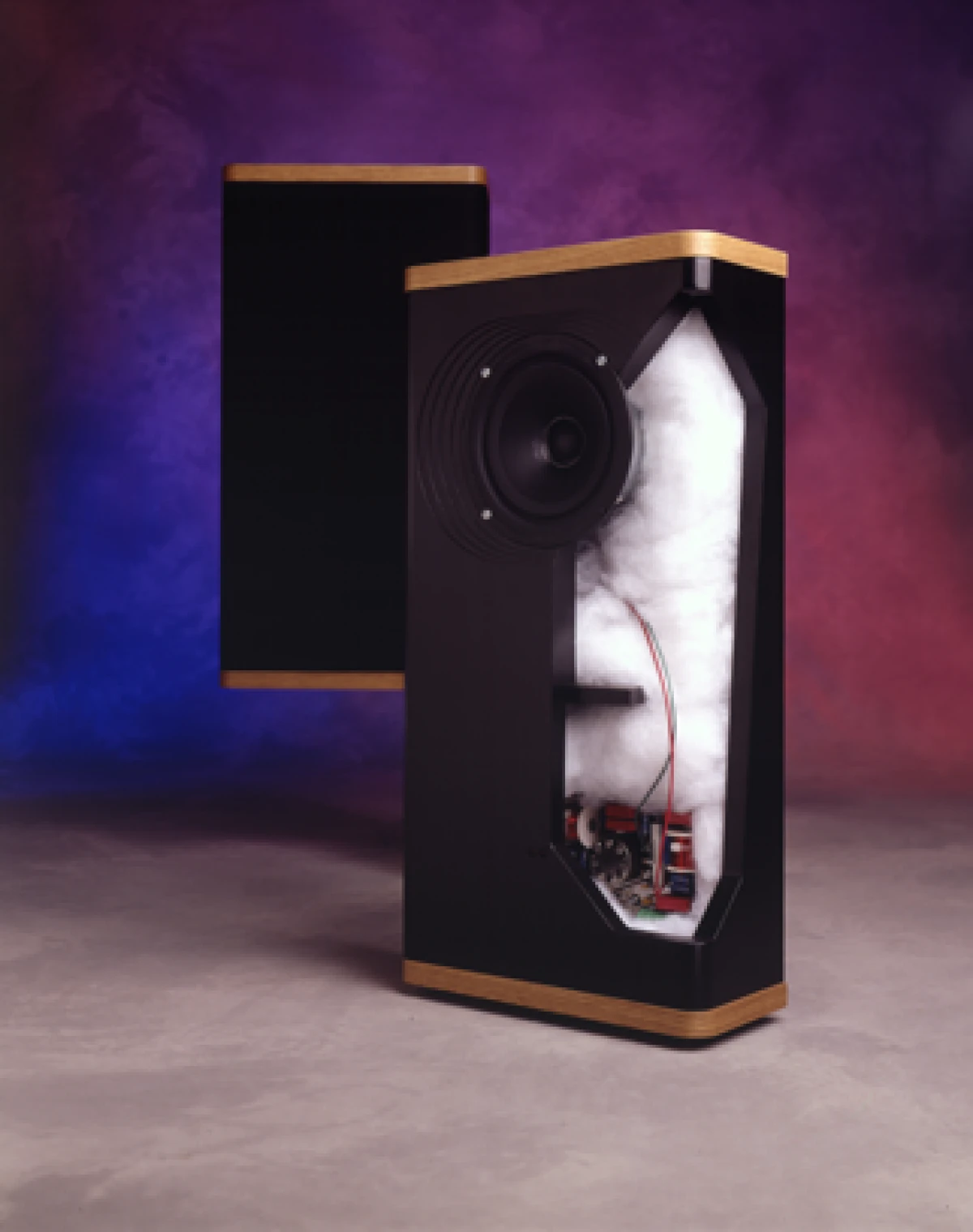
The single coaxial unit places a 1 inch patented Perfect Piston carbon tweeter at the centre of a 6.5 inch mineral-filled polycone woofer held in a die-cast basket. Frequency response is quoted at 64 Hz to 40 kHz within plus or minus 3 dB. Sensitivity is 86 dB at 1 metre with a 2.83 volt input. Impedance is 8 ohms nominal with a minimum of 5 ohms. Division between the two drivers happens at 3.5 kHz through first-order filters sloping at 6 dB per octave. Cables attach to barrier strips that accept spade lugs up to 11 mm wide.
Engineering and use context
Vandersteen builds its speakers to preserve the time and phase relationships of the signal. In a larger model this is done by stepping the drivers back on a sloped baffle, but the company states a box this small lacks the physical room for that, so the woofer and tweeter share one axis instead. Both drivers are wired in positive polarity. The enclosure is made of medium density fiberboard. According to the manual, the aligned coaxial layout means the speaker can be laid on its side without changing its behaviour, and it can go in a cabinet cavity behind a cloth fascia as well as on an open shelf. The maker describes it as meant for a bookshelf close to the rear boundary. Sixteen veneers and finishes are offered, from black, cherry, maple, oak and walnut to upgrade woods such as birdseye maple, ebony, purple heart, rosewood, sapele and wenge.
Pairing
The manual calls the even impedance an easy load, which widens the choice of amplification to include receivers and integrated amplifiers, and states that the VLR works with valve or transistor designs. For home theatre the company designed the VLR to integrate with its V2W subwoofer, with the VCC-2 on-wall centre speaker as a matching front channel.
Alternatives
Within the same compact range Vandersteen offers the VLR Wood, which shares this coaxial arrangement but has a critically damped alloy-dome tweeter at a lower price.
Key specs that matter
The single coaxial unit places a 1 inch patented Perfect Piston carbon tweeter at the centre of a 6.5 inch mineral-filled polycone woofer held in a die-cast basket. Frequency response is quoted at 64 Hz to 40 kHz within plus or minus 3 dB. Sensitivity is 86 dB at 1 metre with a 2.83 volt input. Impedance is 8 ohms nominal with a minimum of 5 ohms. Division between the two drivers happens at 3.5 kHz through first-order filters sloping at 6 dB per octave. Cables attach to barrier strips that accept spade lugs up to 11 mm wide.
Engineering and use context
Vandersteen builds its speakers to preserve the time and phase relationships of the signal. In a larger model this is done by stepping the drivers back on a sloped baffle, but the company states a box this small lacks the physical room for that, so the woofer and tweeter share one axis instead. Both drivers are wired in positive polarity. The enclosure is made of medium density fiberboard. According to the manual, the aligned coaxial layout means the speaker can be laid on its side without changing its behaviour, and it can go in a cabinet cavity behind a cloth fascia as well as on an open shelf. The maker describes it as meant for a bookshelf close to the rear boundary. Sixteen veneers and finishes are offered, from black, cherry, maple, oak and walnut to upgrade woods such as birdseye maple, ebony, purple heart, rosewood, sapele and wenge.
Pairing
The manual calls the even impedance an easy load, which widens the choice of amplification to include receivers and integrated amplifiers, and states that the VLR works with valve or transistor designs. For home theatre the company designed the VLR to integrate with its V2W subwoofer, with the VCC-2 on-wall centre speaker as a matching front channel.
Alternatives
Within the same compact range Vandersteen offers the VLR Wood, which shares this coaxial arrangement but has a critically damped alloy-dome tweeter at a lower price.
Specifications
Model name
VLR CT
Frequency Response low +/- 3dB (Hz)
64
Frequency Response high +/- 3dB (Hz)
40 000
Sensitivity (dB at 1 W/1m)
86
Impedance (Ohms)
8
Power amplifier requirements (W)
30 - 100
Has internal amplification
N/A
Internal amplification power (W)
N/A
Size (sm)
20.32 × 30.48 × 29.2
Weight (kg)
9.9
Official link
More components
Bookshelf Speakers
Vandersteen Audio VSM-1
Bookshelf Speakers
Vandersteen Audio VLR Wood