
All

Bookshelf Speakers — Graham Audio LS5/5
Description, images, technical data and specifications
Graham Audio LS5/5
Image source — © Graham Audio
The LS5/5 is a three-way stand-mount monitor made in Britain by Graham Audio, a firm that rebuilds classic BBC designs, and it revives a design the BBC documented in a 1967 research report. Work on it started in 1959 under Spencer Hughes and Dudley Harwood, and the corporation used the original for monitoring classical music recordings and, for decades, for calibrating microphones against its technical specifications. Graham presented its revision in 2019 with Derek Hughes, son of Spencer, as consultant designer. The US price was about USD 20,000 per pair, and the dedicated stands added USD 1,099.
Key specs that matter
A 300 mm long-throw bass unit, a 200 mm midrange and a 25 mm soft-dome tweeter share a reflex-loaded cabinet, with crossover points at 400 Hz and 3.5 kHz. Response is 40 Hz to 20 kHz within 2 dB, sensitivity is 88 dB SPL for 2.83 V at 1 m and nominal impedance is 8 ohm. A pair reaches more than 104 dB at 2 m. The cabinet measures 70 cm high, 36 cm wide and 48 cm deep, and each speaker weighs 35.5 kg. Gold-plated terminals are fitted, and veneers include cherry, oak, walnut and ebony.
Engineering and use context
The 1967 original carried its own 25 W amplifier, while the Graham version is passive. Better magnets, drive units, adhesives and crossover parts raise power handling by 10 dB, a tenfold increase over the BBC unit. The most visible feature is the slotted front panel. Two slots partly cover the bass and midrange cones, leaving the tweeter open, and this makes each cone behave like a smaller diaphragm, so it stays wide in dispersion up to a higher frequency. Graham explains the reasoning with the midrange handover, where an 8 inch cone already narrows at 2 kHz while the 1 inch dome still radiates widely at 4 kHz, leaving a dip in off-axis energy without the slots. The result is a smoother power response and coverage of roughly 60 degrees either side of the axis. Slot width, baffle spacing and remaining timber thickness were set by measurement to avoid resonances behind the panel. Construction is of the BBC thin-wall type, with walls allowed to flex at low frequencies and extra bracing at edges and corners.
Pairing
Given its middling efficiency and even load the LS5/5 wants solid-state or strong valve amplification, and Graham lists 50 to 200 W of unclipped programme power. The dedicated stands keep the heavy cabinet at the intended height.
Alternatives
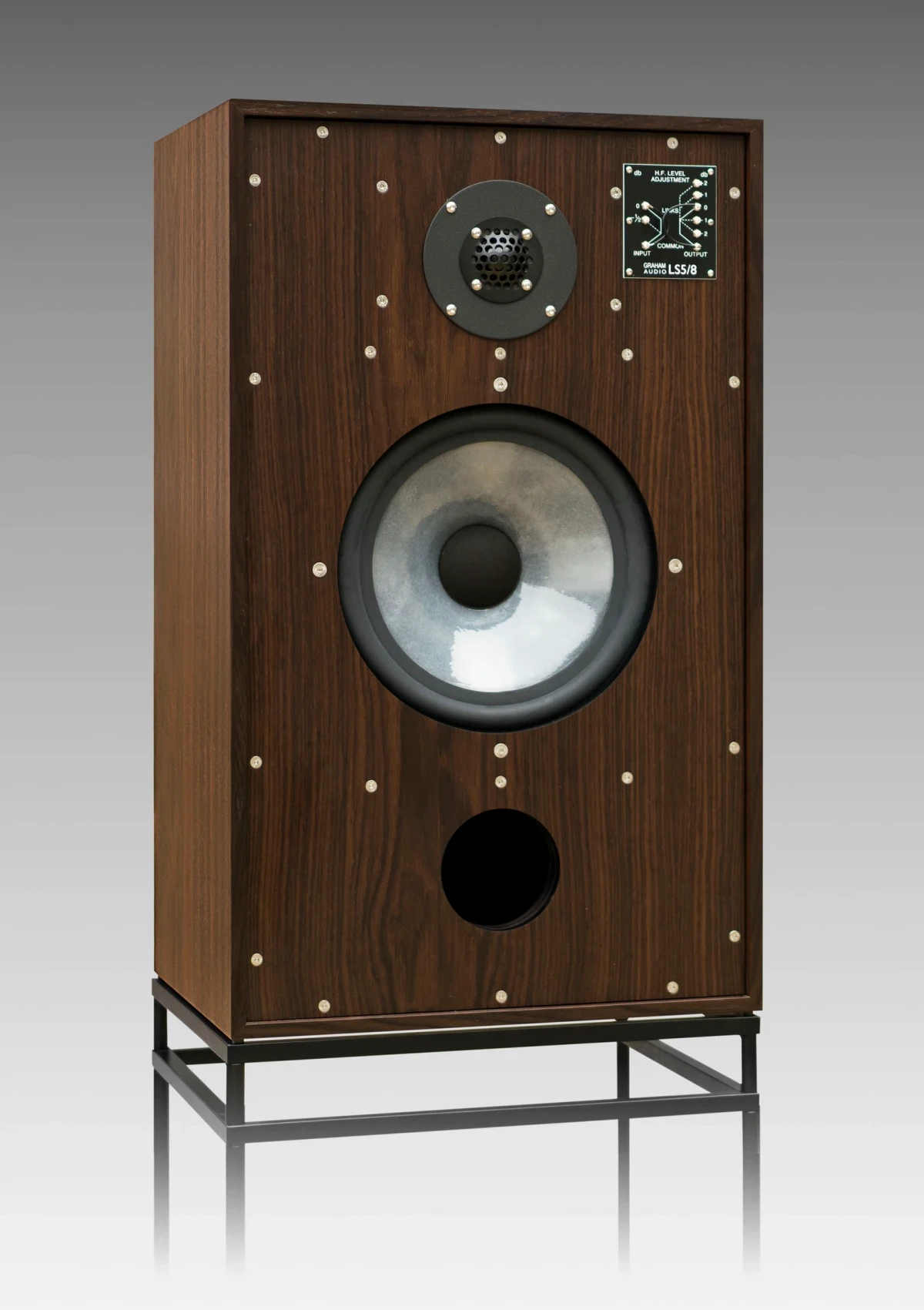
The Graham LS5/8 is the licensed BBC stand-mount that followed when studios needed higher playback levels than the LS5/5 was built for.
Key specs that matter
A 300 mm long-throw bass unit, a 200 mm midrange and a 25 mm soft-dome tweeter share a reflex-loaded cabinet, with crossover points at 400 Hz and 3.5 kHz. Response is 40 Hz to 20 kHz within 2 dB, sensitivity is 88 dB SPL for 2.83 V at 1 m and nominal impedance is 8 ohm. A pair reaches more than 104 dB at 2 m. The cabinet measures 70 cm high, 36 cm wide and 48 cm deep, and each speaker weighs 35.5 kg. Gold-plated terminals are fitted, and veneers include cherry, oak, walnut and ebony.
Engineering and use context
The 1967 original carried its own 25 W amplifier, while the Graham version is passive. Better magnets, drive units, adhesives and crossover parts raise power handling by 10 dB, a tenfold increase over the BBC unit. The most visible feature is the slotted front panel. Two slots partly cover the bass and midrange cones, leaving the tweeter open, and this makes each cone behave like a smaller diaphragm, so it stays wide in dispersion up to a higher frequency. Graham explains the reasoning with the midrange handover, where an 8 inch cone already narrows at 2 kHz while the 1 inch dome still radiates widely at 4 kHz, leaving a dip in off-axis energy without the slots. The result is a smoother power response and coverage of roughly 60 degrees either side of the axis. Slot width, baffle spacing and remaining timber thickness were set by measurement to avoid resonances behind the panel. Construction is of the BBC thin-wall type, with walls allowed to flex at low frequencies and extra bracing at edges and corners.
Pairing
Given its middling efficiency and even load the LS5/5 wants solid-state or strong valve amplification, and Graham lists 50 to 200 W of unclipped programme power. The dedicated stands keep the heavy cabinet at the intended height.
Alternatives
The Graham LS5/8 is the licensed BBC stand-mount that followed when studios needed higher playback levels than the LS5/5 was built for.
Specifications
Model name
LS5/5
Frequency Response low +/- 3dB (Hz)
40
Frequency Response high +/- 3dB (Hz)
20 000
Sensitivity (dB at 1 W/1m)
88
Impedance (Ohms)
8
Power amplifier requirements (W)
50 - 250
Has internal amplification
N/A
Internal amplification power (W)
N/A
Size (sm)
36 × 65 × 48
Weight (kg)
35.5
Official link
More components
Bookshelf Speakers
Graham Audio LS8/1
Bookshelf Speakers
Graham Audio LS5/8S
Bookshelf Speakers
Graham Audio BBC Licensed LS5/9
Bookshelf Speakers
Graham Audio BBC Licensed LS5/8