
All

Bookshelf Speakers — Epos ES-7N
Description, images, technical data and specifications
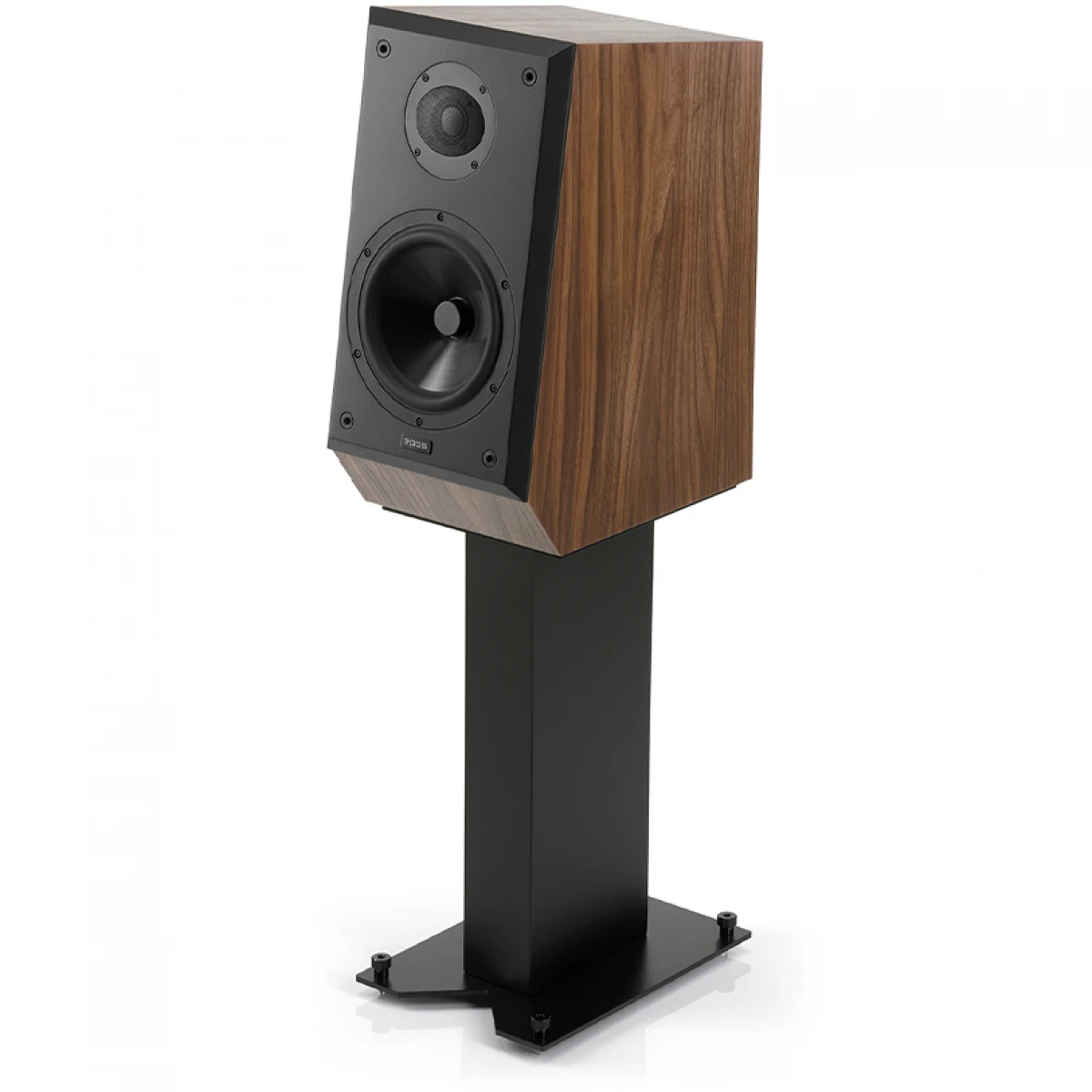
Epos ES-7N
Image source — © Epos
The ES-7N is the smaller of the stand-mount loudspeakers in the current Epos range, a two-way bass reflex design in a compact cabinet. Epos describes it as the second model of a planned three-speaker range. It shares its tweeter with the larger ES-14N and is offered in four finishes - orange, white and black semi-matte paint or walnut veneer. As with every model in this series, it has no built-in amplification and needs a separate one.
Key specs that matter
A 130 mm woofer with a mica-filled polypropylene cone covers the bass and midrange, while a 28 mm aluminium dome tweeter with a ceramic coating handles the treble. The crossover point is 2,000 Hz, and the quoted frequency range runs from 48 Hz to 28,000 Hz. Measured at 2.83 V, sensitivity is 86 dB or 89 dB at 1 m, depending on the position of a rear switch. Nominal impedance is 4 ohm, with a minimum of 3 ohm at 15 kHz and low phase shift. The cabinet is 290 mm tall, 200 mm wide and 270 mm deep, and each speaker weighs 7.6 kg.
Engineering and use context
Injection moulding forms the woofer cone and it is driven by a 30 mm voice coil on a former of glass fibre and epoxy. The motor carries an impedance control ring to reduce distortion and intermodulation. A low-hysteresis rubber surround and a Nomex spider rated for high temperatures keep the suspension linear at larger excursions. Epos leaves ferrofluid out of the tweeter, which uses a ferrite magnet, so that its behaviour stays stable as temperature changes. The crossover uses polypropylene, polyester and low-loss electrolytic capacitors, mostly air-core inductors and custom non-inductive resistors. Its rear two-position switch adapts the filter either to semi-free-space placement or to use near a wall or on a shelf. Cabinet walls are built from two layers of 8 mm MDF with a high-loss damping layer between them, while the front baffle is doubled with chamfered edges and the top plate is a damped double layer. One internal brace controls panel resonance. The reflex port is bent and has selectively damped ventilation holes. The bass roll-off is tailored to stay flat rather than rising into a boom. Silicone rubber spikes come in the box, and four threaded inserts take 4 mm screws.
Pairing
The impedance minimum in the treble sits under the nominal rating, so a partnering amplifier needs to remain stable driving low loads.
Alternatives
The Epos ES-14N is the bigger two-way stand-mount in this Epos series.
Key specs that matter
A 130 mm woofer with a mica-filled polypropylene cone covers the bass and midrange, while a 28 mm aluminium dome tweeter with a ceramic coating handles the treble. The crossover point is 2,000 Hz, and the quoted frequency range runs from 48 Hz to 28,000 Hz. Measured at 2.83 V, sensitivity is 86 dB or 89 dB at 1 m, depending on the position of a rear switch. Nominal impedance is 4 ohm, with a minimum of 3 ohm at 15 kHz and low phase shift. The cabinet is 290 mm tall, 200 mm wide and 270 mm deep, and each speaker weighs 7.6 kg.
Engineering and use context
Injection moulding forms the woofer cone and it is driven by a 30 mm voice coil on a former of glass fibre and epoxy. The motor carries an impedance control ring to reduce distortion and intermodulation. A low-hysteresis rubber surround and a Nomex spider rated for high temperatures keep the suspension linear at larger excursions. Epos leaves ferrofluid out of the tweeter, which uses a ferrite magnet, so that its behaviour stays stable as temperature changes. The crossover uses polypropylene, polyester and low-loss electrolytic capacitors, mostly air-core inductors and custom non-inductive resistors. Its rear two-position switch adapts the filter either to semi-free-space placement or to use near a wall or on a shelf. Cabinet walls are built from two layers of 8 mm MDF with a high-loss damping layer between them, while the front baffle is doubled with chamfered edges and the top plate is a damped double layer. One internal brace controls panel resonance. The reflex port is bent and has selectively damped ventilation holes. The bass roll-off is tailored to stay flat rather than rising into a boom. Silicone rubber spikes come in the box, and four threaded inserts take 4 mm screws.
Pairing
The impedance minimum in the treble sits under the nominal rating, so a partnering amplifier needs to remain stable driving low loads.
Alternatives
The Epos ES-14N is the bigger two-way stand-mount in this Epos series.
Specifications
Model name
ES-7N
Frequency Response low +/- 3dB (Hz)
N/A
Frequency Response high +/- 3dB (Hz)
N/A
Sensitivity (dB at 1 W/1m)
86
Impedance (Ohms)
4
Power amplifier requirements (W)
N/A
Has internal amplification
N/A
Internal amplification power (W)
N/A
Size (sm)
29.0 x 20.0 x 27.0
Weight (kg)
7.6
Official link
More components
Bookshelf Speakers
Epos ES-14N