
All

Bookshelf Speakers — Epos ES-14N
Description, images, technical data and specifications
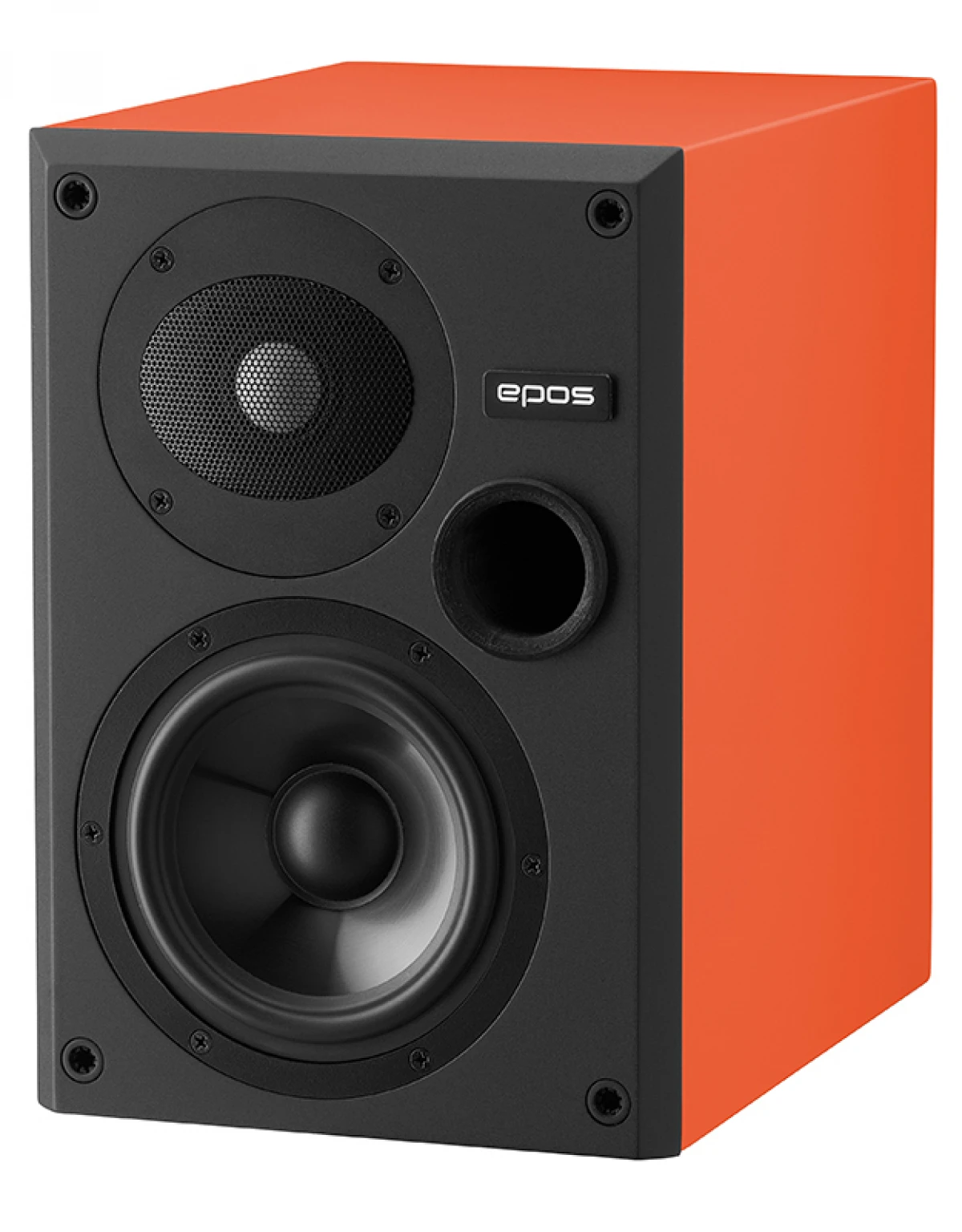
Epos ES-14N
Image source — © Epos
The ES-14N is a reworked version of the classic Epos ES14, a brand founded by Robin Marshall in 1983 and taken over around 2020 by Karl-Heinz Fink, whose FinkTeam now builds it. This two-way model sits between the smaller ES-7N and the larger ES-28N in the current range. It pairs a 7 inch bass unit with a 28 mm tweeter in a reflex cabinet, and at 16 kg without a stand it is a substantial box for its category. The European price was about EUR 4,000 per pair, or EUR 4,600 with the matching stands. Cabinet volume is essentially unchanged from the original ES14, which used a metal dome tweeter, a polypropylene mid-bass cone and a minimal crossover of just a capacitor and a resistor.
Key specs that matter
Epos rates the frequency response at 40 Hz to 23 kHz at the minus 6 dB points and 33 Hz to 25 kHz at minus 10 dB. Sensitivity is 87 dB at 2.83 V and 1 m. Average impedance stays above 6 ohm, with a minimum of 4.3 ohm at 160 Hz. Distortion is quoted at 0.2 percent THD at 1 W. The cabinet measures 491 mm high, 250 mm wide and 385 mm deep, and it comes in walnut, white semi-matte or black semi-matte.
Engineering and use context
Behind the bass cone sit a 35 mm voice coil, a hybrid ferrite and neodymium magnet and an injection-moulded polypropylene cone of variable thickness with mica filling, held by a low-hysteresis rubber surround. The tweeter has an aluminium dome with a ceramic compound coating for stiffness, a voice coil matching the dome size and no ferrofluid, and it sits in its own isolated cavity inside the box. The enclosure is built from double-layer MDF bonded with damping glue into sandwich panels, with one-dimensional braces to control panel vibration. The front baffle is tilted to time-align the two drivers, and a 45 degree chamfer on the front plate reduces diffraction. A low-noise port exits at the rear, its internal opening covered with soft material, and the reflex system follows a flat fourth-order alignment tuned to 38 Hz. The crossover hands over at 2,700 Hz as a fourth-order acoustic Linkwitz-Riley type and relies on film capacitors and air-core coils where they matter most, baffle step compensation for the woofer and a notch filter aimed at the tweeter resonance near 30 kHz.
Pairing
Given the upper-bass dip, the partnering amplifier should cope comfortably with a load of roughly 4 ohm. Connection is through German-made 4 mm banana sockets with low metal mass. Epos offers a matching optional stand at a recommended height of 515 mm, built with a four-layer glued wooden core, twin steel plates with a bitumen layer and adjustable spikes, and notes that 55 cm stands from other makers are also compatible.
Alternatives
For a more compact stand-mount design from the same Epos range, the ES-7N is the option below it.
Key specs that matter
Epos rates the frequency response at 40 Hz to 23 kHz at the minus 6 dB points and 33 Hz to 25 kHz at minus 10 dB. Sensitivity is 87 dB at 2.83 V and 1 m. Average impedance stays above 6 ohm, with a minimum of 4.3 ohm at 160 Hz. Distortion is quoted at 0.2 percent THD at 1 W. The cabinet measures 491 mm high, 250 mm wide and 385 mm deep, and it comes in walnut, white semi-matte or black semi-matte.
Engineering and use context
Behind the bass cone sit a 35 mm voice coil, a hybrid ferrite and neodymium magnet and an injection-moulded polypropylene cone of variable thickness with mica filling, held by a low-hysteresis rubber surround. The tweeter has an aluminium dome with a ceramic compound coating for stiffness, a voice coil matching the dome size and no ferrofluid, and it sits in its own isolated cavity inside the box. The enclosure is built from double-layer MDF bonded with damping glue into sandwich panels, with one-dimensional braces to control panel vibration. The front baffle is tilted to time-align the two drivers, and a 45 degree chamfer on the front plate reduces diffraction. A low-noise port exits at the rear, its internal opening covered with soft material, and the reflex system follows a flat fourth-order alignment tuned to 38 Hz. The crossover hands over at 2,700 Hz as a fourth-order acoustic Linkwitz-Riley type and relies on film capacitors and air-core coils where they matter most, baffle step compensation for the woofer and a notch filter aimed at the tweeter resonance near 30 kHz.
Pairing
Given the upper-bass dip, the partnering amplifier should cope comfortably with a load of roughly 4 ohm. Connection is through German-made 4 mm banana sockets with low metal mass. Epos offers a matching optional stand at a recommended height of 515 mm, built with a four-layer glued wooden core, twin steel plates with a bitumen layer and adjustable spikes, and notes that 55 cm stands from other makers are also compatible.
Alternatives
For a more compact stand-mount design from the same Epos range, the ES-7N is the option below it.
Specifications
Model name
ES-14N
Frequency Response low +/- 3dB (Hz)
40
Frequency Response high +/- 3dB (Hz)
23 000
Sensitivity (dB at 1 W/1m)
87
Impedance (Ohms)
6
Power amplifier requirements (W)
N/A
Has internal amplification
N/A
Internal amplification power (W)
N/A
Size (sm)
49.1 x 25.0 x 38.5
Weight (kg)
16
Official link
More components
Bookshelf Speakers
Epos ES-7N