
All

Power amplifiers mono — VTL Siegfried Series II Reference
Description, images, technical data and specifications
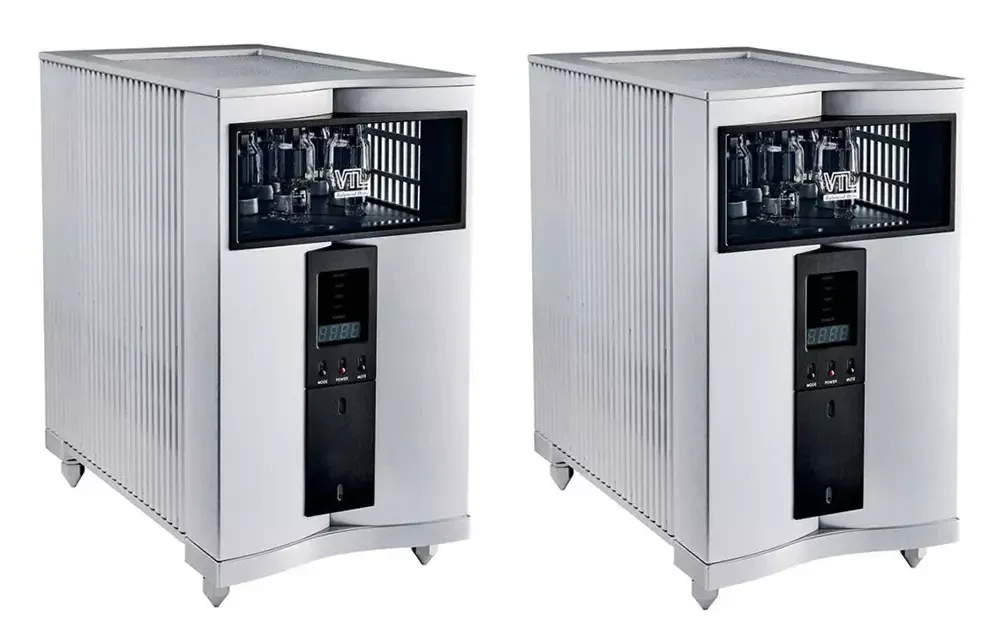
VTL Siegfried Series II Reference
Image source — © VTL
The Siegfried Series II Reference is the Reference-line valve monoblock of VTL, the California company led by Luke Manley. The original Siegfried appeared around 2000 as part of VTL's Reference line and was among the first valve amplifiers with true automatic bias and fault sensing. The Series II, introduced in late 2011, reworked the complete signal path while keeping the platform's power output and tube complement.
Key specs that matter
Output is 650 W in tetrode mode and 330 W in triode mode into 5 ohms, from 20 Hz to 20 kHz at below 2.5% THD. The optimum load range is 4 to 8 ohms. Input sensitivity varies between 1 and 2 V depending on the damping factor setting, and input impedance is 45 kohm. Signal-to-noise is -110 dB. The tube complement per monoblock is twelve 6550 or KT88 output tubes, one 12AT7 and two 12BH7. Power consumption is 600 W at idle and 1500 W at full power. Each chassis measures 292 x 610 x 610 mm in width, depth and height, and each monoblock weighs 90 kg unpacked.
Engineering and use context
The Series II uses a fully balanced differential circuit from input to output, so a single-ended input signal is converted to balanced internally. A differential input stage drives a differential phase splitter and a lower-impedance push-pull output stage with twelve paralleled output tubes. The proprietary output transformer was redesigned with more interleaving and tighter coupling for wider bandwidth. There is zero global negative feedback, and a short, fast local feedback loop needs no capacitor compensation, keeping the amplifier stable with difficult loads. A user-adjustable damping factor control varies output impedance in four steps. A microprocessor ramps up the plate voltage gradually at start-up, sets the bias of each output tube automatically, detects failing tubes and monitors the mains, power supply current and regulator temperature. Switching between tetrode and triode takes a few minutes and is counted down on the display. The precision-regulated power supply occupies much of the chassis, which is built from extruded anodised aluminium.
Pairing
The power reserve and wide optimum load range make the Siegfried II a match for large, low-sensitivity speakers in big rooms. Each monoblock needs its own mains outlet and floor-level ventilation because of its high idle draw.
Alternatives
VTL's MB-450 Series II Signature is the smaller monoblock that inherits auto-bias and fault sensing from the Siegfried platform.
Key specs that matter
Output is 650 W in tetrode mode and 330 W in triode mode into 5 ohms, from 20 Hz to 20 kHz at below 2.5% THD. The optimum load range is 4 to 8 ohms. Input sensitivity varies between 1 and 2 V depending on the damping factor setting, and input impedance is 45 kohm. Signal-to-noise is -110 dB. The tube complement per monoblock is twelve 6550 or KT88 output tubes, one 12AT7 and two 12BH7. Power consumption is 600 W at idle and 1500 W at full power. Each chassis measures 292 x 610 x 610 mm in width, depth and height, and each monoblock weighs 90 kg unpacked.
Engineering and use context
The Series II uses a fully balanced differential circuit from input to output, so a single-ended input signal is converted to balanced internally. A differential input stage drives a differential phase splitter and a lower-impedance push-pull output stage with twelve paralleled output tubes. The proprietary output transformer was redesigned with more interleaving and tighter coupling for wider bandwidth. There is zero global negative feedback, and a short, fast local feedback loop needs no capacitor compensation, keeping the amplifier stable with difficult loads. A user-adjustable damping factor control varies output impedance in four steps. A microprocessor ramps up the plate voltage gradually at start-up, sets the bias of each output tube automatically, detects failing tubes and monitors the mains, power supply current and regulator temperature. Switching between tetrode and triode takes a few minutes and is counted down on the display. The precision-regulated power supply occupies much of the chassis, which is built from extruded anodised aluminium.
Pairing
The power reserve and wide optimum load range make the Siegfried II a match for large, low-sensitivity speakers in big rooms. Each monoblock needs its own mains outlet and floor-level ventilation because of its high idle draw.
Alternatives
VTL's MB-450 Series II Signature is the smaller monoblock that inherits auto-bias and fault sensing from the Siegfried platform.
Specifications
Model name
Siegfried Series II Reference
Input sensitivity (mV)
1000 - 2000
Input impedance (balanced) (Ω)
45 000
Input impedance (single-ended) (Ω)
45 000
Output impedance (balanced) (Ω)
N/A
Output impedance (single-ended) (Ω)
N/A
Max current (A)
N/A
Output power (8Ω) (W)
Tetrode: 650, Triode: 330
Output power (4Ω) (W)
N/A
Gain (dBu)
N/A
Frequency response low +/- 3dB (Hz)
20
Frequency response high +/- 3dB (Hz)
20 000
Signal to Noise Ratio (dB)
110
Total Harmonic Distortion + Noise (0% global feedback) (%)
N/A
Total Harmonic Distortion + Noise (100% global feedback) (%)
N/A
Max power consumption (W)
1500
Damping factor
N/A
Dimensions (mm)
292 x 610 x 610
Weight (kg)
147
Official link
More components
Power amplifiers mono
VTL Lohengrin Reference

Power amplifiers mono
VTL MB-450 Series III Signature
Power amplifiers mono
VTL MB-185 Series III Signature

Power amplifiers mono
VTL MB-125