

R2R vs Delta-Sigma - a Complete Comparison of DAC Conversion Architectures
Choosing the best technology in 2026

26.09.2026 17:17 | ~5 minutes read
Plenty of lances have been broken over digital-to-analogue conversion - devotees of the R2R ladder point to a fluid, analogue sound, while advocates of delta-sigma chips talk about accuracy and dynamics. In this guide we work through every technical nuance of the modern architectures that convert a digital signal into an analogue one.
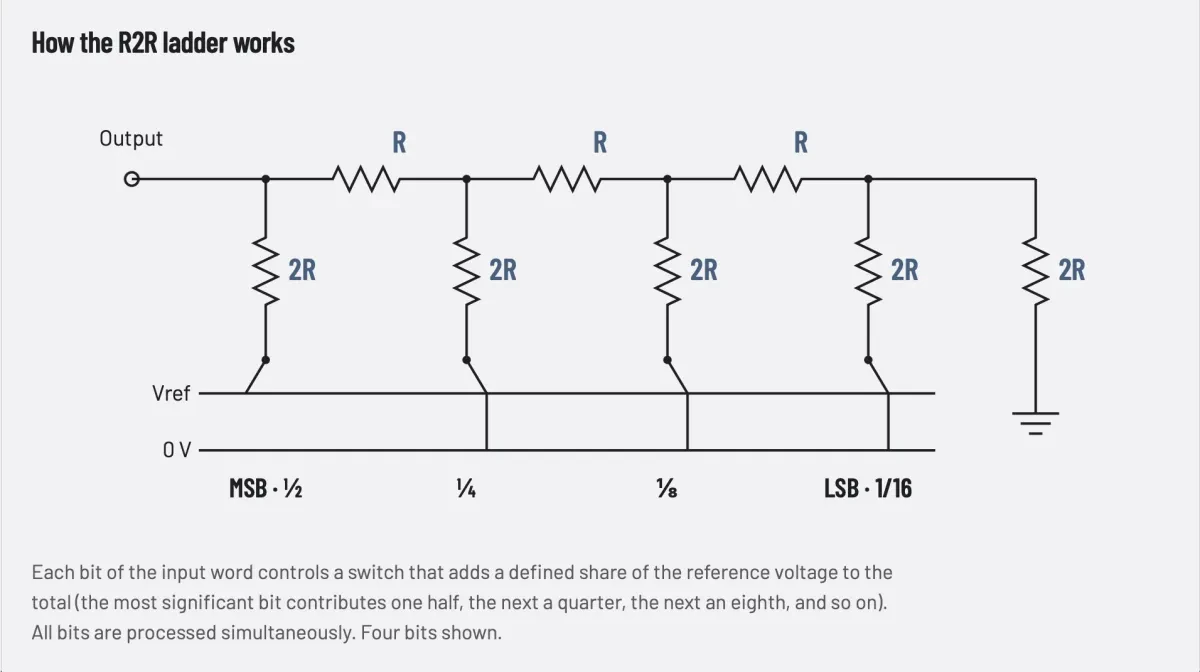
How the R2R ladder works
R2R, or the ladder network, is the “direct” method of digital-to-analogue conversion. A network of resistors of two values, differing by exactly a factor of two, is arranged so that each bit of the input word controls a switch that adds a defined share of the reference voltage to the total (the most significant bit contributes one half, the next a quarter, the next an eighth, and so on). The signal appears at the output immediately, with no intermediate conversion. Hence its other name - the multibit design DAC, since all bits are processed simultaneously.
The limits of accuracy
How correctly an R2R matrix works is determined by the accuracy of its resistors. For the contribution of the most significant bit not to swamp that of the least significant, the value of the most significant resistor must be held to better than one divided by two to the power of N, where N is the bit depth.
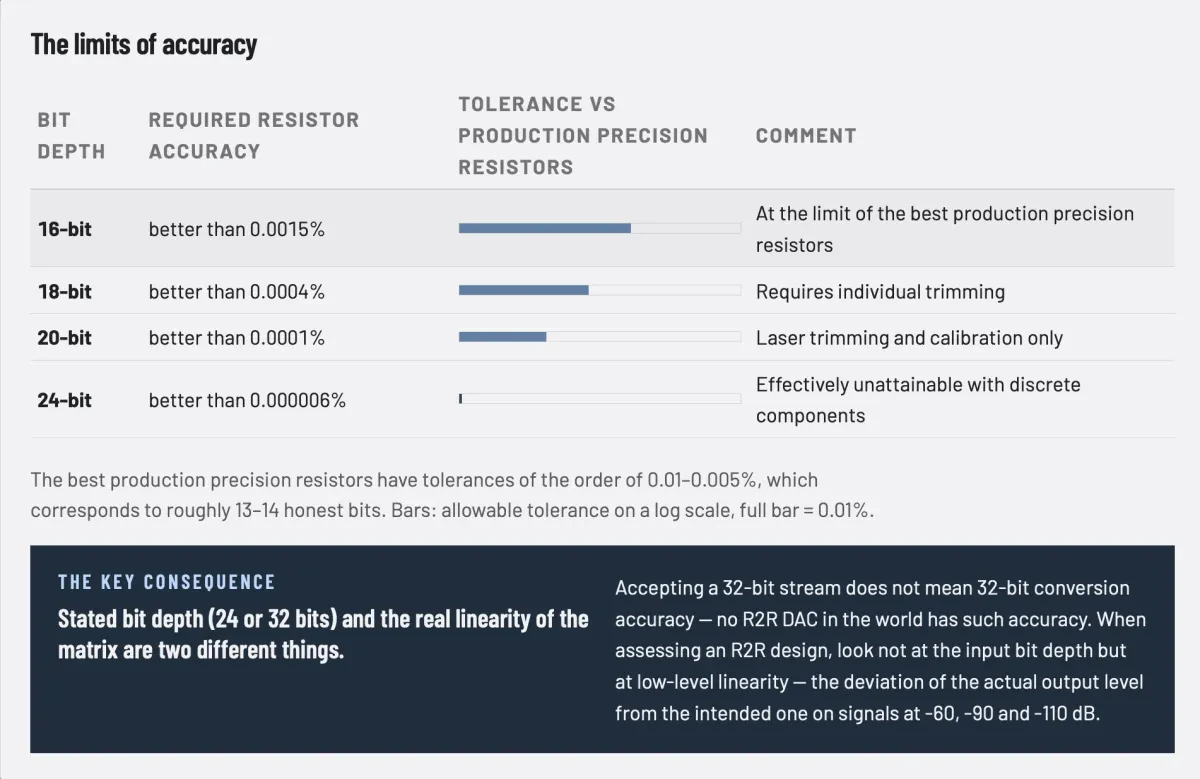
The best production precision resistors have tolerances of the order of 0.01–0.005%, which corresponds to roughly 13–14 honest bits. Anything beyond that is achieved by individual selection, laser trimming, or calibration of the matrix with compensation for deviations.
Temperature and time-related problems
Because resistors have a temperature coefficient of resistance, their values drift as the unit warms up and the factory calibration ceases to be accurate. Hence two design measures characteristic of High-End R2R units - temperature stabilisation of the reference and periodic self-calibration of the matrix. Resistors also drift over the long term, which is why units of this type sometimes need recalibrating after years of use.
How does delta-sigma conversion work?
Delta-sigma solves the problem in a fundamentally different way from R2R. Instead of striving for high accuracy in amplitude, the architecture trades bit depth for speed. The signal is oversampled many times over, typically by a factor of 64 or 128, and is then quantised to a small number of levels - in the limiting case, to a single bit. Such coarse quantisation generates considerable quantisation noise, but this is where the key mechanism comes in - noise shaping. The modulator’s feedback loop is arranged so that the quantisation noise is pushed out of the audio band into the high frequencies, where it is removed by the analogue filter at the output.
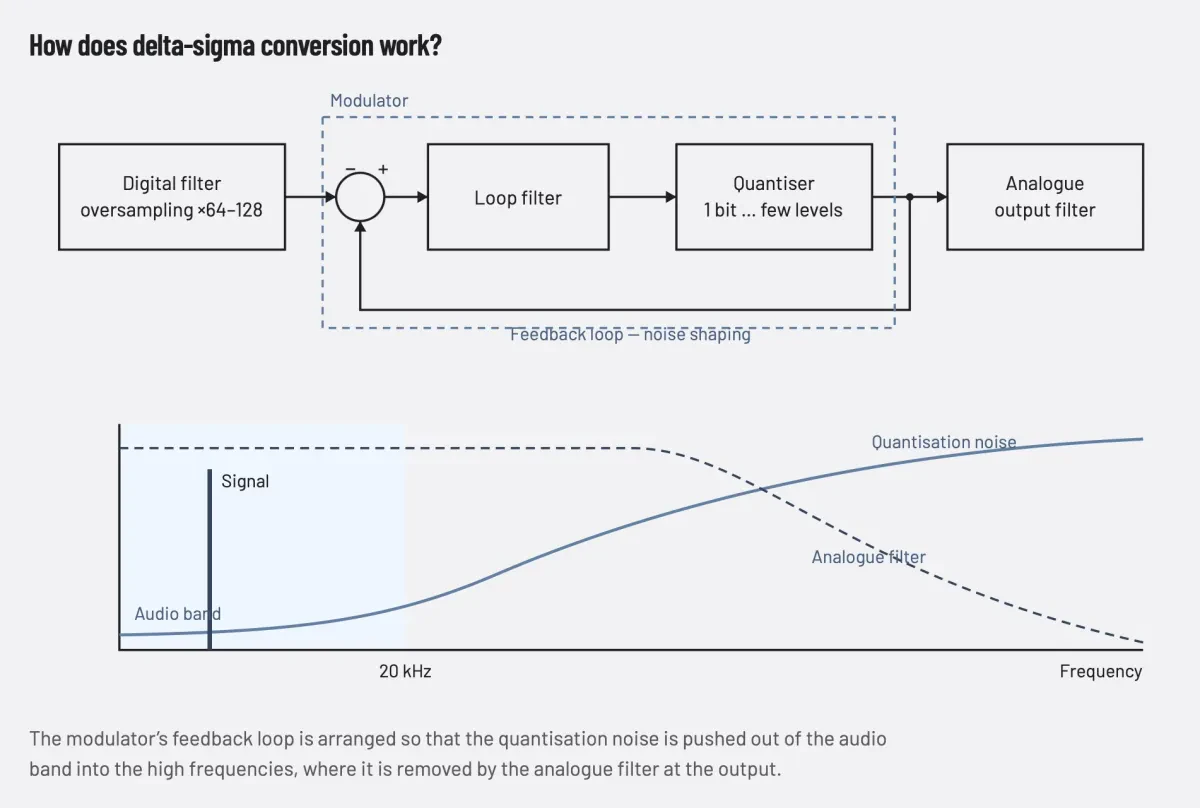
The result is an extremely low noise level and very high linearity within the band up to 20 kHz, because the linearity of a one-bit or few-bit quantiser is trivially assured - this chip has no resistors whose values could drift.
Nuances
Ultrasonic noise. The displaced energy does not disappear; it sits above 20 kHz. With insufficient filtering it can load the DAC’s output stage.
Idle tones. On a constant or very quiet input signal, the modulator is prone to forming periodic patterns that produce discrete components in the spectrum. Modern designs counter this by adding dither and increasing the order of the modulator.
Dependence on the digital filter. Oversampling requires a digital filter, and its characteristics become part of the device’s sound. Hence the switchable filters on most modern units.
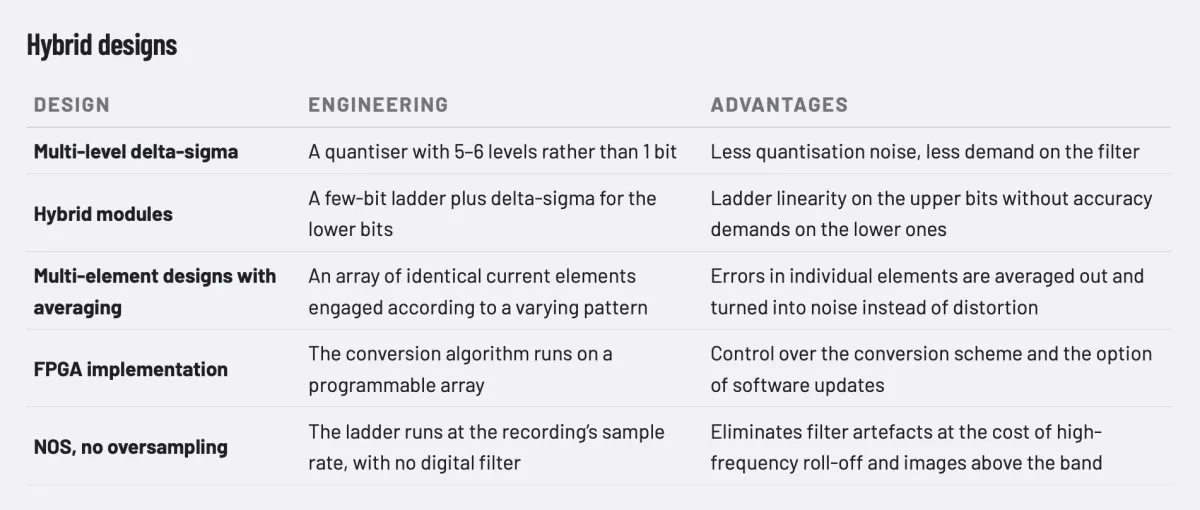
Hybrid designs
Today a significant proportion of top-tier DACs use not just the two schemes described above, but hybrid designs.
The digital filter is exceptionally important
Since it is the filter that determines the system’s behaviour in the time domain, its influence can be comparable to that of the conversion scheme itself.
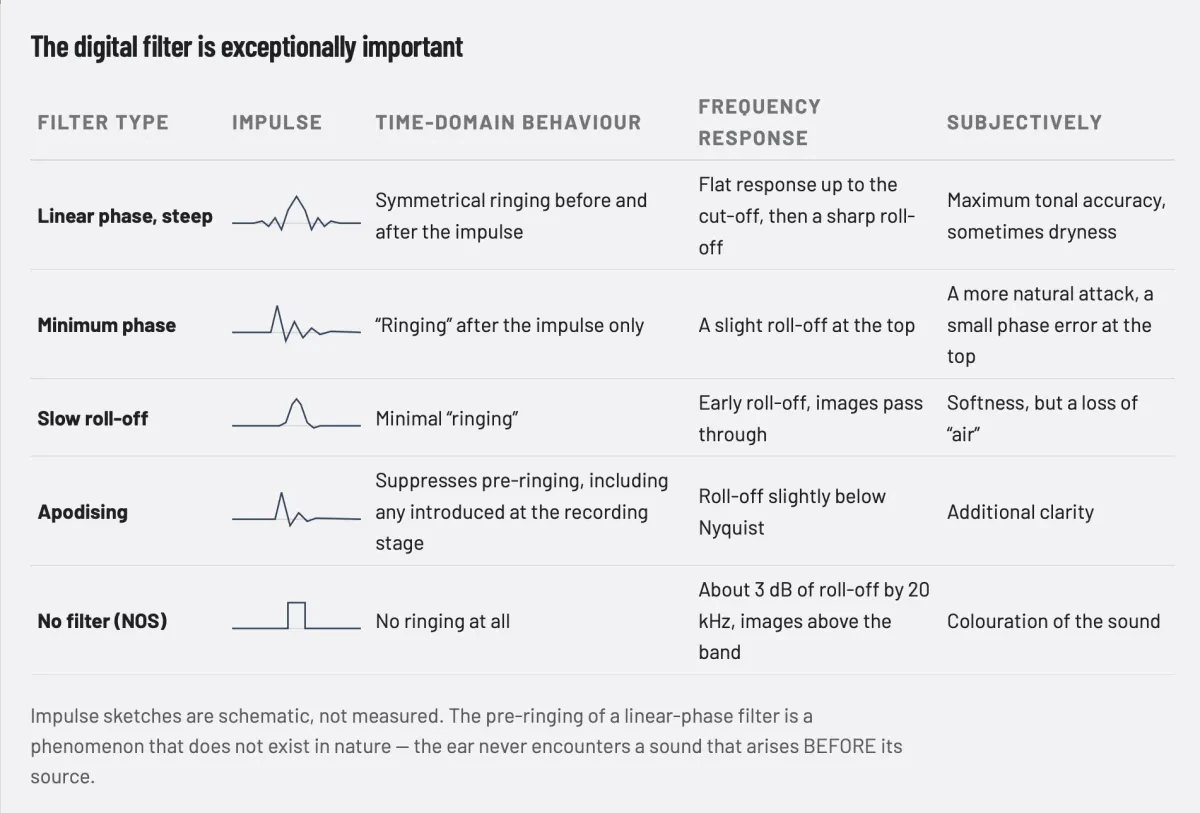
The pre-ringing of a linear-phase filter is a phenomenon that does not exist in nature - the ear never encounters a sound that arises BEFORE its source. This accounts for a large share of the complaints levelled at digital audio. The counter-argument is that the amplitude of pre-ringing is extremely low and concentrated at the very edge of the audible band.
Which parameters are measurable?
On most parameters, delta-sigma conversion delivers far better specifications. R2R has a structural advantage in one respect only - the absence of idle tones.
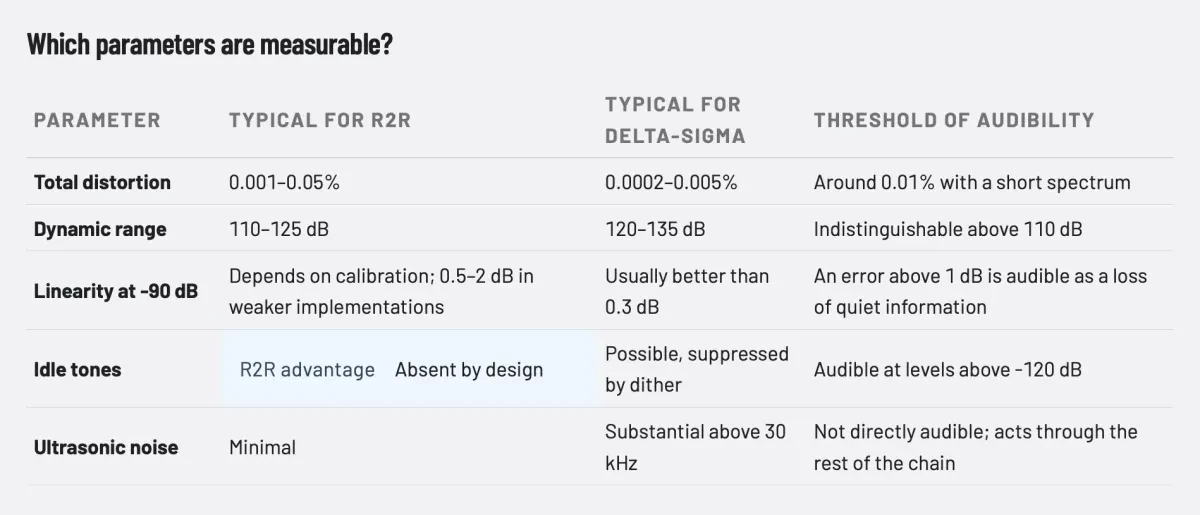
And yet, in live listening, a considerable share of audiophiles prefer R2R DACs. Why?
The character of the errors. Non-linearity errors in a ladder produce a spectrum that falls away as the harmonic order rises. Delta-sigma errors manifest as a modulation of the noise floor that depends on the signal. The ear reads the latter as unnaturalness.
The absence of a digital filter, or a simplified one. Many R2R units run without oversampling, and what is attributed to the architecture is in fact the absence of pre-ringing.
The analogue section and the power supply. Units built on a discrete ladder are almost always more expensive and therefore have a more serious output stage and power supply.
WHAT TO KEEP IN MIND
The spread of quality within each architecture is many times greater than the difference between architectures. A poorly executed R2R design with an uncalibrated ladder sounds worse than a competently built delta-sigma unit costing half as much. And vice versa.
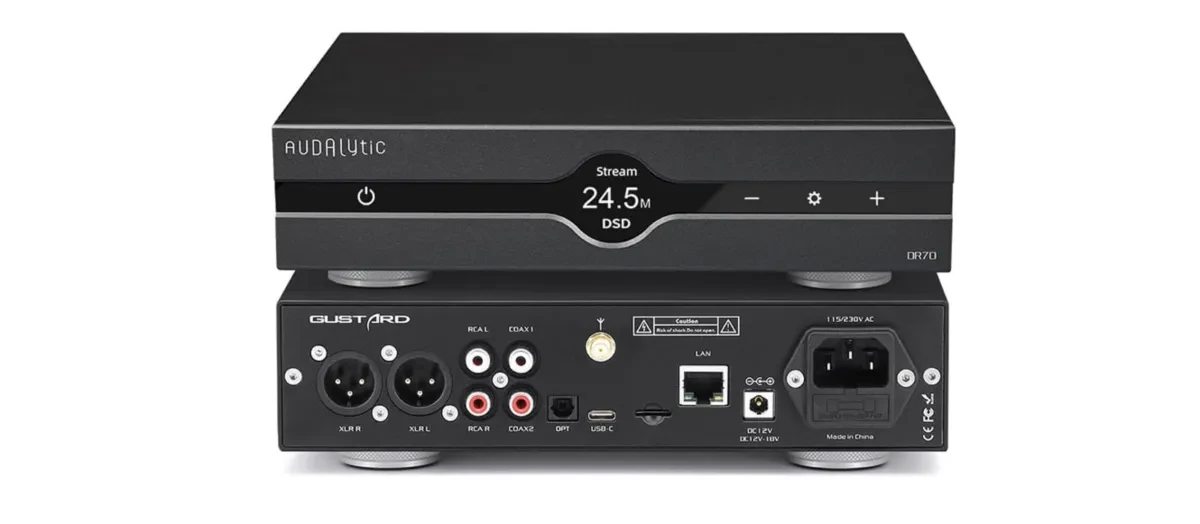
What shapes a DAC’s sonic character?
The analogue output stage. It determines output impedance, behaviour under load and the unit’s own distortion spectrum.
The power supply. Separate rails for the digital and analogue sections, and the quality of regulation.
Clocking. What matters is not so much the absolute jitter figure as its stability and spectral character.
The digital filter. It determines time-domain behaviour and is audible on transients.
The conversion architecture itself. Its contribution is on a par with filtering and the rest.
Which DAC should you choose?
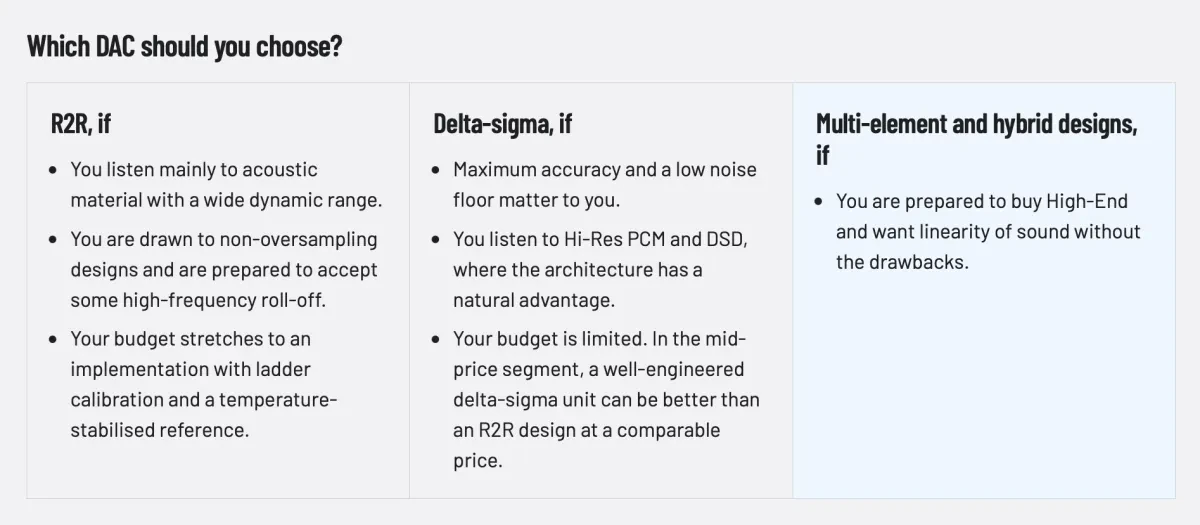
Checklist
Ask manufacturers for linearity data at -60, -90 and -110 dB. This is the single most informative parameter for comparing converters.
Check the output impedance. A figure above 500 Ω may cause problems with some preamplifiers.
Check the stated output level. A level mismatch between units makes direct listening comparison unreliable.
Check whether there is a choice of digital filter.
For an R2R design, check whether ladder self-calibration and reference temperature stabilisation are provided.
Do not compare units by the bit depth of the digital input they accept.
Level-match the sound pressure when comparing. A difference of 0.3 dB will be taken for superior quality.
Make the final decision only after extensive listening.