
All

Headphones amplifiers — ROSESELSA RS9039
Description, images, technical data and specifications
ROSESELSA RS9039
Image source — © ROSESELSA
ROSESELSA builds the RS9039 as a pocket-sized combination of USB converter and headphone amplifier, and the brand was previously known as Rose Technics, a Chinese maker. Launched on 27 May 2024 at a suggested price of USD 79.99, it was the first USB dongle to use the ES9039Q2M converter chip from ESS, the successor to the ES9038Q2M with lower distortion and a higher signal-to-noise ratio. The name of the device comes directly from that chip, and the RS9039 was one of the earliest portable products to carry any ES9039 series converter.
Key specs that matter
Output power is 240 mW from the 3.5 mm single-ended jack and 300 mW from the 4.4 mm balanced jack, both measured at 1 kHz into 32 ohm. At the same 1 kHz and 32 ohm test point, THD+N is 0.0003 percent, while ROSESELSA quotes a 126 dB signal-to-noise figure. The frequency range is given as 20 Hz to 20 kHz within 0.5 dB, and headphones from 16 to 300 ohm are supported. Decoding covers PCM up to 32 bit and 384 kHz and native DSD256. The body measures 48 x 22 x 12 mm and weighs about 14.5 g.
Engineering and use context
The ES9039Q2M uses ESS HyperStream IV architecture but has no headphone amplifier on board, so ROSESELSA pairs it with a separate ESS headphone driver chip to deliver the output power. The housing is machined from aluminium alloy by CNC and given a matte finish. The input is a USB Type-C socket with a detachable cable, so a worn lead can be replaced instead of the whole device. A Type-C cable is supplied as standard, and versions with a Lightning cable are sold for iPhones that use that connector. The basic Type-C version has a regular price of USD 85.99, and package options that add a BRIDGE adapter for Type-C or Lightning sources.
Pairing
Sources include smartphones, tablets and laptops with a USB Type-C port, or Lightning devices with the matching cable. ROSESELSA presents the output power as suited to high-impedance headphones and says its low noise floor means sensitive models should stay free of background hiss. Sensitive in-ear monitors work on the single-ended output, while high-impedance full-size headphones benefit from the extra power of the balanced socket, which needs a headphone cable with a matching plug. Laptops running a music player can also use the dongle as an external converter in place of their built-in headphone socket.
Alternatives
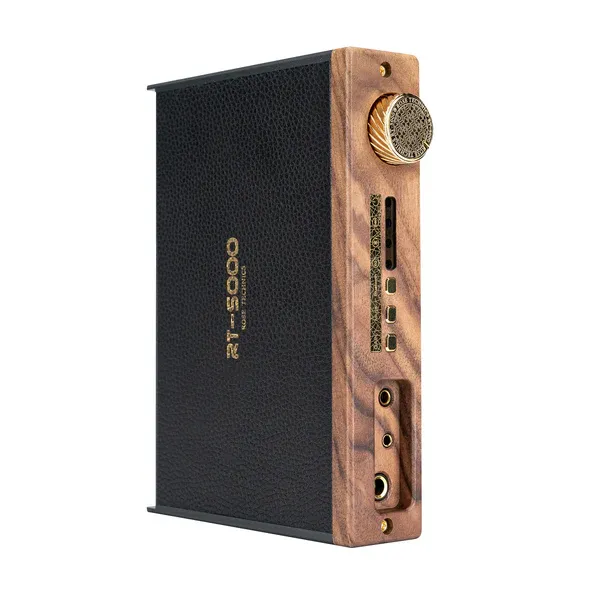
The ROSESELSA RT-5000 is a desktop headphone amplifier with DAC built on dual ES9038PRO chips.
Key specs that matter
Output power is 240 mW from the 3.5 mm single-ended jack and 300 mW from the 4.4 mm balanced jack, both measured at 1 kHz into 32 ohm. At the same 1 kHz and 32 ohm test point, THD+N is 0.0003 percent, while ROSESELSA quotes a 126 dB signal-to-noise figure. The frequency range is given as 20 Hz to 20 kHz within 0.5 dB, and headphones from 16 to 300 ohm are supported. Decoding covers PCM up to 32 bit and 384 kHz and native DSD256. The body measures 48 x 22 x 12 mm and weighs about 14.5 g.
Engineering and use context
The ES9039Q2M uses ESS HyperStream IV architecture but has no headphone amplifier on board, so ROSESELSA pairs it with a separate ESS headphone driver chip to deliver the output power. The housing is machined from aluminium alloy by CNC and given a matte finish. The input is a USB Type-C socket with a detachable cable, so a worn lead can be replaced instead of the whole device. A Type-C cable is supplied as standard, and versions with a Lightning cable are sold for iPhones that use that connector. The basic Type-C version has a regular price of USD 85.99, and package options that add a BRIDGE adapter for Type-C or Lightning sources.
Pairing
Sources include smartphones, tablets and laptops with a USB Type-C port, or Lightning devices with the matching cable. ROSESELSA presents the output power as suited to high-impedance headphones and says its low noise floor means sensitive models should stay free of background hiss. Sensitive in-ear monitors work on the single-ended output, while high-impedance full-size headphones benefit from the extra power of the balanced socket, which needs a headphone cable with a matching plug. Laptops running a music player can also use the dongle as an external converter in place of their built-in headphone socket.
Alternatives
The ROSESELSA RT-5000 is a desktop headphone amplifier with DAC built on dual ES9038PRO chips.
Specifications
Model name
RS9039
Maximum Power, 32 Ohms (mW RMS per channel)
240 (RCA) + 300 (XLR)
Maximum Power, 50 Ohms (mW RMS per channel)
N/A
Maximum Power, 300 Ohms (mW RMS per channel)
N/A
Maximum Power, 600 Ohms (mW RMS per channel)
N/A
Frequency response low +/- 3dB (Hz)
N/A
Frequency response high +/- 3dB (Hz)
N/A
Gain (dBu)
N/A
THD (% at 1V RMS, 300 ohms)
0.0003
Signal to Noise Ratio (dB)
126
IMD (%, CCIR, 300 Ohms)
N/A
Crosstalk (dB, 20Hz-20KHz, 300 Ohms)
N/A
Output Impedance (Ohms)
N/A
Dimensions (mm)
48 x 22 x 12
Weight (kg)
0.0145
Official link
More components
Headphones amplifiers
ROSESELSA RT-5000