Tube vs Solid State Amplifiers - Which Sounds Better in 2026?
Detailed analysis of technologies and their advantages

13.08.2026 16:25 | ~6 min read
The eternal audiophile question: which amplification topology is better, tube or solid-state? The short answer is simple. If your loudspeakers hold a stable impedance no lower than 6 ohms and a sensitivity above 90 dB, a tube amplifier is worth considering. If your speakers show impedance dips below 3 ohms, that approach will only harm the system. Like it or not, tube and solid-state designs differ first of all in their nonlinear distortion spectrum and their output impedance, and every other parameter turns out to be a derivative of those two figures.
Now let us work through the details, but let us set out the axiom of choice straight away. The amplifier is chosen to suit the loudspeakers, not the other way round!
Differences between tube and solid-state amplifiers
Difference one - the harmonic spectrum
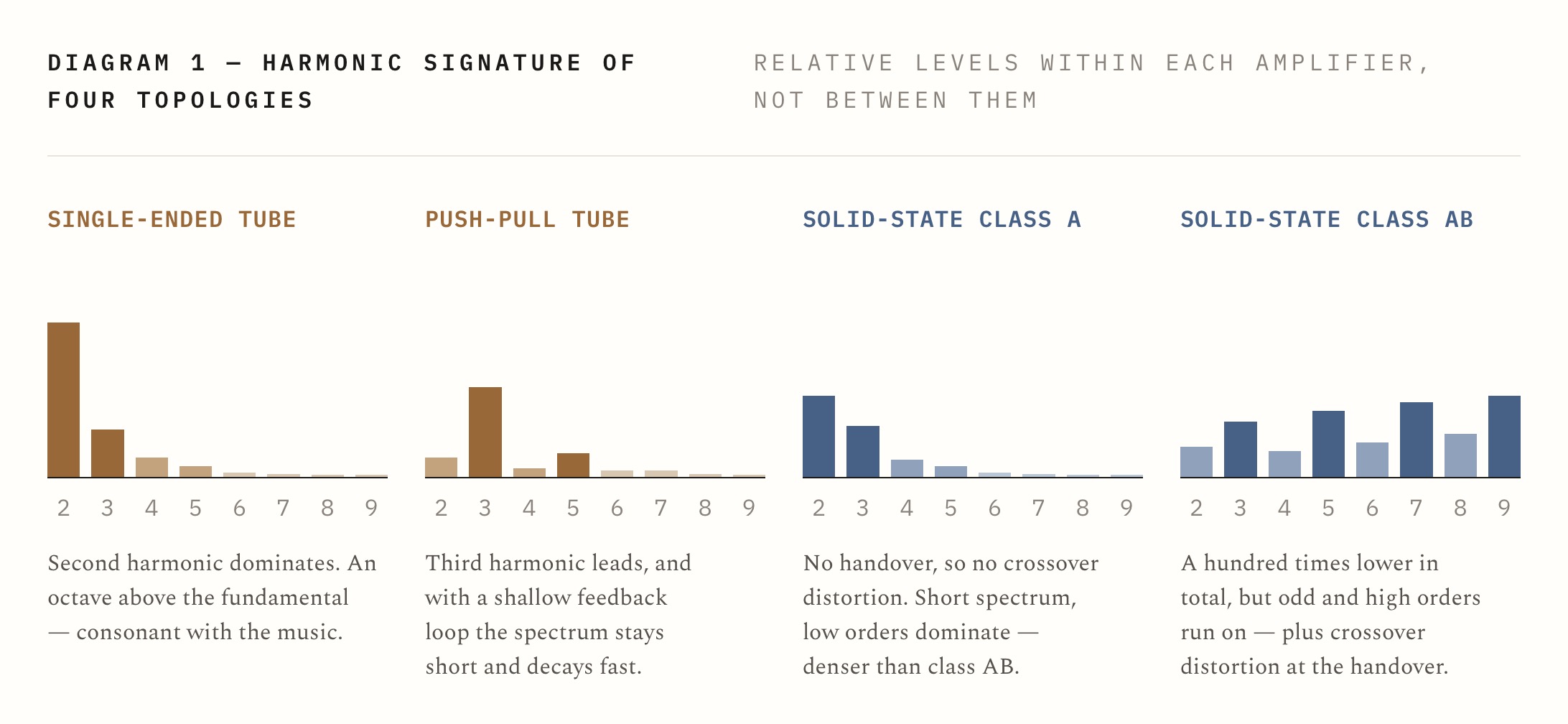
There are no perfect amplifiers on the market and there never will be. Every amplifier alters the original audio signal slightly by adding harmonics. What matters here is not the total figure on the spec sheet, but how many harmonics there are and what order they are.
Single-ended tube amplifier, by virtue of its circuit topology, generates predominantly the second harmonic, at twice the frequency of the fundamental. The second harmonic corresponds to an octave and is heard as an addition precisely consonant with the music: timbres become richer, instruments gain density, the stage seems three-dimensional.
Push-pull tube amplification works differently but stays pleasant to the ear. There is little second harmonic here, but there is third, which with a shallow feedback loop produces a short, fast-decaying spectrum.
Class A solid-state amplifier - output transistors operate continuously; there is no moment of signal handover between the output stage's branches. Distortion - the very mechanism that gives Class AB designs a synthetic sound at low volumes - is absent here. The harmonic spectrum is short and dominated by low-order harmonics, resulting in a sound that is denser than that of Class AB designs. Output impedance is low and the damping factor relatively high; this approach captures some (though not all) of the benefits of tube circuitry while offering superior speaker control - albeit at the cost of low efficiency, high heat dissipation, and a lengthy warm-up period before listening. Power output for such amplifiers in the mid-range segment is modest, while truly powerful units come with a very high price tag.
Class AB solid-state amplifier with deep global negative feedback pushes total distortion down to a minimum. But what remains in the signal is odd-order and high-order harmonics, plus crossover distortion at the moment the signal is handed between the halves of the output stage. The ear reads that small amount of debris in a completely different way, sensing hardness and something synthetic: a metallic edge and aggressive treble. The level of such distortion can be a hundred times lower than in a tube circuit, yet hearing will be far more sensitive to it than to the tube variety.
So we arrive at a rule: THD figures can only be compared between amplifiers of the same topology. Otherwise an amplifier at 0.5% dominated by the second harmonic may sound cleaner and more natural than one at 0.05% sitting on high-order odd harmonics.
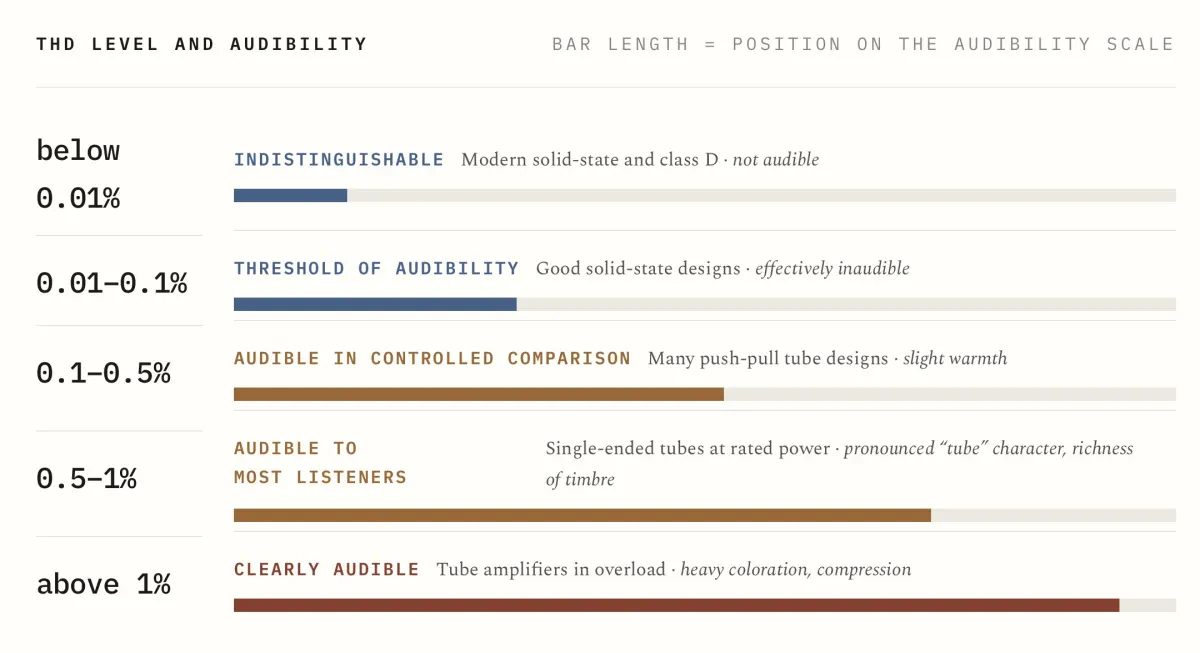
Intermodulation distortion (IMD) deserves a separate mention. Unlike harmonic distortion, intermodulation products are not tied to the fundamental by musical intervals, so even 0.05-0.1% is felt as fatiguing. It is low IMD rather than low THD that gives you the amplifier you can listen to for hours without a hint of fatigue.
Difference two - damping factor
A solid-state amplifier with global feedback has an output impedance in the hundredths of an ohm. A tube amplifier, even with an output transformer and feedback, usually offers between 0.5 and 3 ohms, and a single-ended tube amplifier with zero feedback up to 3-8 ohms. The consequence is the damping factor, which is to say control over the drivers of the loudspeaker.
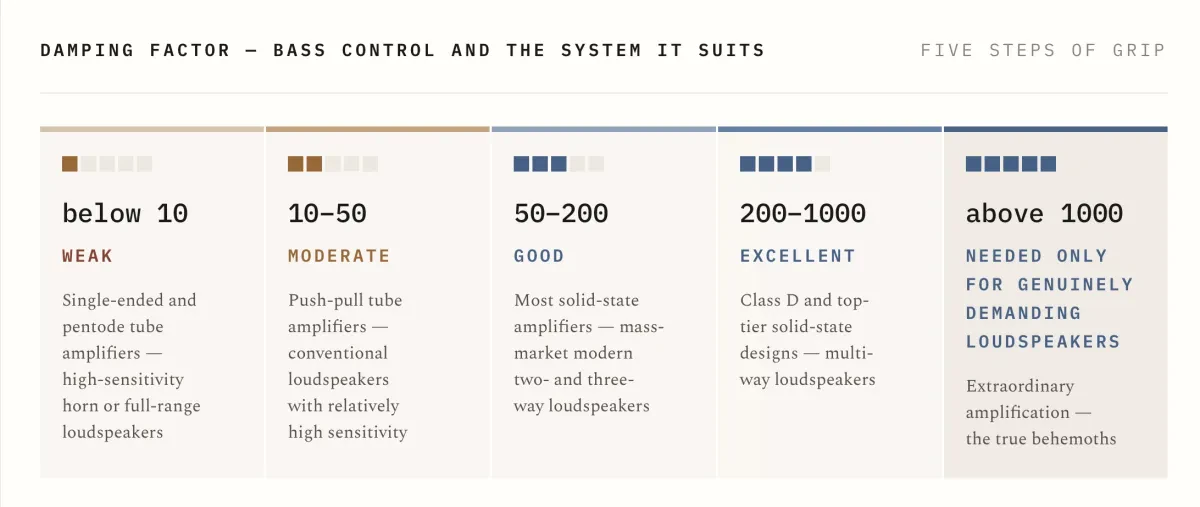
Damping factor means bass control Suitable system
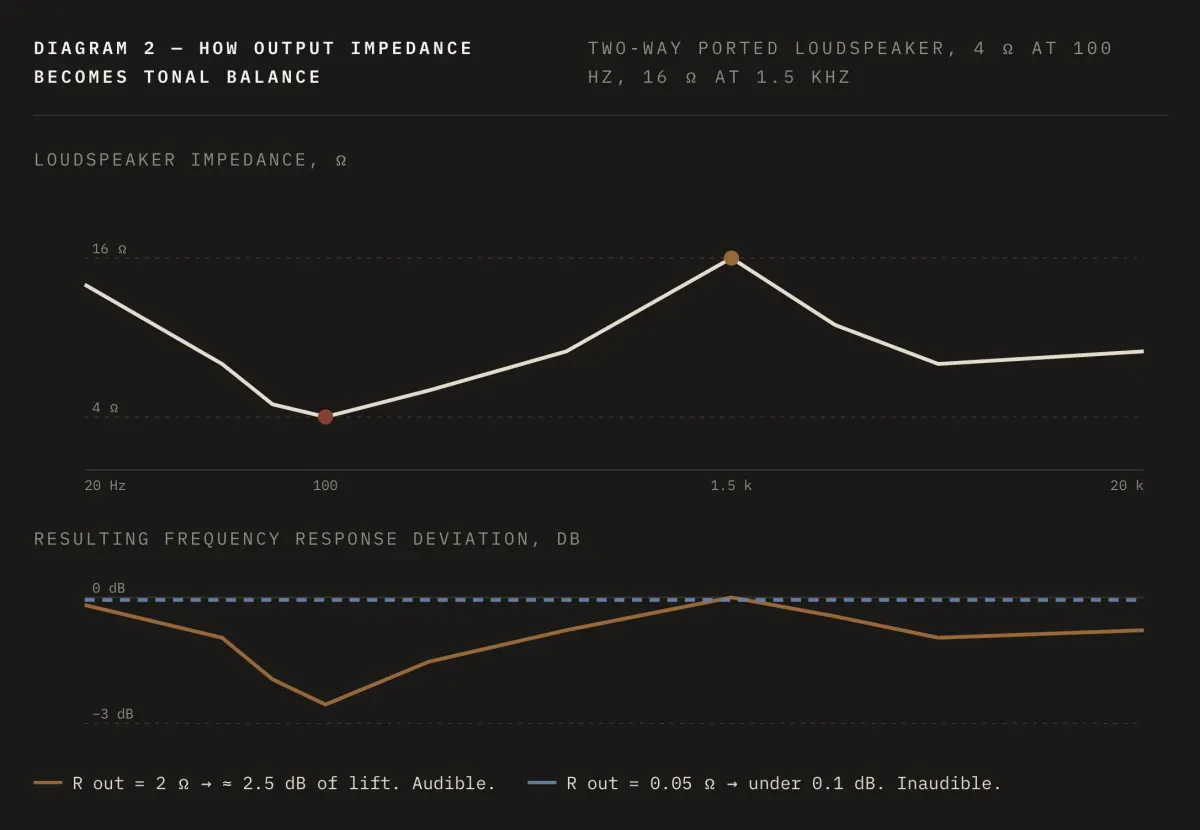
Do not forget either that output impedance turns the loudspeaker's impedance curve into frequency response deviation. An amplifier with an output impedance of 3 ohms, driving speakers whose impedance runs between 3 and 20 ohms (a typical two-way ported system), will produce a frequency response deviation of 2-4 dB.
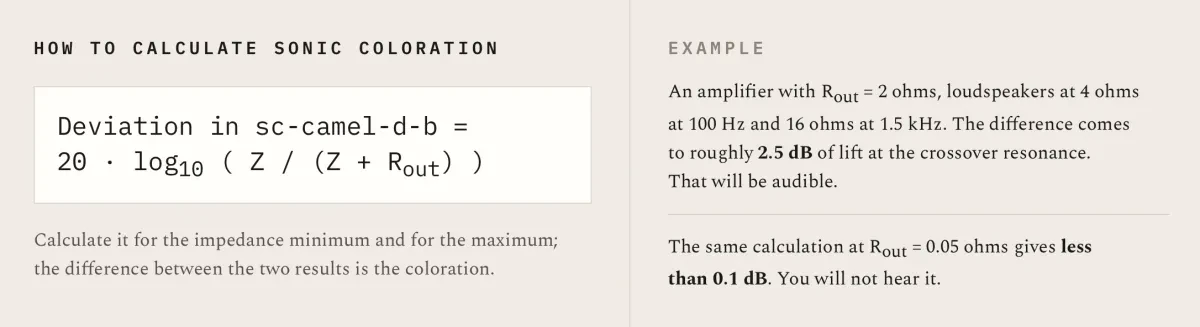
This is exactly why the line "tubes just colour the sound" is plain wrong. What colours the sound is not the tube amplifier but the interaction of a high output impedance with the uneven impedance of one particular loudspeaker. Find that tube amplifier a worthy partner, a speaker with a flat impedance curve, and the coloration disappears.
Difference three - clipping
A solid-state amplifier in clipping (overload) limits the signal abruptly: the treble is sheared off and a series of high odd-order harmonics appears in the response. You hear that as dirty, unpleasant sound.
A tube amplifier enters clipping gradually, with a progressive rise of the second and third harmonics and a gentle rounding of the treble. Subjectively this is perceived as compression.
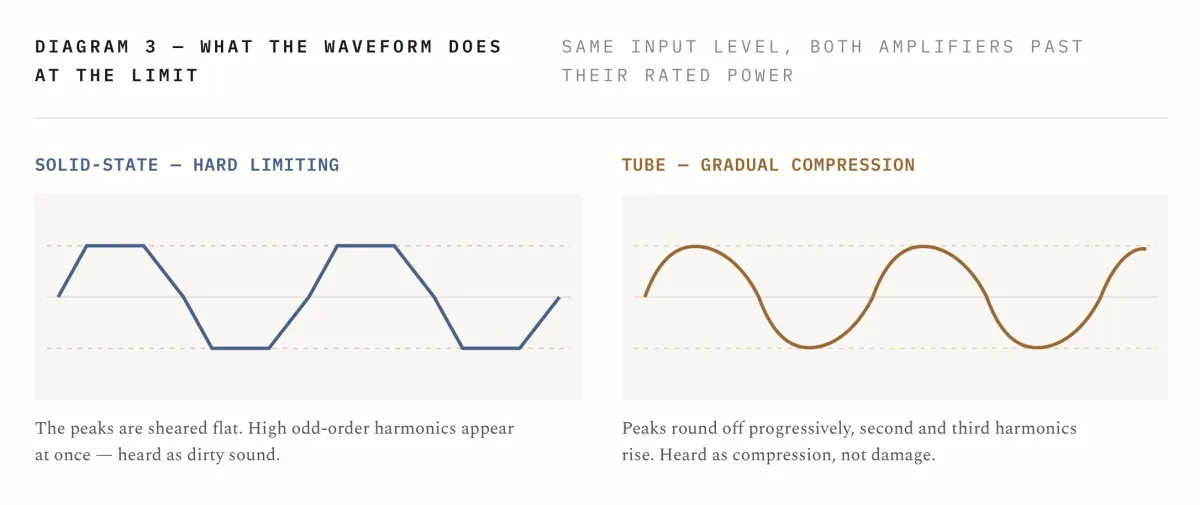
Amplifiers in ordinary rooms are not usually run at the limit of their power, true, but a symphony orchestra at fortissimo can wring every last drop out of the amplification. The result is that 2 x 20 tube watts at home turn out to be "louder" than 2 x 30 solid-state watts. The reason is that the tube design has more usable headroom before the limit becomes audible.
How much power do you actually need?
Loudspeaker sensitivity is quoted in dB with 1 W applied and measured at 1 metre. Every doubling of power adds 3 dB.
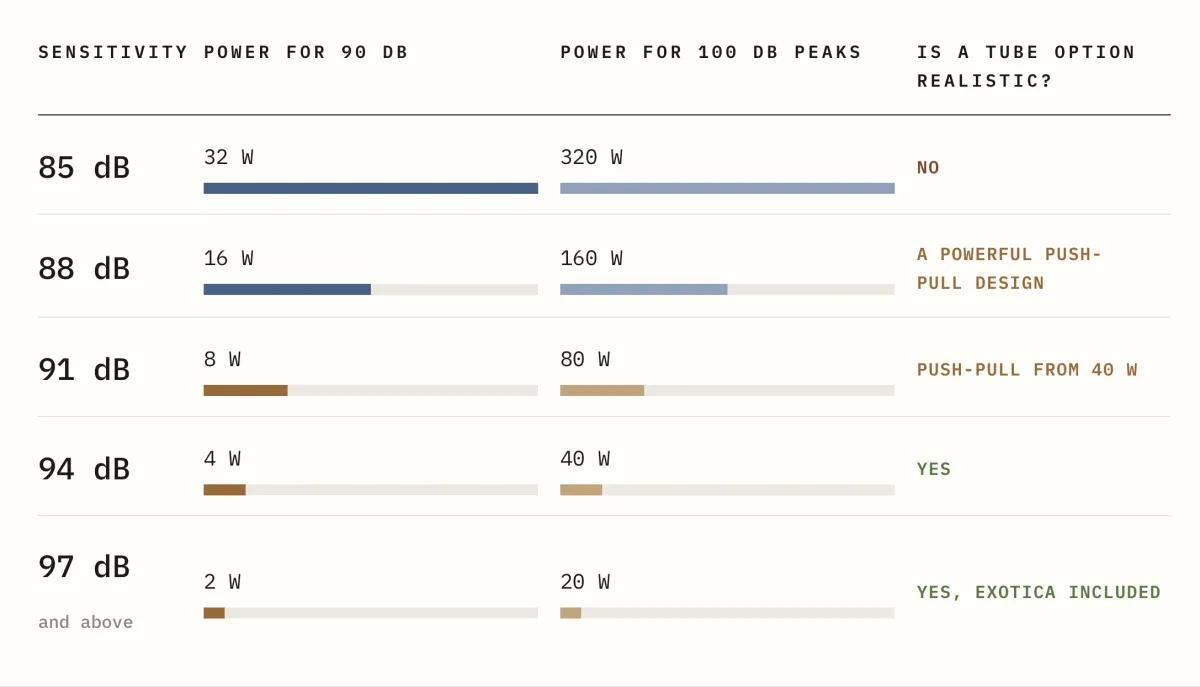
Just remember that all of this is described from a distance of 1 metre. In a typical listening room, with 3 metres between the loudspeakers and the sofa, you have to add 6-8 dB with an allowance for reverberation. In other words, you need four times the power shown in the table.
Five types of load
A classification of loudspeakers based on the combination of impedance, phase angle and the equivalent resistive value of the peak load.
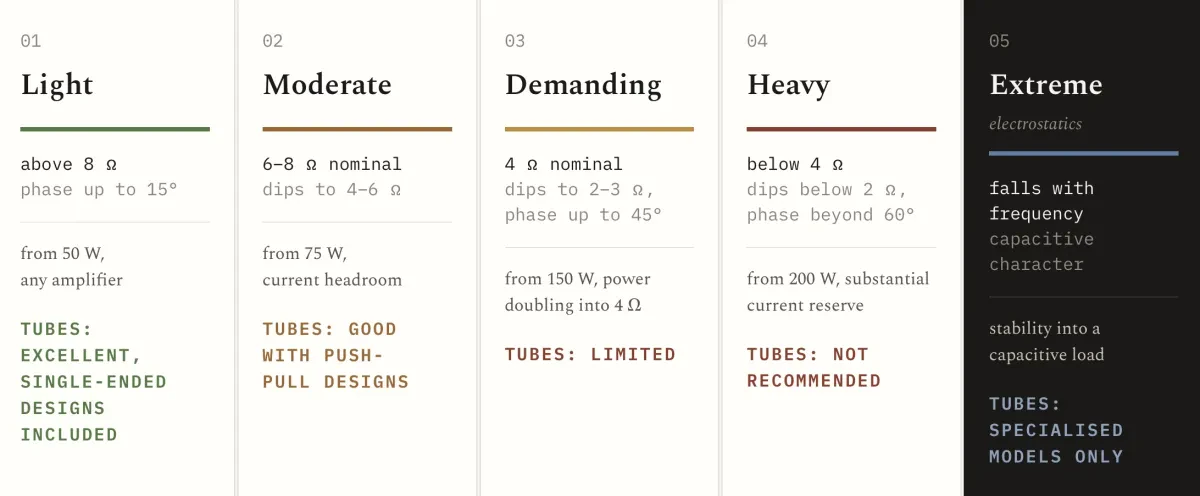
One more rule: the lower the impedance, the more the solid-state advantage becomes a question of whether the system functions at all in physical terms.
Class D in 2026
Fifteen years ago everybody had something bad to say about class D amplification, and the technology had problems enough. Today, class D amplifiers taking feedback after the output filter have solved the key problem: frequency response no longer depends on loudspeaker impedance. Low distortion, an excellent signal-to-noise ratio, a high damping factor, plus compact dimensions, low weight and little heat. These amplifiers now deliver a neutral, agreeable sound, though of course they cannot offer the tube's second harmonic.
Hybrid designs
The "tube input or driver stage plus solid-state output" arrangement is fairly common now. It guarantees low output impedance and power from the transistor section, plus a small admixture of second harmonic from the tube stage. There is no full tube sound here, but the result is ennobled.
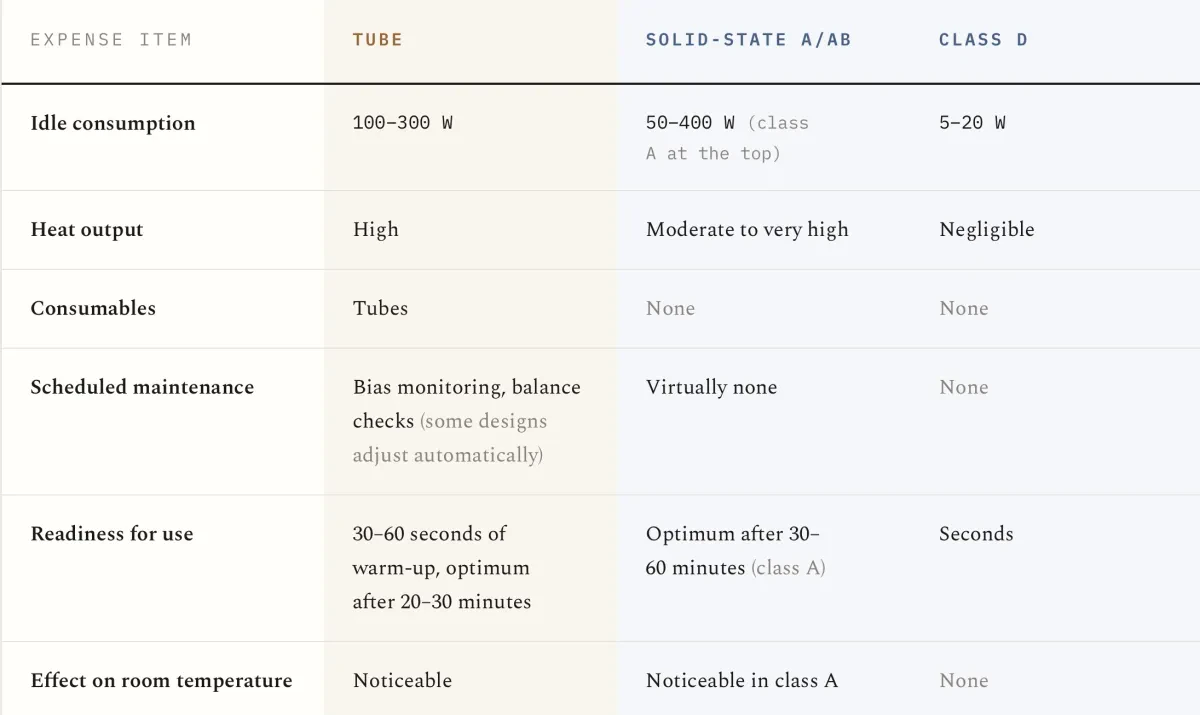
Cost of ownership
When choosing tube amplification, you cannot overlook the cost of replacing tubes or the heat output.
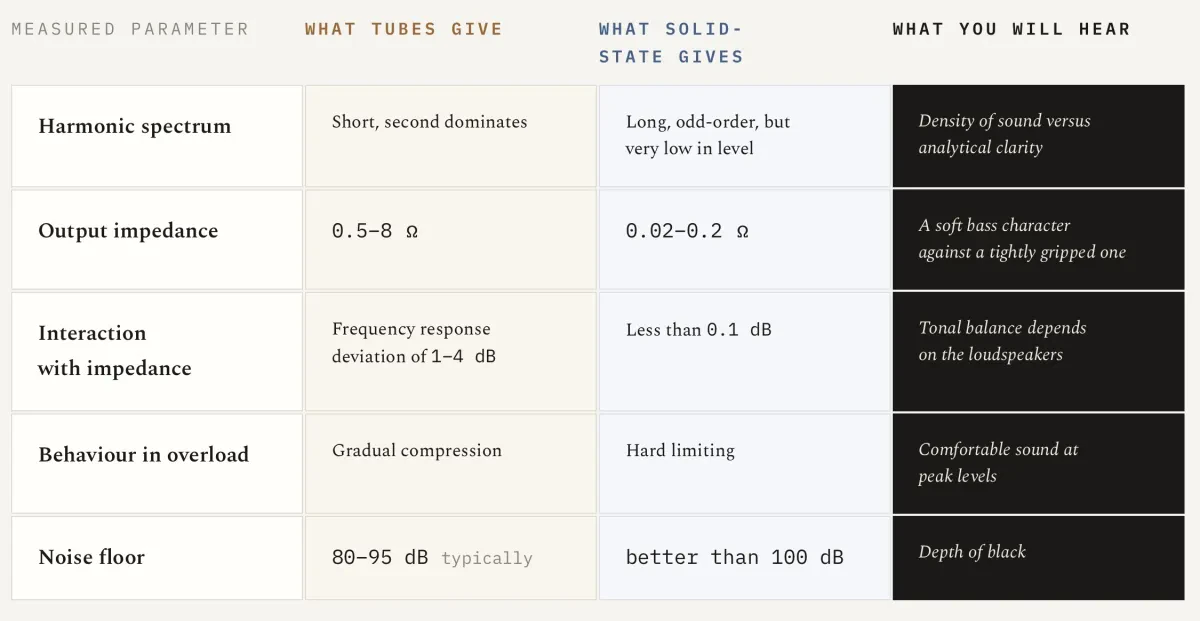
Translating measurements into listening results
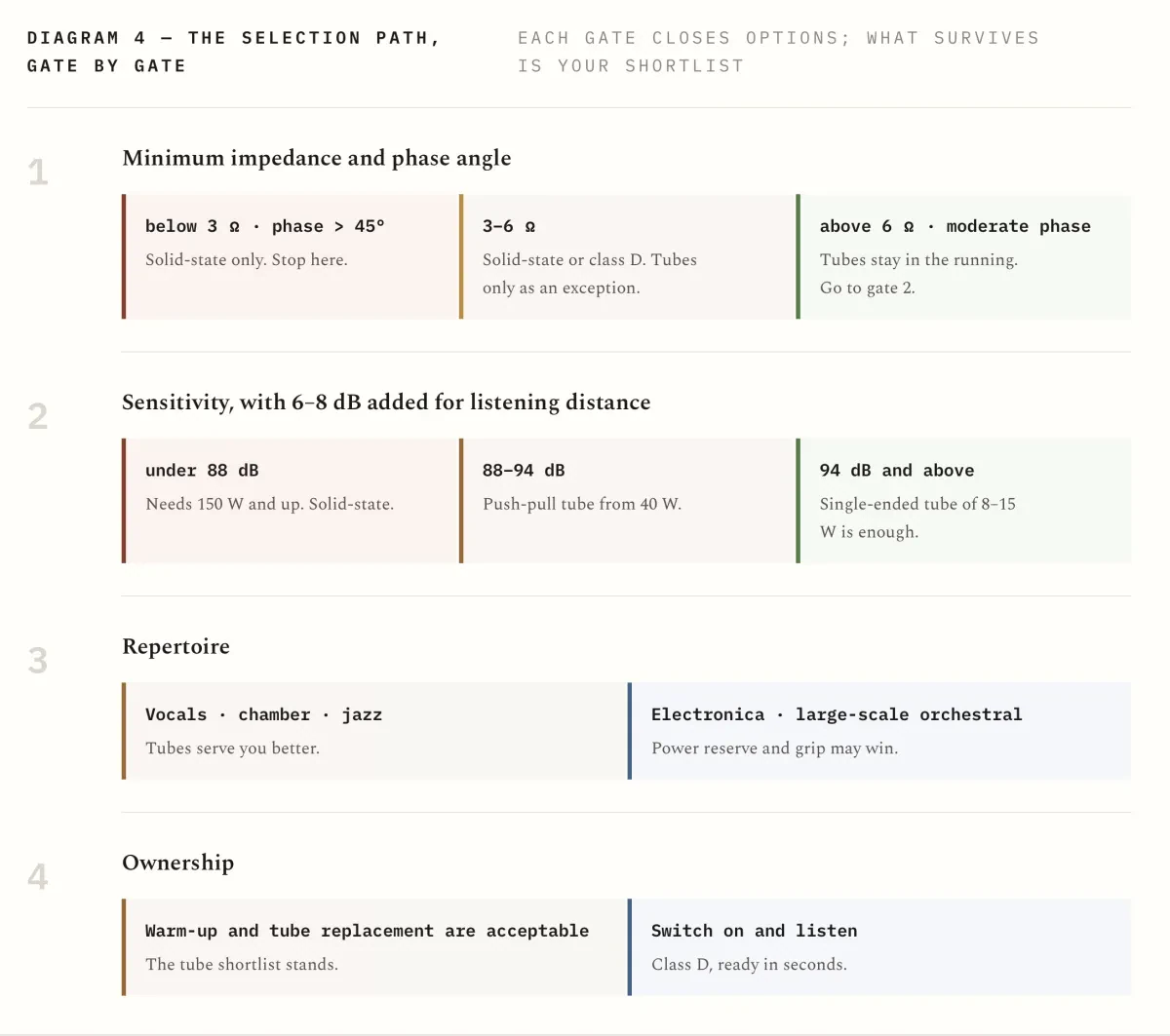
Four key questions when choosing amplification
1. What is the minimum impedance and phase angle of your loudspeakers? Below 3 ohms with a phase angle beyond 45 degrees means solid-state only. Above 6 ohms with a moderate phase angle puts a tube amplifier on the table.
2. What is the sensitivity and what listening level do you want? Check the power table above, then add headroom for listening distance and for the dynamic range of your favourite tracks.
3. What do you listen to most often? Small ensembles, vocals, chamber music, jazz: tubes will serve you better. Electronica and large-scale orchestral work: the power reserve and grip of a solid-state design may win.
4. Are you prepared to wait? Warm-up before every listening session and tube replacement are simply part of tube ownership.
The Selection!
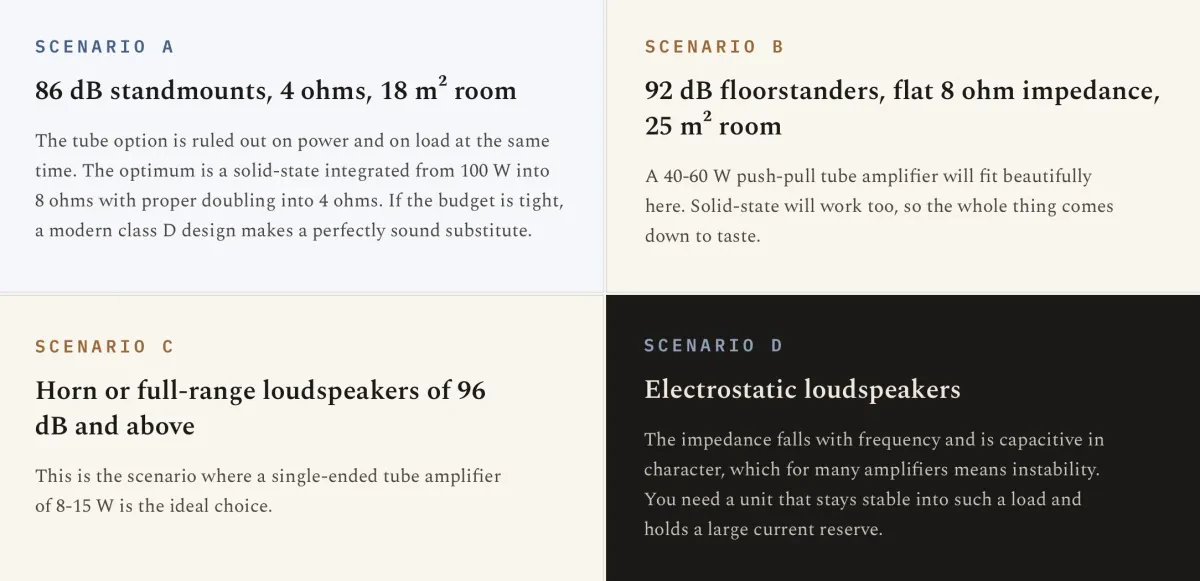
Scenarios