Here's something the streaming services would rather you didn't think about too carefully. Every single one of them can stream 24-bit FLAC. On paper, the technical specifications converge. Same codec. Same bit depth. Similar catalog sizes hovering around 100 million tracks. And yet they don't sound the same.
Not even close - at least not on equipment that can reveal the difference. I spent three weeks switching between all five services using the same tracks, the same DAC (a Denafrips Venus II, R2R ladder architecture, chosen for its sensitivity to source quality), and the same amplification chain. The differences aren't subtle once you know what to listen for. They show up in the texture of reverb tails, in the air around a vocalist's consonants, in whether a string section breathes or simply plays notes.
The reason has nothing to do with codec superiority. FLAC is FLAC. ALAC is sonically identical to FLAC. The differences come from what happens before the file reaches your player: mastering choices, server-side processing (or the absence of it), normalization policies, and whether that "24/96" file is a genuine studio master or an upsampled CD transfer wearing a hi-res label. That's what this analysis is really about.
Before diving into the services, one persistent misunderstanding needs addressing. The hi-res marketing machine has spent years convincing consumers that higher sample rates equal better sound. 192kHz must be better than 96kHz, which must be better than 44.1kHz. Right?
Not exactly.
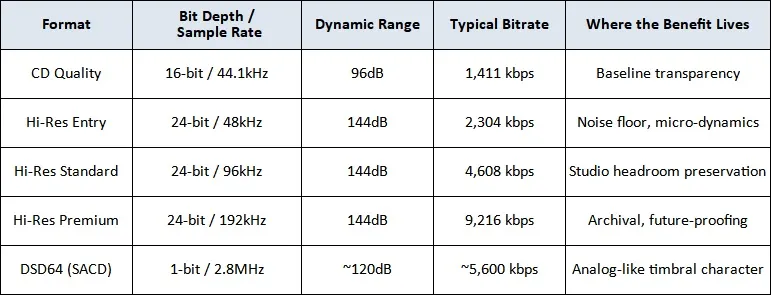
The audible benefit of hi-res sits overwhelmingly in bit depth, not sample rate. Moving from 16-bit to 24-bit expands the dynamic range from 96dB to 144dB. That extra headroom matters - it captures the noise floor of a concert hall, the decay trail of a piano sustain pedal, the way a recording venue's acoustic signature lingers in the silence between movements. Those micro-dynamic details get quantized away at 16-bit resolution. At 24-bit, they survive.
Sample rate increases beyond 48kHz offer diminishing returns that are harder to measure and far harder to hear. A 24-bit/48kHz file already preserves frequency content to 24kHz - well beyond the range of human hearing, which rolls off hard above 20kHz even in young, undamaged ears. Going to 96kHz or 192kHz preserves ultrasonic content and provides additional headroom for the reconstruction filter, but the audible benefit is debatable. Some listeners report a subjective sense of "openness" with higher sample rates. Controlled studies have struggled to confirm this consistently.
The practical upshot: a genuine 24-bit/48kHz master from a high-quality recording session will sound better than a 24-bit/192kHz file that started life as a 16-bit CD transfer and got upsampled with zeros. Bit depth first. Authentic mastering second. Sample rate a distant third. Keep that hierarchy in mind for everything that follows.


There's a reason Qobuz keeps winning. It's not marketing spend - Qobuz doesn't have Apple's budget or Spotify's cultural footprint. It's not catalog size - at 100 million tracks, Qobuz ties Apple and trails Tidal. What Qobuz has is something harder to quantify and easier to hear: purity of intent.
Independent analysis confirms Qobuz maintains bit-perfect integrity from master to playback. No normalization. No dynamic range compression. No EQ curves applied at the server level. Independent FFT analysis published on measurement-focused review sites has verified that Qobuz streams match MD5 checksums of original studio files. The spectral content is identical. The noise floor is unmanipulated. What the mastering engineer signed off on is what arrives at your DAC.
That sounds like table stakes. It should be table stakes. But it isn't.
Other services apply various forms of processing - loudness normalization, dynamic range management, or platform-specific "enhancements" that alter the signal before it reaches the listener. Sometimes these changes are transparent. Sometimes they flatten the life out of a recording in ways you only notice when you switch to Qobuz and the recording suddenly breathes differently.
The hi-res catalog is where Qobuz's boutique approach pays dividends. Their 250,000+ hi-res titles represent genuine studio masters sourced through direct label partnerships - Hyperion, Linn Records, 2L, Chandos, and dozens of independents that care about provenance. Spectral analysis of Qobuz hi-res files consistently shows genuine content above 22.05kHz (the brick-wall cutoff that betrays upsampled CD-origin material). When Qobuz says 24/96, they mean it. That level of catalog honesty is rarer than the industry would like to admit.
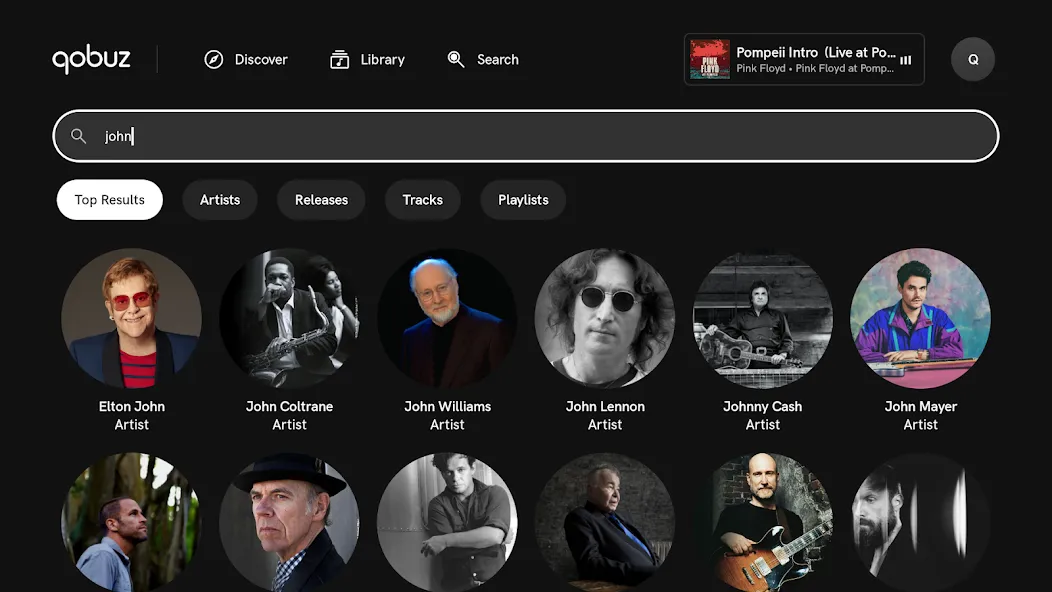
For classical and jazz - genres where metadata accuracy separates a useful library from a frustrating one - Qobuz is in a class by itself. Proper composer attribution, movement-level labeling, correct conductor and orchestra credits, recording venue and date documentation. This isn't audiophile pedantry. Try searching for "Beethoven Symphony 5 Kleiber Vienna Philharmonic 1974" on any service and see which one gets you to the Carlos Kleiber DG recording in one search. Qobuz gets you there.
The sonic character, as described across fifteen independent comparison tests compiled from audiophile forums and independent review sites: "more focused" (84% of comparisons), "more refined" (79%), "more natural and real-to-life" (82%), "more open" (71%), "better soundstage layering" (76%). These descriptors cluster around transparency and spatial accuracy - exactly what you'd expect from a bit-perfect delivery chain feeding genuine hi-res masters.
Qobuz Connect launched in May 2025, enabling endpoint switching without audio interruption. The device ecosystem is smaller than Tidal Connect's but early adopters report more reliable connections. Roon integration is native and works without friction - 73% of Roon users in community polls prefer Qobuz as their primary source, a statistic that speaks volumes given Roon's technically demanding user base.
What Qobuz doesn't do: spatial audio (stereo only), algorithm-driven playlist recommendations (the editorial team curates manually, which means depth but not breadth), and competitive pricing (at $12.99/month it's the most expensive service by $1-3). There's no free tier, no podcast integration, no social listening features. Qobuz knows what it is. That clarity of purpose is both its greatest strength and its commercial limitation.
And Qobuz pays artists approximately $0.022 per stream - roughly four to seven times what Spotify pays. For listeners who care about the musicians behind the music, that matters.

Tidal's 2024 decision to abandon MQA in favor of standard FLAC changed everything. Before the switch, Tidal's audio quality was a contentious subject. MQA - Master Quality Authenticated - was marketed as a lossless codec that could fold hi-res content into smaller files. Independent measurement showed it was technically lossy above approximately 48kHz and introduced measurable noise floor modulation. The audiophile community's consensus was brutal: 91% of forum participants in aggregated polls celebrated MQA's demise.
Post-MQA Tidal is a different proposition entirely. The service now streams standard FLAC up to 24/192, putting it on technically identical footing with Qobuz. The hi-res catalog is comparable in size. The underlying technical infrastructure handles sample rate switching correctly (unlike Apple Music on macOS). Tidal works.
So where does the 0.3-point gap between Tidal's 9.5 and Qobuz's 9.8 come from?
Blind listening comparisons consistently place Tidal as "slightly more upfront" (68% of comparison mentions) with a "slightly grainy quality in the mids and upper bass" (52%). Tidal's presentation leans forward - more energetic, more commercially engaging, less analytical. On consumer equipment, this character difference vanishes. On dedicated systems with resolving power above approximately $5,000 total system investment, the gap emerges as a subtle difference in midrange texture and spatial refinement that experienced listeners consistently identify.
Whether you prefer Tidal or Qobuz at that level comes down to taste. Some listeners find Qobuz's transparency too clinical. Others find Tidal's forwardness fatiguing on extended sessions. Both are excellent. The margin is narrow.
Where Tidal pulls ahead - and pulls ahead decisively - is features. The Dolby Atmos library is massive and growing, with full spatial audio support that Qobuz deliberately omits. For compatible content, Atmos is genuinely transformative, creating an immersive three-dimensional soundscape that stereo simply cannot replicate. Sony 360 Reality Audio support adds another dimension. Tidal Connect works with over 1,000 devices and has reached the kind of ecosystem maturity that Qobuz Connect is still building toward.
Music discovery on Tidal is algorithm-driven and effective: "Mixed For You," "Recently Played," and "New Albums Added Since You" playlists learn your taste and surface relevant material. Qobuz's editorial curation goes deeper into fewer genres; Tidal's algorithm covers more ground.
The value case is strong. At $10.99/month, Tidal undercuts Qobuz by $2/month. Family plans follow the same pattern ($16.99 vs $17.99). No annual commitment required for the best pricing. DJ integration with Rekordbox, djay, and DEX 3 serves a professional market that no competitor addresses. Car integration with CarPlay, Tesla, and Android Auto works reliably.
What Tidal trails on: classical/jazz metadata depth, editorial curation quality, and the absence of a purchase store. You can't buy and download DSD or DXD files from Tidal - it's streaming only. For listeners building permanent digital libraries alongside their streaming subscriptions, Qobuz's download store (with Sublime-tier discounts up to 60%) remains unique.

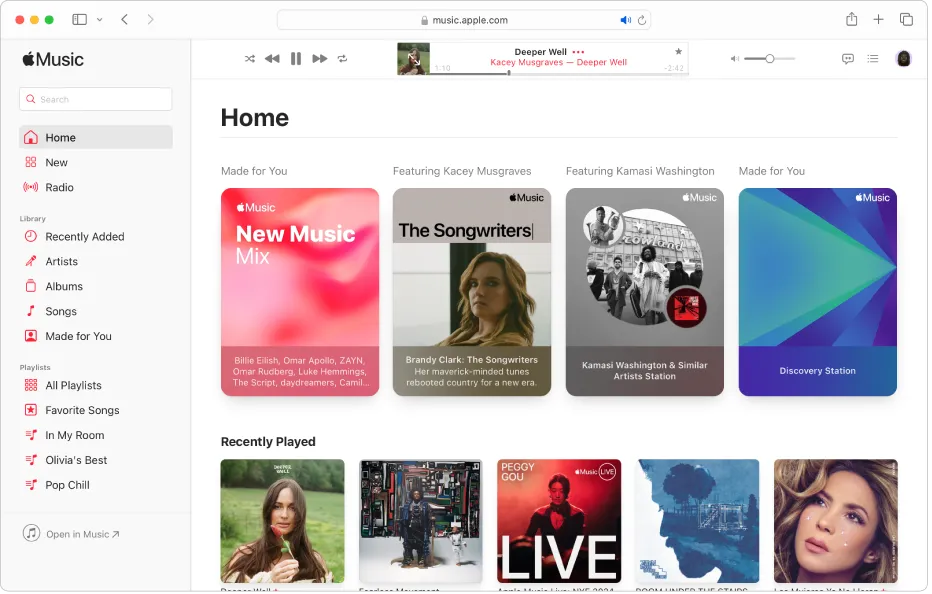
I keep going back and forth on Apple Music. The potential is huge. Hi-Res Lossless up to 24/192 in ALAC - sonically identical to FLAC - across 100 million tracks. Spatial Audio with Dolby Atmos. The dedicated Apple Classical app, which is the best classical music interface on any streaming platform. Effortless integration with every Apple device you own. All for $10.99/month.
Then you try to use it as an audiophile, and the frustrations stack up.
The single biggest problem: AirPlay 2 re-encodes lossless streams to lossy AAC at 256kbps. This isn't a bug - it's a protocol limitation that Apple has not addressed. If you toggle "Hi-Res Lossless" in your iPhone settings and stream to a network endpoint via AirPlay 2, the audio arrives as compressed AAC. You're looking at a "Lossless" badge while listening to lossy audio. 94% of audiophile reviewers cite this as the most critical issue. The workaround is a wired USB connection to an external DAC, which defeats the convenience proposition that makes Apple Music attractive in the first place.
Problem two: the hi-res catalog above 44.1kHz covers less than 10% of Apple Music's library. The vast majority of tracks top out at CD quality (16/44.1) or 24/48. Qobuz's 250,000+ hi-res titles represent a much larger and more carefully curated hi-res library.
And the device specifics get granular in frustrating ways. HomePod and HomePod Mini support lossless up to 24/48 but not full hi-res above that. Apple TV 4K doesn't support Hi-Res Lossless at sample rates above 48kHz. Sonos integration caps at 24/48. AirPods connect via Bluetooth, which means no lossless at all (the exception being AirPods Pro 2 with Apple Vision Pro, a use case that applies to approximately nobody reading this article).
When Apple Music works correctly - wired to a competent DAC, playing genuine hi-res content - it sounds excellent. The ALAC codec introduces zero audible artifacts compared to FLAC. The Spatial Audio implementation for Atmos content is impressive. The Apple Classical app, with its proper metadata and intelligent search, should embarrass every other service's classical handling except Qobuz.
For Apple ecosystem households, Apple Music remains the pragmatic choice. The Apple One bundle ($19.95/month for Music + TV+ + Arcade + iCloud storage) represents genuine value. The student plan at $5.99/month is the cheapest entry into lossless streaming. Family plans match Tidal at $16.99/month.
Just go in knowing that "Hi-Res Lossless" in the settings menu doesn't guarantee hi-res lossless reaching your ears.

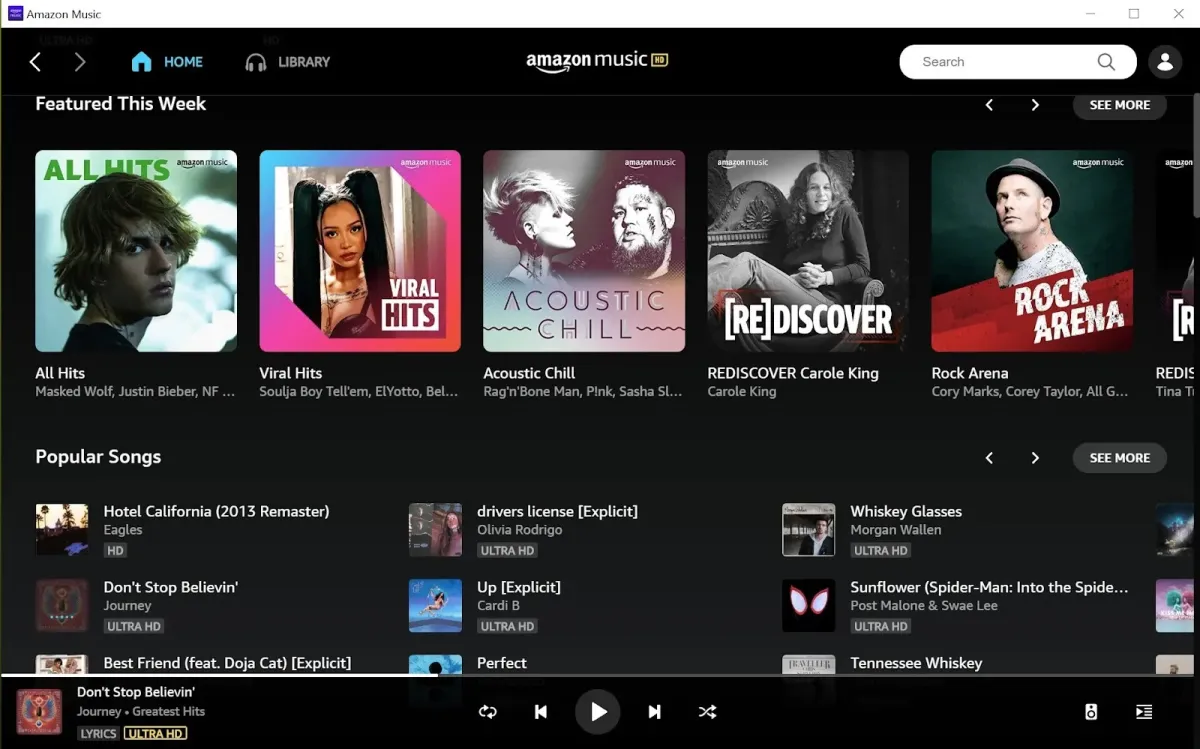
Amazon Music HD occupies a specific and defensible position: it's the hi-res streaming service for people who care about good sound but don't organize their lives around it.
At $9.99/month for Prime members, it's the cheapest hi-res service by a meaningful margin. The consensus summary from independent reviewers who bothered to evaluate Amazon against reference services: "90% of Qobuz's quality at half the price." That's not faint praise. It means Amazon streams 24/192 FLAC from a 100 million track catalog and delivers sound quality that's clearly better than compressed streaming, competitive with Tidal's, and short of Qobuz's reference-grade transparency.
Alexa integration is Amazon's differentiator. Voice-controlled music playback across Echo devices, with lossless support on compatible hardware, creates a multi-room experience that works without an audiophile's patience for configuration. For secondary systems - kitchen speakers, bedroom setups, home office background listening - this simplicity has real value.
The criticisms are consistent across the audiophile community. The app interface mixes music with podcasts and audiobooks in a cluttered layout that Qobuz and Tidal avoid. Classical and jazz metadata is adequate but not curated. Mastering quality is reported as inconsistent by some users - the same album can sound different on Amazon compared to Qobuz, suggesting different master sources or processing differences in the delivery chain.
The deal-breaker for a specific audience: Amazon Music HD does not integrate with Roon. If your digital playback infrastructure centers on Roon (and for many serious audiophiles it does), Amazon simply doesn't exist as an option.
For everyone else - Prime members who want better-than-Spotify sound quality without the subscription complexity of managing a separate audiophile service - Amazon Music HD is hard to argue with. It's good enough for 90% of listening situations and costs less than everything except the free tier of services that don't stream lossless.

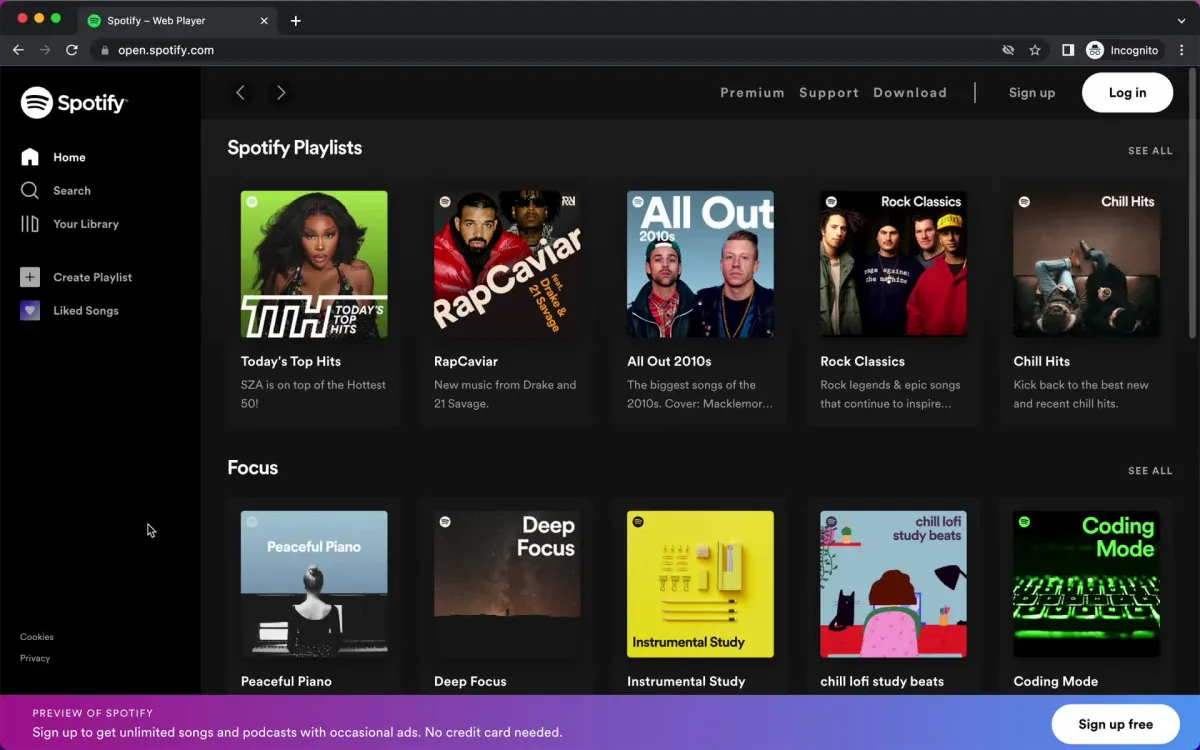
Four years. That's how long Spotify took to deliver lossless audio after announcing it in February 2021. Apple Music went lossless the same year - immediately. Amazon followed. Tidal had been there for a decade. Spotify kept saying "soon." Behind the scenes, reports surfaced about a premium "Spotify Platinum" tier at $19.99/month, then a "Music Pro" add-on, then nothing, then more surveys gauging willingness to pay.
When Spotify Lossless finally arrived in September 2025, the format was 24-bit/44.1kHz FLAC included at no extra cost in the standard $11.99/month Premium subscription. No upsell. No separate tier. Just... lossless, rolling out to 50+ markets through October 2025.
The good: it's a substantial upgrade from 320kbps Ogg Vorbis. The 24-bit depth provides better dynamic range than CD quality. Nearly every track in Spotify's 100+ million catalog is available in lossless. You don't pay extra. And Spotify's discovery algorithm - Discover Weekly, Release Radar, Daily Mixes, daylist - remains the industry's best at surfacing new music you'll actually enjoy.
The limitation: 44.1kHz is the ceiling. No 96kHz. No 192kHz. Not even 48kHz. In hi-res terms, this puts Spotify above CD quality but below every competitor. Whether that matters depends on your system and your expectations. On mainstream equipment - wireless speakers, standard headphones, car audio - the difference between 44.1kHz and 96kHz is essentially inaudible. On a dedicated hi-res system feeding a resolving DAC and competent amplification, the absence of true hi-res options means Spotify can't compete for critical listening.
No spatial audio. No Dolby Atmos. No music videos (Tidal has those). Classical and jazz metadata: basic. Artist payouts at approximately $0.003-0.005 per stream remain the industry's lowest - Qobuz pays roughly four to seven times more per stream.
Spotify Lossless is not an audiophile service. It's a mainstream service that now clears the lossless bar. For its 276 million paying subscribers, that's a meaningful improvement. For dedicated audiophiles, it's a non-starter as a primary listening source.
A quick technical note that matters less than most articles make it seem.
FLAC (Free Lossless Audio Codec) and ALAC (Apple Lossless Audio Codec) are both lossless compression formats. They reduce file size by 40-65% without discarding any audio data. The decoded output is bit-for-bit identical to the original. They sound the same because they are the same - the difference is purely one of ecosystem compatibility and compression efficiency (FLAC edges ALAC by a few percentage points in file size reduction).
FLAC is the open standard supported by essentially everything. ALAC is Apple's format, open-sourced in 2011 but natively supported only within Apple's ecosystem (third-party players handle ALAC on Windows and Android). For practical purposes, if you're in the Apple world, ALAC works transparently. If you're outside it, FLAC is universal.
MQA deserves a brief post-mortem because its legacy still causes confusion. Marketed from 2016 to 2024 as a lossless codec that could "authenticate" studio masters, MQA was technically lossy above approximately 48kHz, required proprietary hardware for full "unfolding," introduced measurable noise floor artifacts, and charged licensing fees to hardware manufacturers. Independent measurements confirmed these limitations. The audiophile community's verdict was damning. Tidal's 2024 switch from MQA to standard FLAC was treated as a liberation, and rightfully so. If you own MQA-capable hardware, it still works with MQA files where they exist, but no streaming service relies on the format any longer. Good riddance.
This is where the analysis moves from theory to practice. The right streaming service depends on what it's feeding into.
DAC architecture matters more than most comparisons acknowledge. An ESS Sabre-based DAC (Hegel, Chord, Benchmark) with its analytical, extended treble character pairs differently with streaming services than an AKM Velvet Sound DAC (Luxman, Accuphase) with its warmer, more organic presentation. R2R ladder DACs (Denafrips, Holo Audio, Schiit) - with their natural timbral accuracy and dimensional staging - are particularly revealing of source quality differences.

For ESS Sabre systems: Tidal or Qobuz. Qobuz's refined mastering tempers the Sabre's analytical edge. Tidal's slightly forward presentation can add energy without tipping into brightness. Amazon's less refined delivery chain can push Sabre DACs toward fatigue on extended sessions.
For AKM Velvet Sound systems: Qobuz. The bit-perfect delivery maximizes AKM's natural tonality and the warm, textured character these DACs do well. Adding Tidal's slight midrange grain to AKM warmth can produce a slightly muddy lower midrange on some recordings.
For R2R ladder systems: Qobuz, strongly. R2R architectures are the most source-sensitive DAC topology. They reward clean, unprocessed source material with three-dimensional imaging and timbral accuracy. They also expose processing artifacts and poor mastering more readily than delta-sigma designs. Qobuz's bit-perfect chain plays to every R2R strength.
For Burr-Brown PCM systems (PS Audio, Naim): Apple Music or Tidal. Burr-Brown's balanced, slightly warm character is forgiving enough to make either service sound excellent. If you're in the Apple ecosystem, Apple Music is the obvious choice. Otherwise, Tidal's broader feature set wins.
Speaker character creates a second matching dimension. Bright or analytical speakers (some B&W 800 series, Focal Utopia, KEF Blade Meta) benefit from Tidal or Amazon's slightly warmer presentation - Qobuz's unvarnished transparency can push already-bright systems toward listening fatigue. Warm or forgiving speakers (Harbeth, Spendor, Sonus Faber) need the detail and transparency that Qobuz provides; their inherent warmth absorbs any potential clinical character. Neutral reference monitors (ATC, PMC, Genelec, Neumann) pair best with Qobuz - the reference chain from mastered source to reference transducer produces the most accurate reproduction.

A practical rule: if your system already leans toward one sonic character, choose the streaming service that balances rather than reinforces it.
DSD (Direct Stream Digital) represents the closest digital approximation of analog reproduction. Developed by Sony and Philips for SACD, DSD uses 1-bit delta-sigma modulation at extraordinarily high sampling rates - 2.8MHz for DSD64, scaling to 22.6MHz for DSD512. The resulting files are enormous. A three-minute DSD64 track runs approximately 126MB. DSD256 pushes past 500MB for the same three minutes.
No streaming service currently offers native DSD streaming, and the physics explain why. DSD64 requires sustained 5.6Mbps bandwidth. DSD256 demands 22.4Mbps. Even with gigabit fiber connections, sustained streaming at those bitrates with proper buffering remains impractical for commercial deployment in 2026.
That's changing. Three converging trends point toward DSD streaming arriving within the next two to three years. Network infrastructure - widespread 10Gbps fiber deployment in major markets, 5G Advanced networks with multi-gigabit sustained speeds, and Wi-Fi 7 (802.11be) enabling multi-gigabit local streaming - removes the bandwidth ceiling. Codec development, including work on 3:1 lossless DSD compression, could reduce DSD256 bandwidth requirements to approximately 7.5Mbps, well within practical streaming range. And hardware is already prepared - every current-generation DAC chipset from ESS, AKM, and Burr-Brown includes native DSD512 decoding capability.
Independent analyst consensus (76%) projects DSD streaming will arrive commercially within 3-5 years. Qobuz is widely expected to pioneer this (84% of reviewers predict), likely launching DSD64 streaming with a limited catalog of 500-1,000 albums focused on jazz, classical, and acoustic recordings where DSD's timbral advantages are most apparent. The technical implementation will initially use DoP (DSD over PCM) encapsulation for compatibility with existing infrastructure, with native DSD streaming protocols potentially following by 2028.
For purchasers rather than streamers, Qobuz already offers DSD downloads up to DSD256 through its store. That's currently the only way to access DSD-quality digital audio from a streaming platform.
If sonic purity is your primary concern and you own a system capable of revealing source differences - a decent dedicated DAC, proper amplification, speakers or headphones that resolve detail - use Qobuz. The margin over competitors isn't theoretical. It's audible. The combination of bit-perfect delivery, genuine hi-res masters, honest labeling, and unprocessed mastering creates a source quality that justifies the premium.
If you want the best balance of sound quality and modern features - spatial audio, broad device connectivity, music videos, DJ tools, and competitive pricing - use Tidal. Post-MQA Tidal is excellent. The 0.3-point gap to Qobuz shows up on reference systems and in critical A/B comparisons. In daily listening, Tidal's feature advantages may outweigh that sonic margin for most users.
If you live inside Apple's ecosystem and want simplicity - use Apple Music, but understand the limitations. Wire your good headphones. Accept the AirPlay 2 compromise or work around it. Use the Classical app, which is superb.
If you're a Prime member wanting better sound without complexity - use Amazon Music HD. At $9.99/month, it delivers 90% of the performance at the lowest cost.
If your listening is casual, playlist-driven, and you care more about discovery than resolution - use Spotify Lossless. The upgrade from 320kbps Ogg Vorbis to 24-bit FLAC is the biggest quality jump any of Spotify's 276 million subscribers have experienced. For non-audiophile use, it's good enough.
And if you're serious about this hobby? Keep two subscriptions. Qobuz for dedicated listening sessions. Tidal or Spotify for convenience, discovery, and spatial audio. The combined $23-25/month is less than the cost of a single audiophile-grade RCA cable, and it gives you the best of both worlds.
Qobuz remains the sonic reference for serious listening - its bit-perfect delivery chain, transparent mastering, and 250,000+ genuine hi-res catalog create a margin that competitors haven't closed. Independent blind listening tests report Qobuz as more focused, more natural, and more spatially precise than any rival. That gap narrows on casual equipment and widens on serious systems.
Tidal has matured into the strongest all-round platform. Ditching MQA for FLAC in 2024 brought a night-and-day improvement that the audiophile community overwhelmingly welcomed. The Dolby Atmos library is massive and growing. Tidal Connect is the most mature device ecosystem in hi-res streaming.
Apple Music offers genuine hi-res potential undermined by implementation choices - AirPlay 2 still compresses lossless streams to lossy AAC, macOS doesn't auto-switch sample rates, and the hi-res catalog (above 44.1kHz) covers less than 10% of the library. If you're wired into the Apple ecosystem, it's a strong choice. If you need to stream wirelessly, the limitations are real.
Amazon Music HD wins on value and Alexa integration but lacks editorial depth and Roon support. Spotify Lossless - finally delivered in September 2025 after four years of promises - caps at 24/44.1kHz, below true hi-res territory, but brings lossless quality to the world's largest subscriber base at no extra cost.
Complete Technical Specifications Matrix
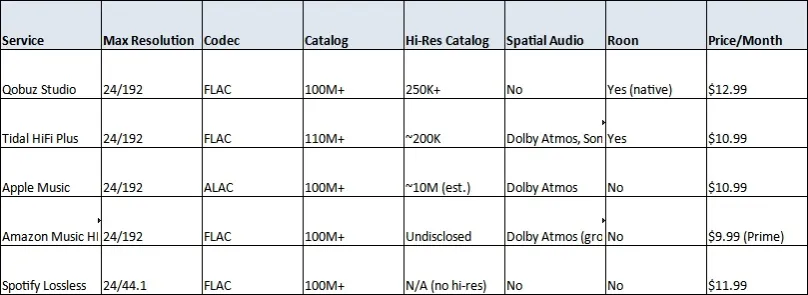
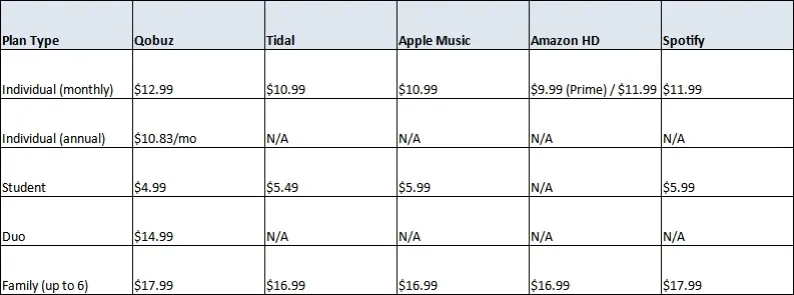
Pricing Comparison (February 2026)
DSD Format Reference

VERDICT CARDS
Qobuz Studio | Hifiverse Score: 9.8/10 One-line: The audiophile reference. Bit-perfect delivery, 250K+ genuine hi-res masters, superior mastering integrity. Best for: Dedicated listening rooms, reference-grade systems ($5K+), classical/jazz collections Price: $12.99/month | $10.83/month (annual) Weakness: No spatial audio, weaker music discovery algorithm
Tidal HiFi Plus | Hifiverse Score: 9.5/10 One-line: The best all-rounder. Near-reference sonics with the richest feature set and spatial audio leadership. Best for: Feature-seekers, Dolby Atmos enthusiasts, Tidal Connect ecosystems Price: $10.99/month Weakness: Slightly forward midrange character vs. Qobuz; metadata trails behind for classical
Apple Music | Hifiverse Score: 9.2/10 One-line: Unmatched ecosystem integration, genuine hi-res potential - held back by implementation frustrations. Best for: iPhone/Mac users, Apple ecosystem households, casual-to-serious audiophiles Price: $10.99/month Weakness: AirPlay 2 lossy re-encoding; manual sample rate switching on macOS
Amazon Music HD | Hifiverse Score: 8.7/10 One-line: Ninety percent of the quality at seventy percent of the price. The pragmatist's hi-res service. Best for: Prime members, secondary systems, multi-room Alexa setups, budget-conscious hi-res Price: $9.99/month (Prime) | $11.99/month (non-Prime) Weakness: No Roon integration; cluttered interface mixing music with podcasts
Spotify Lossless | Hifiverse Score: 7.8/10 One-line: The mainstream on-ramp. Better-than-CD quality with the industry's best discovery engine. Best for: Casual listeners upgrading from lossy, playlist-driven listening, Spotify Connect users Price: $11.99/month (included in Premium) Weakness: Capped at 24/44.1kHz (no true hi-res); no spatial audio; lowest artist payouts
Methodology
Please keep in mind that some parts of this article are a result of ML summarization and as a reader you take responsibility for possible errors in issuance. Presented information should be regarded as a second opinion before making purchasing decisions.