
Все

Фонокорректоры — European Audio Team (EAT) E-Glo CB
Описание, изображения, технические характеристики и спецификации
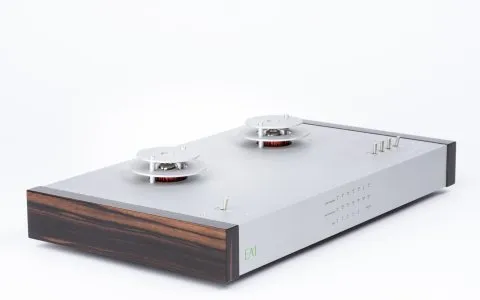
European Audio Team (EAT) E-Glo CB
Источник изображения — © European Audio Team (EAT)
The E-Glo CB is a single-box hybrid phono preamplifier made by hand in Europe by EAT as a fully discrete hybrid design with two ECC83S valves. Balanced XLR sockets are provided for the cartridge feed and for the line signal leaving the unit, MM and MC pickups are both supported, and buyers pick a silver or black finish. Its switches, loading options and case dimensions match those of the E-Glo SB.
Key specs that matter
Six gain steps are offered of 40, 45, 50, 55, 65 and 70 dB, with an extra 6 dB available through the XLR outputs. Moving magnet input impedance can be chosen from 30k, 36k, 42k, 47k, 53k, 59k, 65k and 75k ohm, with capacitance of 50, 150, 270, 370, 520 or 620 pF. Moving coil loading runs through 10, 18, 43, 75, 150, 300, 600 and 1200 ohm. Signal to noise is rated above 92 dBV for moving magnet (102 dBV IEC A) and above 80 dBV for moving coil (90 dBV IEC A). Distortion is under 0.005 percent at 1 V RMS on the 40 to 55 dB gain settings and 0.04 percent on the 65 and 70 dB settings, and RIAA accuracy holds within 0.5 dB between 20 Hz and 20 kHz. The case is 395 x 86 x 262 mm and weighs 5 kg without its power supply.
Engineering and use context
A fully symmetrical gain stage is used, and the circuit uses no IC op amps. Each channel is built as a separate mono path, and equalisation is split between passive and active sections. Semi-crystalline hydrocarbon polypropylene film capacitors sit in the gain and RIAA stages. A subsonic filter works at 20 Hz with an 18 dB per octave slope. Rows of front switches give direct access to gain, loading and the filter, and two turntables can be connected at once with their settings stored individually. Power arrives from an external 18 V, 1000 mA adapter that accepts 110 to 250 V at 50 or 60 Hz, and consumption peaks at 17 W, dropping below 0.5 W in standby. The valves are lit by dimmable LED backlighting in changeable colours, and magnetic side panels are optional, either piano black or high gloss Makassar wood.
Pairing
Output impedance is 100 ohm on RCA and 2 x 100 ohm on XLR, so the unit can feed either a single-ended line input or a balanced connection on the next component in the chain. A balanced cartridge lead from the tonearm can be taken straight to the XLR input.
Alternatives
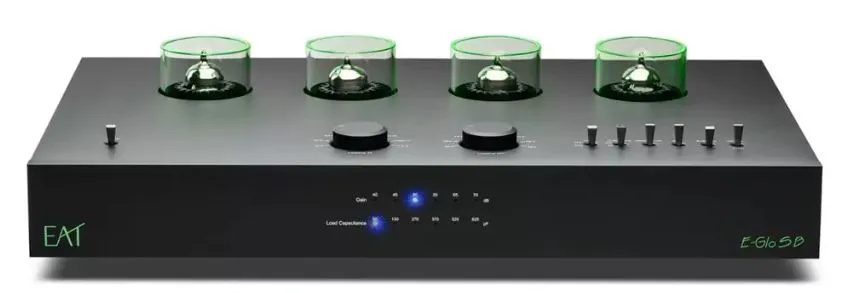
The EAT E-Glo SB uses the same case and settings but moves its second amplification stage entirely to valves, with two ECC83S and two E88CC.
Key specs that matter
Six gain steps are offered of 40, 45, 50, 55, 65 and 70 dB, with an extra 6 dB available through the XLR outputs. Moving magnet input impedance can be chosen from 30k, 36k, 42k, 47k, 53k, 59k, 65k and 75k ohm, with capacitance of 50, 150, 270, 370, 520 or 620 pF. Moving coil loading runs through 10, 18, 43, 75, 150, 300, 600 and 1200 ohm. Signal to noise is rated above 92 dBV for moving magnet (102 dBV IEC A) and above 80 dBV for moving coil (90 dBV IEC A). Distortion is under 0.005 percent at 1 V RMS on the 40 to 55 dB gain settings and 0.04 percent on the 65 and 70 dB settings, and RIAA accuracy holds within 0.5 dB between 20 Hz and 20 kHz. The case is 395 x 86 x 262 mm and weighs 5 kg without its power supply.
Engineering and use context
A fully symmetrical gain stage is used, and the circuit uses no IC op amps. Each channel is built as a separate mono path, and equalisation is split between passive and active sections. Semi-crystalline hydrocarbon polypropylene film capacitors sit in the gain and RIAA stages. A subsonic filter works at 20 Hz with an 18 dB per octave slope. Rows of front switches give direct access to gain, loading and the filter, and two turntables can be connected at once with their settings stored individually. Power arrives from an external 18 V, 1000 mA adapter that accepts 110 to 250 V at 50 or 60 Hz, and consumption peaks at 17 W, dropping below 0.5 W in standby. The valves are lit by dimmable LED backlighting in changeable colours, and magnetic side panels are optional, either piano black or high gloss Makassar wood.
Pairing
Output impedance is 100 ohm on RCA and 2 x 100 ohm on XLR, so the unit can feed either a single-ended line input or a balanced connection on the next component in the chain. A balanced cartridge lead from the tonearm can be taken straight to the XLR input.
Alternatives
The EAT E-Glo SB uses the same case and settings but moves its second amplification stage entirely to valves, with two ECC83S and two E88CC.
Характеристики
Название модели
E-Glo CB
Входы (балансные)
1
Входы (небалансные)
1
Входное сопротивление MC (по току) (Ω)
30 - 75 000 (MM), 10 - 1200 (MC)
Входное сопротивление MM/MC (по напряжению) (Ω)
N/A
Выходное сопротивление (Ω)
N/A
Усиление (dB)
40, 45, 50, 55, 65 and 70
Точность кривых коррекции воспроизведения (dB)
N/A
Нижняя граница частотного диапазона +/- 3дБ (Hz)
20
Верхняя граница частотного диапазона +/- 3дБ (Hz)
20 000
Коэффициент гармонических искажений + шум (%)
N/A
Габариты (mm)
395 × 86 × 262
Вес (kg)
5
Официальная ссылка
Связанные материалы
Другие компоненты
Фонокорректоры
European Audio Team (EAT) E-Glo SB
Фонокорректоры
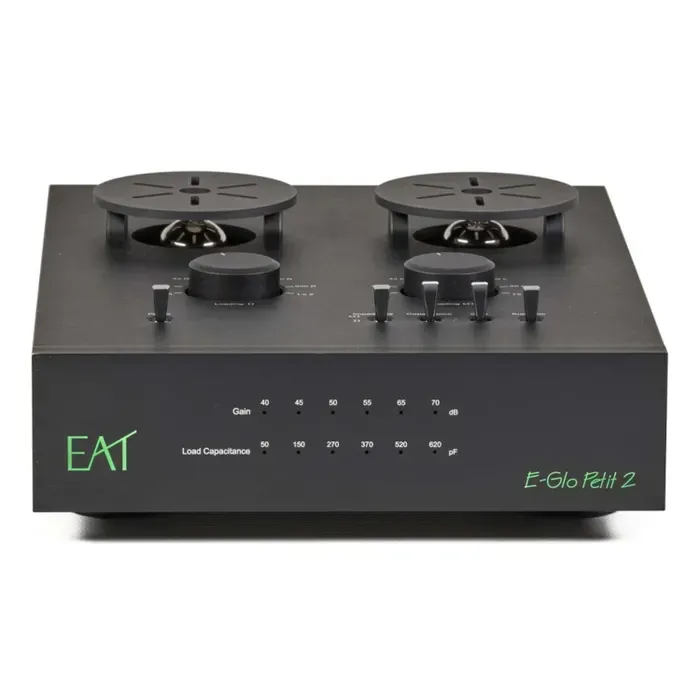
European Audio Team (EAT) E-GLO PETIT 2
Фонокорректоры
European Audio Team (EAT) E-GLO
Фонокорректоры
European Audio Team (EAT) E-GLO PETIT
Фонокорректоры
European Audio Team (EAT) E-GLO S