
Все

Напольная акустика — Davone Audio Reference One
Описание, изображения, технические характеристики и спецификации
Davone Audio Reference One
Источник изображения — © Davone Audio
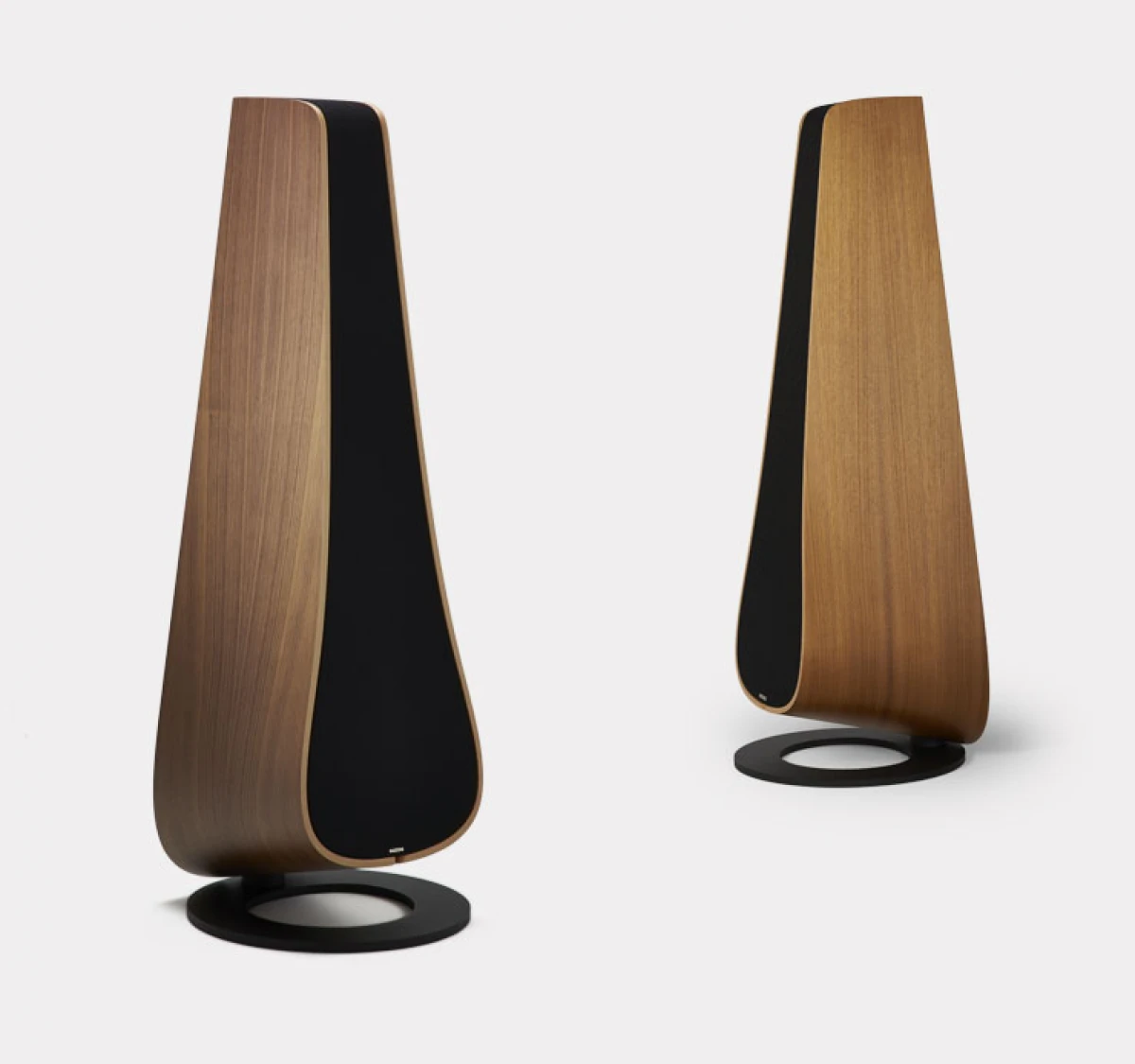
The Reference One is a Davone Audio three-way tower, and the first model of its Reference line, designed and built in Denmark, followed by the Reference Two and Reference Three. Its curved cabinet is formed from bent plywood and finished in quarter-cut walnut veneer combined with either soft white or black leather, and a cloth grille that hides the bass port outlet.
Key specs that matter
Davone fits a 1 inch beryllium dome weighing only 0.1 g, flush-mounted, with its first breakup mode above 40 kHz, and its magnet system produces 2 Tesla in the gap. A 4.5 inch midrange uses a Textreme carbon fibre membrane from the Swedish company Oxeon. Bass comes from a 10 inch driver with a hard paper cone, a double magnet, a 3 inch long-throw voice coil and a limiting spider. Internal surfaces are deliberately non-parallel, and acoustic ties and baffles inside the box further break up standing waves. Rated response is 29 Hz to 30 kHz at -3 dB. Sensitivity is 87 dB measured at 2.83 V and 1 m. Nominal impedance is 4 ohm, with a minimum of 3.4 ohm at 26 Hz, and it stays above 4 ohm from 37 Hz upwards. Davone's own drawing gives each speaker a height of 97 cm, a width of 47 cm and a depth of 37 cm, with a weight of 42 kg.
Engineering and use context
Davone shapes every wall from 25 mm form-pressed plywood using a high-pressure and high-temperature bending process, and the curved form adds stiffness on its own. Inside, bracing made of 18 mm and 22 mm plywood ties the walls together. The bass reflex port fires upwards and is linear, oversized, damped and without sharp corners, with a cross-section equal to 30 percent of the woofer membrane area to keep air velocity low. According to Davone, the Textreme midrange spreads its breakup modes so that they carry little energy, and the light beryllium dome pushes its own breakup far beyond the audible range. The speaker terminals at the back are made by WBT. The impedance minimum sits in the deepest bass, where the amplifier has to supply the most current.
Pairing
Davone asks for amplifiers of 100 W or more, and this bass dip favours transistor amplification able to deliver high current into low loads. The upward-firing port and wide front suit a room of around 20 m2 or larger.
Alternatives
The Davone Reference Two sits beside it as a further tower in the Reference family.
Key specs that matter
Davone fits a 1 inch beryllium dome weighing only 0.1 g, flush-mounted, with its first breakup mode above 40 kHz, and its magnet system produces 2 Tesla in the gap. A 4.5 inch midrange uses a Textreme carbon fibre membrane from the Swedish company Oxeon. Bass comes from a 10 inch driver with a hard paper cone, a double magnet, a 3 inch long-throw voice coil and a limiting spider. Internal surfaces are deliberately non-parallel, and acoustic ties and baffles inside the box further break up standing waves. Rated response is 29 Hz to 30 kHz at -3 dB. Sensitivity is 87 dB measured at 2.83 V and 1 m. Nominal impedance is 4 ohm, with a minimum of 3.4 ohm at 26 Hz, and it stays above 4 ohm from 37 Hz upwards. Davone's own drawing gives each speaker a height of 97 cm, a width of 47 cm and a depth of 37 cm, with a weight of 42 kg.
Engineering and use context
Davone shapes every wall from 25 mm form-pressed plywood using a high-pressure and high-temperature bending process, and the curved form adds stiffness on its own. Inside, bracing made of 18 mm and 22 mm plywood ties the walls together. The bass reflex port fires upwards and is linear, oversized, damped and without sharp corners, with a cross-section equal to 30 percent of the woofer membrane area to keep air velocity low. According to Davone, the Textreme midrange spreads its breakup modes so that they carry little energy, and the light beryllium dome pushes its own breakup far beyond the audible range. The speaker terminals at the back are made by WBT. The impedance minimum sits in the deepest bass, where the amplifier has to supply the most current.
Pairing
Davone asks for amplifiers of 100 W or more, and this bass dip favours transistor amplification able to deliver high current into low loads. The upward-firing port and wide front suit a room of around 20 m2 or larger.
Alternatives
The Davone Reference Two sits beside it as a further tower in the Reference family.
Характеристики
Название модели
Reference One
Нижняя граница частотного диапазона +/- 3дБ (Hz)
29
Верхняя граница частотного диапазона +/- 3дБ (Hz)
30 000
Чувствительность (dB at 1 W/1m)
87
Импеданс (Ohms)
4
Требования к усилителю мощности (W)
>100
Наличие встроенного усилителя
Н/д
Мощность встроенного усилителя (W)
N/A
Размер (sm)
97 × 47 × 37
Вес (kg)
42
Официальная ссылка
Другие компоненты
Напольная акустика
Davone Audio Solo-R
Напольная акустика
Davone Audio Moxie
Напольная акустика
Davone Audio Meander
Напольная акустика
Davone Audio Twist
Напольная акустика
Davone Audio Solo