
Все

Напольная акустика — KEF Reference 5 Meta
Описание, изображения, технические характеристики и спецификации
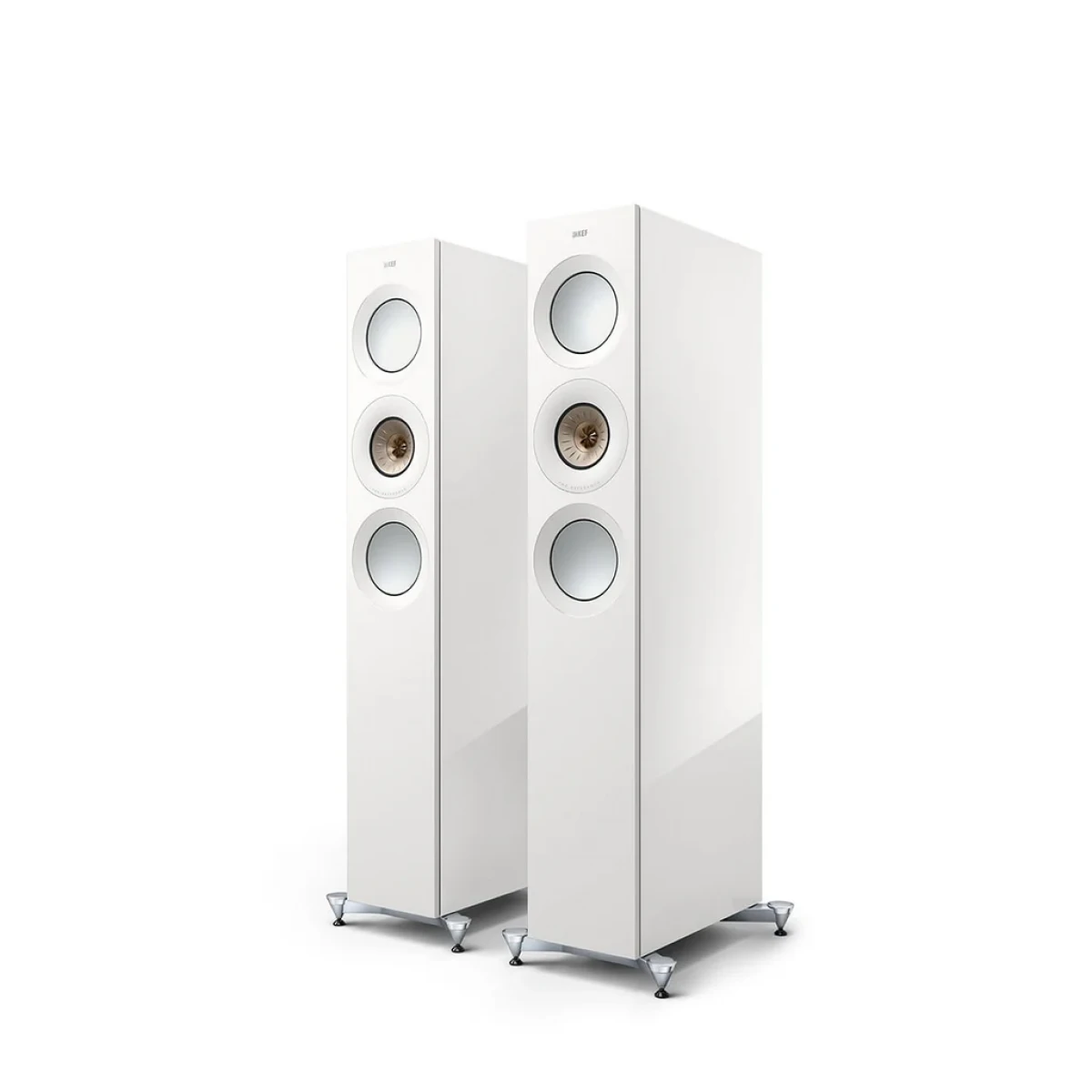
KEF Reference 5 Meta
Источник изображения — © KEF
The Reference 5 Meta is the largest floorstanding model in KEF's Reference series, still designed, engineered and hand-built at KEF's home in Maidstone, Kent, where the company has made loudspeakers since 1961. It uses the same 12th-generation Uni-Q array as the smaller Reference 3 Meta but doubles the number of bass drivers, aiming at larger rooms and higher output levels.
Key specs that matter
The Reference 5 Meta is a vented three-way carrying six drivers - a Uni-Q array combining a 25mm aluminium dome tweeter with MAT and a 125mm aluminium midrange cone, plus four 165mm (6.5-inch) aluminium bass drivers. Crossover points are 450Hz and 2.1kHz. Frequency response is 40Hz to 35kHz (+/-3dB), with free-field -6dB points of 35Hz with the short port or 32Hz with the long port, and typical in-room bass extension to 25Hz. Sensitivity is 88dB at 2.83V/1m, impedance is 4 ohms nominal with a 3.2-ohm minimum, and recommended amplification is 50 to 400W. Maximum output is 116dB, and second and third harmonic distortion at 90dB stays below 0.1% from 2kHz to 20kHz. Each speaker measures 1,350 x 205 x 462mm without plinth and weighs 60.2kg.
Engineering and use context
The narrow cabinet houses all four bass drivers, providing generous total cone area while keeping the front baffle slim, which reduces diffraction and helps the speaker blend into the room visually. Because the four bass units share the load below 450Hz, each moves less for a given level, keeping low-frequency distortion down at high volumes. The Uni-Q array is mounted on a front baffle machined from solid aluminium, a rigid, non-resonant base for the coincident driver. MAT, a maze of tuned channels behind the tweeter, absorbs the rear wave that would otherwise reflect inside the driver. The cabinet uses constrained-layer damping and extensive internal bracing, and the crossover uses components chosen to the same standard as KEF's Blade. Flexible Port Technology lets owners swap between short and long port configurations to trade bass extension against placement close to walls. Each pair is matched to within 0.5dB of a laboratory reference standard.
Pairing
A demanding load of this kind calls for powerful amplification with real current capability. The four-driver bass section suits large rooms where smaller towers would run out of output.
Alternatives
KEF's own Reference 3 Meta uses the same Uni-Q array with two bass drivers for medium-sized rooms.
Key specs that matter
The Reference 5 Meta is a vented three-way carrying six drivers - a Uni-Q array combining a 25mm aluminium dome tweeter with MAT and a 125mm aluminium midrange cone, plus four 165mm (6.5-inch) aluminium bass drivers. Crossover points are 450Hz and 2.1kHz. Frequency response is 40Hz to 35kHz (+/-3dB), with free-field -6dB points of 35Hz with the short port or 32Hz with the long port, and typical in-room bass extension to 25Hz. Sensitivity is 88dB at 2.83V/1m, impedance is 4 ohms nominal with a 3.2-ohm minimum, and recommended amplification is 50 to 400W. Maximum output is 116dB, and second and third harmonic distortion at 90dB stays below 0.1% from 2kHz to 20kHz. Each speaker measures 1,350 x 205 x 462mm without plinth and weighs 60.2kg.
Engineering and use context
The narrow cabinet houses all four bass drivers, providing generous total cone area while keeping the front baffle slim, which reduces diffraction and helps the speaker blend into the room visually. Because the four bass units share the load below 450Hz, each moves less for a given level, keeping low-frequency distortion down at high volumes. The Uni-Q array is mounted on a front baffle machined from solid aluminium, a rigid, non-resonant base for the coincident driver. MAT, a maze of tuned channels behind the tweeter, absorbs the rear wave that would otherwise reflect inside the driver. The cabinet uses constrained-layer damping and extensive internal bracing, and the crossover uses components chosen to the same standard as KEF's Blade. Flexible Port Technology lets owners swap between short and long port configurations to trade bass extension against placement close to walls. Each pair is matched to within 0.5dB of a laboratory reference standard.
Pairing
A demanding load of this kind calls for powerful amplification with real current capability. The four-driver bass section suits large rooms where smaller towers would run out of output.
Alternatives
KEF's own Reference 3 Meta uses the same Uni-Q array with two bass drivers for medium-sized rooms.
Характеристики
Название модели
Reference 5 Meta
Нижняя граница частотного диапазона +/- 3дБ (Hz)
40
Верхняя граница частотного диапазона +/- 3дБ (Hz)
35000
Чувствительность (dB at 1 W/1m)
88
Импеданс (Ohms)
4
Требования к усилителю мощности (W)
50 - 400
Наличие встроенного усилителя
Н/д
Мощность встроенного усилителя (W)
N/A
Размер (sm)
140.2 × 32.3 × 46.7
Вес (kg)
60.2
Официальная ссылка
Другие компоненты
Напольная акустика
KEF Reference 3 Meta

Напольная акустика
KEF R5 Meta

Напольная акустика
KEF LS60 Wireless Lotus Edition

Напольная акустика
KEF Blade One Meta

Напольная акустика
KEF Blade Two Meta