
Все

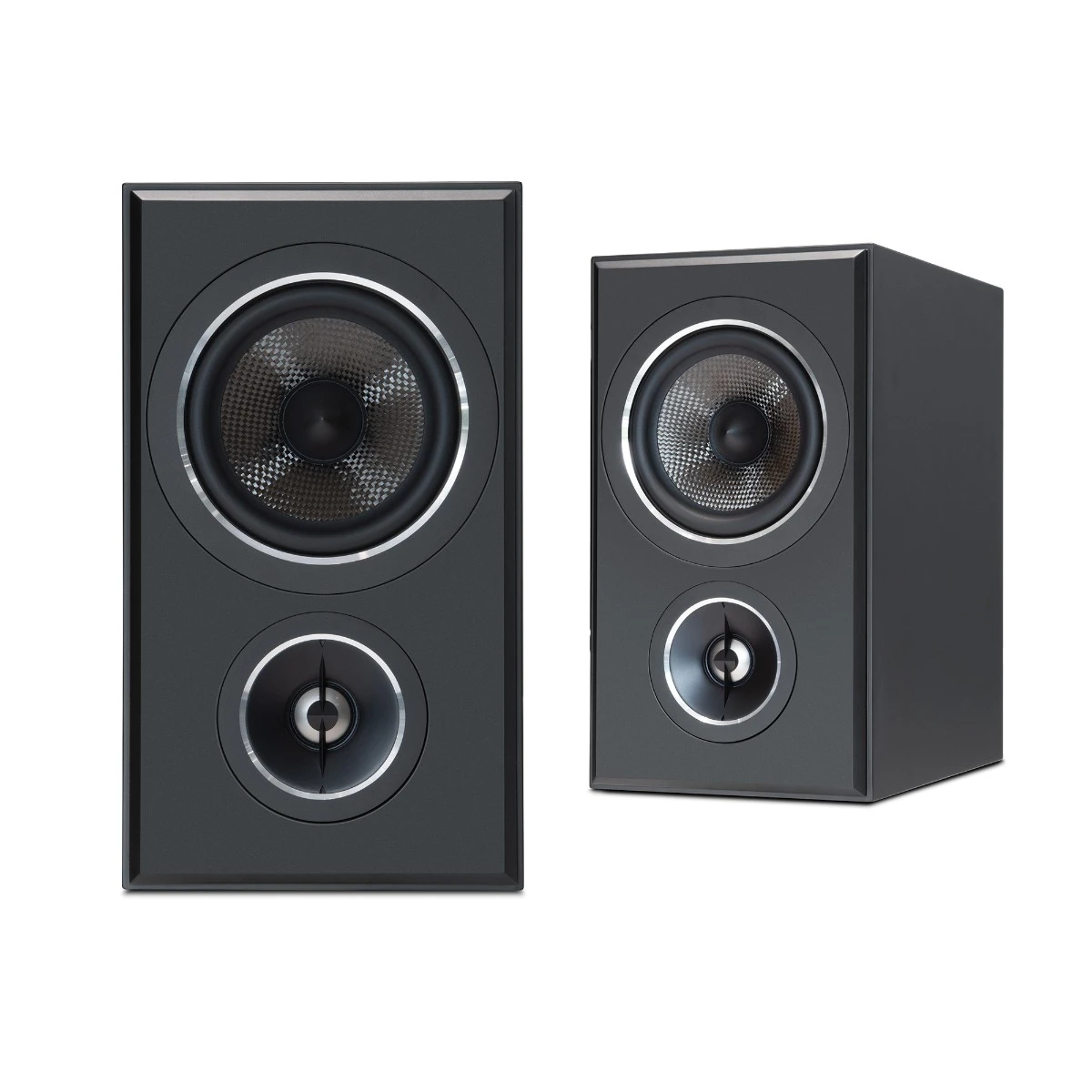
Полочная акустика — Psb Alpha P3
Описание, изображения, технические характеристики и спецификации
Psb Alpha P3
Источник изображения — © Psb
The Alpha P3 is the smallest bookshelf speaker in PSB's Alpha series, the entry range of PSB Speakers, which Paul Barton started in Ontario and which belongs to the Lenbrook group today. The current Alpha generation revised the drivers, crossover and cabinet of the original Alpha while keeping its compact format, and the P3 is aimed at desktops, shelves and small stereo or surround systems.
Key specs that matter
Its two drivers are a 19 mm (3/4 in) black anodised aluminium dome tweeter and a 102 mm (4 in) textured polypropylene woofer with rubber surround, crossed at 3000 Hz with a fourth-order slope. Response is 57 Hz to 21 kHz (+/-3 dB) on axis, sensitivity is 85 dB, nominal impedance is 8 ohms, and PSB suggests 10 W to 80 W of power. The cabinet measures 130 x 220 x 174 mm in width, height and depth, at 2.2 kg per cabinet.
Engineering and use context
The tweeter is ferrofluid cooled and sits behind a front waveguide that controls dispersion on and off axis. PSB places it below the woofer, which keeps the acoustic centres aligned for a listener at desk height or with the speaker on a low shelf. The woofer uses a dual-layer voice coil and a strong magnet, and its textured polypropylene cone resists break-up. The bass reflex port is a rear-firing tube based on a design Paul Barton developed in the 1970s, extending output toward 43 Hz at the limit of the port's range. The crossover was re-engineered to control directivity and flatten response, using a complex Linkwitz-Riley acoustic filter design. The cabinet combines wall thickness and internal bracing to control resonance, and its damping material was first used in PSB's higher-end models. Five-way gold-plated binding posts, magnetically attached grilles and a woodgrain vinyl finish in black ash or walnut complete the build, and PSB offers a five-year warranty.
Pairing
As an easy 8 ohm load, the P3 suits small integrated amplifiers and compact streaming amplifiers of 20 to 50 W per channel at close listening distances. Because the rear port adds bass near a wall, a gap of 20 to 30 cm behind the cabinet keeps its low end in check. In a desktop system, angling the speakers toward the listener places the tweeter axis at ear height. The small cabinet also makes the P3 a practical rear-channel speaker in a compact surround system, mounted on a shelf or bracket behind the seating, and a subwoofer takes over below its bass limit.
Alternatives
PSB's Alpha P5 steps up to a bigger woofer and cabinet within the Alpha line.
Key specs that matter
Its two drivers are a 19 mm (3/4 in) black anodised aluminium dome tweeter and a 102 mm (4 in) textured polypropylene woofer with rubber surround, crossed at 3000 Hz with a fourth-order slope. Response is 57 Hz to 21 kHz (+/-3 dB) on axis, sensitivity is 85 dB, nominal impedance is 8 ohms, and PSB suggests 10 W to 80 W of power. The cabinet measures 130 x 220 x 174 mm in width, height and depth, at 2.2 kg per cabinet.
Engineering and use context
The tweeter is ferrofluid cooled and sits behind a front waveguide that controls dispersion on and off axis. PSB places it below the woofer, which keeps the acoustic centres aligned for a listener at desk height or with the speaker on a low shelf. The woofer uses a dual-layer voice coil and a strong magnet, and its textured polypropylene cone resists break-up. The bass reflex port is a rear-firing tube based on a design Paul Barton developed in the 1970s, extending output toward 43 Hz at the limit of the port's range. The crossover was re-engineered to control directivity and flatten response, using a complex Linkwitz-Riley acoustic filter design. The cabinet combines wall thickness and internal bracing to control resonance, and its damping material was first used in PSB's higher-end models. Five-way gold-plated binding posts, magnetically attached grilles and a woodgrain vinyl finish in black ash or walnut complete the build, and PSB offers a five-year warranty.
Pairing
As an easy 8 ohm load, the P3 suits small integrated amplifiers and compact streaming amplifiers of 20 to 50 W per channel at close listening distances. Because the rear port adds bass near a wall, a gap of 20 to 30 cm behind the cabinet keeps its low end in check. In a desktop system, angling the speakers toward the listener places the tweeter axis at ear height. The small cabinet also makes the P3 a practical rear-channel speaker in a compact surround system, mounted on a shelf or bracket behind the seating, and a subwoofer takes over below its bass limit.
Alternatives
PSB's Alpha P5 steps up to a bigger woofer and cabinet within the Alpha line.
Характеристики
Название модели
Alpha P3
Нижняя граница частотного диапазона +/- 3дБ (Hz)
57
Верхняя граница частотного диапазона +/- 3дБ (Hz)
21 000
Чувствительность (dB at 1 W/1m)
85
Импеданс (Ohms)
8
Требования к усилителю мощности (W)
10 - 80
Наличие встроенного усилителя
Н/д
Мощность встроенного усилителя (W)
N/A
Размер (sm)
13.0 x 22.0 x 17.4
Вес (kg)
2.2
Официальная ссылка
Другие компоненты
Полочная акустика
Psb alpha-am3
Полочная акустика
Psb Alpha AM5
Полочная акустика
Psb Alpha P5
Полочная акустика
Psb Alpha iQ
Полочная акустика
Psb Imagine B50