

Усилители мощности моно — Dan D'Agostino Relentless Epic 1600 Mono Amplifier
Описание, изображения, технические характеристики и спецификации
Dan D'Agostino Relentless Epic 1600 Mono Amplifier
Источник изображения — © Dan D'Agostino
Key specs that matter
The maker rates output at 1,600 W into 8 ohms, 3,200 W into 4 ohms and 6,400 W into 2 ohms. Distortion is 0.05 % at 1 kHz at 1,600 W into 8 ohms, frequency response is 20 Hz to 20 kHz within 0.1 dB, and slew rate is 100 V per microsecond. Output impedance is under 0.03 ohm from 20 Hz to 20 kHz, giving a damping factor above 267 referenced to 8 ohms. Noise sits more than 75 dB below output, A-weighted. Gain is 28 dB and input impedance 100 kohm. Each unit measures 57.2 x 29.2 x 82.8 cm and weighs 258 kg. Consumption is 40 W in standby, 480 W at idle and up to 10 kW at maximum.
Engineering and use context
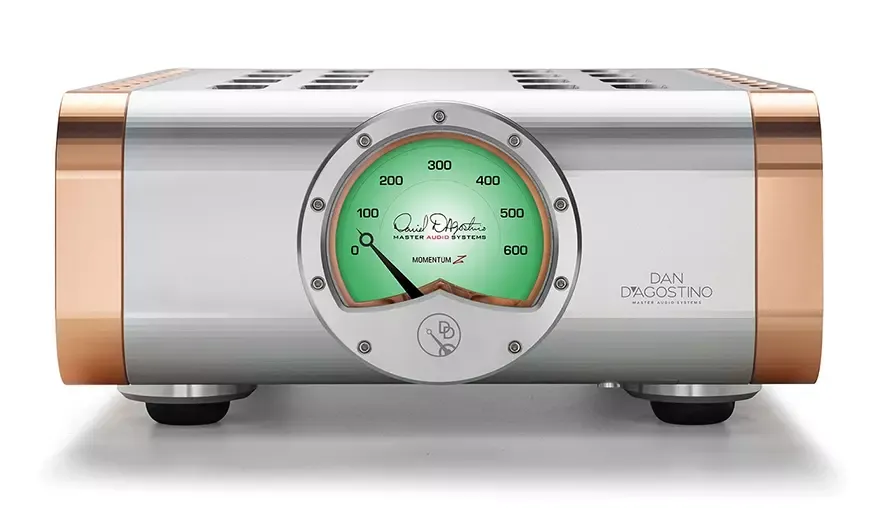
Output duty falls to 112 transistors, each measured and matched for gain linearity from 50 mA to 5 A. Driver transistors were upgraded to handle 33 % more power per device, and their count was doubled compared with the earlier design. Class A operating bias was raised by nearly 50 %, while a bias stability circuit keeps it consistent and prevents excessive temperatures. The circuit runs without global negative feedback, uses current mirror circuitry for symmetrical rails, and applies the Super Rail concept to raise the voltage feeding the stage before the outputs. Power comes from a 5.5 kW linear transformer in multiple sections, potted and shielded in metal to reduce noise, followed by a custom rectifier and a 600,000 microfarad 100 V capacitor bank. A slow-start circuit prevents tripped circuit breakers at switch-on. The solid aluminium chassis is precision machined with no visible fasteners, and a copper and aluminium hybrid heatsink with an elliptical profile handles cooling. A power meter over 20 cm across adjusts its range and response to the incoming signal.
Pairing
Two units make up a stereo system. Each accepts one balanced XLR input, so the preamplifier must provide balanced outputs, and one pair of binding posts per chassis connects the loudspeaker. The power draw and weight call for a dedicated mains circuit and a floor placement able to carry the load.
Alternatives
The Dan D'Agostino Progression M550 sits in the Progression line as a mono power amplifier of lower output.
Характеристики
Название модели
Relentless Epic 1600 Mono Amplifier
Чувствительность входа (mV)
N/A
Входное сопротивление (балансное) (Ω)
N/A
Входное сопротивление (небалансное) (Ω)
N/A
Выходное сопротивление (балансное) (Ω)
N/A
Выходное сопротивление (небалансное) (Ω)
N/A
Максимальный ток (A)
N/A
Выходная мощность (8Ω) (W)
1500
Выходная мощность (4Ω) (W)
3000
Усиление (dBu)
28
Нижняя граница частотного диапазона +/- 3дБ (Hz)
0.1
Верхняя граница частотного диапазона +/- 3дБ (Hz)
100 000
Отношение сигнал/шум (dB)
>113
Коэффициент гармонических искажений + шум (0% обратной связи) (%)
N/A
Коэффициент гармонических искажений + шум (100% обратной связи) (%)
<0,007
Максимальное энергопотребление (W)
480
Коэффициент демпфирования
>267
Габариты (mm)
572 x 280 x 826
Вес (kg)
258
Официальная ссылка
Связанные материалы
Другие компоненты
Усилители мощности моно
Dan D'Agostino Momentum Z