

Усилители мощности моно — VTL Lohengrin Reference
Описание, изображения, технические характеристики и спецификации
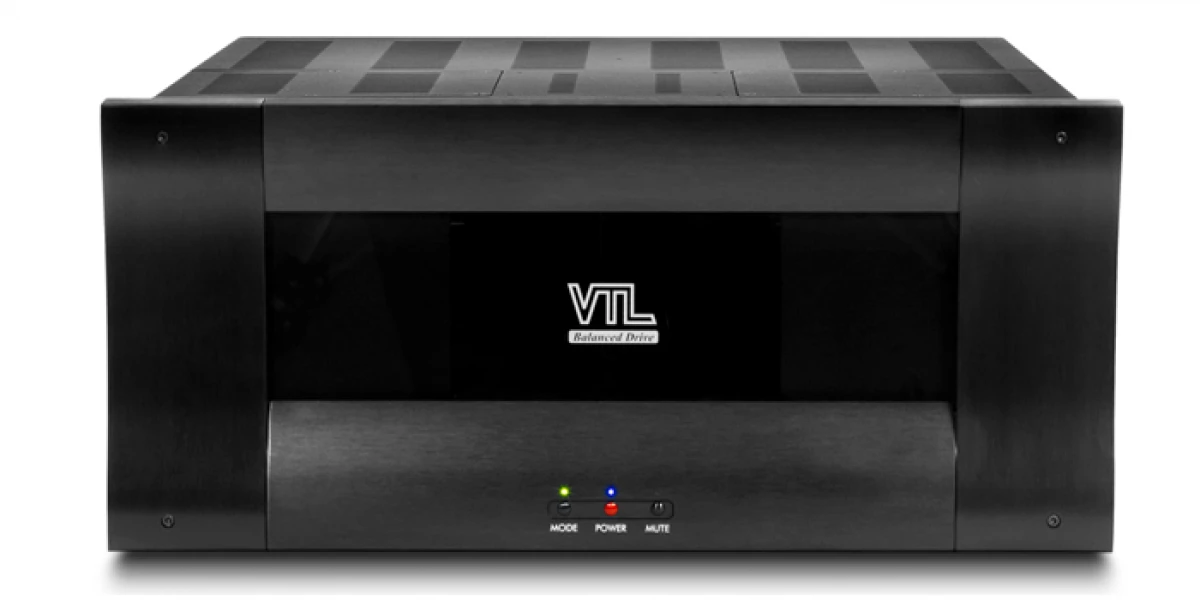
VTL Lohengrin Reference
Источник изображения — © VTL
Key specs that matter
Rated output across 20 Hz to 20 kHz is 400 W in tetrode mode and 200 W in triode mode, both specified into a 5 ohm load, with total harmonic distortion below 2.5% at full power in either mode. The tube set per unit is one 12AT7, two 12BH7 and eight 6550 or KT-88. The output stage runs in class AB1, and the optimal load range is 4 to 8 ohm. Each monoblock has one balanced XLR input, one single-ended RCA input and a single pair of 5-way binding posts. Input impedance is 47 kohm, input sensitivity varies between 1 and 2 V depending on the damping setting, and common mode rejection on the balanced input is 60 dB. Signal-to-noise ratio is quoted as -110 dB. Power draw is 350 W at idle and 900 W at full output. A single chassis is 29 cm wide, 49 cm deep and 50 cm high at 77 kg net, and a pair ships in one crate at 227 kg.
Engineering and use context
The input and driver stages are fully balanced and differential, so a single-ended source still produces a balanced signal at the output. There is no global negative feedback, only a shorter local loop, and VTL states that the amplifier is unconditionally stable without capacitor compensation. Bandwidth reaches 100 kHz at -1 dB. A user-adjustable DF control changes output impedance and damping factor to suit the loudspeaker. The heavily interleaved multi-section output transformer is a VTL design, and the low impedance of the output stage allowed a simpler transformer with less step-down. Plate and screen supplies are precision-regulated and adjustable, a separate discrete regulated supply feeds the input and driver circuits, and the bias supply is regulated so tube operating points stay put under normal mains fluctuation. A microprocessor handles automatic bias, tetrode and triode switching, layered fault sensing against output tube failure, in-rush current limiting and a standby mute that lowers tube current to extend tube life. An RS-232 port gives two-way control and diagnostics. All signal path capacitors are Mundorf silver oil types, with film bypasses on the supply capacitors.
Pairing
The wide load window and high output suit large passive loudspeakers, and a preamplifier with balanced outputs uses the XLR input directly.
Alternatives
Among VTL monoblocks, the closest relative is the Siegfried Series II Reference, source of the driver stages and power supply used in the Lohengrin.
Характеристики
Название модели
Lohengrin Reference
Чувствительность входа (mV)
N/A
Входное сопротивление (балансное) (Ω)
N/A
Входное сопротивление (небалансное) (Ω)
N/A
Выходное сопротивление (балансное) (Ω)
N/A
Выходное сопротивление (небалансное) (Ω)
N/A
Максимальный ток (A)
N/A
Выходная мощность (8Ω) (W)
400 (tetrod), 200 (diod)
Выходная мощность (4Ω) (W)
N/A
Усиление (dBu)
N/A
Нижняя граница частотного диапазона +/- 3дБ (Hz)
N/A
Верхняя граница частотного диапазона +/- 3дБ (Hz)
N/A
Отношение сигнал/шум (dB)
N/A
Коэффициент гармонических искажений + шум (0% обратной связи) (%)
N/A
Коэффициент гармонических искажений + шум (100% обратной связи) (%)
N/A
Максимальное энергопотребление (W)
900
Коэффициент демпфирования
N/A
Габариты (mm)
290 × 490 × 500
Вес (kg)
77
Официальная ссылка
Связанные материалы
Другие компоненты

Усилители мощности моно
VTL Siegfried Series II Reference

Усилители мощности моно
VTL MB-450 Series III Signature
Усилители мощности моно
VTL MB-185 Series III Signature

Усилители мощности моно
VTL MB-125