
All

Turntables — Reed MUSE 1C
Description, images, technical data and specifications
Reed MUSE 1C
Image source — © Reed
The Muse 1C is the entry point into the turntable range of Reed, the Lithuanian manufacturer founded by radio engineer Vidmantas Triukas, who has worked in hi-fi since 1985 and holds three patents in acoustic noise transmission. It is Reed's first deck with a traditional, 1970s-inspired wooden plinth, but much of its technology, including the main bearing and drive traction control, is inherited from the company's flagship Muse 3C.
Key specs that matter
The Muse 1C is offered with either friction (rim) drive or belt drive, both powered by two DC motors. It plays 16, 33, 45 and 78rpm, with 78rpm manually adjustable from 70 to 85rpm. Speed is stabilised by a quartz-referenced phase-locked loop, with a maximum deviation of average speed of +/-0.05%. The deck runs on 10 to 14V DC from the supplied 100-240V adapter or Reed's own Source 12V power supply, and weighs 15kg unpacked. The shipping carton measures 650 x 520 x 350mm, and finishes are Moonlit Black or Karelian birch.
Engineering and use context
The friction-drive version is Reed's modern reinterpretation of the classic idler and rim-drive principle, built around a precisely machined drive system with the traction control carried over from the Muse 3C, so the platter gets the torque and speed stability of rim drive without the rumble associated with vintage idler decks. Two DC motors share the drive, and the quartz PLL continuously corrects speed against a crystal reference. The slender platter and raised centre section let the drive mechanism sit inside the plinth without making it thick. A built-in electronic inclinometer with an accuracy of 1mm per metre measures the deck's tilt, so it can be levelled precisely without a separate spirit level, and its readout shares the display used for speed control. Operation is through five buttons on the top panel for standby and speed selection, and the external power supply keeps mains transformers away from the cartridge.
Pairing
The Muse 1C takes a single centre-mount or off-centre-mount tonearm with an effective length from 9.5 to 12 inches, which covers most modern arms, including Reed's own 1H and 3P models. Because tonearm leads exit from the arm itself, the choice of arm also defines the cable to the phono stage. The 16 and adjustable 78rpm speeds make it suitable for collectors of shellac and early vinyl, using a dedicated 78 stylus.
Alternatives
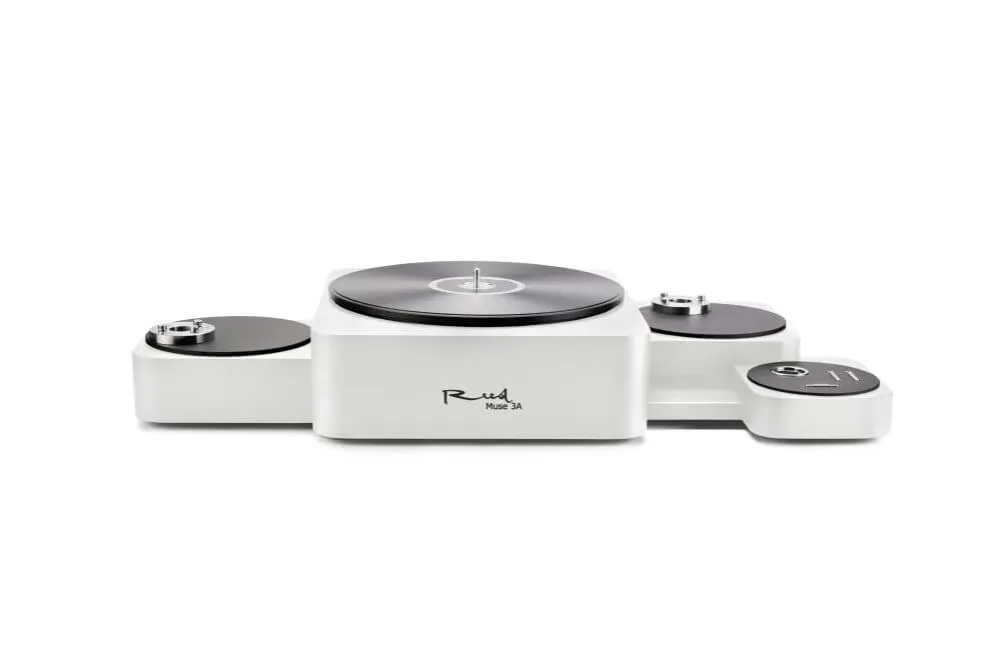
Reed's own Muse 3A offers a more flexible chassis with provision for two tonearms for buyers who want to run mono and stereo arms side by side.
Key specs that matter
The Muse 1C is offered with either friction (rim) drive or belt drive, both powered by two DC motors. It plays 16, 33, 45 and 78rpm, with 78rpm manually adjustable from 70 to 85rpm. Speed is stabilised by a quartz-referenced phase-locked loop, with a maximum deviation of average speed of +/-0.05%. The deck runs on 10 to 14V DC from the supplied 100-240V adapter or Reed's own Source 12V power supply, and weighs 15kg unpacked. The shipping carton measures 650 x 520 x 350mm, and finishes are Moonlit Black or Karelian birch.
Engineering and use context
The friction-drive version is Reed's modern reinterpretation of the classic idler and rim-drive principle, built around a precisely machined drive system with the traction control carried over from the Muse 3C, so the platter gets the torque and speed stability of rim drive without the rumble associated with vintage idler decks. Two DC motors share the drive, and the quartz PLL continuously corrects speed against a crystal reference. The slender platter and raised centre section let the drive mechanism sit inside the plinth without making it thick. A built-in electronic inclinometer with an accuracy of 1mm per metre measures the deck's tilt, so it can be levelled precisely without a separate spirit level, and its readout shares the display used for speed control. Operation is through five buttons on the top panel for standby and speed selection, and the external power supply keeps mains transformers away from the cartridge.
Pairing
The Muse 1C takes a single centre-mount or off-centre-mount tonearm with an effective length from 9.5 to 12 inches, which covers most modern arms, including Reed's own 1H and 3P models. Because tonearm leads exit from the arm itself, the choice of arm also defines the cable to the phono stage. The 16 and adjustable 78rpm speeds make it suitable for collectors of shellac and early vinyl, using a dedicated 78 stylus.
Alternatives
Reed's own Muse 3A offers a more flexible chassis with provision for two tonearms for buyers who want to run mono and stereo arms side by side.
Specifications
Model name
MUSE 1C
Speed
33/45/78
Drive
Belt
Suspension
N/A
Tonearm preinstalled
N/A
Tonearm model
N/A
Cartridge preinstalled
N/A
Cartridge model
N/A
Platter
N/A
Motor
DC
Wow and Flutter (%)
N/A
Signal to Noise (dB)
N/A
Rumble (-dB)
N/A
Dimensions (mm)
650 x 520 x 350
Weight (kg)
15
Official link
More components
Turntables
Reed MUSE 3C
Turntables
Reed MUSE 3A