All

Tonearms — Dohmann Audio REED 5A
Description, images, technical data and specifications
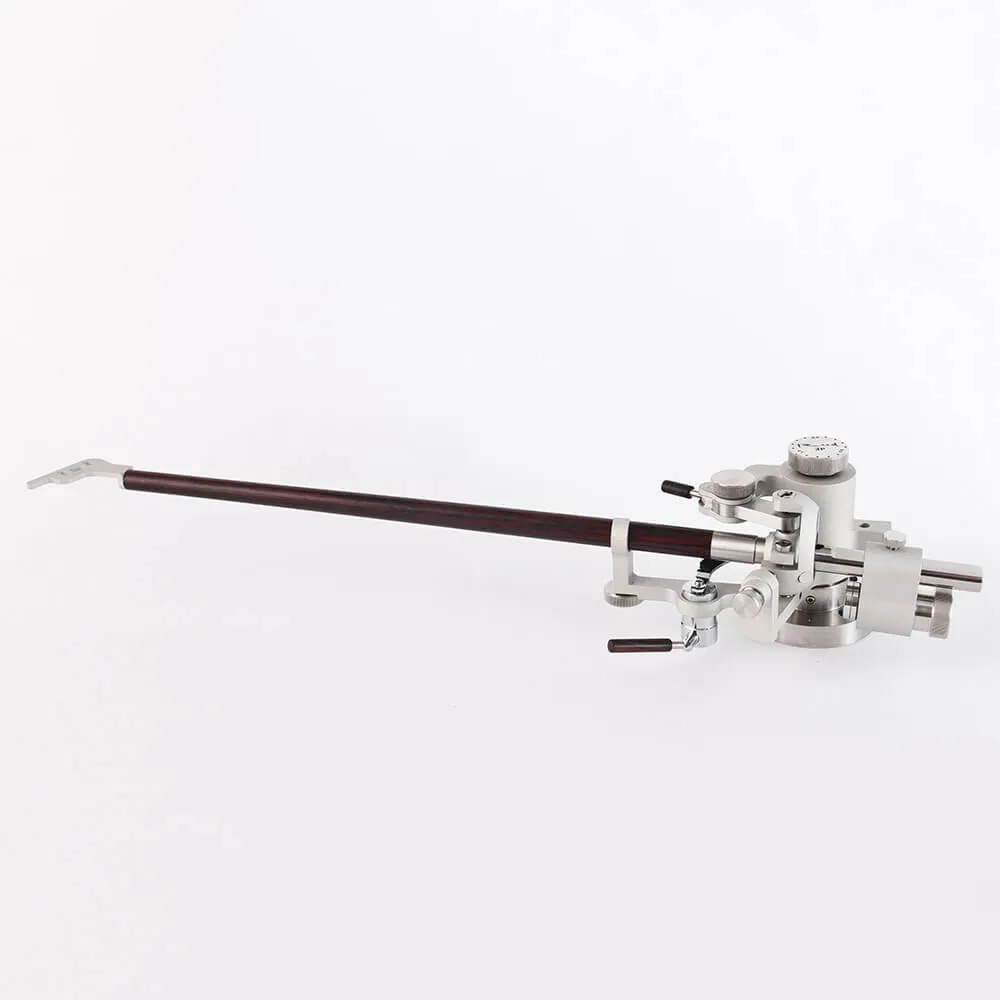
Dohmann Audio REED 5A
Image source — © Dohmann Audio
Reed builds the 5A in the Kaunas district of Lithuania. The company's founder and designer, Vidmantas Triukas, is a radio engineer active in audio since 1985, with three patents in acoustics and ultrasound. Reed made its first tonearm around 2008 and remains a company of five people. The 5A is a tangential-pivot arm based on Thales geometry, and it belongs to Reed's tangential line together with the laser-guided 5T. Other Reed arms are the 1H, 2B, 2G and 3P.
Key specs that matter
Maximum tracking error is ±4 minutes of arc, compared with about 1.2 to 2.5 degrees for conventional pivoted arms, according to Reed. No anti-skating is needed. VTA adjusts in increments as fine as ±0.2 mm and azimuth over ±8 degrees, and an integrated level with an adjuster sets the horizontal plane to ±2 mm per metre. The arm accepts Reed or SME-type headshells. The mounting distance is 251 mm, for platters up to 330 mm in diameter and platter heights of 26 to 46 mm. Downforce ranges from 10 to 30 mN, and cartridges from 5.5 to 19.5 g can be fitted, or from 4.0 to 25.0 g as an option. Offset and overhang are both zero. Effective mass is 10 to 16 g depending on the armwand, wenge at 10 to 14 g, Macassar ebony at 10 to 16 g, cocobolo at 12 to 16 g and light or dark teak at 8 to 12 g. Finishes are Seashell white and black.
Engineering and use context
The 5A holds the stylus at the correct angle across the whole record by mechanical geometry alone, without the motor, laser and electronic controller of the 5T or the air compressors used by some linear-tracking arms. The armtube is suspended in the same way as on the Reed 3P. A rear link runs on low-noise ceramic rolling bearings, and the lever turns on a ceramic bearing resting on a sapphire and molybdenum-carbide thrust bearing, the same type used on the front link and on the vertical and horizontal axes. Because the stylus stays tangential, the arm has zero offset and zero overhang, and no skating force arises that would need correction. Swapping between the wooden armwands shifts the effective mass to suit stiffer or softer cartridge suspensions.
Pairing
The 5A fits turntables within the mounting range above, and its cartridge range covers most moving-coil and moving-magnet designs. Heavier armwands suit low-compliance cartridges and lighter ones high-compliance models.
Alternatives
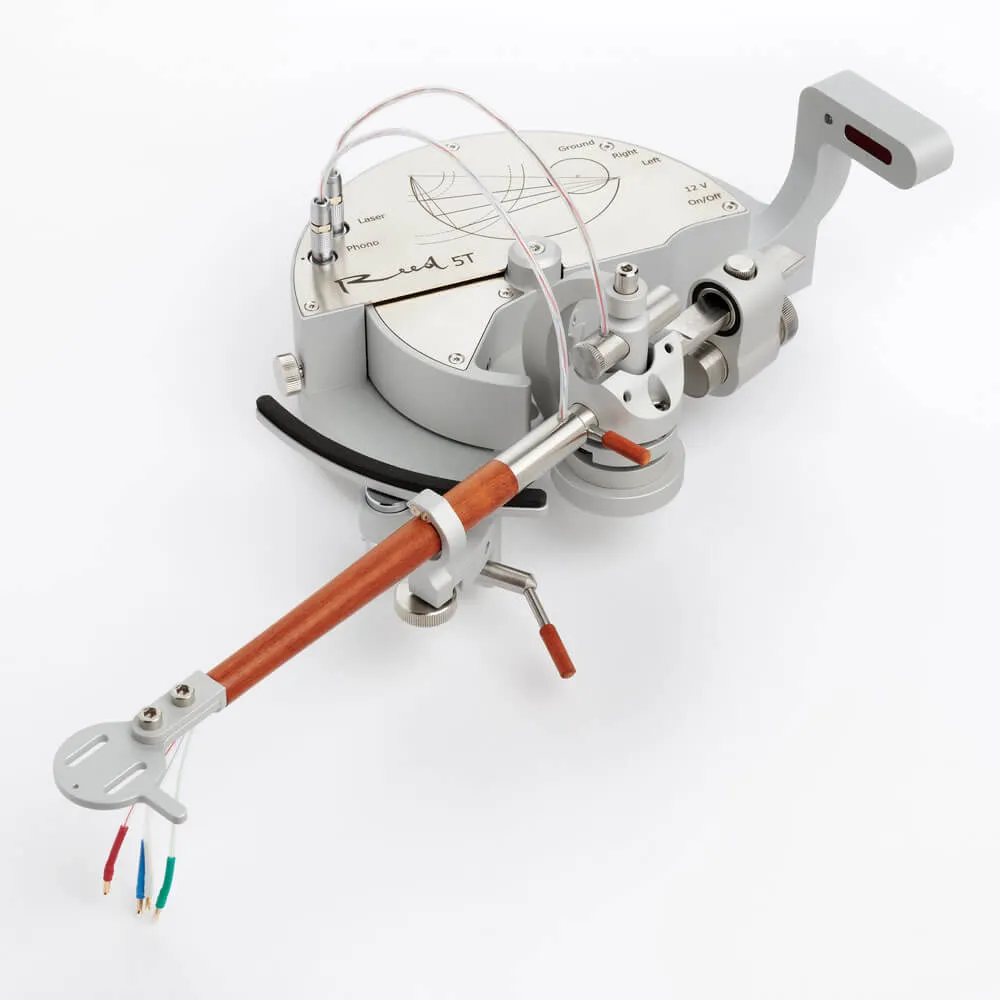
The Reed 5T is the laser-guided, motor-driven tangential sibling of the 5A.
Key specs that matter
Maximum tracking error is ±4 minutes of arc, compared with about 1.2 to 2.5 degrees for conventional pivoted arms, according to Reed. No anti-skating is needed. VTA adjusts in increments as fine as ±0.2 mm and azimuth over ±8 degrees, and an integrated level with an adjuster sets the horizontal plane to ±2 mm per metre. The arm accepts Reed or SME-type headshells. The mounting distance is 251 mm, for platters up to 330 mm in diameter and platter heights of 26 to 46 mm. Downforce ranges from 10 to 30 mN, and cartridges from 5.5 to 19.5 g can be fitted, or from 4.0 to 25.0 g as an option. Offset and overhang are both zero. Effective mass is 10 to 16 g depending on the armwand, wenge at 10 to 14 g, Macassar ebony at 10 to 16 g, cocobolo at 12 to 16 g and light or dark teak at 8 to 12 g. Finishes are Seashell white and black.
Engineering and use context
The 5A holds the stylus at the correct angle across the whole record by mechanical geometry alone, without the motor, laser and electronic controller of the 5T or the air compressors used by some linear-tracking arms. The armtube is suspended in the same way as on the Reed 3P. A rear link runs on low-noise ceramic rolling bearings, and the lever turns on a ceramic bearing resting on a sapphire and molybdenum-carbide thrust bearing, the same type used on the front link and on the vertical and horizontal axes. Because the stylus stays tangential, the arm has zero offset and zero overhang, and no skating force arises that would need correction. Swapping between the wooden armwands shifts the effective mass to suit stiffer or softer cartridge suspensions.
Pairing
The 5A fits turntables within the mounting range above, and its cartridge range covers most moving-coil and moving-magnet designs. Heavier armwands suit low-compliance cartridges and lighter ones high-compliance models.
Alternatives
The Reed 5T is the laser-guided, motor-driven tangential sibling of the 5A.
Specifications
Model name
REED 5A
Type
Tangential
Effective mass (g)
Wenge: 10-14g, Makassar Ebony: 10-16g, Cocobolo: 12-16g, Teak Light: 8-12g, Teak Dark: 8-12g
Effective length (mm)
N/A
Cartridge Balance range (g)
N/A
Offset angle (deg)
N/A
Overhang (mm)
N/A
Weight (g)
N/A
Official link
More components
Tonearms
Dohmann Audio SCHRÖDER CB-11
Tonearms
Dohmann Audio SCHRÖDER CB-9
Tonearms
Dohmann Audio REED 5T
Tonearms
Dohmann Audio REED 3P 12"