
All

Phonostages - Edwards Audio INTRO MM
Description, images, technical data and specifications
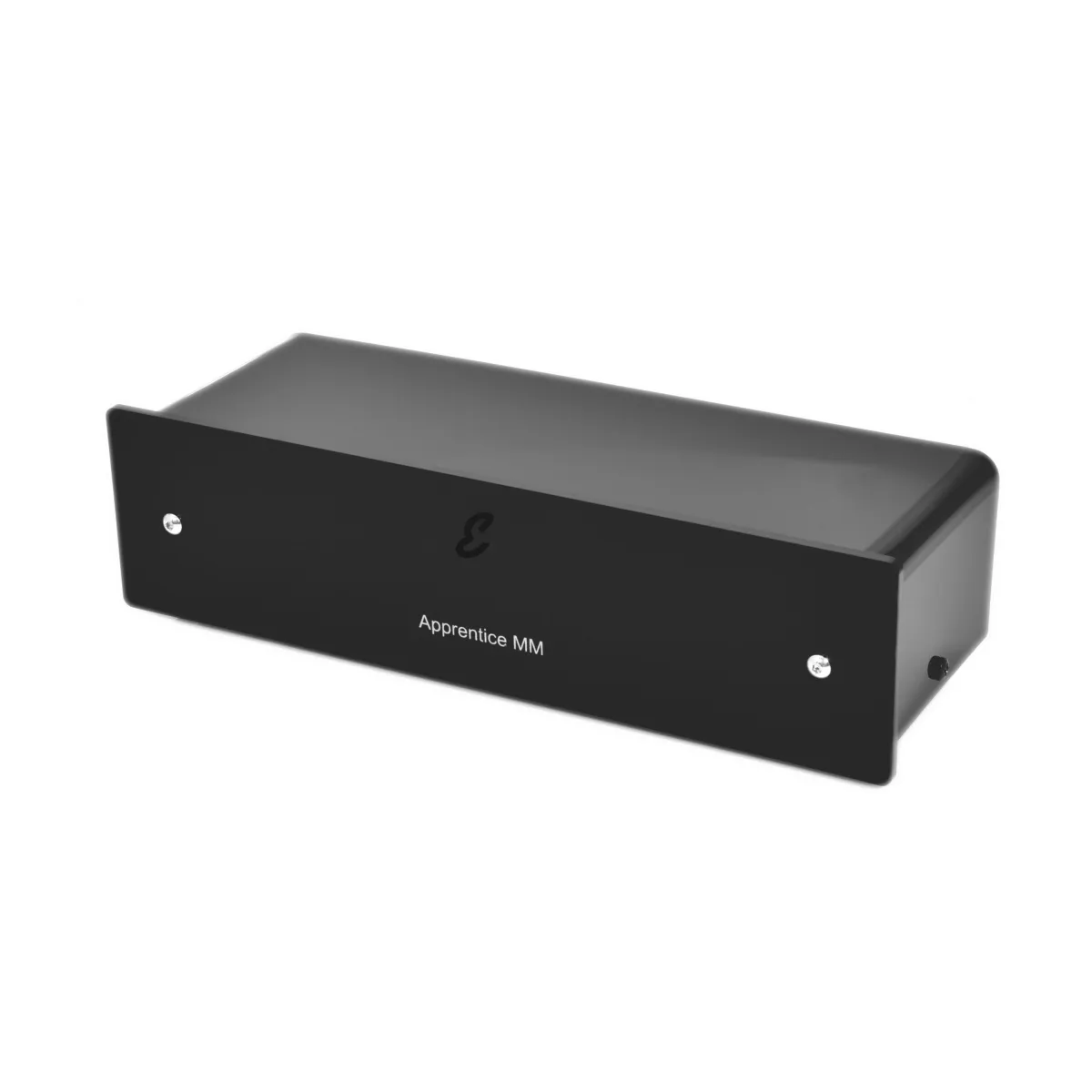
Edwards Audio INTRO MM
Image source - (c) Edwards Audio
The Intro MM is the entry-level phono stage of Edwards Audio, the British maker of turntables, amplifiers and phono stages. Edwards showed it at the North West Audio Show 2025 alongside the Apprentice MM Mk4. It takes the original Apprentice design back to its basic form and adds the upgrades developed since then. Launch price was GBP 99.95 including VAT.
Key specs that matter
There is one moving-magnet input with a fixed 47 kohm load and 120 pF input capacitance. Gain is 42.5 dB, output impedance is below 10 ohms and signal-to-noise ratio is 80 dB. Frequency response is 10 Hz - 100 kHz, and RIAA accuracy is ±0.25 dB from 20 Hz to 20 kHz. Maximum input is 72 mV, and maximum output is 7.5 V RMS. Power comes from an external low-noise AC plug-top supply, consumption is 1 W, and a T250mA anti-surge 20 mm fuse protects the unit.
Engineering and use context
Gain and input loading match those of the more expensive Apprentice MM Mk4. Edwards derived the Apprentice circuit from its MM1. Treble equalisation is passive and bass equalisation is active, and a second amplifier stage buffers the equalisation network. That buffer stage gives the very low output impedance for driving long interconnects and amplifier inputs of any impedance without loss.
Its case is non-magnetic aluminium rather than steel, avoiding the interference a steel enclosure can introduce into high-gain circuitry. With a plug-top supply, the mains transformer sits outside the phono circuit. The compact enclosure is built in the UK in black, grey, red, white, green or blue. Shown at the same event, the Apprentice MM Mk4 moved to an internal power supply and cut consumption from 3 W to 1 W on the same RIAA circuit concept, and an Intro MM owner can later move up to it.
Pairing
A moving-magnet cartridge is required. The output connects to any line-level amplifier input. Turntables without a built-in phono stage, including Edwards Audio's own, are the intended source.
Alternatives
Edwards Audio's Apprentice MM Mk4 is the higher moving-magnet phono stage of the range, with an 81 dB signal-to-noise ratio.
Specifications
Model name
INTRO MM
Inputs (balanced)
N/A
Inputs (single-ended)
1
MC current-sensing input impedance (Ω)
N/A
MM/MC voltage input impedance (Ω)
47 000
Output impedance (Ω)
<10
Gain (dB)
42.5
Playback EQ curves accuracy (dB)
N/A
Frequency response low +/- 3dB (Hz)
10
Frequency response high +/- 3dB (Hz)
100 000
Total Harmonic Distortion + Noise (%)
N/A
Dimensions (mm)
N/A
Weight (kg)
N/A
Official link
More components
Phonostages
Edwards Audio Apprentice MM mk4