
All

DACs — Chord HUGO 2
Description, images, technical data and specifications
Chord HUGO 2
Image source - (c) Chord
Chord Electronics, the British company based in Kent, makes the Hugo 2 as a portable converter with a built-in headphone amp. It was designed by Rob Watts and converts digital audio on a programmable FPGA running Chord's own code in place of a ready-made converter chip. The same unit works as a battery-powered DAC for a phone or laptop, a desktop headphone amplifier or a line-level DAC in a hi-fi system.
Key specs that matter
Conversion runs on a Xilinx Artix-7 (XC7A15T) FPGA. Digital inputs are USB (micro-B), coaxial, optical and aptX Bluetooth, and over USB the Hugo 2 accepts PCM up to 768kHz and DSD up to DSD512. Signal-to-noise ratio is 126dB, THD plus noise is below 0.0001% and output impedance is only 0.025 ohms. Outputs are 3.5mm and 6.35mm headphone sockets plus a pair of RCA line outputs. The aluminium case measures 21 x 100 x 130mm and weighs 365g, and the internal battery lasts around seven hours.
Engineering and use context
Rob Watts' design centres on the reconstruction filter, the part of a DAC that rebuilds the continuous signal between digital samples. The Hugo 2 uses a WTA (Watts Transient Aligned) filter with 49,152 taps, far longer than the filters inside standard DAC chips, with the aim of reconstructing timing more accurately. The converter is a 10-element pulse array, a discrete design in which the FPGA drives resistors and switches directly instead of a multi-bit ladder or a conventional delta-sigma chip. Because the output stage is driven so directly, output impedance stays extremely low, and headphones of any impedance are driven without the source altering their frequency response. Four selectable digital filters and a crossfeed function for headphone listening are built in. They are operated with illuminated spherical buttons whose colours show sample rate, volume and settings. On battery the circuitry is isolated from mains noise, and music playback continues during charging. A remote control is supplied for desktop use.
Pairing
On the move, the Hugo 2 connects to a phone by USB or Bluetooth and drives both sensitive IEMs and demanding full-size headphones. At home the RCA outputs feed an integrated or power amplifier, and thanks to the volume control a power amp can be connected straight to it without a separate preamplifier. Chord's 2go module clips onto the chassis and adds network streaming and local storage.
Alternatives
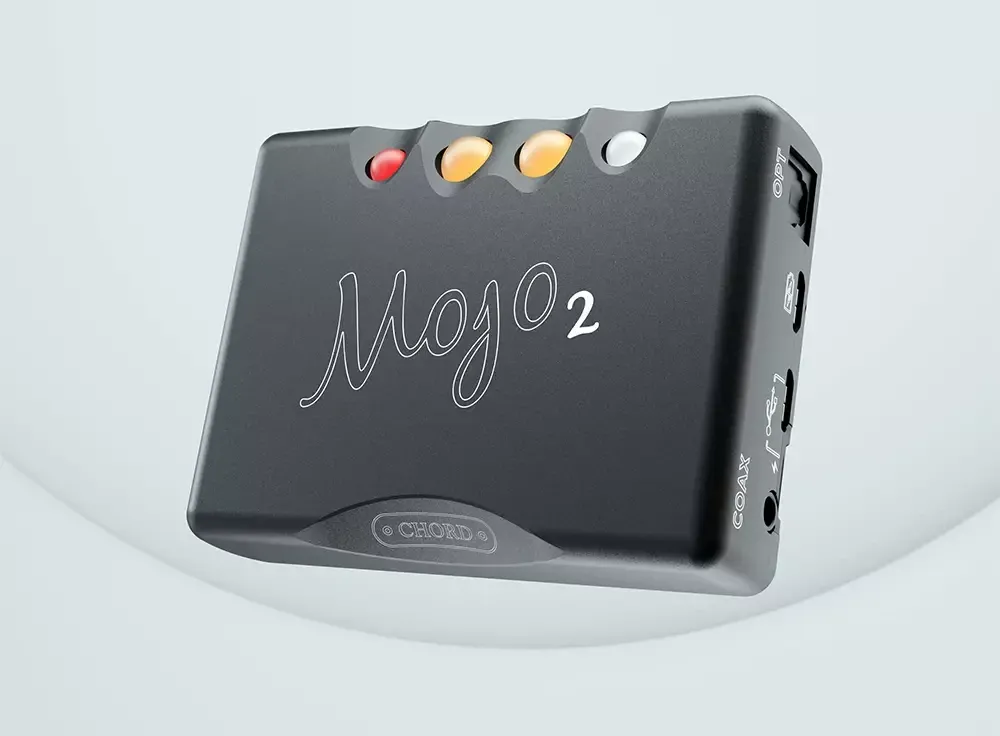
The Chord Mojo 2 is smaller and cheaper, yet relies on the same FPGA conversion approach in a portable body.
Specifications
Model name
HUGO 2
Conversion type
N/A
Engine
Xilinx Artix 7 (XC7A15T) FPGA
DSD compatability
N/A
Parameters
N/A
Frequency response low +/- 3dB (Hz)
20
Frequency response high +/- 3dB (Hz)
20 000
Gain (dBu)
N/A
Output Level (balanced) (V)
N/A
Output Level (single-ended) (V)
N/A
Input Impedance (balanced) (Ω)
N/A
Input Impedance (single-ended) (Ω)
N/A
Output Impedance (balanced) (Ω)
N/A
Output Impedance (single-ended) (Ω)
0.025
Analog outputs
N/A
Signal to Noise Ratio (dB)
126
Total Harmonic Distortion + Noise (% at 22 kHz)
<0.0001
Dimensions (mm)
21 x 100 x 130
Weight (kg)
0.365
Official link
More components
DACs
Chord Mojo 2
DACs
Chord DAVE
DACs
Chord HUGO TT 2

DACs
Chord QUTEST
DACs
Chord Hugo TT2