
All

Floorstanding loudspeakers — Living Voice Vox Palladian
Description, images, technical data and specifications
Living Voice Vox Palladian
Image source — © Living Voice
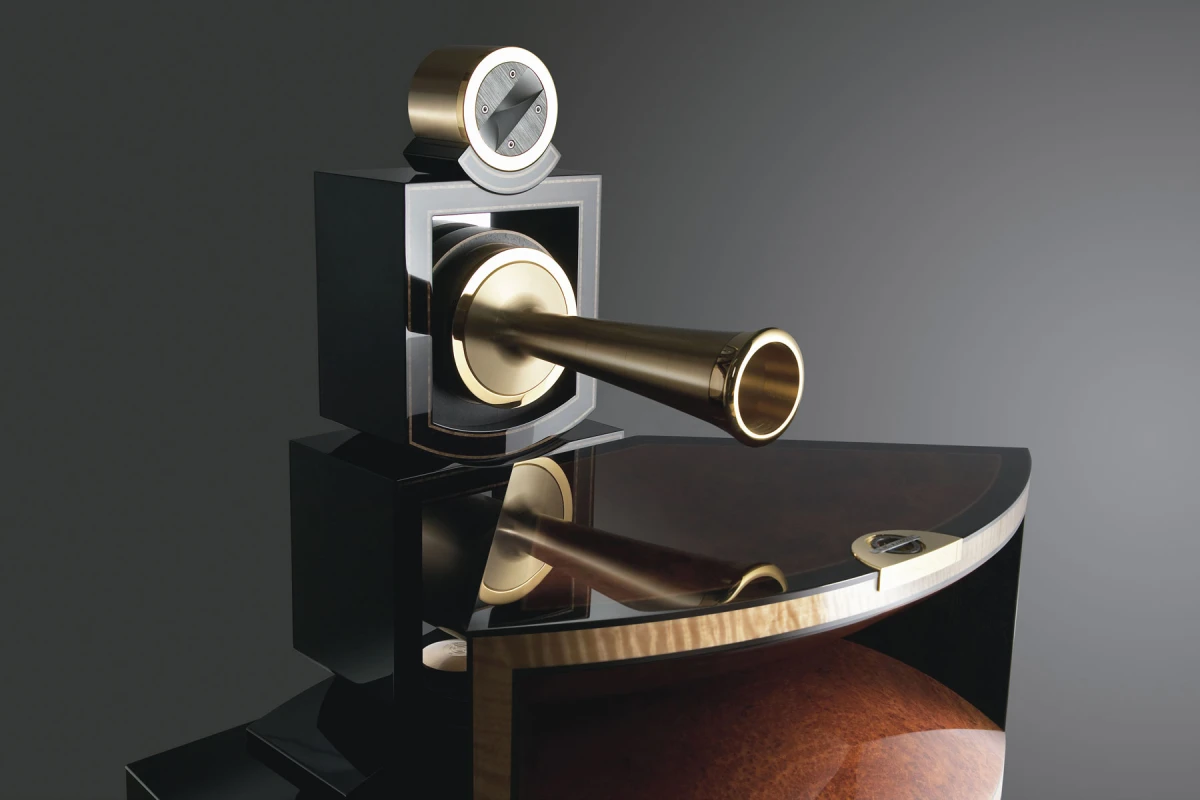
The Vox Palladian is a four-way composite horn loudspeaker from Living Voice of Britain, built with the same technology as the Vox Olympian but in a structure the maker describes as significantly simplified. Living Voice positions it with a cleaner, more contemporary look than its bigger sibling. It was shown at High End 2016 in Munich. The asking price was GBP 252,000 per pair, and a matching Palladian Basso bass system cost a further GBP 198,000 per pair.
Key specs that matter
Living Voice quotes 105 dB sensitivity, an 8 ohm impedance and a frequency range of 70 Hz to 35 kHz. Power handling is given as 100 W. The cabinet measures 680 mm in width, 620 mm in depth and 1800 mm in height, and each one weighs 210 kg.
Engineering and use context
The lowest section of the cabinet uses a Vitavox 151 driver in a folded horn leg made from 34 mm plywood. The midrange uses a modified Vitavox S2 compression driver with a simplified mechanical structure and a revised suspension, loaded by a machined wooden horn identical to the one on the Olympian. Treble comes from a TAD 2002 tweeter in the same bronze trumpet used on the bigger model. At the top sits the LV4 super tweeter, developed by Living Voice together with Vitavox, an exponentially horn-loaded aluminium ring radiator driven by a massive alnico magnet. The crossover lives in an external enclosure with hinged lids, so key values can be adjusted in place, and it is built from non-branded audiophile parts. To cut cost, the exotic veneers and piano lacquers of the Olympian give way to a satin finish over wood veneer with bare edges, the bronze work is chemically patinated to a brown tone, and the conical feet are replaced by a conventional plinth with spikes. The superstructure uses squared-off framework panels with a clear finish.
Pairing
With such high sensitivity, the Palladian lets a low-output tube design, such as a single-ended triode, reach high listening levels, and the benign load keeps the demands on the output transformer modest. Tuning the external crossover in place also helps match the horns to a given amplifier. The Palladian Basso extends the system downward. Its drivers match those of the Vox Elysian in a smaller folded horn with a different geometry, with two drivers firing into a shared acoustic chamber that vents through side-mounted ports. Living Voice also lists the Vox Basso, a 250 litre reflex cabinet with one 18 inch driver reaching 20 Hz.
Alternatives
The Living Voice Vox Olympian is the more elaborate four-way horn system, extending to 45 kHz in a 1600 mm tall cabinet with a TAD ET703 beryllium top driver.
Key specs that matter
Living Voice quotes 105 dB sensitivity, an 8 ohm impedance and a frequency range of 70 Hz to 35 kHz. Power handling is given as 100 W. The cabinet measures 680 mm in width, 620 mm in depth and 1800 mm in height, and each one weighs 210 kg.
Engineering and use context
The lowest section of the cabinet uses a Vitavox 151 driver in a folded horn leg made from 34 mm plywood. The midrange uses a modified Vitavox S2 compression driver with a simplified mechanical structure and a revised suspension, loaded by a machined wooden horn identical to the one on the Olympian. Treble comes from a TAD 2002 tweeter in the same bronze trumpet used on the bigger model. At the top sits the LV4 super tweeter, developed by Living Voice together with Vitavox, an exponentially horn-loaded aluminium ring radiator driven by a massive alnico magnet. The crossover lives in an external enclosure with hinged lids, so key values can be adjusted in place, and it is built from non-branded audiophile parts. To cut cost, the exotic veneers and piano lacquers of the Olympian give way to a satin finish over wood veneer with bare edges, the bronze work is chemically patinated to a brown tone, and the conical feet are replaced by a conventional plinth with spikes. The superstructure uses squared-off framework panels with a clear finish.
Pairing
With such high sensitivity, the Palladian lets a low-output tube design, such as a single-ended triode, reach high listening levels, and the benign load keeps the demands on the output transformer modest. Tuning the external crossover in place also helps match the horns to a given amplifier. The Palladian Basso extends the system downward. Its drivers match those of the Vox Elysian in a smaller folded horn with a different geometry, with two drivers firing into a shared acoustic chamber that vents through side-mounted ports. Living Voice also lists the Vox Basso, a 250 litre reflex cabinet with one 18 inch driver reaching 20 Hz.
Alternatives
The Living Voice Vox Olympian is the more elaborate four-way horn system, extending to 45 kHz in a 1600 mm tall cabinet with a TAD ET703 beryllium top driver.
Specifications
Model name
Vox Palladian
Frequency Response low +/- 3dB (Hz)
70
Frequency Response high +/- 3dB (Hz)
35 000
Sensitivity (dB at 1 W/1m)
105
Impedance (Ohms)
8
Power amplifier requirements (W)
100
Has internal amplification
N/A
Internal amplification power (W)
N/A
Size (sm)
68.0 × 62.0 × 180.0
Weight (kg)
210
Official link
More components

Floorstanding loudspeakers
Living Voice Auditorium R25A 25th Anniversary
Floorstanding loudspeakers
Living Voice Vox Olympian

Floorstanding loudspeakers
Living Voice R80