
All

Other devices — Analog Audio Design TP-1100
Description, images, technical data and specifications
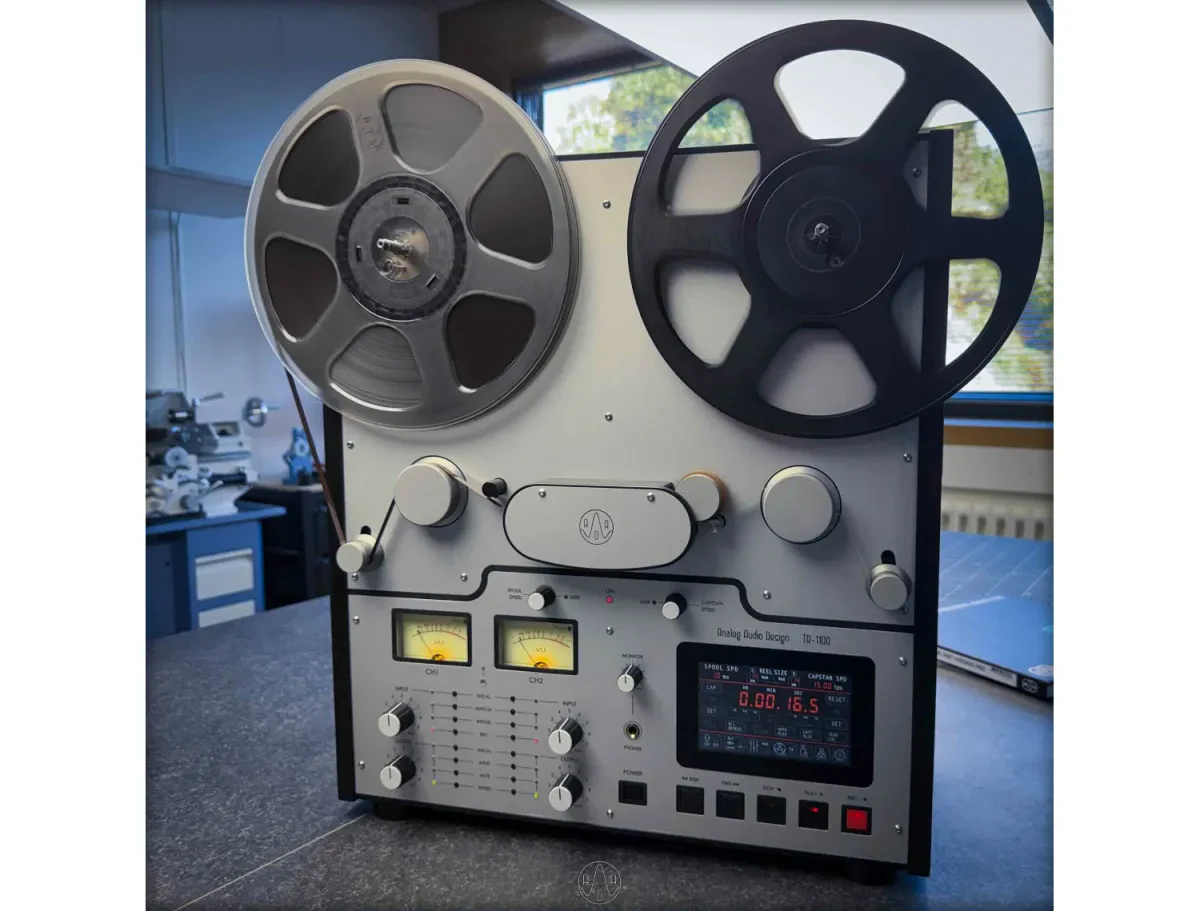
Analog Audio Design TP-1100
Image source — © Analog Audio Design
The TP-1100 is a playback-only open-reel tape deck from Analog Audio Design, a French company that engineer Christophe Martinez started in Pleumeur-Bodou, Brittany. His first machine, the TP-1000, took four years to develop in a garage workshop. The TP-1100 keeps the same player concept but moves the reels to direct-drive motors, adds a 30 ips speed and gains a switchable bypass output, and an updated version was presented in March 2026. For the TP-1000 Martinez sourced heads from the Belgian supplier once used for Studer transports, and the current catalogue also lists a TP-1000 Gold Edition.
Key specs that matter
The deck plays quarter-inch (6.35 mm) tape in the 2-track, 2-channel format with a DIN track width of 2.7 mm, on reels up to 30 cm. Speeds of 30 ips (76.2 cm/s), 15 ips (38.1 cm/s) and 7.5 ips are selected by switch, held within +/-0.05%, and a pitch control covers +/-100% in steps of 0.01 ips. Wow and flutter is quoted below 0.030% peak at 30 ips, 0.045% at 15 ips and 0.09% at 7.5 ips, DIN 45507 weighted. Response at 0 VU and +/-2 dB spans 30 Hz to 25 kHz at the top speed, 30 Hz to 22 kHz at 15 ips and 30 Hz to 20 kHz at 7.5 ips. Signal-to-noise is 71 dB unweighted and 78 dB A-weighted at the two faster speeds, and 70 and 77 dB at 7.5 ips. Distortion stays at or below 0.8% at 1 kHz and 15 ips, with 60 dB or more between channels. The chassis is 466 mm wide, 519 mm high and 305 mm deep, and it weighs 28.5 kg.
Engineering and use context
A DC servo motor turns the capstan through a belt, while each reel sits on its own direct-drive servo motor. Fast wind offers three preset speeds of 2, 6 and 10 m/s plus manual control from 1 to 12 m/s. Playback equalisation switches between NAB and IEC, and the reproduce reference can be set to 320 or 514 nWb/m to match the flux level of a given tape. The mains input accepts 90 to 264 VAC at 47 to 63 Hz, and consumption peaks at 250 W. An RJ45 Ethernet port handles remote control and firmware updates, an IR input takes the RC-1000 handset, and a 19-inch rack kit is offered.
Pairing
Line outputs on XLR connectors switch between balanced +4 dBu and unbalanced -10 dBV. A separate bypass XLR output lets the signal go to an external preamplifier, and a headphone socket supplies up to 1.5 W into 8 ohm.
Alternatives
The earlier TP-1000 player from the same French maker is limited to 15 and 7.5 ips with belt-driven reel motors and a weight of 28 kg.
Key specs that matter
The deck plays quarter-inch (6.35 mm) tape in the 2-track, 2-channel format with a DIN track width of 2.7 mm, on reels up to 30 cm. Speeds of 30 ips (76.2 cm/s), 15 ips (38.1 cm/s) and 7.5 ips are selected by switch, held within +/-0.05%, and a pitch control covers +/-100% in steps of 0.01 ips. Wow and flutter is quoted below 0.030% peak at 30 ips, 0.045% at 15 ips and 0.09% at 7.5 ips, DIN 45507 weighted. Response at 0 VU and +/-2 dB spans 30 Hz to 25 kHz at the top speed, 30 Hz to 22 kHz at 15 ips and 30 Hz to 20 kHz at 7.5 ips. Signal-to-noise is 71 dB unweighted and 78 dB A-weighted at the two faster speeds, and 70 and 77 dB at 7.5 ips. Distortion stays at or below 0.8% at 1 kHz and 15 ips, with 60 dB or more between channels. The chassis is 466 mm wide, 519 mm high and 305 mm deep, and it weighs 28.5 kg.
Engineering and use context
A DC servo motor turns the capstan through a belt, while each reel sits on its own direct-drive servo motor. Fast wind offers three preset speeds of 2, 6 and 10 m/s plus manual control from 1 to 12 m/s. Playback equalisation switches between NAB and IEC, and the reproduce reference can be set to 320 or 514 nWb/m to match the flux level of a given tape. The mains input accepts 90 to 264 VAC at 47 to 63 Hz, and consumption peaks at 250 W. An RJ45 Ethernet port handles remote control and firmware updates, an IR input takes the RC-1000 handset, and a 19-inch rack kit is offered.
Pairing
Line outputs on XLR connectors switch between balanced +4 dBu and unbalanced -10 dBV. A separate bypass XLR output lets the signal go to an external preamplifier, and a headphone socket supplies up to 1.5 W into 8 ohm.
Alternatives
The earlier TP-1000 player from the same French maker is limited to 15 and 7.5 ips with belt-driven reel motors and a weight of 28 kg.
Specifications
Model name
TP-1100
Highlights
N/A
Dimensions (mm)
N/A
Weight (g)
N/A
Official link
Related content
More components
Other devices
Analog Audio Design TR-1100