
All

Preamplifiers — Hegel P20
Description, images, technical data and specifications
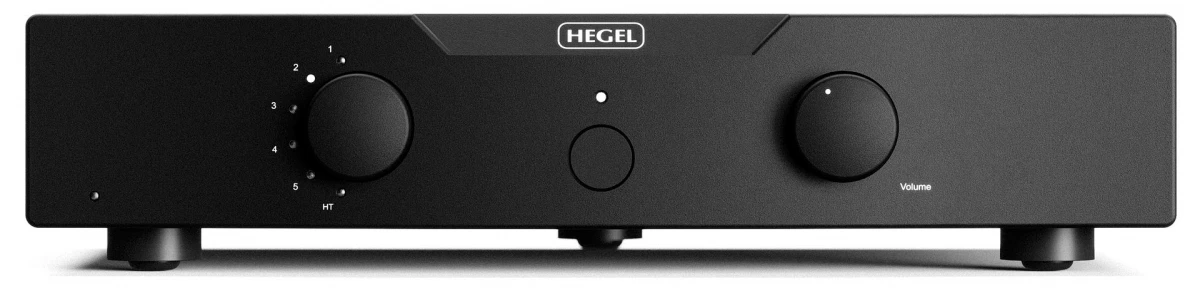
Hegel P20
Image source - (c) Hegel
The P20 is the entry-level preamplifier from Hegel Music Systems and opens the Hegel Reference line. It is a purely analogue control centre that carries over design concepts from its higher-tier sibling in the same range, and the manufacturer lists it in black.
Key specs that matter
There are five regular inputs, of which one is a balanced XLR and four are RCA, and a dedicated Home Theatre input is added for system integration. Outputs comprise a balanced XLR, one unbalanced RCA output and a separate RCA recording output at fixed line level. In balanced mode noise stays over 130 dB below the signal, crosstalk below -100 dB, distortion below 0.005 percent, and intermodulation below 0.01 percent measured with 19 kHz and 20 kHz tones. The chassis measures 8 cm high, 43 cm wide and 30 cm deep and weighs 10 kg.
Engineering and use context
To reach its noise figure the P20 uses Silicon Germanium transistors together with high-frequency components that Hegel applies in an unusual role inside an audio circuit. A deliberately compact layout keeps the signal path short. The design also draws on three Hegel concepts, namely Organic Sound, DualAmp and DualPower, the last two separating the gain stages and their power supplies. Volume, source selection and muting are handled by the supplied Hegel RC8 remote, which is machined from solid aluminium and carries the same bead-blasted, anodised finish as the preamplifier chassis, itself milled from solid aluminium. Hegel states the goal of the design as setting a new standard of price and performance in preamplifiers. The Home Theatre input passes the signal through at a fixed level, letting a surround processor feed the front channels via the same power amplifier that the P20 feeds in stereo use.
Pairing
The XLR and RCA main outputs allow connection to a power amplifier over either cable type, and the fixed recording output supplies a tape deck or another system independently of the volume setting. Up to four unbalanced sources, for example a DAC, phono preamplifier or CD player, use the four RCA inputs, while a balanced source takes the XLR input. Because the unit has no digital inputs of its own, any streaming or computer source needs an external converter.
Alternatives
The Hegel P30A, marketed as The Conductor, is the higher of the two preamplifiers in the current Hegel range.
Specifications
Model name
P20
Analog inputs (balanced)
1
Analog inputs (single-ended)
4
Analog outputs (balanced)
1
Analog outputs (single-ended)
1
Gain (dBu)
N/A
Input sensitivity (mV)
N/A
Output voltage (V)
N/A
Input impedance (balanced) (Ω)
N/A
Input impedance (single-ended) (Ω)
N/A
Output impedance (balanced) (Ω)
N/A
Output impedance (single-ended) (Ω)
N/A
Maximum output level (balanced) (dBu)
N/A
Maximum output level (single-ended) (dBu)
N/A
Volume control range (dBu)
N/A
Frequency response low +/- 3dB (Hz)
N/A
Frequency response high +/- 3dB (Hz)
N/A
Signal to Noise Ratio (SNR, unweighted) (dB)
>130
Total Harmonic Distortion + Noise (THD+N) (%)
< 0.005
Dimensions (mm)
80 x 430 x 300
Weight (kg)
10
Official link
More components
Preamplifiers
Hegel P30A