

Preamplifiers — Boulder 2110
Description, images, technical data and specifications
Boulder 2110
Image source — © Boulder
Key specs that matter
Six balanced XLR inputs feed three pairs of main balanced XLR outputs, intended for bi- and tri-amplified systems, plus one auxiliary balanced XLR pair with -1 dB gain. Maximum voltage gain is 20 dB. Balanced input impedance is 333 kohm and balanced output impedance is 100 ohm. The input accepts up to 7 Vrms and the output can reach 28 Vrms. THD+N at 2 V output is 0.0008% from 20 Hz to 5 kHz and 0.001% at 20 kHz. Response from 20 Hz to 5 kHz is within +0.00 and -0.03 dB, with -3 dB points at 0.02 Hz and 300 kHz. Channel crosstalk is -134 dB or better. The preamplifier section weighs 28.6 kg and the power supply 21.8 kg.
Engineering and use context
The main chassis carries the control module and front panel, while separate housings for the left and right channels sit on and behind it, while a dedicated power supply chassis holds four isolated supplies serving each analogue channel, the logic and interface circuits, and standby. The audio sections have no electrical link to the user interface and are controlled through optical transmitters and sensors. Gain comes from the 993S, a surface-mount, fully discrete gain stage used only in the 2110, and the circuit is differentially balanced from input to output. All supplies are linear, and a DC filter blocks up to 3 V DC on the mains. The volume attenuator is fully balanced to avoid step noise, covers a 100 dB range, and can be programmed to move in 0.1, 0.5 or 1.0 dB steps. Inputs are programmable, and a Theater Mode can be configured. Front-panel information appears behind a wrap-around mirror-glass display window, and the controls are hand-polished stainless steel. Power draw is 240 W at most, 85 W at idle and 500 mW in standby.
Pairing
With only balanced connections, the 2110 needs sources and power amplifiers with XLR sockets, such as Boulder's 2150 monoblocks or the 2160, and the three main output pairs make it possible to drive separate amplifiers for bass, midrange and treble sections of an active or bi-amplified speaker system.
Alternatives
Boulder's 3010 is the preamplifier of the 3000 Series, which adds a large colour LCD and Ethernet with OpenHome compatibility.
Specifications
Model name
2110
Analog inputs (balanced)
6
Analog inputs (single-ended)
N/A
Analog outputs (balanced)
3
Analog outputs (single-ended)
N/A
Gain (dBu)
20
Input sensitivity (mV)
N/A
Output voltage (V)
N/A
Input impedance (balanced) (Ω)
333 000
Input impedance (single-ended) (Ω)
N/A
Output impedance (balanced) (Ω)
100
Output impedance (single-ended) (Ω)
N/A
Maximum output level (balanced) (dBu)
28
Maximum output level (single-ended) (dBu)
N/A
Volume control range (dBu)
N/A
Frequency response low +/- 3dB (Hz)
0.02
Frequency response high +/- 3dB (Hz)
300 000
Signal to Noise Ratio (SNR, unweighted) (dB)
N/A
Total Harmonic Distortion + Noise (THD+N) (%)
0.001
Dimensions (mm)
180.0 x 162.8 x 67.1 (main) + 157 x 40.4 x 180.0 (PSU)
Weight (kg)
34.9 (main) + 26.5 (PSU)
Official link
More components
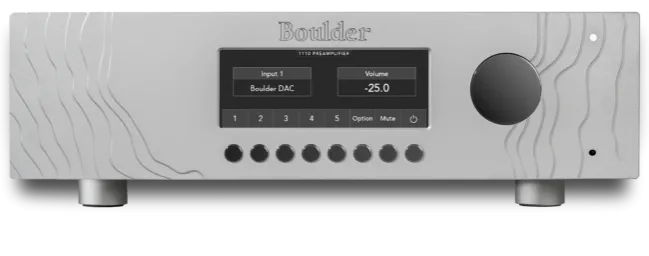
Preamplifiers
Boulder 1110
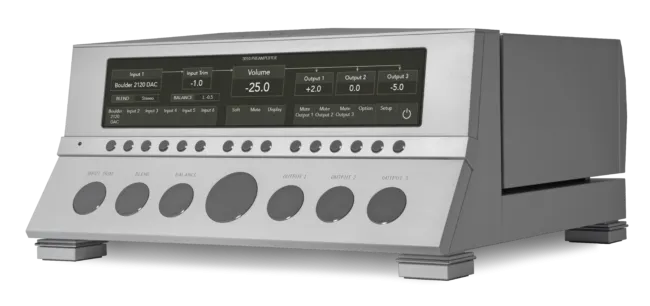
Preamplifiers
Boulder 3010