
All

Integrated amplifiers — TAD TAD-A1000
Description, images, technical data and specifications
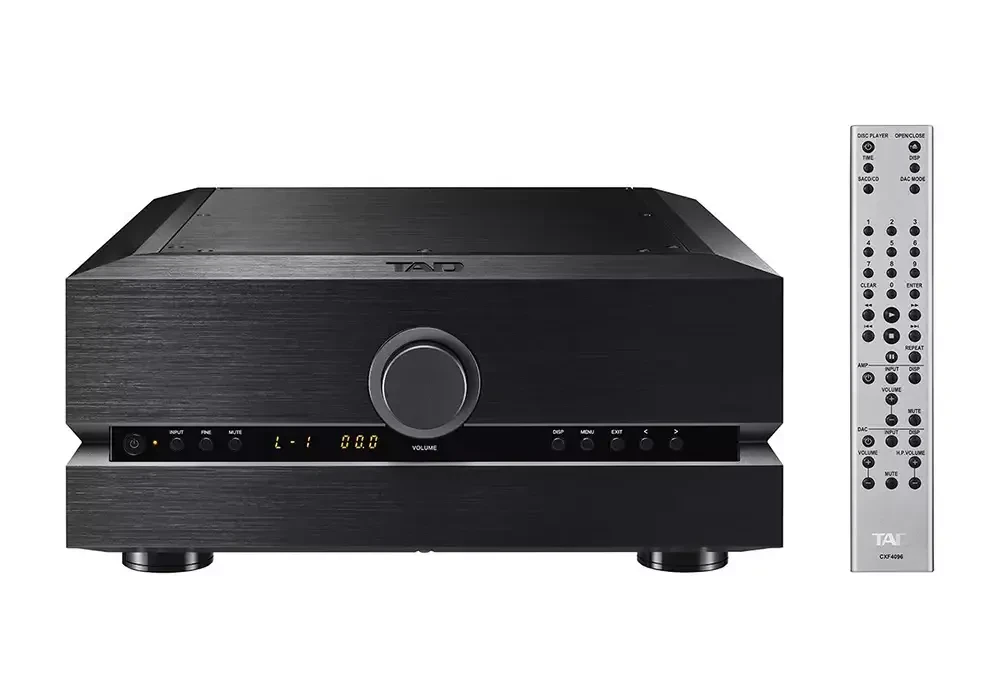
TAD TAD-A1000
Image source - (c) TAD
The TAD-A1000 is the first integrated amplifier from Technical Audio Devices Laboratories, the Japanese company that began as Pioneer's professional driver brand and took on its present name in 2007. Launched in 2025 as part of the Evolution line, one step below the Reference series, it combines the preamplifier technology of TAD's separates with a Class D analogue power amplifier platform and is designed as a partner for the Evolution Series speakers.
Key specs that matter
Output is 250 W per channel into 4 ohms at 1 kHz, and rated distortion stays below 0.05% at 125 W into 4 ohms. Frequency response extends from 10 Hz to 50 kHz (+0/-3 dB), signal-to-noise ratio is 100 dB or better and gain is 41.5 dB. There are four balanced XLR inputs at 100 kohm and two unbalanced RCA inputs at 50 kohm. Power consumption is 130 W, with standby below 0.5 W. The chassis measures 440 x 200 x 553 mm and weighs 29 kg.
Engineering and use context
The preamplifier section uses a single-stage current-feedback flat amplifier developed for TAD's Reference preamplifiers, with FET devices selected in matched pairs for the positive and negative halves. Volume is controlled by TAD's resistor-ladder electronic attenuator, whose distortion is below 0.0005% at 1 Vrms. Circuit and layout are fully symmetrical, and in a bridge-tied load arrangement each speaker is driven by two amplification stages, so the path is balanced all the way through. Every channel has its own transformer windings, rectification, smoothing and regulation, and the three power transformers are laid out symmetrically. The Class D output stage uses Direct FET devices with very low on-resistance, supplied by twin high-capacity toroidal transformers and four 33000 uF capacitors designed by TAD. It runs cool enough to do without conventional heatsinks. Non-magnetic resistors and capacitors and OFC leads without nickel plating keep magnetic distortion down. The preamplifier, power stage, transformers and control circuits occupy four separate chambers, and three feet with internal inverted spikes support the chassis. The speaker terminals are taken from the Reference power amplifiers.
Pairing
The balanced inputs suit sources with XLR outputs, and the high gain gives ample level from any line source. The output power handles low-sensitivity floorstanders, TAD's own Evolution One and Evolution Two among them. The A1000 has no digital inputs, so a DAC or streamer with analogue outputs is needed for digital sources.
Alternatives
The TAD-A1000D builds on the same amplifier platform and adds a digital section with AES/EBU, coaxial, optical and USB inputs.
Specifications
Model name
TAD-A1000
Type
Integrated amplifier
Analog inputs (balanced)
4
Analog inputs (single-ended)
2
Input sensitivity (mV)
N/A
Input impedance (balanced) (Ω)
N/A
Input impedance (single-ended) (Ω)
N/A
Output impedance (balanced) (Ω)
N/A
Output impedance (single-ended) (Ω)
N/A
D/A conversion
N/A
Phono MM/MC current-sensing input impedance (Ω)
N/A
Output power (8Ω) (W)
N/A
Output power (4Ω) (W)
2 x 250
Gain (dBu)
41.5
Frequency response low +/- 3dB (Hz)
10
Frequency response high +/- 3dB (Hz)
50000
Signal to Noise Ratio (dB)
100
Total Harmonic Distortion + Noise (%)
0.005
Damping factor
N/A
Dimensions (mm)
440 × 200 × 553
Weight (kg)
29
Official link
Related content
More components
Integrated amplifiers
TAD TAD-A1000D