

Speaker Cables and Interconnects - Do Audiophile Cables Actually Matter?
An engineering view in 2026

26.09.2026 16:54 | ~5 minutes read
Cable comparisons are the great audio holy war of recent decades. Yet a cable is neither a magical artefact nor a plain connector with no bearing on the sound. To settle the question of what cables do in Hi-Fi and High-End systems from the standpoint of engineering and measurable parameters, we need to treat them as passive components with three parameters. Only then can we dot the is - by working out whether those parameters exceed the thresholds of audibility in a given system. So let’s go through every nuance of how audiophile cables sound, from the dry and impartial position of an engineer.
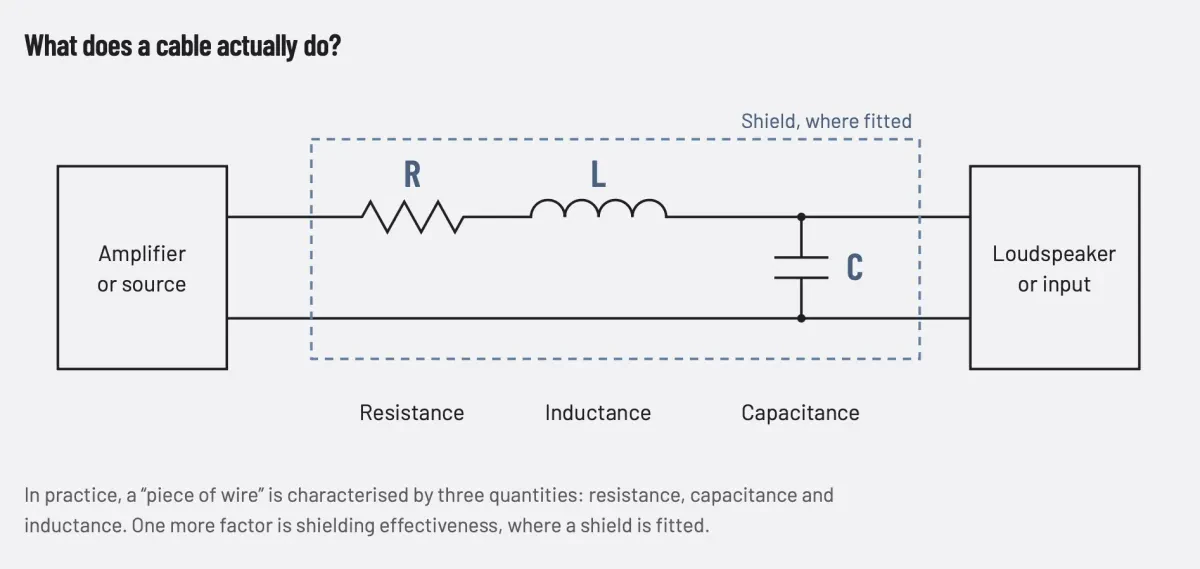
What does a cable actually do?
In practice, a “piece of wire” (or cable) is characterised by three quantities: resistance, capacitance and inductance. One more factor is shielding effectiveness, where a shield is fitted. No other mechanism by which a passive conductor measurably affects the signal has yet been identified.
The question therefore reduces to arithmetic - what are these values, and do the effects they produce exceed the thresholds of audibility? Matters of taste, metaphysics and esoterica we will set aside for now - the author of this article himself uses High-End cables in his own system, chosen after lengthy testing and comparison, but the purpose of this piece is to understand the picture as modern physics describes it, not to account for variables we do not yet know about and can only guess at. So what follows is not a debunking pamphlet, but simply an impartial look at what can work “by the textbook” and what is unlikely to.
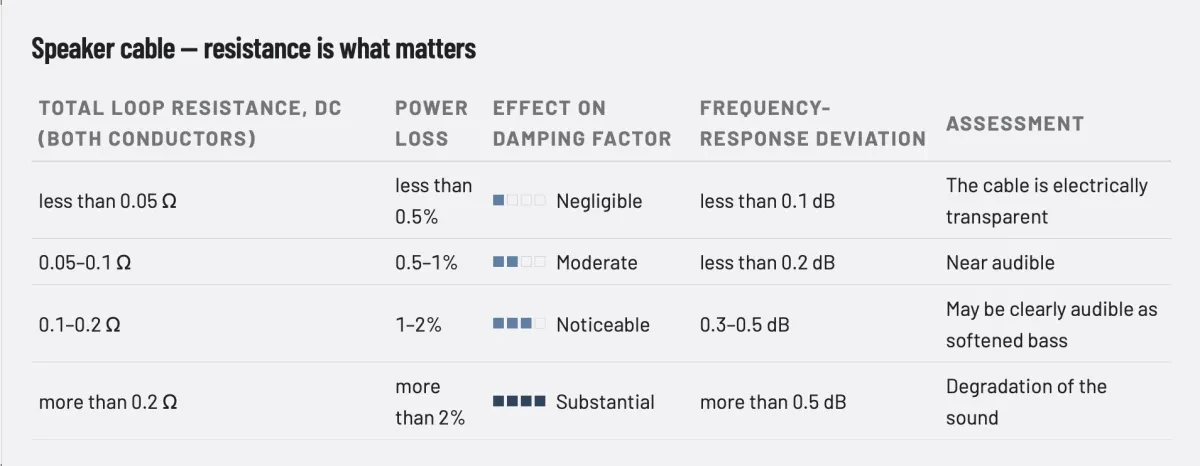
Speaker cable - resistance is what matters
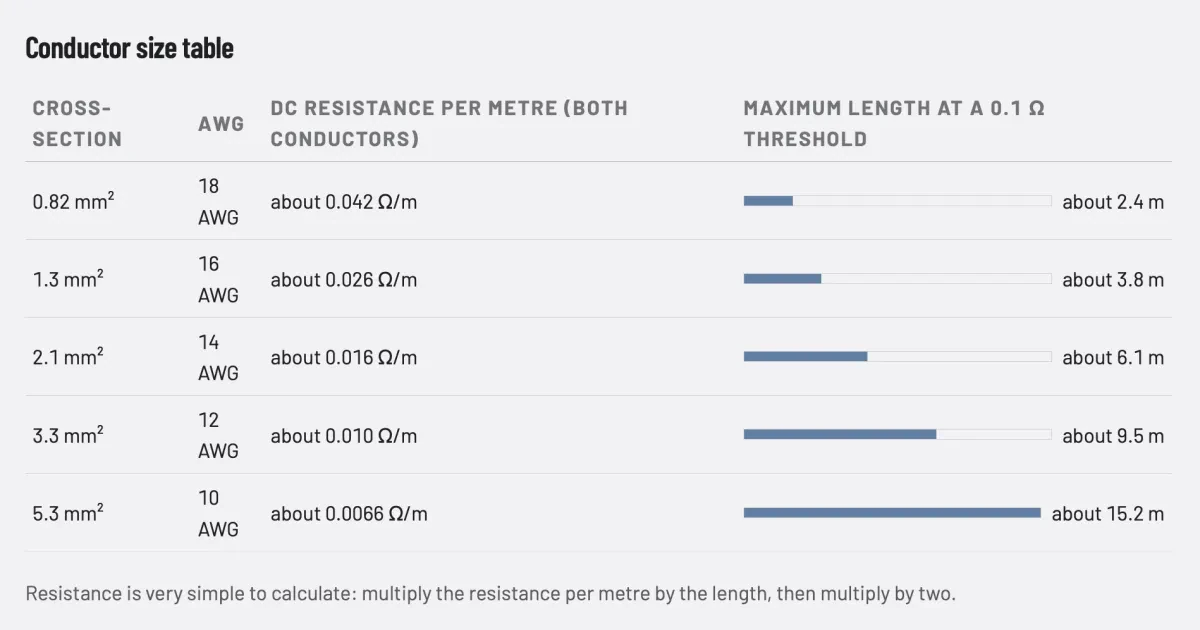
A speaker cable has to carry high current at low voltage. Here resistance produces three effects - power loss, a reduction in damping factor and, in combination with the reactive load of the loudspeaker, deviations in frequency response
Conductor size table
Resistance is very simple to calculate - multiply the resistance per metre by the length, then multiply by two.
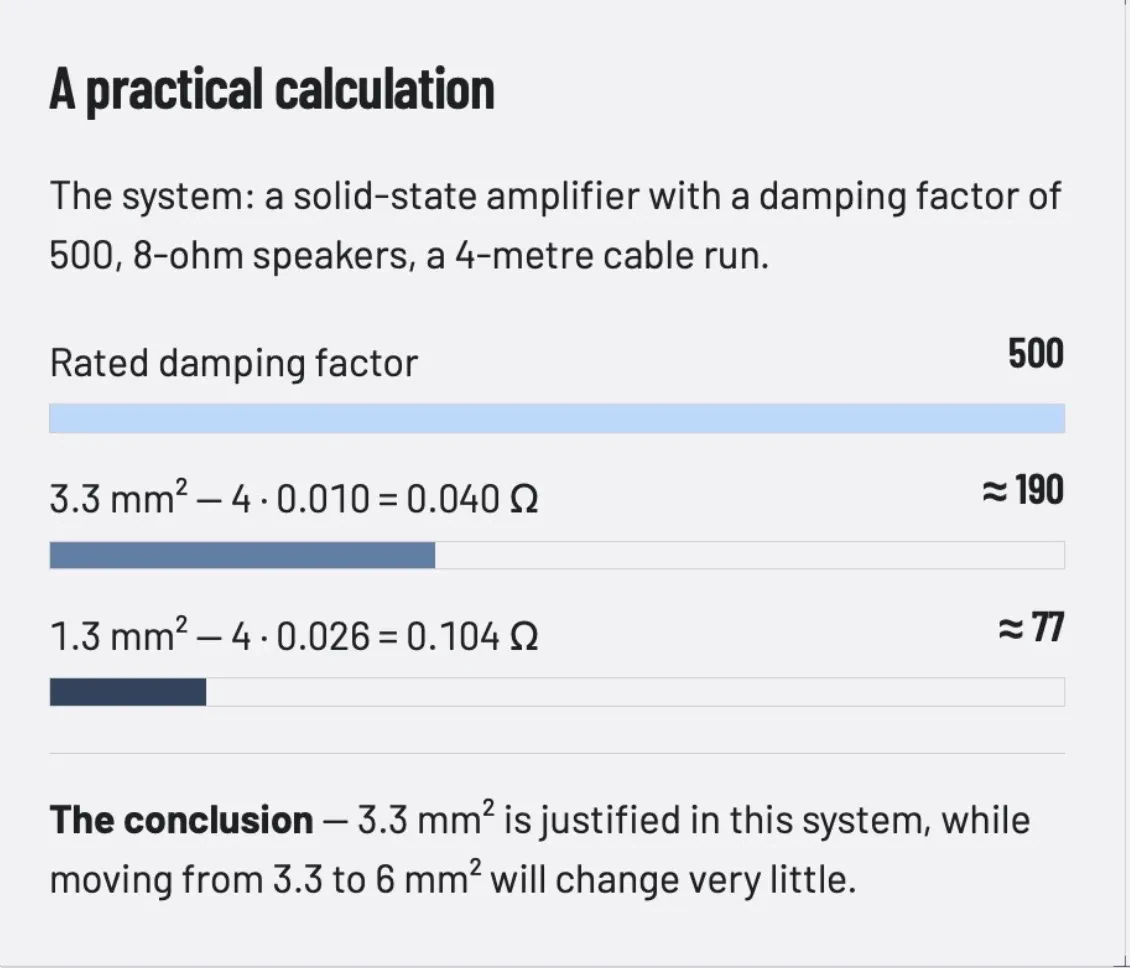
A few words about damping factor
Look closely at the figures - an amplifier with a rated damping factor of 500 works at an effective value of 77–190 over a realistic cable length. Which means that rated figures above 200 are largely nullified by the cable.
And there is a second consequence - with a tube amplifier of 2 ohms output impedance, a cable resistance of 0.1 Ω amounts to 5% of it and will barely be noticeable. The lower an amplifier’s damping factor, the less critical the speaker cable. This physical axiom is the opposite of what audiophiles are usually told.
Interconnects - capacitance is what matters
An interconnect has to carry voltage at negligible current, so resistance plays no significant role here. What matters is capacitance, which together with the source’s output impedance forms a low-pass filter. The cut-off frequency is given by the formula F = 1 / (2 · π · R · C), where R is the source output impedance in ohms and C is the cable’s total capacitance in farads.
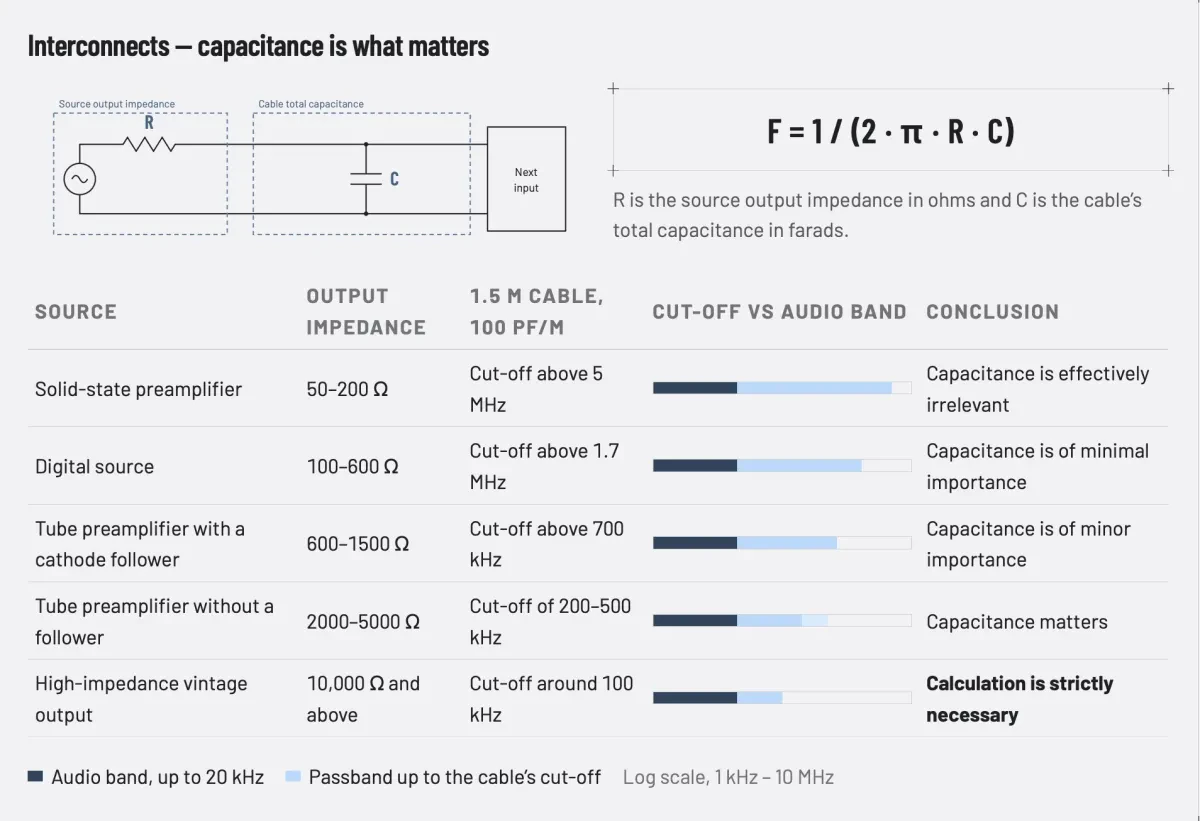
The engineering conclusion - in many modern systems the capacitance of an interconnect has no significant effect on the sound. Problems arise when a very high source output impedance, high capacitance per metre and a long cable run come together.
And when is calculation strictly necessary? In the connection between cartridge and phono stage the signal level is measured in millivolts, the cable capacitance enters directly into the loading calculation for an MM cartridge, and the difference between 100 and 400 pF is clearly audible.
Digital cables - a different matter entirely
From an engineering standpoint the situation here is different, because what is transmitted is not analogue levels but a digital stream.
USB and Ethernet. Protocols with error checking. In theory, provided the connection works at all, the content of the stream is identical.
SPDIF and AES/EBU. The clock is carried along with the data, so cable quality can affect jitter through the integrity of the signal edges. In practice, with the correct characteristic impedance (75 Ω for coaxial SPDIF, 110 Ω for AES/EBU) and a sensible length, the effect is negligible, especially with modern devices that reclock the incoming stream.
Optical TOSLINK. Jitter here is considerably higher than with electrical interfaces, owing to the characteristics of the transmitter and receiver. That is a property of the interface - but the cable’s contribution will be substantial.
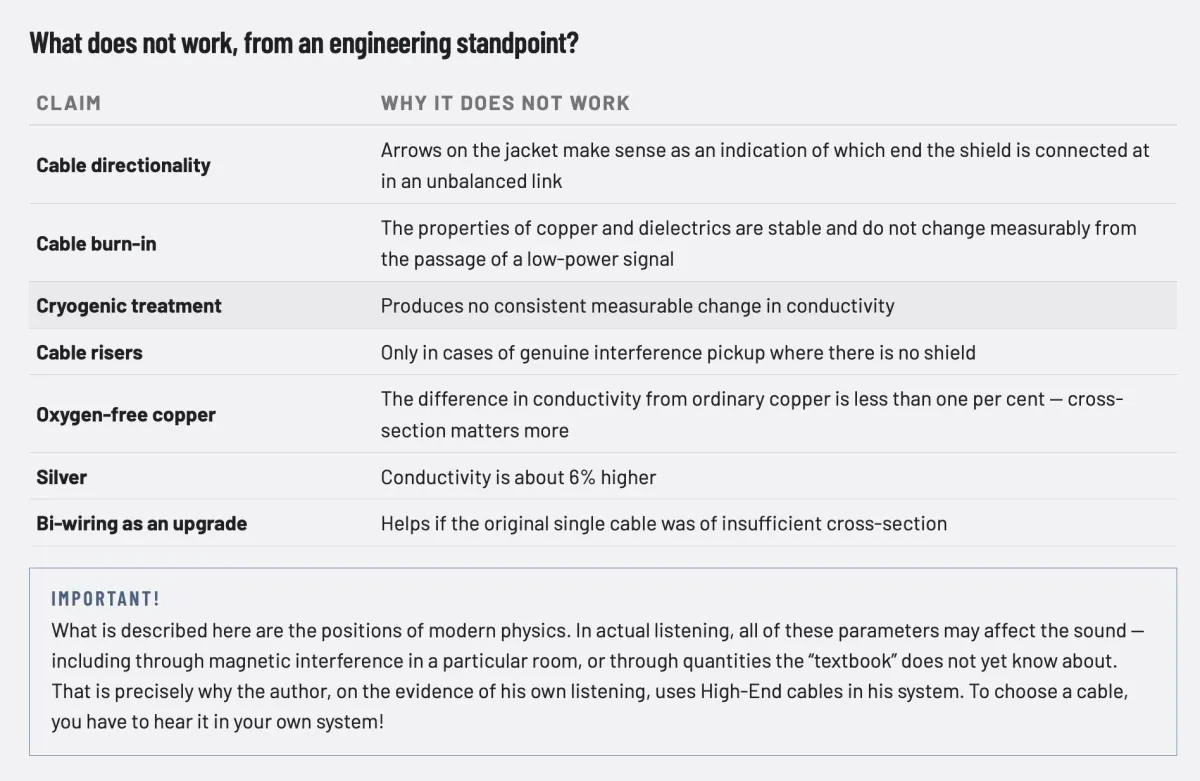
Important! What is described here are the positions of modern physics. In actual listening, all of these parameters may affect the sound - including through magnetic interference in a particular room, or through quantities the “textbook” does not yet know about. That is precisely why the author, on the evidence of his own listening, uses High-End cables in his system. To choose a cable, you have to hear it in your own system!
…and what does work?
Sufficient cross-section for your length. Work it out from the table above.
Connector and contact quality. An oxidised or loose contact creates a non-linear contact resistance, and that will be audible straight away.
Shielding where there is interference. If mains wiring runs alongside the cable, if the system contains switch-mode power supplies, or if there are dimmers in the flat, a shield solves a concrete problem.
Mechanical reliability. A cable that holds its geometry and does not fail at the connectors will last for decades.
Published parameters. If a manufacturer states resistance, capacitance and inductance per metre, that is a substantive engineering conversation.
Budgeting
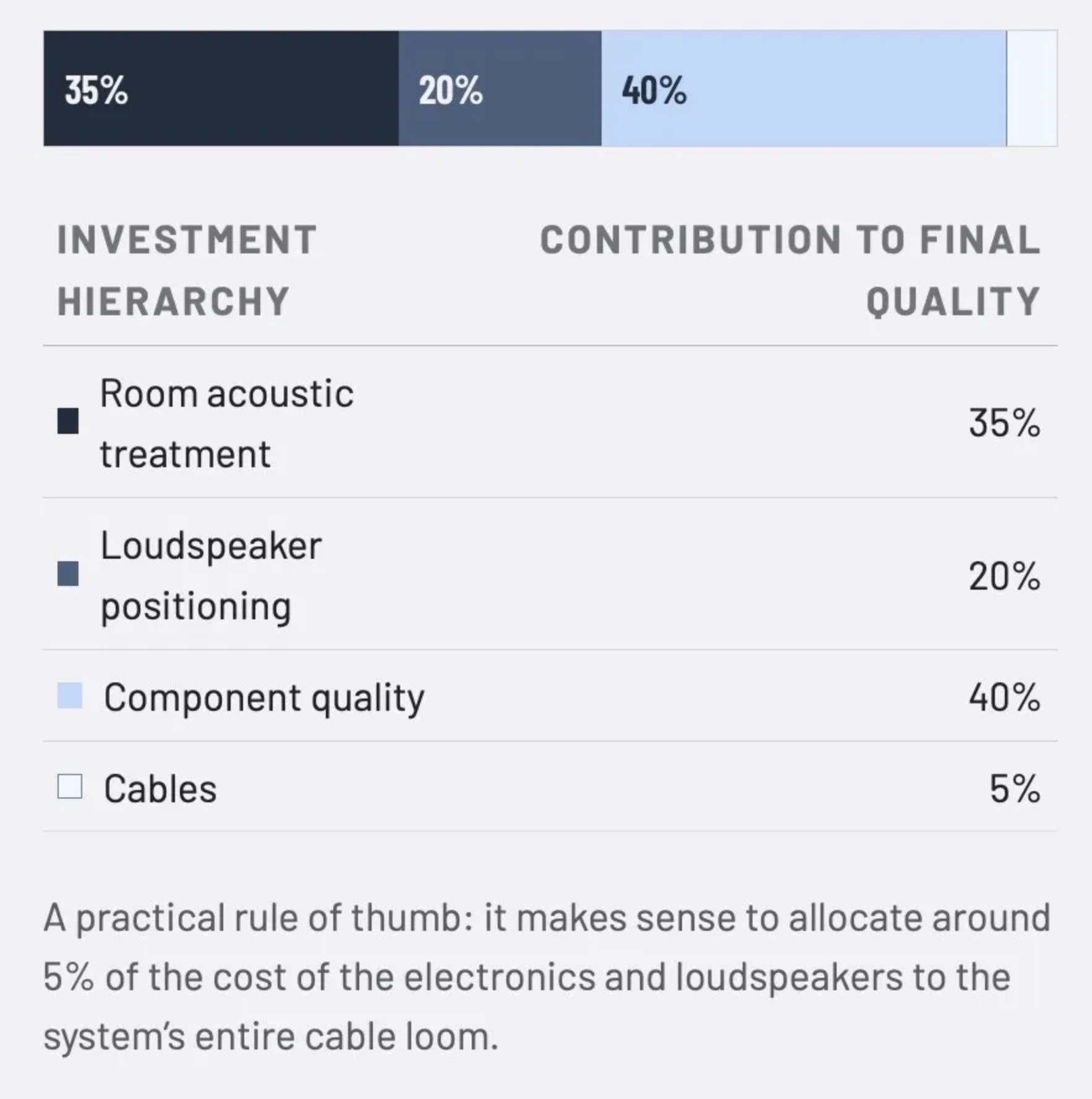
A practical rule of thumb - it makes sense to allocate around 5% of the cost of the full system (and don't forget about placement and room treatment or choosing a room).
How to compare and choose cables?
Level-match the sound pressure. Different cables can produce a difference of a fraction of a decibel, and even 0.3 dB is perceived as “better” rather than as “louder”.
Arrange for fast switching. A test with long changeover gaps assesses your memory, not the cables.
Run enough comparison cycles, across different musical genres.
Afterwards, live with the chosen cable for a week, then run another round of comparisons.
Put a cable that is clearly more expensive than your choice into the system and run a round of comparisons against it.