

Focal Diva Utopia Review - Active Wireless Floorstanding Speakers
Five years in development, Naim amplification and a built-in streamer

12.10.2026 15:45 | ~9 min read
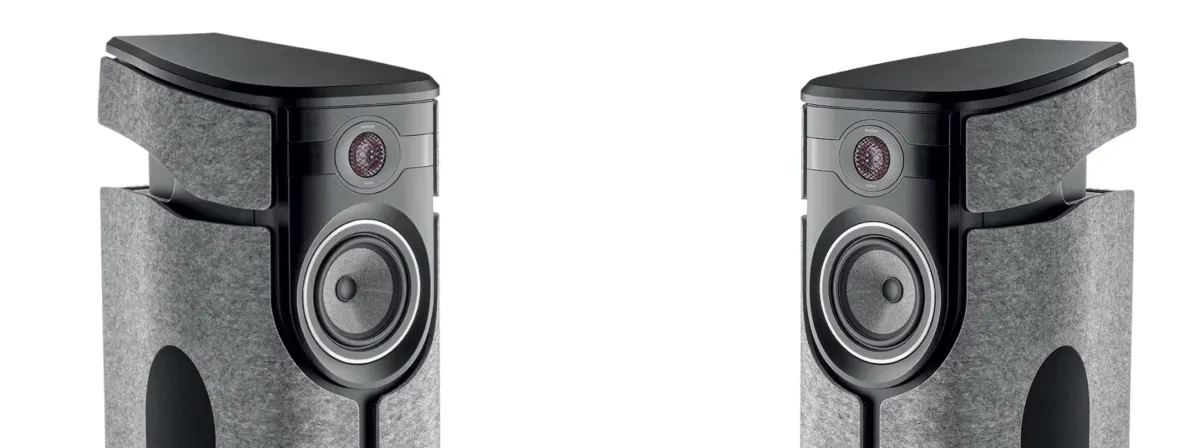
The Focal Diva Utopia is a fully fledged alternative to a large separates-based high-end system. A pair of these speakers can easily replace a streamer, DAC, preamplifier, power amplifier and passive loudspeakers - and all the installation calls for is mains sockets, since the link between the two speakers is wireless. We approached the evaluation and testing of the Focal Diva Utopia with a clean slate, setting aside the high-end industry's clichés (namely, that only components split into separate boxes can deliver ultimate quality).
This high-end model launched the family of the same name and is the result of a joint effort by two of the group's brands. Focal of Saint-Étienne was responsible for the acoustic design and drive units, while Britain's Naim took care of amplification, power supply, digital-to-analogue conversion, DSP and the network platform. According to a Focal representative, the amplifier section draws on work done for the Naim Classic 200 and 300 series. The Focal Diva Utopia premiered in October 2024 and, according to the manufacturer, took five years to develop.
Advantages of an active loudspeaker design
The case for an active design comes down to three key technical advantages.
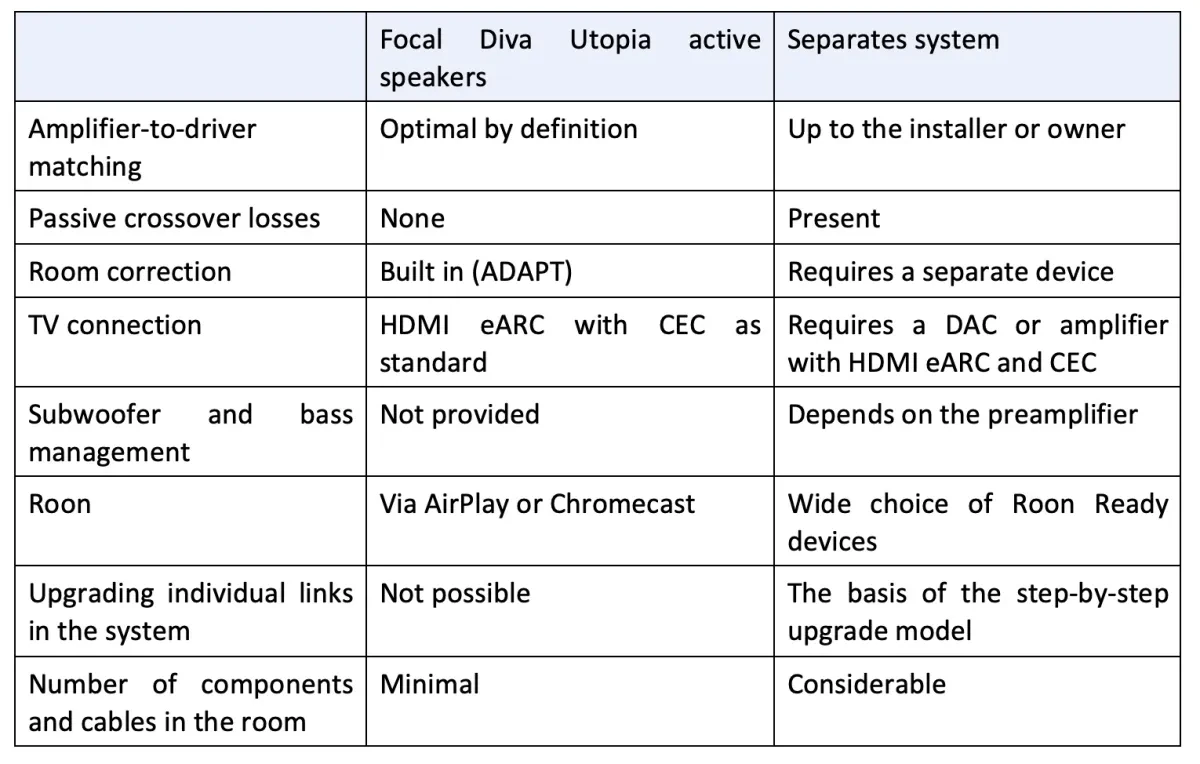
1. No passive crossover between amplifier and driver. Each drive unit is connected directly to its own amplifier, and the frequency split takes place before amplification, at signal level. Losses in crossover inductors and resistors disappear and so does the interaction between the crossover's impedance and the amplifier's output impedance.
2. Amplifier matched to a specific driver. The designer knows the exact load on each channel and optimises the output stage and current reserve accordingly.
3. Digital correction. Filters are implemented in DSP with arbitrary slopes and phase response rather than being limited to what is physically achievable with passive components. The same platform allows the response to be corrected for the room and loudness compensation to be adjusted with volume
Cabinet
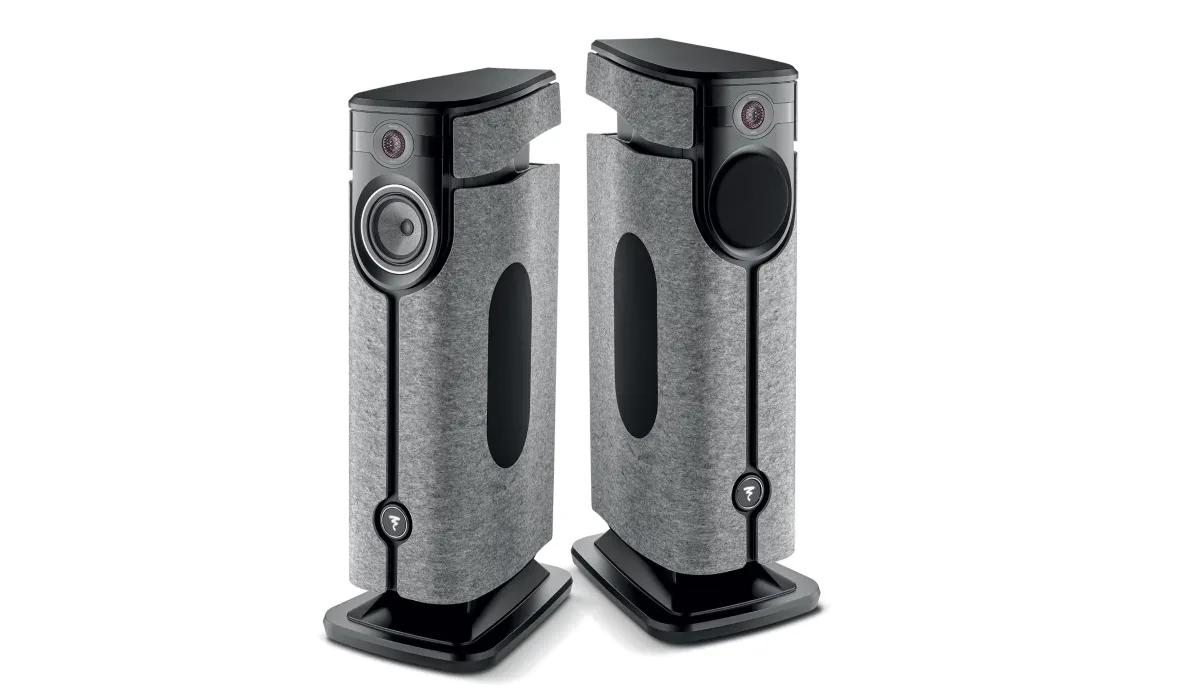
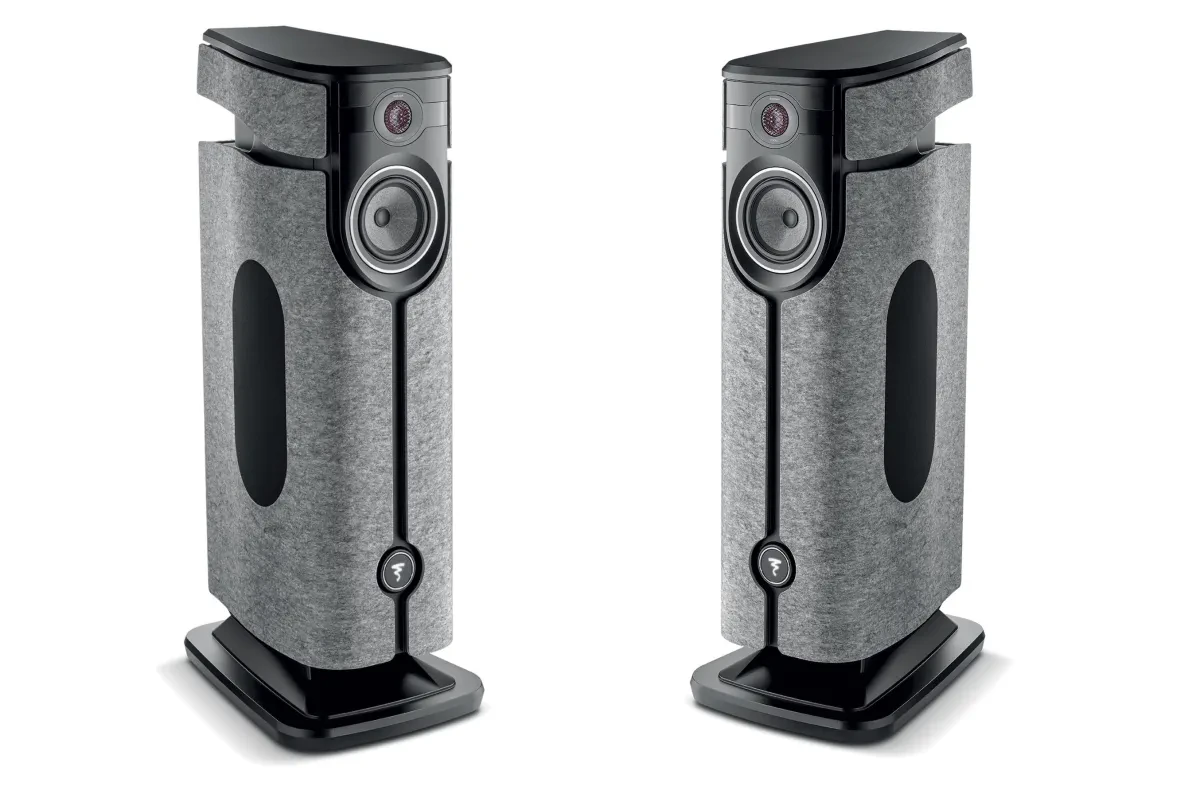
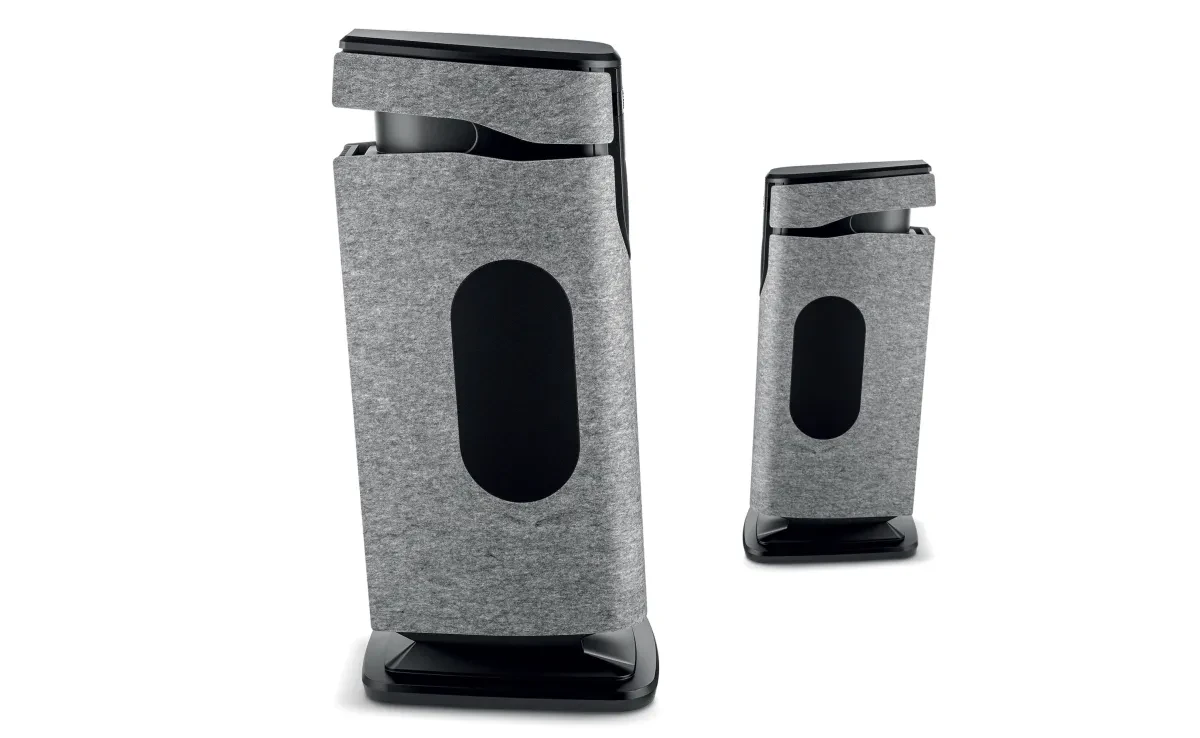
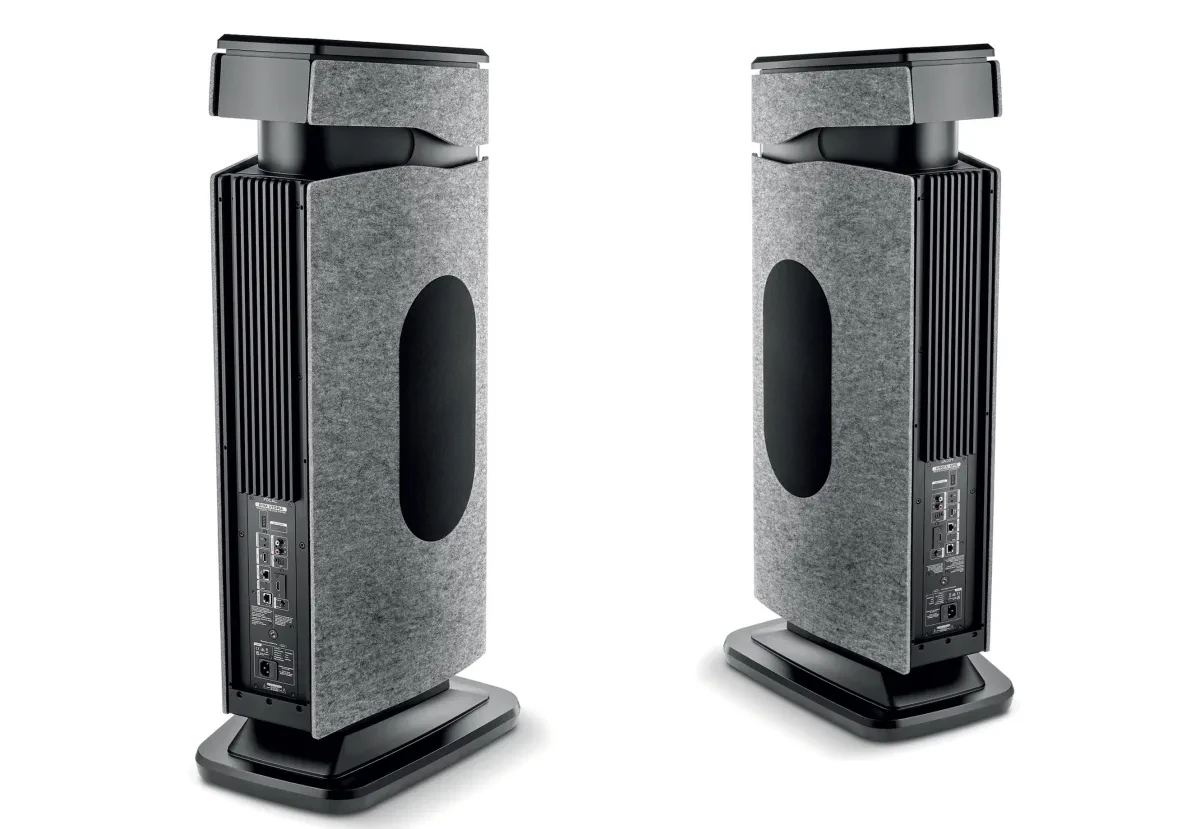
The cabinet is made from a high-density polymer by reaction injection moulding (RIM) and assembled from three parts. Focal has already used this polymer in the Kanta line - it allows the wall shapes and internal bracing to be tailored to the results of finite-element modelling, something that is hard to achieve with MDF. Internal volume is around 50 litres, the alignment is bass reflex, and the port fires downwards onto an angled ramp in the aluminium base. Each speaker measures 121 × 42 × 56 cm and weighs 64 kg. Castors are built into the base, and spikes plus protective cups for parquet floors are supplied - first find the position, then fit the spikes. The electronics are housed in a slide-out module on the rear panel, which simplifies servicing. In the standard version the removable side panels are covered in grey OEKO-TEX certified felt. Since June 2025, lacquered side panels in Black High Gloss, Dune High Gloss and Off White High Gloss have also been available (they can be fitted to previously purchased speakers as well).
IAL2 tweeter
The high-frequency driver is a 27 mm pure beryllium inverted dome with an M-profile, mounted in a shallow waveguide. IAL (Infinite Acoustic Loading) refers to the loading behind the dome, which absorbs the rear wave and prevents it from returning to the diaphragm. Beryllium was chosen for its combination of stiffness and low density - the dome's first resonance is pushed above 40 kHz, well beyond the audible range. The M-profile solves two problems at once - it reduces directivity, widening the comfortable listening area, and increases the stiffness of the dome itself, which further lowers distortion. The 25 mm voice coil improves power handling and thermal stability.
Midrange driver
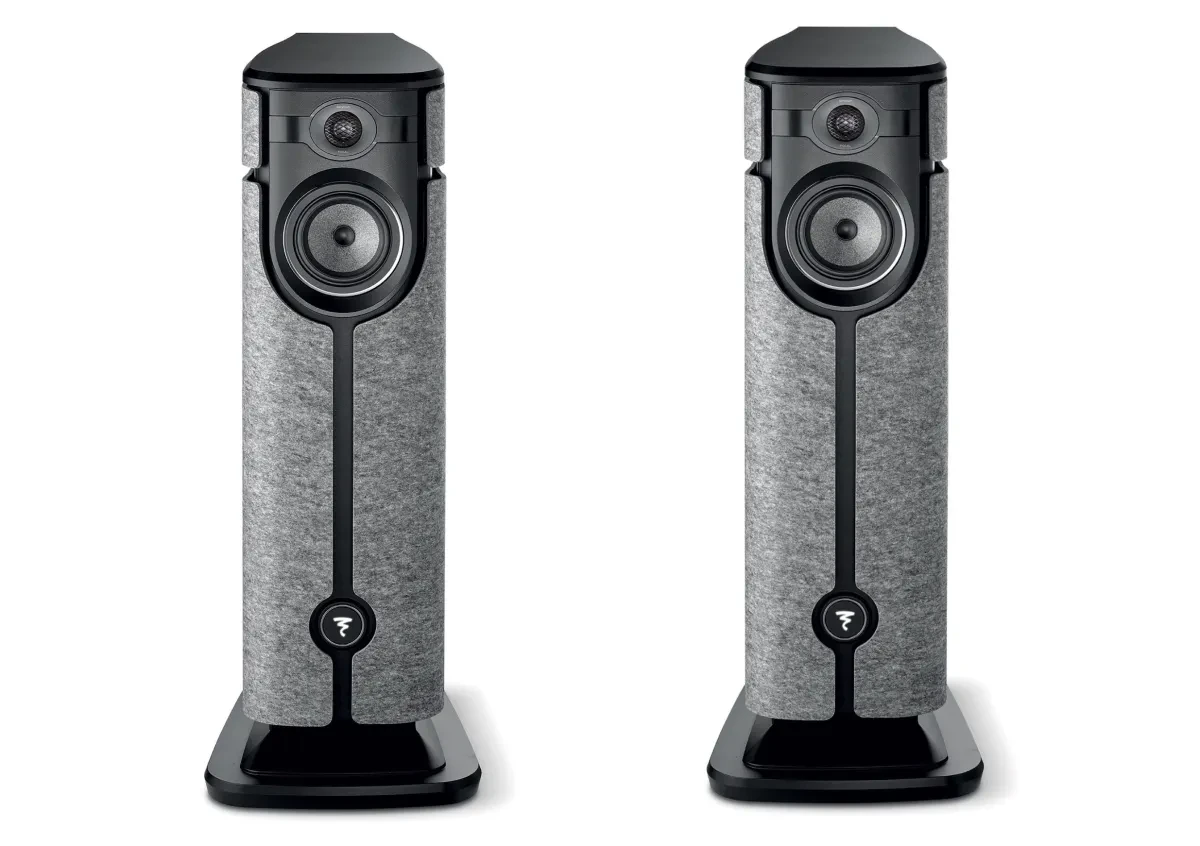
The 16.5 cm midrange driver is built around Focal's signature W sandwich cone - layers of glass fibre around a foam core. This construction delivers high stiffness at moderate mass and allows damping to be tuned by choosing the thickness of the layers. The TMD (Tuned Mass Damper) surround with tuned damping masses suppresses the surround's own resonances, while the NIC (Neutral Inductance Circuit) motor with a Faraday ring stabilises the magnetic field and voice-coil inductance at large excursions.
Woofers
Four 16.5 cm drivers with the same W cone are used, two on each side panel, in a push-push configuration. The drivers on opposite walls move in sync, so the reaction forces transmitted to the cabinet cancel each other out. This provides the necessary radiating area while keeping the front baffle narrow, which benefits diffraction and imaging precision.
The rated frequency range is 27 Hz - 40 kHz (-3 dB), and at -6 dB the lower limit extends to 24 Hz. For a 50-litre cabinet with six-inch drivers, this is the result of the bass reflex port working together with the DSP that controls the bass section.
Amplification
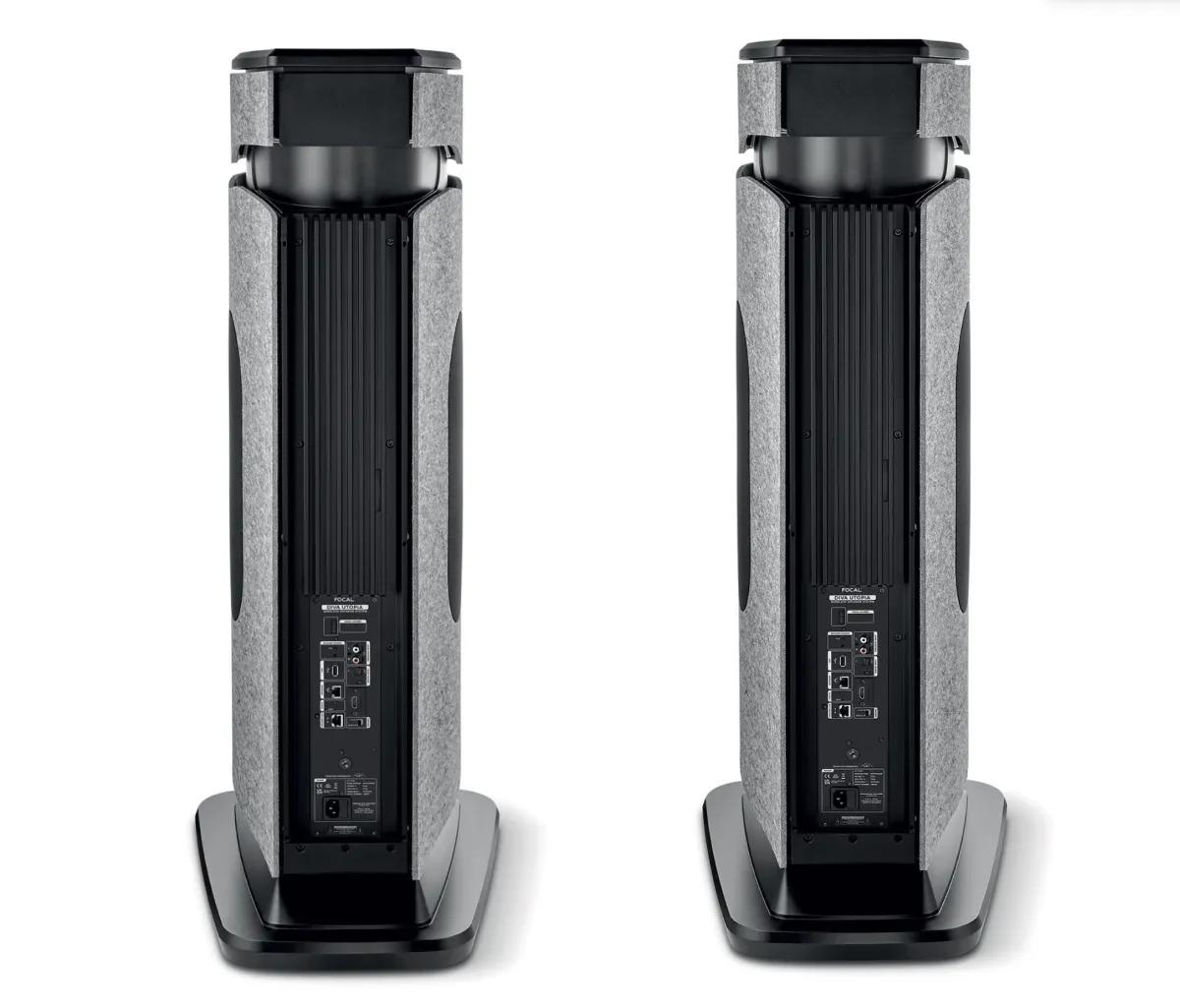
Each speaker has built-in, per-band Class AB amplification designed by Naim - 250 W for the bass section, 75 W for the midrange and 75 W for the treble, for a total of 400 W per speaker and 800 W per system. Steering clear of Class D is a matter of principle here and reflects Naim's house approach. Heat is dissipated through an anodised aluminium heatsink on the rear panel, so the speakers cannot be placed right up against a wall.
Digital section
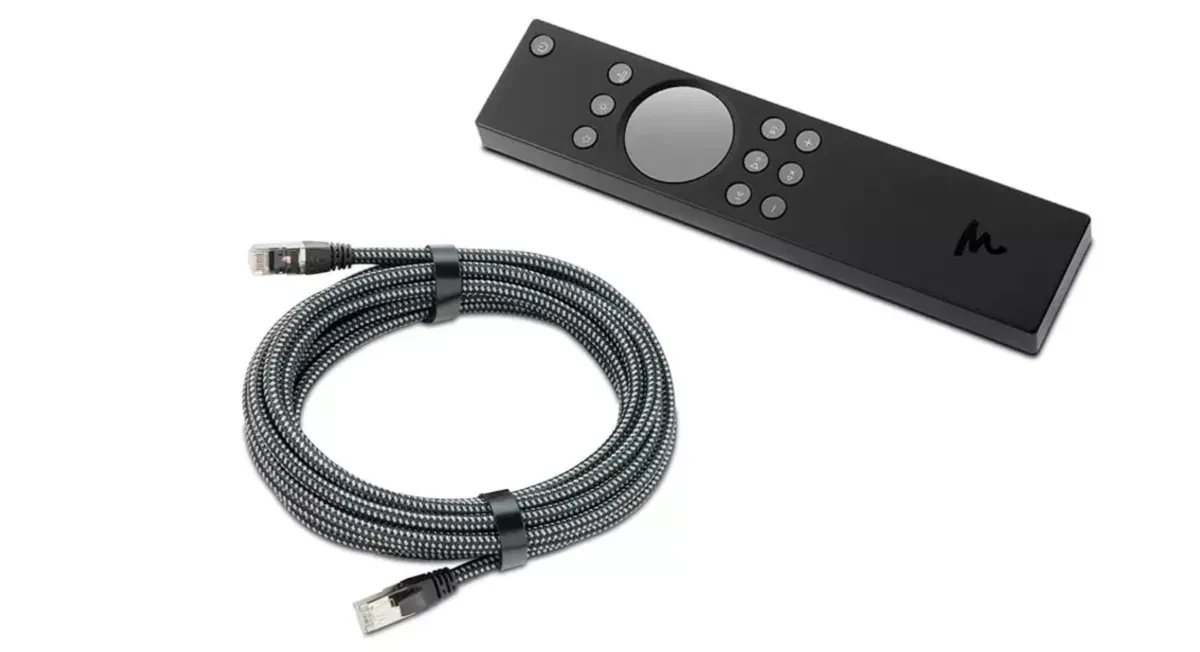
The DAC accepts PCM up to 384 kHz / 32-bit and DSD64/128, with support for FLAC, ALAC, WAV, AIFF, AAC and OGG. The analogue line input is digitised by an ADC. The master speaker sends the signal to the second one over an ultra-wideband (UWB) radio link in the 6-9 GHz band, at 96 kHz / 24-bit and with no audible latency. For material at sample rates up to 192 kHz, the speakers are connected with the supplied RJ45 Speaker Link cable. The pair is paired at the factory, and pairing is restored automatically after a reset. Each speaker needs its own mains socket.
Commutation
The wired inputs are located on the primary speaker - HDMI eARC with CEC, Toslink optical, analogue RCA, USB-A for external storage and Ethernet. There is no USB-B input, so the system cannot be used as a USB DAC for a computer. There is no built-in phono stage either. Wireless interfaces are Wi-Fi 6 and Bluetooth 5.3 with aptX Adaptive, AAC and SBC. AirPlay 2, Google Cast, Spotify Connect, TIDAL Connect, Qobuz, UPnP, internet radio and QQ Music via QPlay are supported. There is no Roon Ready certification. The system integrates easily into a multiroom setup (up to 32 Focal and Naim devices), and drivers are available for Control4, Crestron, Elan, RTI and Savant. Control is via the Focal & Naim app, voice assistants and a remote that communicates over Zigbee.
ADAPT correction
Focal's ADAPT (Adaptive Acoustic Personal Tuning) correction is set up in the app without a measurement microphone - using test signals played through a smartphone and the listener's own assessment. The intensity is adjustable (70% by default), and only one profile can be stored. Correction operates up to 450 Hz, with the focus on the region below 70 Hz, where room modes are concentrated.
400 W of power in an active system
Four hundred watts in an active system and four hundred watts from an external amplifier are different quantities, and the two should not be confused. First, there are no passive crossover losses here, which in a conventional three-way system would eat up a noticeable share of the power delivered. Second, the power is distributed across the bands in line with the real energy spectrum of music. The fair comparison for these speakers is a passive system with three-channel amplification and an active crossover.
Maximum SPL of 116 dB
The 116 dB SPL figure is reached at a distance of 1 m. At 3 m in free field the level is 106 dB, and once reflections in a living room are taken into account, peaks at the listening position reach roughly 105-109 dB. That covers the needs of any domestic scenario with headroom to spare and without a hint of compression.
Bass level 27 Hz from a 50-litre cabinet
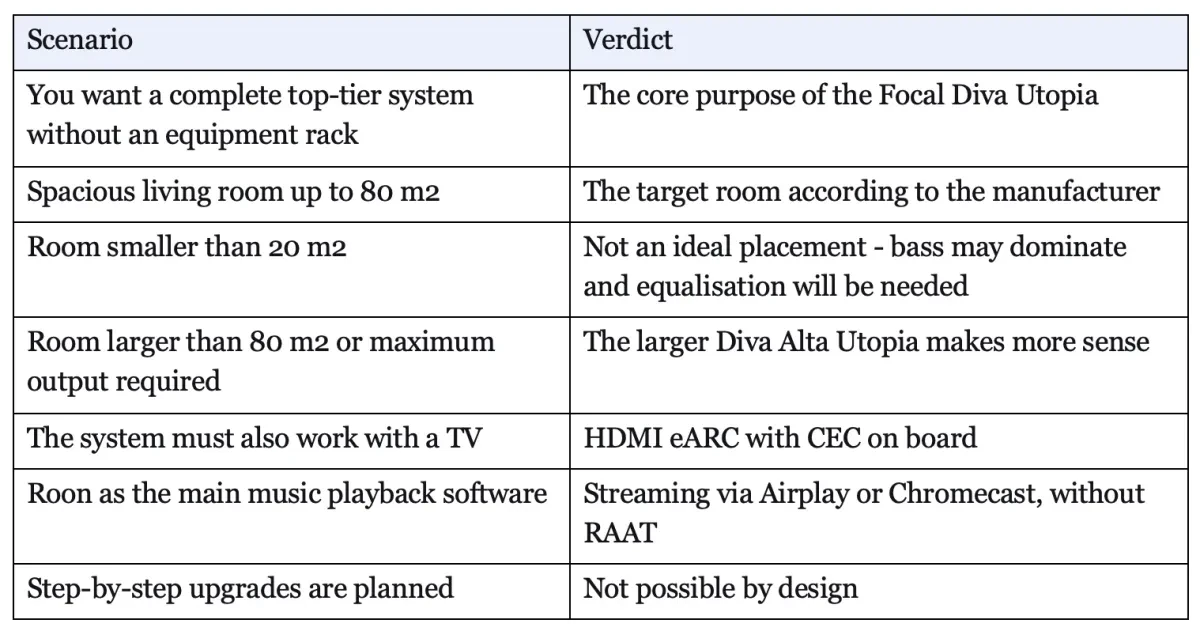
Deep bass from a cabinet of this volume always means the room will take part in the sound more than you might like. In rooms up to 20-25 m2 the lower octaves will readily excite modal boom, which is why the manufacturer targets the model at rooms up to 80 m2, and in smaller rooms ADAPT correction becomes an essential tool
Force-cancelling drivers arrangement
With the drivers arranged in side-facing pairs with opposing reaction forces, the net impulse transmitted to the cabinet is close to zero. As a result, the cabinet does not re-radiate or colour the midrange. Mounting the woofers on the sides also makes the speaker less sensitive to its distance from the front wall.
Placement
The recommendations are typical for floorstanding bass reflex speakers - the speakers are toed in towards the listener and form an equilateral triangle with the listening position, with generous clearance from the side and rear walls. First fine-tune the placement by ear, then run ADAPT, and finally fit the spikes.
Pros and cons
Position in the range
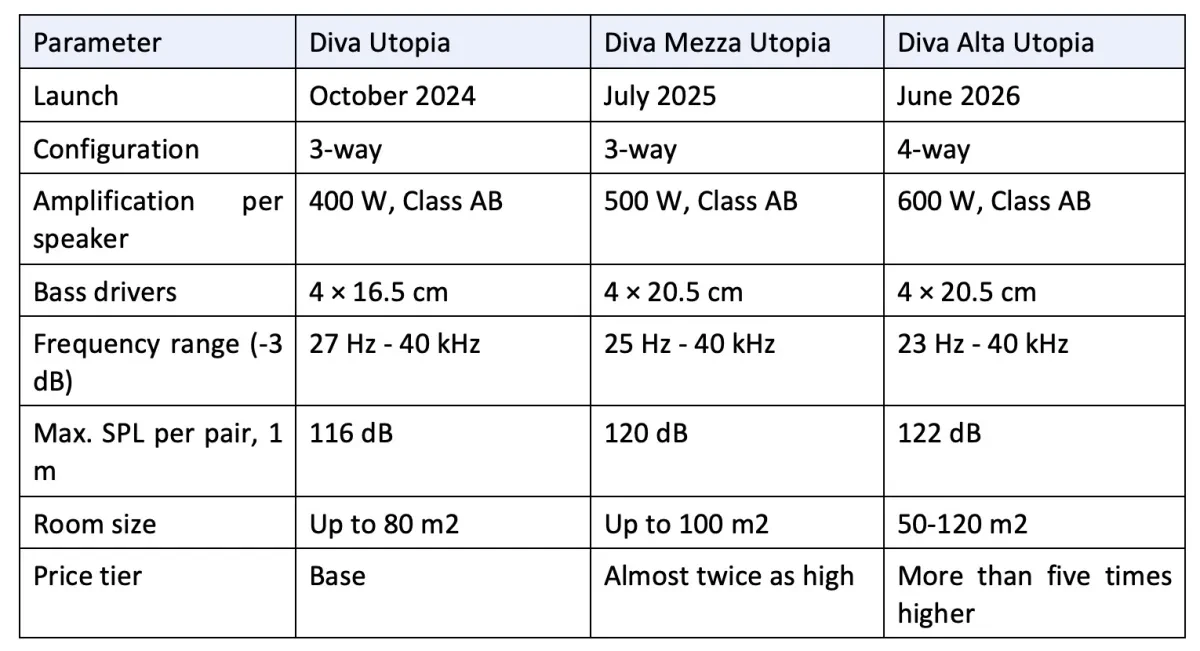
In July 2025 the Diva Mezza Utopia arrived on the market with a cabinet enlarged to 62 litres, eight-inch bass drivers and reworked Naim electronics. In June 2026 the new four-way Diva Alta Utopia became the flagship - it uses a dedicated 13 cm M-profile midrange driver with carbon reinforcement, a beryllium tweeter with PRISM technology and the Focus Time Management scheme from the Grande Utopia. These speakers, naturally, cost more.
Listening
The Focal Diva Utopia delivers a neutral tonal balance, and the driver integration is flawless - the transitions between bands are inaudible and the system sounds like a single source. The beryllium tweeter, the company's calling card, delivers very fast and extended treble, free of any forwardness or harshness.
The Focal Diva Utopia is just as strong in the midrange - vocals are perfectly outlined and intelligible, and the soundstage is precise, three-dimensional and absolutely stable. Backed by tight, dry bass that the room correction fits beautifully even into a less-than-ideal room, the Focal Diva Utopia delivers crystal-clear, honest sound.
It may lack a touch of raw ferocity, but charm is there in abundance - the sound always remains refined, ultra-detailed, flowing and completely fatigue-free. The sense of rhythm is superb (you can feel the Naim amplification at work) - your feet start dancing on their own.
After extended listening sessions, the conclusion is clear - the goal of creating an integrated all-in-one system packaged as a pair of speakers with built-in electronics has been brilliantly achieved. What we have here is luxurious top-tier presentation, superb micro- and macrodynamics, and a lively, natural and exceptionally beautiful sound that is hard not to fall in love with. This is one of those cases where breaking the rules has produced an engineering masterpiece.
Who it's for
Frequently asked questions
Do I need a cable between the speakers?
No, the signal is transmitted over a UWB radio link at 96 kHz / 24-bit without compression. The RJ45 Speaker Link cable is needed for signals up to 192 kHz / 24-bit.
Can I connect a turntable?
Yes, through an external phono stage into the analogue RCA input. Bear in mind, though, that the analogue signal is digitised for DSP processing.
Is Roon supported?
There is no Roon Ready certification. Music from Roon can be played via AirPlay or Chromecast.
Can I add a subwoofer?
There is no subwoofer output. The 24 Hz lower limit at -6 dB makes a subwoofer unnecessary.
How does the Diva Utopia differ from the Diva Mezza Utopia?
The Mezza has a 62-litre cabinet instead of 50 litres, 20.5 cm woofers instead of 16.5 cm, 500 W of amplification per speaker instead of 400 W and an updated streaming module. It is designed for rooms up to 100 m2 and costs almost twice as much.
Does the system work with a TV?
Yes, the HDMI eARC input with CEC support lets you control the volume with the TV remote and play sound through the speakers without any additional devices.
Evaluations
Stage
96%
Detailing
96%
Macrodynamics
94%
Microdynamics
95%
Bass extension
94%
Timbral authenticity
97%
Genre versatility
94%
Overall
95%
Verdict
The Focal Diva Utopia is a loudspeaker that breaks with convention and offers technological excellence rather than compromise in its class. An active design with dedicated Class AB amplification for each band, no passive crossover in the power path, force-cancelling bass drivers, room correction and uncompressed transmission between channels - everything meets the highest standards, as does the model's captivating sound.
Particular qualities
Force-cancelling bass driver arrangement
Maximum SPL of 116 dB
ADAPT room-correction
Specifications
Model name
DIVA UTOPIA
Frequency Response low +/- 3dB (Hz)
30
Frequency Response high +/- 3dB (Hz)
40000
Sensitivity (dB at 1 W/1m)
N/A
Impedance (Ohms)
N/A
Power amplifier requirements (W)
N/A
Has internal amplification
Yes
Internal amplification power (W)
75 + 75 + 250
Size (sm)
121.0 × 42.0 × 56.0
Weight (kg)
64
Official link