

Vorverstärker - Octave Audio Jubilee Preamp
Beschreibung, Bilder, technische Daten und Spezifikationen
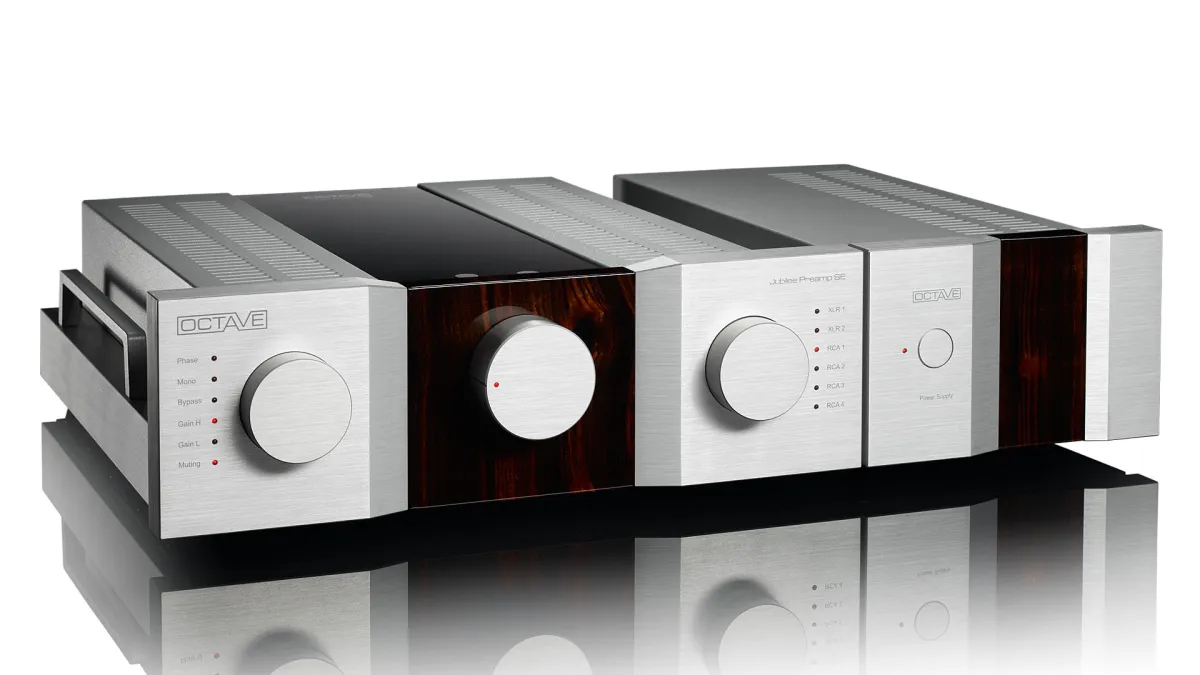
Octave Audio Jubilee Preamp
Bildquelle - (c) Octave Audio
Key specs that matter
The tube complement is four ECC82. Inputs are six RCA and two XLR, with an optional bypass function for input tape 2, and outputs are two RCA, two XLR and two tape record (RCA). Gain is 10 dB / 17.5 dB (low / high) via RCA and 16 dB / 23.5 dB via XLR. Octave specifies a frequency range of 3 Hz - 100 kHz (1.5 dB), harmonic distortion of 0.1% at 3 V / 7.5 kOhm and a signal-to-noise ratio of 90 dB (gain high) / 98 dB (gain low). The preamplifier measures 435 x 152 x 480 mm (W x H x D) and weighs 17.2 kg, and the external power supply measures 220 x 152 x 480 mm and weighs 11.5 kg.
Engineering and use context
Three features set it apart from other Octave amplifiers - a precision balancing stage with tubes, a discrete output stage with semiconductors and zero feedback. Both the amplifier and balancing stages are pure tube circuits. Phase and anti-phase of the balanced output are generated with constant phase and amplitude symmetry for balanced power amplifiers. In the output stage a feedback-free unity gain power buffer gives a low output impedance with high current capability. None of the stages uses overall feedback, and Octave states that a zero-feedback preamplifier requires a power supply of high stability with very low noise and hum. XLR inputs are equipped with broadband transformers and a ground lift.
Power management controls heating, operating voltage and the safety functions, releases the signal path only after all tube parameters have stabilised and includes an electronic fuse. Soft start electronics with inrush current limitation ramp up the heater and operating voltages. A two-level gain selector adapts the gain to the efficiency of the loudspeaker. Options are a home theatre bypass, in which the volume control is bypassed, and a 47-position stepped attenuator that cannot be operated from the remote control. Casework is silver or black, with front middle sections in slate or granite, and birch, walnut or Makassar burl on request.
Pairing
The balanced outputs are intended for balanced power amplifiers. Matching power amplifiers of the same line are the Jubilee 300 B and Jubilee Class A.
Alternatives
The Jubilee Preamp SE is its successor, with in-house XLR input transformers, a home theatre bypass input as standard and a higher signal-to-noise ratio.
Spezifikationen
Modellbezeichnung
Jubilee Preamp
Analogeingänge (symmetrisch)
2
Analogeingänge (unsymmetrisch)
6
Analogausgänge (symmetrisch)
2
Analogausgänge (unsymmetrisch)
2
Verstärkung (dBu)
10 (RCA) + 16 (XLR)
Eingangsempfindlichkeit (mV)
N/A
Ausgangsspannung (V)
N/A
Eingangsimpedanz (symmetrisch) (Ω)
N/A
Eingangsimpedanz (unsymmetrisch) (Ω)
N/A
Ausgangsimpedanz (symmetrisch) (Ω)
N/A
Ausgangsimpedanz (unsymmetrisch) (Ω)
N/A
Maximaler Ausgangspegel (symmetrisch) (dBu)
N/A
Maximaler Ausgangspegel (unsymmetrisch) (dBu)
N/A
Regelbereich der Lautstärke (dBu)
N/A
Untere Grenzfrequenz +/- 3dB (Hz)
3
Obere Grenzfrequenz +/- 3dB (Hz)
100 000
Signal-Rausch-Abstand (SNR, unbewertet) (dB)
90
Klirrfaktor + Rauschen (THD+N) (%)
0.1
Abmessungen (mm)
435 x 152 x 480
Gewicht (kg)
17.2
Offizieller Link
Weitere Komponenten
Vorverstärker
Octave Audio Jubilee Preamp SE

Vorverstärker
Octave Audio Phono Module

Vorverstärker
Octave Audio HP 300 SE

Vorverstärker
Octave Audio HP 700 SE