All

DACs — Mola Mola DAC
Description, images, technical data and specifications
Mola Mola DAC
Image source — © Mola Mola
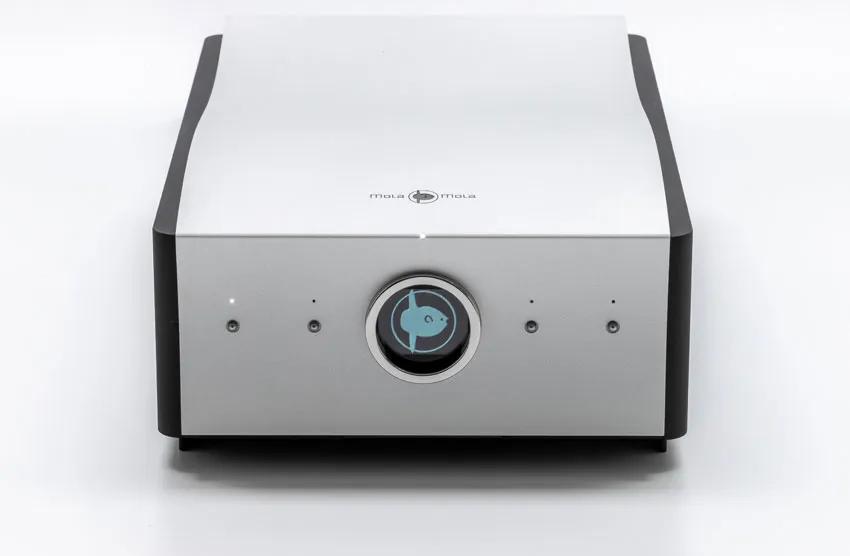
The Mola Mola DAC is not a standalone box but an optional digital-to-analogue converter board that installs inside the Makua preamplifier or the Kula integrated amplifier from Mola Mola, the Dutch electronics brand based in Groningen. The converter was developed entirely in-house, with the maker's own circuits and algorithms rather than a bought-in converter IC, and Mola Mola argues that current converter chips reach only about 22 bits of dynamic range and 20 bits of linearity. The same discrete converter was later released as a separate unit, the Tambaqui. European retail prices for the module are around EUR 6,500.
Key specs that matter
Digital inputs on the module are AES/EBU on XLR, optical Toslink, USB type B, Bluetooth with SBC, AAC, aptX and LDAC, and Ethernet with Roon Ready certification. PCM is accepted up to 384 kHz and 32 bit, and DSD up to quad speed as DoP or native, but rates above 192 kHz, word lengths above 24 bit and DSD256 work only over USB and Roon. Signal to noise ratio is 130 dB, and THD and IMD are below the measurement threshold, estimated at -140 dB. Full-scale output is 20 dBu. Bandwidth extends to 80 kHz with an apodizing response. Integrated jitter is below 1 ps from 10 Hz upwards and below 300 fs from 1 kHz, and jitter rejection exceeds 80 dB at 1 Hz after 20 seconds.
Engineering and use context
The converter is a stack of two boards that fits the option slot of the host chassis. The first board upsamples all incoming audio to 3.125 MHz at 32 bit and turns it into noise-shaped PWM. The second board carries two mono DACs, each a discrete 32-stage FIR DAC followed by a single-stage fourth-order filtering I/V converter, which turns the PWM back into an analogue signal. Building the FIR stages from discrete parts and giving each channel its own converter is how the design avoids the linearity limits of integrated chips. Clocking is handled by a laboratory-grade 100 MHz SC-cut crystal oscillator, which explains the sub-picosecond jitter figures. Once fitted, the digital inputs join the existing routing matrix and preset buttons of the Makua or Kula, so no extra box, mains lead or interconnect is needed. Later versions of the board gained the network connection and Roon Ready status, bringing them in line with the Tambaqui.
Pairing
The module is only usable inside a Makua or Kula. With a Makua, the natural partners are Mola Mola's Perca or Kaluga power amplifiers, and a computer or Roon server on the USB and Ethernet inputs gives access to the highest sample rates.
Alternatives
The Mola Mola Tambaqui puts this converter in its own 200 mm wide chassis with headphone outputs and an additional digital input on an HDMI socket.
Key specs that matter
Digital inputs on the module are AES/EBU on XLR, optical Toslink, USB type B, Bluetooth with SBC, AAC, aptX and LDAC, and Ethernet with Roon Ready certification. PCM is accepted up to 384 kHz and 32 bit, and DSD up to quad speed as DoP or native, but rates above 192 kHz, word lengths above 24 bit and DSD256 work only over USB and Roon. Signal to noise ratio is 130 dB, and THD and IMD are below the measurement threshold, estimated at -140 dB. Full-scale output is 20 dBu. Bandwidth extends to 80 kHz with an apodizing response. Integrated jitter is below 1 ps from 10 Hz upwards and below 300 fs from 1 kHz, and jitter rejection exceeds 80 dB at 1 Hz after 20 seconds.
Engineering and use context
The converter is a stack of two boards that fits the option slot of the host chassis. The first board upsamples all incoming audio to 3.125 MHz at 32 bit and turns it into noise-shaped PWM. The second board carries two mono DACs, each a discrete 32-stage FIR DAC followed by a single-stage fourth-order filtering I/V converter, which turns the PWM back into an analogue signal. Building the FIR stages from discrete parts and giving each channel its own converter is how the design avoids the linearity limits of integrated chips. Clocking is handled by a laboratory-grade 100 MHz SC-cut crystal oscillator, which explains the sub-picosecond jitter figures. Once fitted, the digital inputs join the existing routing matrix and preset buttons of the Makua or Kula, so no extra box, mains lead or interconnect is needed. Later versions of the board gained the network connection and Roon Ready status, bringing them in line with the Tambaqui.
Pairing
The module is only usable inside a Makua or Kula. With a Makua, the natural partners are Mola Mola's Perca or Kaluga power amplifiers, and a computer or Roon server on the USB and Ethernet inputs gives access to the highest sample rates.
Alternatives
The Mola Mola Tambaqui puts this converter in its own 200 mm wide chassis with headphone outputs and an additional digital input on an HDMI socket.
Specifications
Model name
DAC
Conversion type
N/A
Engine
N/A
DSD compatability
Yes
Parameters
up to 384kHz/32 bits and DSD256
Frequency response low +/- 3dB (Hz)
N/A
Frequency response high +/- 3dB (Hz)
N/A
Gain (dBu)
N/A
Output Level (balanced) (V)
N/A
Output Level (single-ended) (V)
N/A
Input Impedance (balanced) (Ω)
N/A
Input Impedance (single-ended) (Ω)
N/A
Output Impedance (balanced) (Ω)
N/A
Output Impedance (single-ended) (Ω)
N/A
Analog outputs
N/A
Signal to Noise Ratio (dB)
130
Total Harmonic Distortion + Noise (% at 22 kHz)
N/A
Dimensions (mm)
N/A
Weight (kg)
N/A
Official link