

CD / SACD players and transports — Gold Note CD-5
Description, images, technical data and specifications
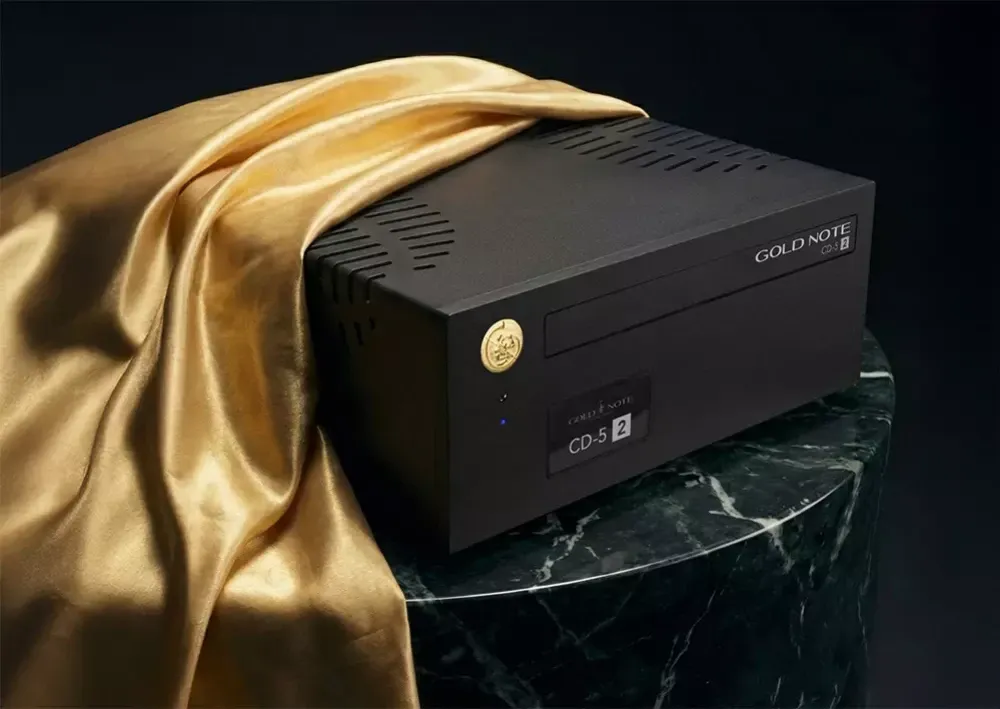
Gold Note CD-5
Image source — © Gold Note
Key specs that matter
Conversion uses the AKM AK4493 chip, and the disc mechanism is a tray loader from Stream Unlimited running its SUOS-Hifi platform. Outputs are RCA and XLR at 2 V RMS with 100 ohm output impedance, plus coaxial at 75 ohms and optical digital outputs. No digital inputs are listed. Frequency response is 20 Hz to 20 kHz within ±0.3 dB, THD is 0.001%, signal to noise ratio is 124 dB and dynamic range is 123 dB. Power consumption is 30 W. The player measures 200 x 80 x 260 mm and weighs 3 kg, with a case of black painted steel and aluminium. A touchscreen and remote control are provided.
Engineering and use context
As a dedicated CD player, the CD-5 plays discs and converts them in its own AK4493 DAC, and its two digital outputs can also pass the disc data to a separate converter. Balanced XLR sockets suit amplifiers with balanced inputs placed some distance away, and the front touchscreen operates the player. Gold Note offers the external PSU-10 EVO supply as an upgrade path. The painted steel and aluminium case differs from the anodised aluminium of the 10 Series models of the same size. Compared with the CD-10, the CD-5 lacks the coaxial and optical inputs and has slightly lower signal to noise and dynamic range figures, and it weighs 1 kg less.
Pairing
Any amplifier with RCA or XLR line inputs can take the output of the CD-5. Gold Note's PA-10 EVO power amplifier or HP-10 headphone amplifier share its compact format. Where a system already has a stand-alone converter, the CD-5 can feed it digitally, and other sources such as a turntable or streamer connect to the amplifier.
Alternatives
The Gold Note CD-10 is the 10 Series CD player in the same case size, adding coaxial and optical digital inputs and reaching higher signal to noise figures.
Specifications
Model name
CD-5
Transport
Yes
Player
Yes
SACD support
N/A
Engine
AKM AK4493
Frequency response low +/- 3dB (for CD) (Hz)
20
Frequency response high +/- 3dB (for CD) (Hz)
20 000
Frequency response low +/- 3dB (for SACD) (Hz)
N/A
Frequency response high +/- 3dB (for SACD) (Hz)
N/A
Gain (dBu)
N/A
Output Level (balanced) (V)
N/A
Output Level (single-ended) (V)
N/A
Input Impedance (balanced) (Ω)
N/A
Input Impedance (single-ended) (Ω)
N/A
Output Impedance (balanced) (Ω)
N/A
Output Impedance (single-ended) (Ω)
N/A
Dynamic range (for CD) (dB)
123
Dynamic range (for SACD) (dB)
N/A
Signal to Noise Ratio (for CD) (dB)
124
Signal to Noise Ratio (for SACD) (dB)
N/A
Total Harmonic Distortion + Noise (for CD) (%)
0.001
Total Harmonic Distortion + Noise (for SACD) (%)
N/A
Dimensions (mm)
200 x 80 x 260
Weight (kg)
3
Official link
More components
CD / SACD players and transports
Gold Note CD-5.2

CD / SACD players and transports
Gold Note CD-10

CD / SACD players and transports
Gold Note CD-1000 MkII