

Moving Magnet vs Moving Coil Cartridges - The Complete Guide
Vinyl Cartridges Without the Marketing

22.08.2026 13:40 | ~7 min read
There is a settled belief in audiophile circles that an MM cartridge is the right fit for an entry-level system, while more grown-up rigs call for an MC. This is usually presented as a choice between an affordable and a more expensive price bracket, which is wrong: what we are really dealing with are two fundamentally different engineering approaches, each with its own strengths and weaknesses. Understanding those differences in depth is exactly what this guide is for. You will find everything here, from circuit topology to load matching and resonance calculations, plus the thing almost nobody writes about: the cost of living with one cartridge type or the other.
The physics - where the difference lies
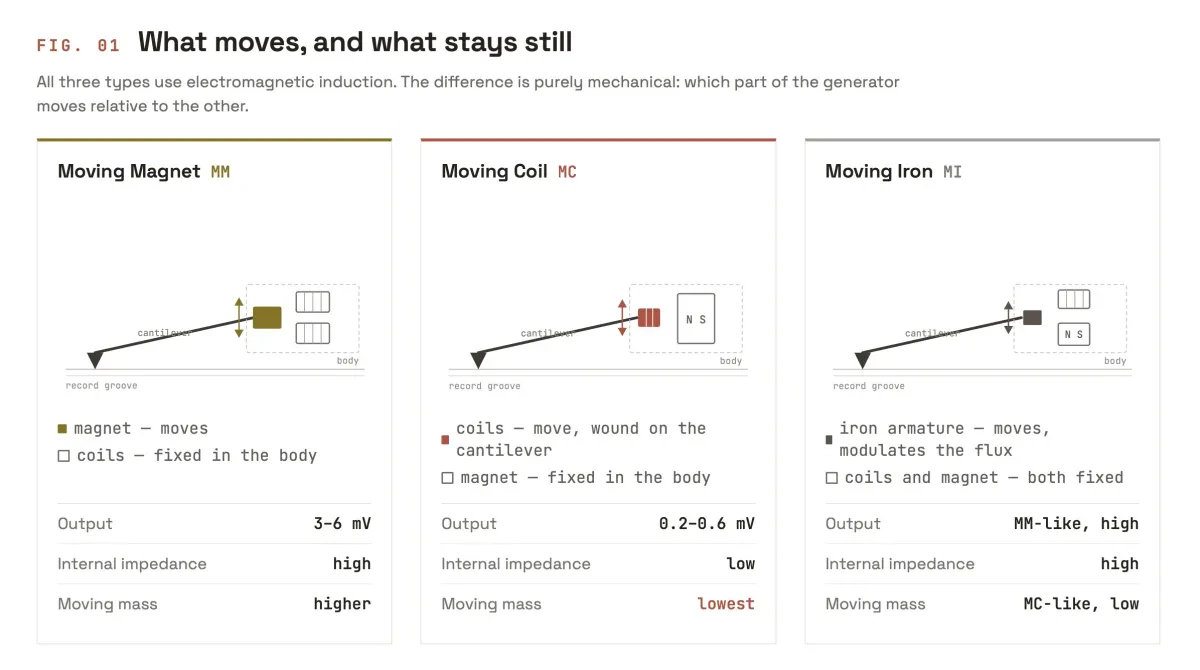
The groove on a record is read by the stylus, and the cartridge itself exists to turn that mechanical movement into an electrical voltage. Every cartridge type described here relies on the law of electromagnetic induction. The difference is purely mechanical: which part of the system moves relative to the other.
Moving Magnet (MM) - the moving-magnet cartridge
The layout is as follows: the stylus is fixed at one end of the cantilever, a magnet at the other. The magnet vibrates within the field of the coils and induces an EMF in them. The coils themselves are stationary and mounted in the cartridge body, and there can be several of them, which delivers a high output level (up to 3-6 mV) and a high internal impedance.
Moving Coil (MC) - the moving-coil cartridge
The arrangement is reversed. The magnet is fixed in the cartridge body, while the coils, which are far smaller, are wound directly onto the rear of the cantilever and move within the magnet field. That approach obviously imposes limits on the mass of the coils, so the number of turns is small, output sits at 0.2-0.6 mV and internal impedance is low as well. In theory, minimal moving mass allows the groove to be tracked slightly more accurately.
THE FUNDAMENTAL ADVANTAGE OF THE MC CARTRIDGE
Lower effective moving mass means a higher upper limit to the mechanical bandwidth and less inertia. The headline numbers (output level, channel separation and the rest) are consequences of the specific implementation.
Moving Iron (MI) - a third cartridge type
Here both the magnet and the coils are stationary, and what moves is a ferromagnetic element that modulates the magnetic flux. Such cartridges combine the low moving mass typical of MC designs with the high output typical of MM. The construction is harder to manufacture and the choice of models is narrower.
Optical cartridges - the exotic option
More exotic variants exist too, such as optical cartridges, which retain the principle of reading the groove with a stylus. From that point on, however, light does the work instead of coils and magnets: as the stylus moves along the groove it passes its motion to a shutter inside the cartridge, which interrupts the light beam travelling between the emitter and the photodetector. The detector converts those changes in light into an analogue music signal.
Reading the record directly with a laser is used in the ELP Laser Turntable, but a number of problems, above all extreme sensitivity to dust, kept the technology from wider adoption.
Output level and what the phono stage has to deliver
This is one of the key parameters for correctly matching a cartridge to a phono stage.
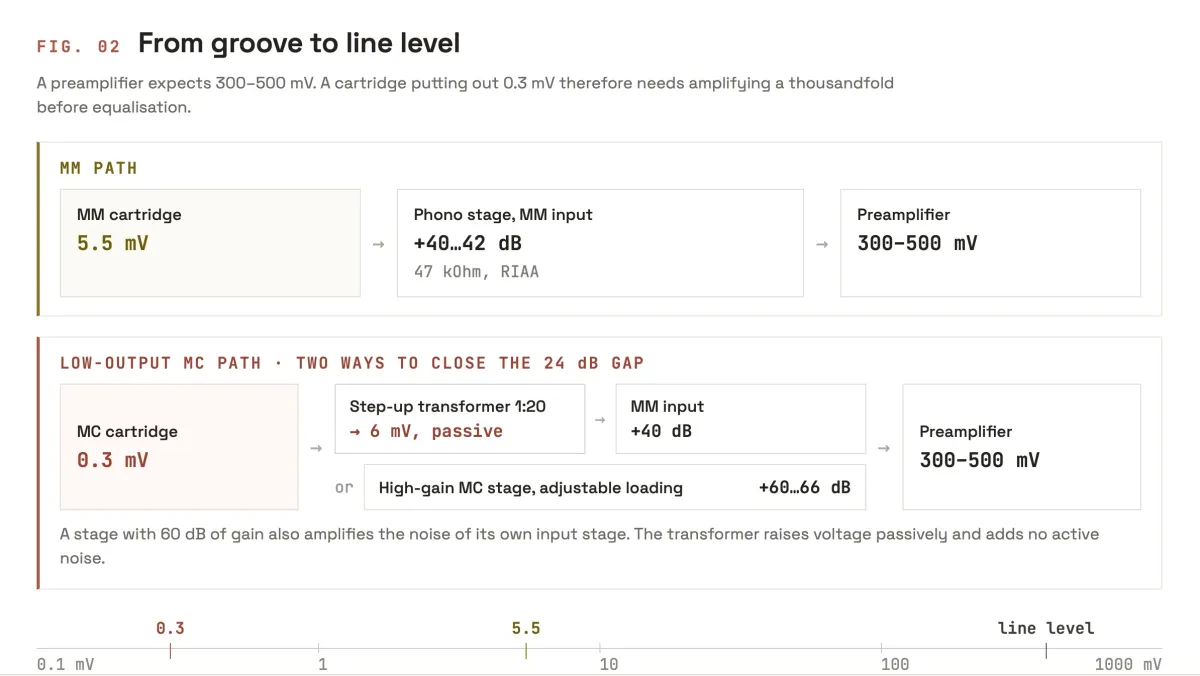
A phono stage is essential in the system because a preamplifier works with a line-level signal of 300-500 mV. In other words, before equalisation and additional amplification, a cartridge putting out 0.3 mV needs to be amplified a thousandfold. Even a phono stage does not fully solve the problem: low-output MC cartridges are exposed to noise, because a stage with 60 dB of gain also amplifies the input stage own noise. That is why the phono stage in a vinyl system is often said to be the link that defines the sound, and why spending on it is always justified, as is the development of true High-End designs.
The step-up transformer - when do you need one?
There is a more elegant solution for low-output MC cartridges: insert a step-up transformer ahead of the phono stage. This module raises the voltage passively, without adding active noise of its own. The ratio is chosen so that the 47 kOhm reflected through the secondary winding presents the cartridge with a load it finds acceptable on the primary side.
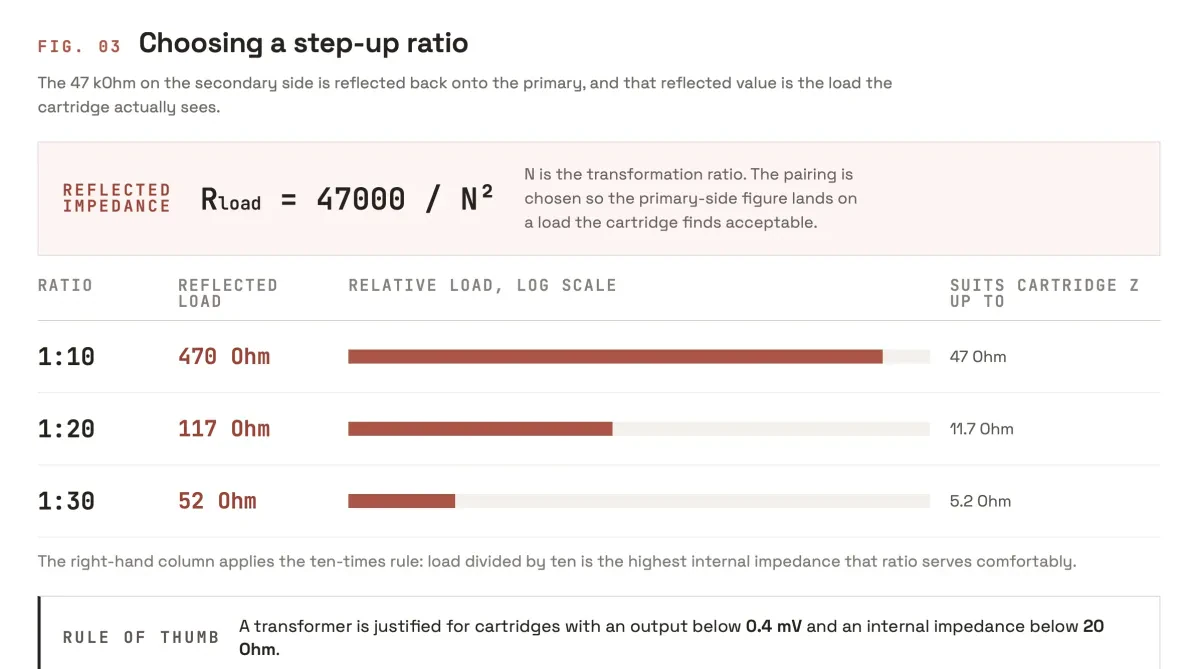
Rule of thumb: a transformer is justified for cartridges with an output below 0.4 mV and an internal impedance below 20 Ohm.
Loading - the single most important parameter for a cartridge
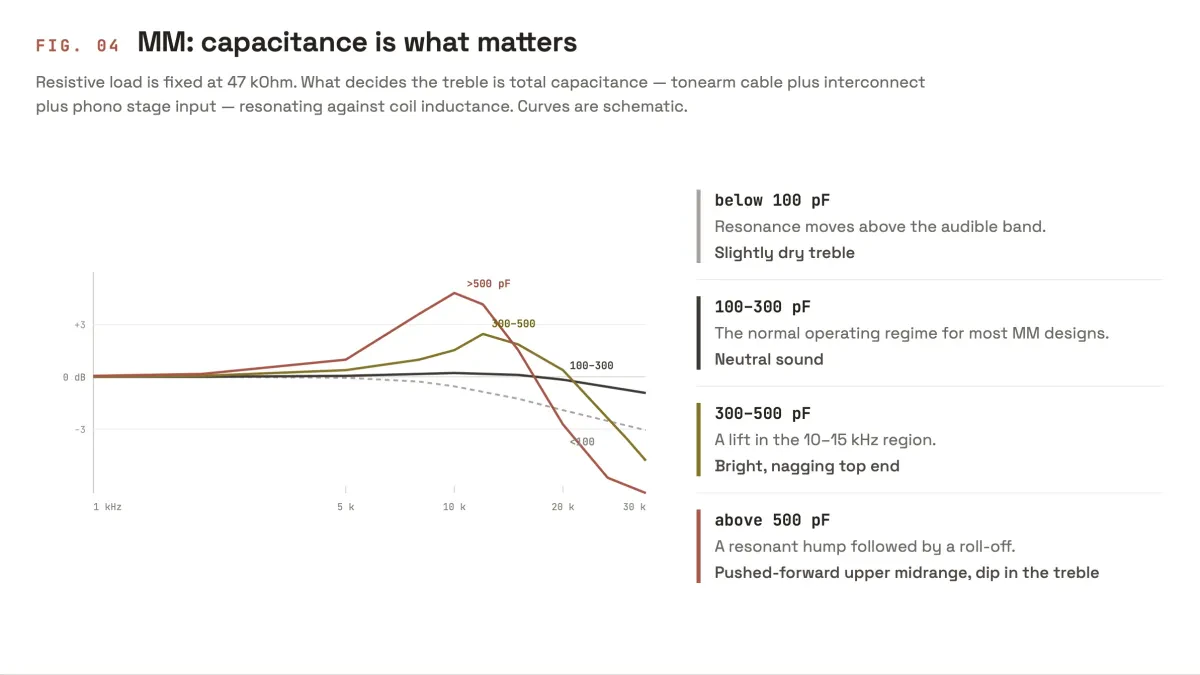
Capacitance is what matters, not impedance. True for MM cartridges
The standard MM load is always fixed at 47 kOhm. What matters most in this configuration is the total capacitance of the system: the capacitance of the tonearm cable, of the interconnect and the input capacitance of the phono stage. MM coils have pronounced inductance, and as load capacitance rises they form a resonant circuit in the treble.
Impedance is what matters, not capacitance. True for MC cartridges
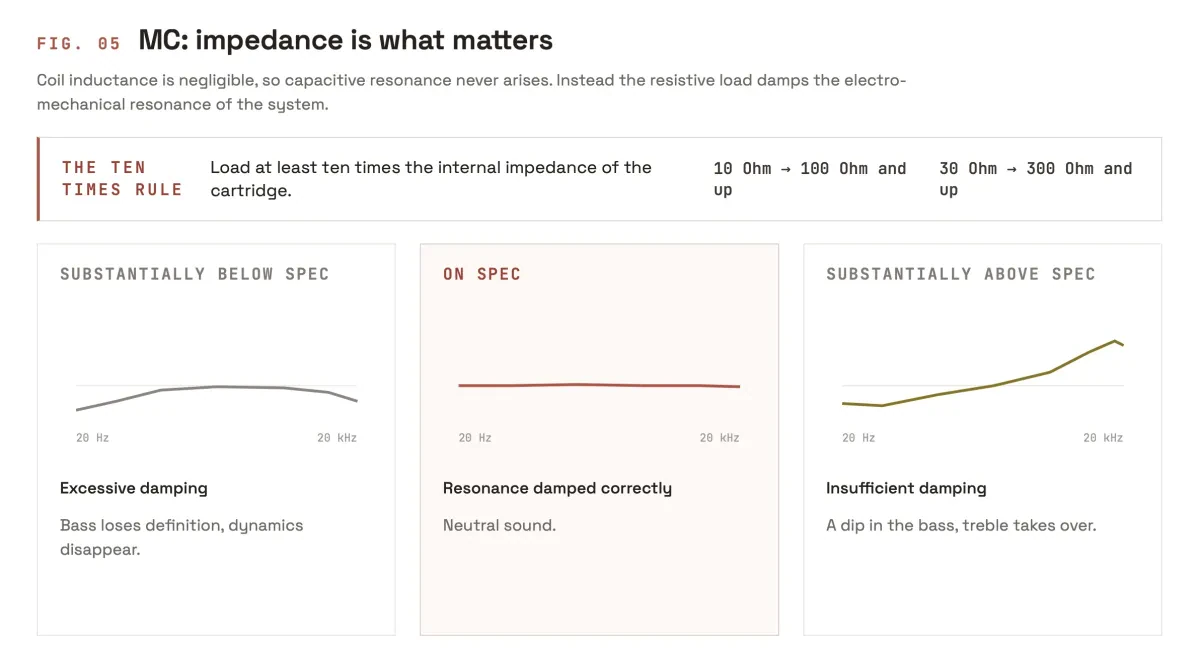
The inductance of MC coils is negligible and capacitive resonance simply does not arise in such systems. A different problem takes its place: the resistive load damps the electro-mechanical resonance of the system.
The basic rule is a load of at least ten times the internal impedance of the cartridge. A cartridge with an internal impedance of 10 Ohm therefore works normally into 100 Ohm and above, one with 30 Ohm will ask for 300 Ohm, and so on.
Arm and cartridge resonance - how to calculate it?
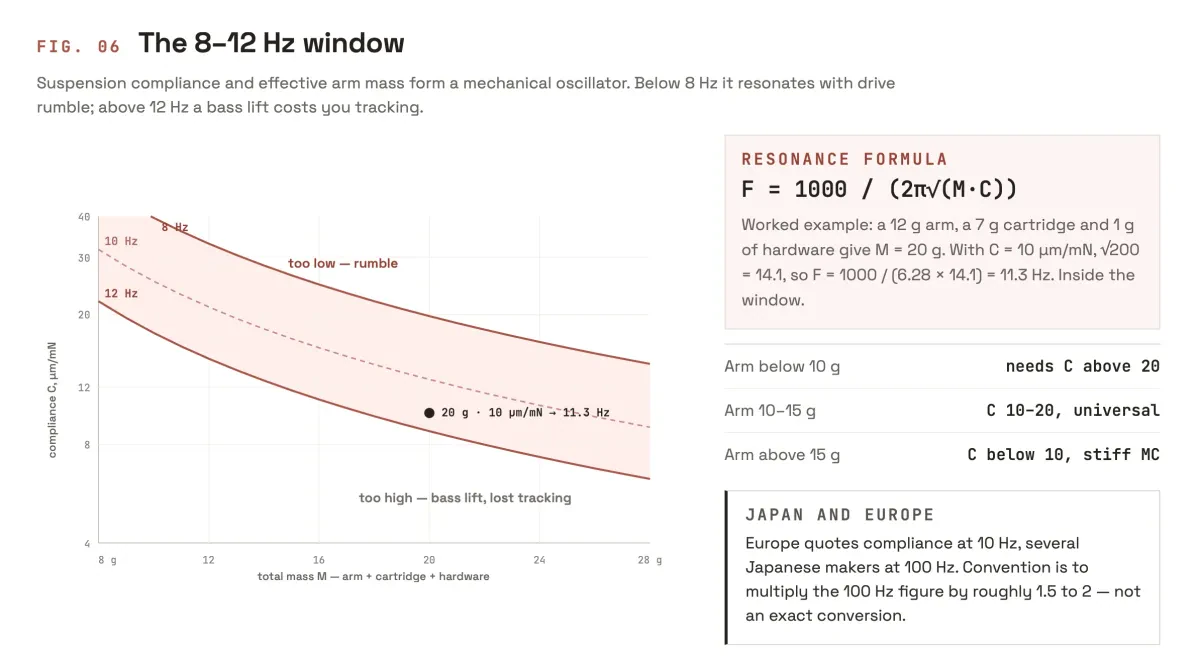
The compliance of the cartridge suspension and the effective mass of the tonearm form a mechanical oscillating system. The frequency of that pairing has to fall between 8 and 12 Hz. Otherwise you are in trouble: below 8 Hz the system will resonate with drive rumble, above 12 Hz tracking will be lost because of a bass lift, since the resonance lands in the low frequencies
Stylus profile - what to look for
The shape of the contact between the diamond stylus and the record groove has an enormous influence on playback quality. Beyond tracking force, you will have to spend time on the other parameters as well.
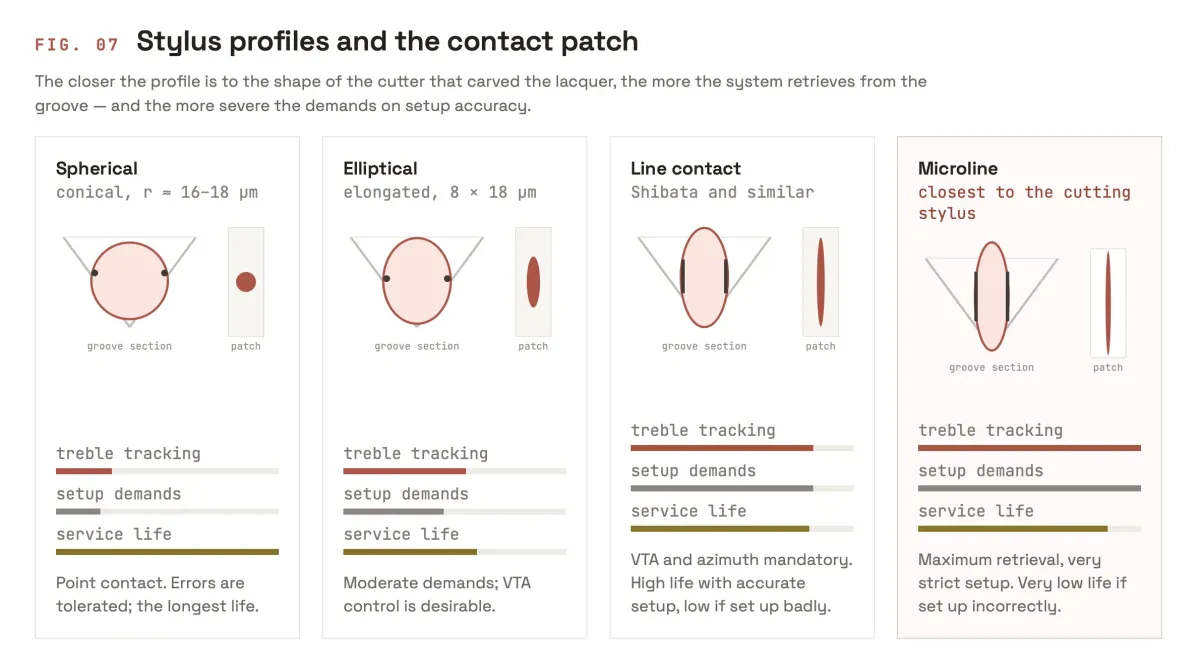
The logic is simple: the closer the profile is to the shape of the cutter that carved the lacquer, the more information the system retrieves from the groove, and the more severe the demands on setup accuracy become.
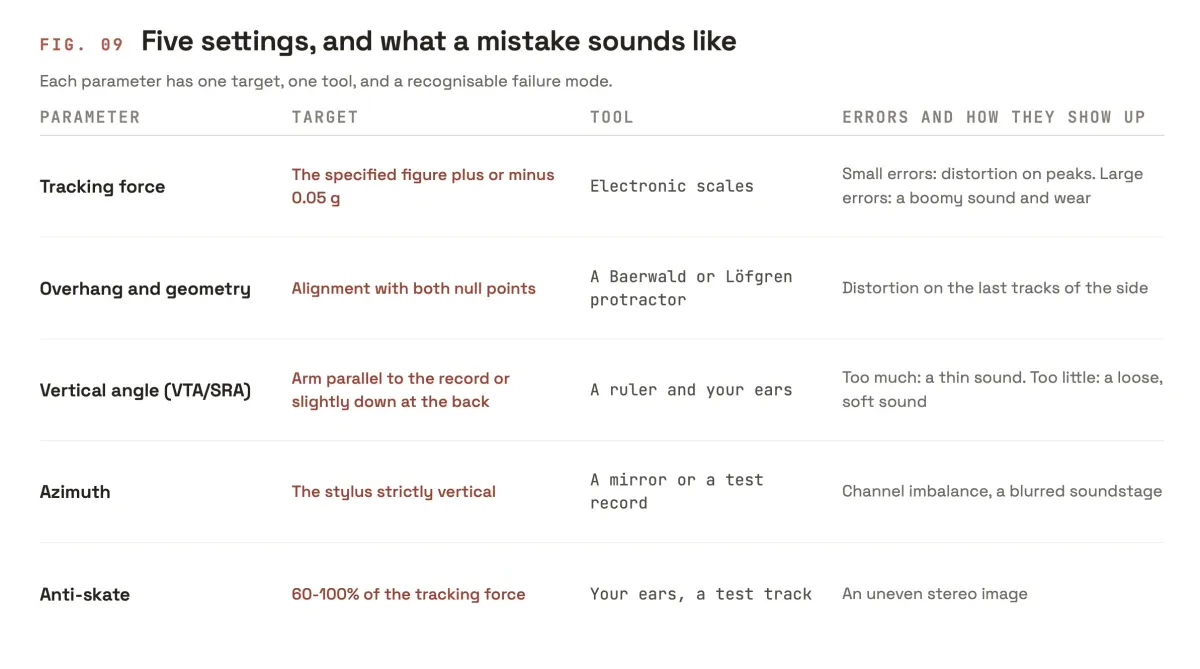
How to set up a vinyl cartridge?
Three vinyl benchmarks
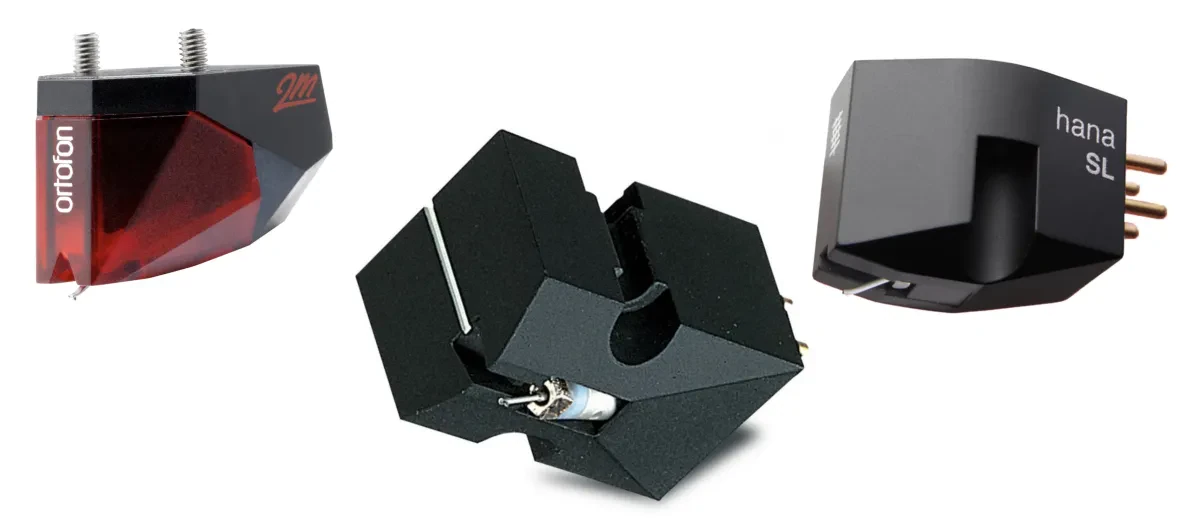
Examples of cartridges that have already become classics, and their specifications.
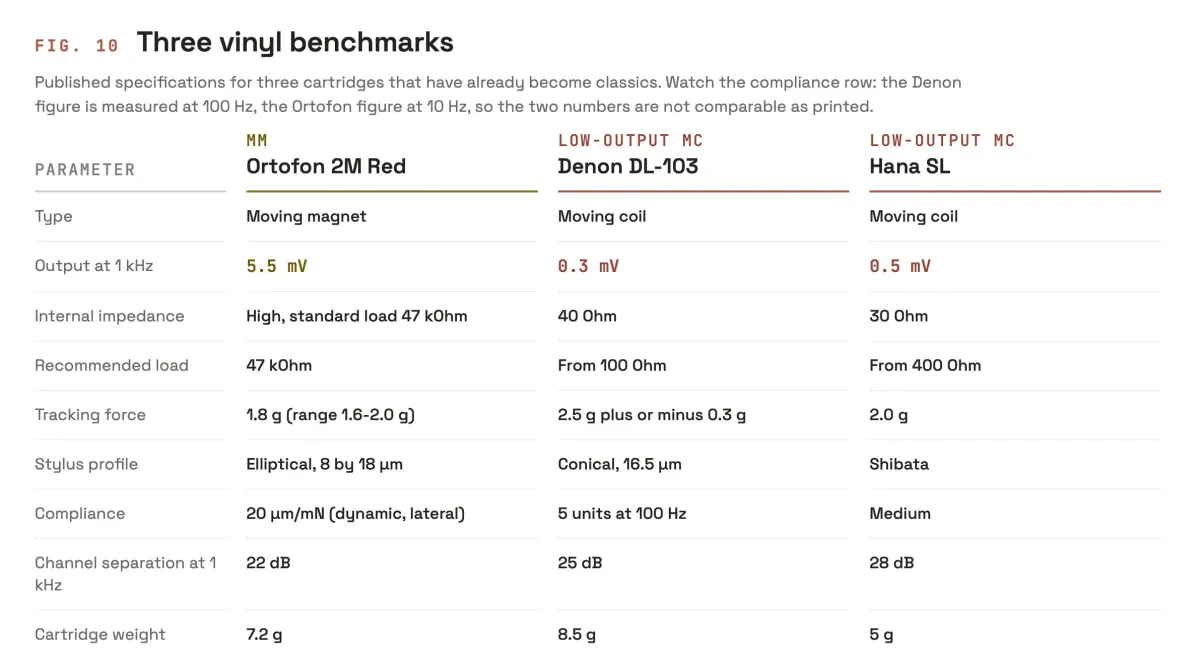
Pay attention to compliance, which we covered above. The quoted 5 units for the Denon DL-103 are measured at 100 Hz, while the 20 units for the Ortofon 2M Red are measured at 10 Hz. Comparing those numbers directly leads to the wrong conclusion. Once converted, it turns out that the Denon DL-103 needs an arm of medium to high effective mass, while the Ortofon 2M Red needs a light one.
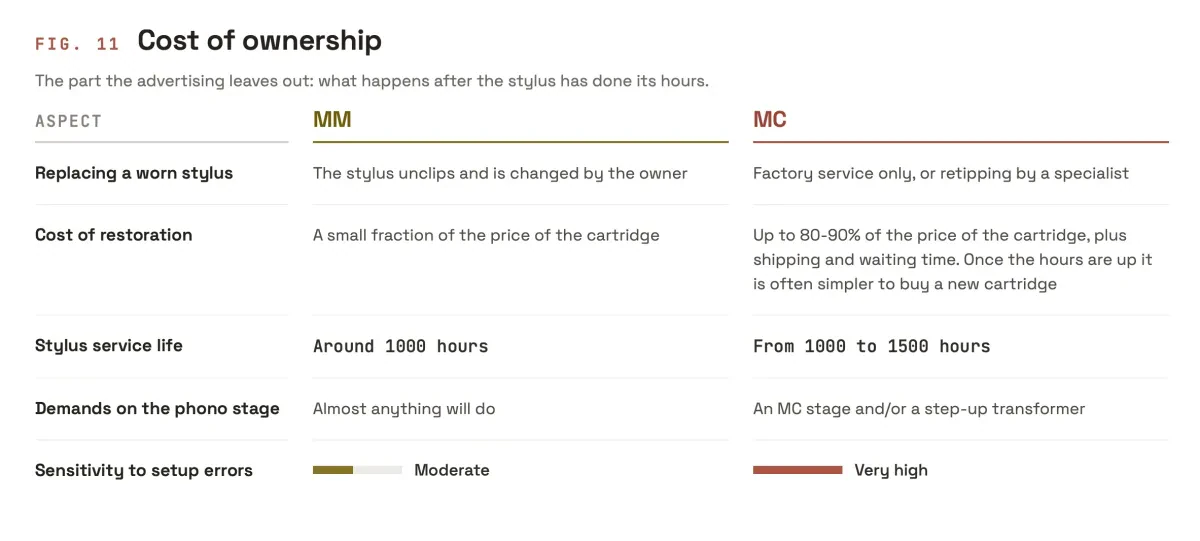
Cost of ownership - what the advertising leaves out
What you will hear and what you will not - MM versus MC
Attack
The lower moving mass of an MC delivers a crisper attack, above all on plucked and percussive instruments.
Level of detail
Not always, and largely dependent on the stylus. An expensive MM with a sophisticated profile can sound more interesting than a mid-tier MC fitted with a line-contact stylus.
A warm sound
The tonal character of an MM cartridge depends on load capacitance, and that contributes more to the character of the sound than the difference from an MC does. So whether the sound comes out warm has nothing to do with the cartridge type.
Tracking on the inner grooves
This depends solely on the stylus profile, not on the type of cartridge.
Choosing a cartridge - scenarios
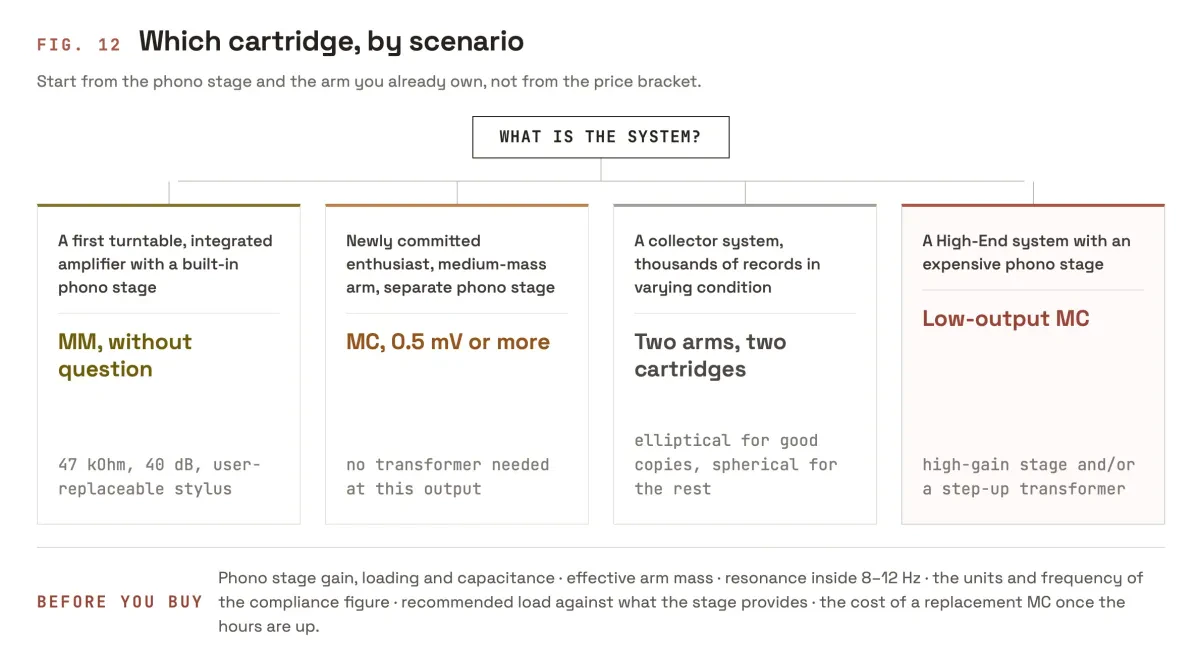
Pre-purchase checklist
1. Establish the type and input parameters of your phono stage: gain, loading, capacitance.
2. Confirm the effective mass of your tonearm.
3. Calculate the resonant frequency to make sure you land in the 8-12 Hz window.
4. Check which units the compliance figure is given in and at which frequency it was measured.
5. Cross-check the recommended load against what your phono stage can actually provide.
6. Factor in the cost of buying a new cartridge in the case of an MC once the hours are up.
7. Make sure you own a set of scales and a protractor. That is the basic minimum.