

Floorstanding vs Bookshelf Speakers - How to Choose in 2026
The Ultimate Guide to Choosing Acoustics

27.08.2026 15:20 | ~6 min read
Which sound better, bookshelf speakers or floorstanders? This eternal audiophile question has no answer and is, in principle, meaningless - because the sound quality of a loudspeaker is determined not only by the size of its cabinet, but by the type of drivers used, the enclosure alignment, the crossover and a mass of other parameters. Most importantly of all, it is determined by how the speaker interacts with your listening room and by the sound pressure level you need. In essence, what we have here is an engineering problem, and it should be phrased like this: which type and form factor of loudspeaker will be optimal for my room?
Three criteria, of which you can only pick two
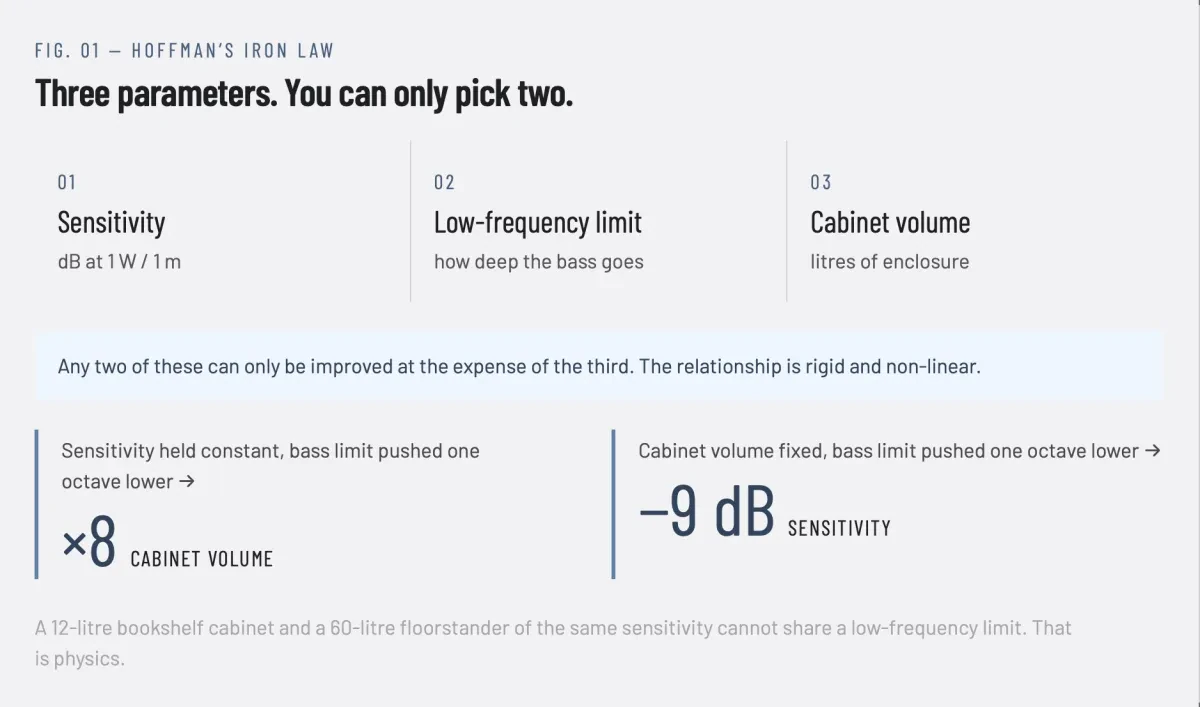
Hoffman's Iron Law is a fundamental rule known to every loudspeaker designer. It goes like this: the sensitivity of a speaker, the low-frequency limit of its response and the volume of its cabinet are linked to one another, and any two of these parameters can only be improved at the expense of the third. The relationship is rigid and non-linear. If, at unchanged sensitivity, you want to push the bass limit an octave lower, the cabinet volume has to grow roughly eightfold. If the cabinet volume is fixed and you still need that extra octave of bass extension, you will lose almost 9 dB of sensitivity.
How bookshelf speakers differ from floorstanders
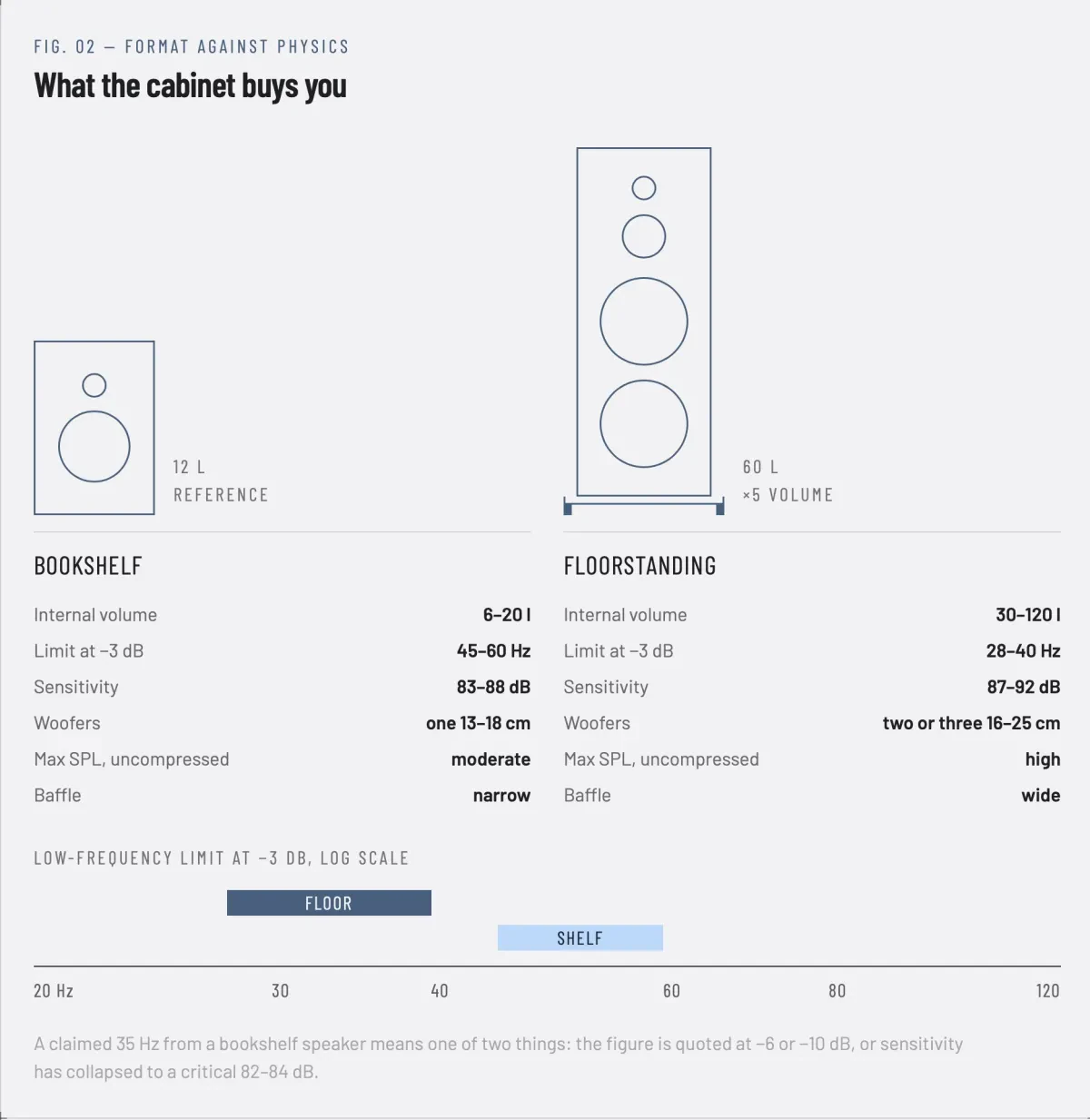
A widespread misconception is that bookshelf speakers save space. No, they do not - to realise their potential, standmounts have to be placed on stands 60-90 cm away from the walls. Which means that they will occupy roughly the same amount of room area as floorstanding loudspeakers. The saving here turns out to be purely visual and aesthetic: compact speakers on stands look more elegant than large rectangular boxes.
The dynamic compression nobody talks about
As a loudspeaker works, the voice coil of the driver heats up and its resistance rises, so at the same applied voltage the driver delivers less acoustic power. The effect is called thermal compression, and it shows up during long listening sessions at high levels or on a succession of dynamic peaks (large orchestral works, symphonic material and so on). A smaller driver has a magnet system with lower thermal capacity, which is why compression sets in earlier.
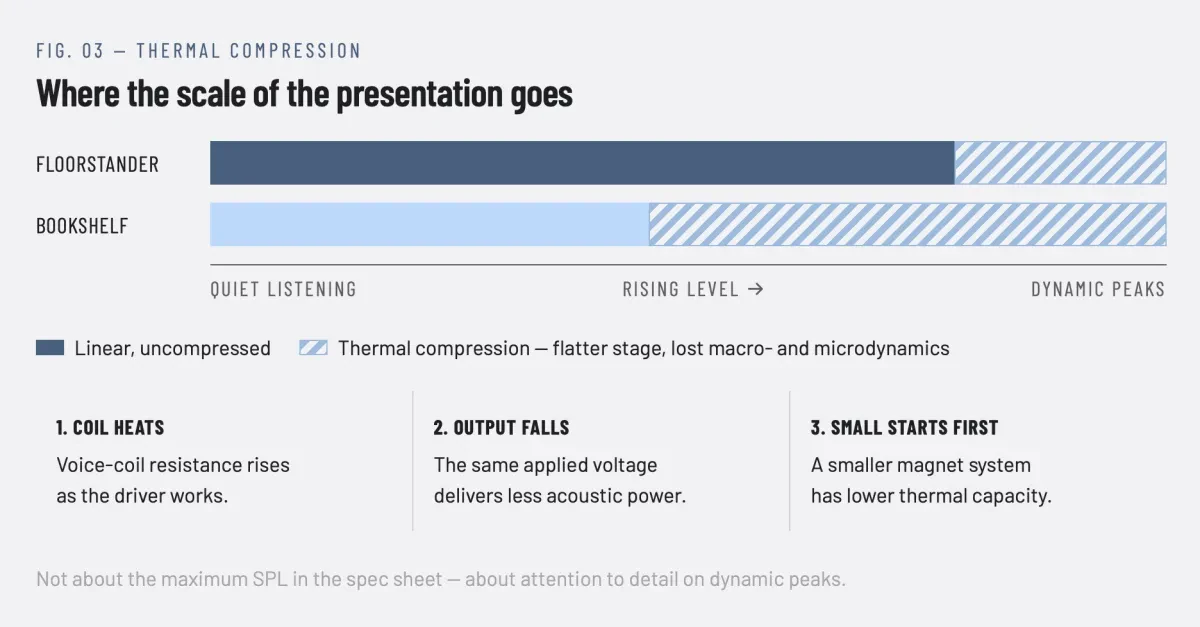
In practice it looks like this: we listen quietly and bookshelf and floorstanding speakers play almost on equal terms; we add volume and the floorstanders increase the scale of the presentation, while the standmounts somehow deliver a flatter soundstage and lose macro- and microdynamics. And this is not about the maximum sound pressure level quoted in the spec sheet - it is specifically about attention to detail on dynamic peaks.
Image precision - which few people remember
On this parameter, by contrast, it is usually bookshelf speakers that win. When a sound wave reaches the edge of the baffle it is re-radiated, creating a secondary source. The wider the baffle, the lower the frequency at which this re-radiation occurs, and the more strongly the loss of localisation is felt.
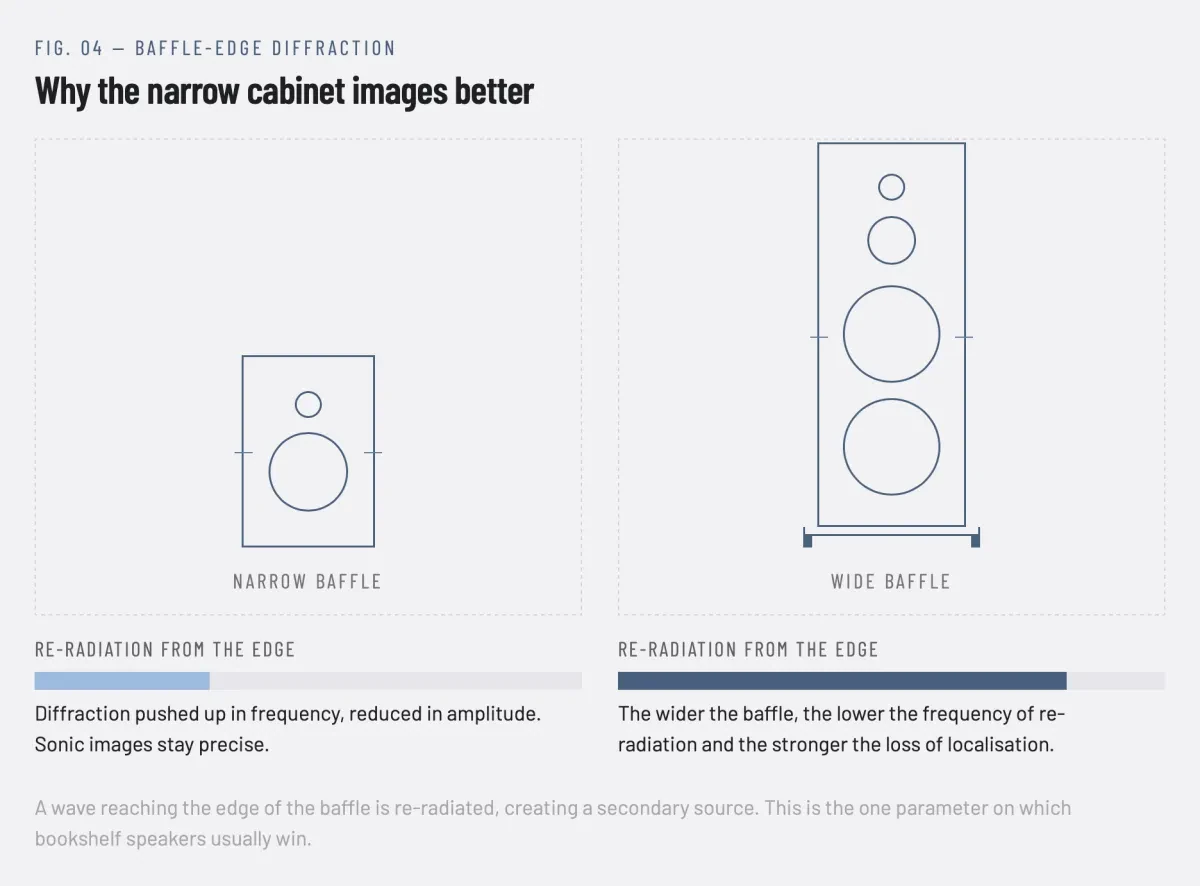
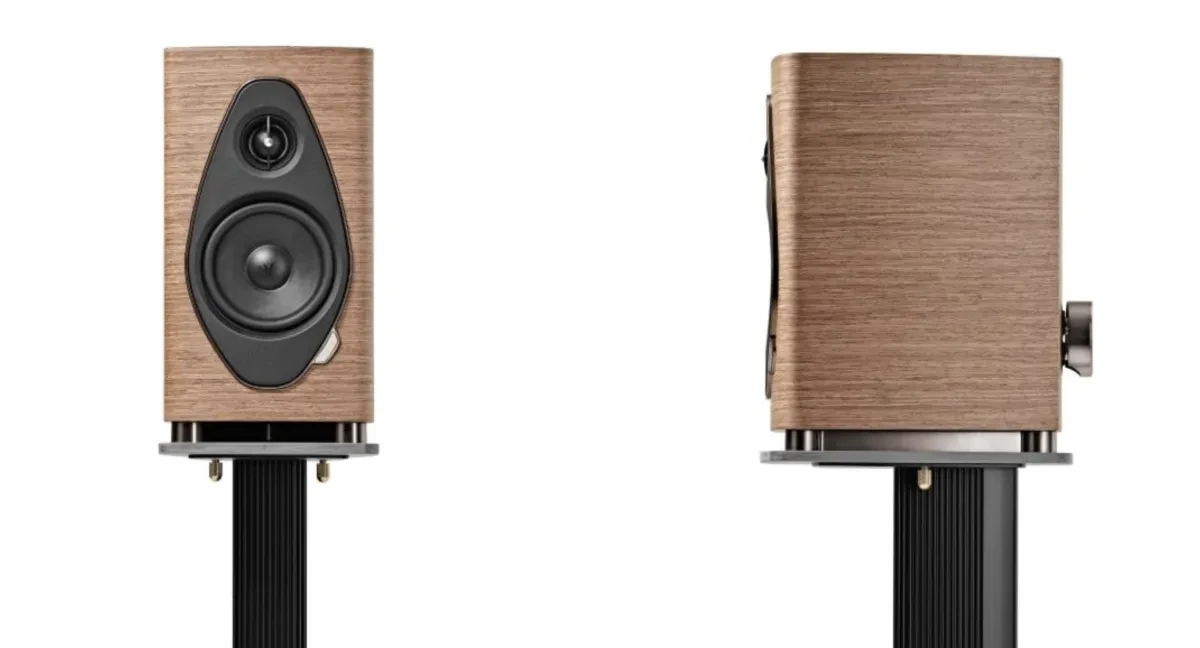
The narrow cabinet of a bookshelf speaker pushes diffraction effects up in frequency and reduces their amplitude. That is precisely why serious standmounts usually deliver more precise sonic images.
The room matters most of all
Finally, we will never tire of repeating that the interaction between the loudspeaker and the listening room affects the sound more strongly than anything else, noticeably outweighing the effects of any number of engineering solutions. As we have written before, the first axial mode of a room is calculated with the formula F = 172 / L, where L is the distance between parallel walls in metres. A room 4 metres long gives a first mode at 43 Hz; 3 metres wide, at 57 Hz.
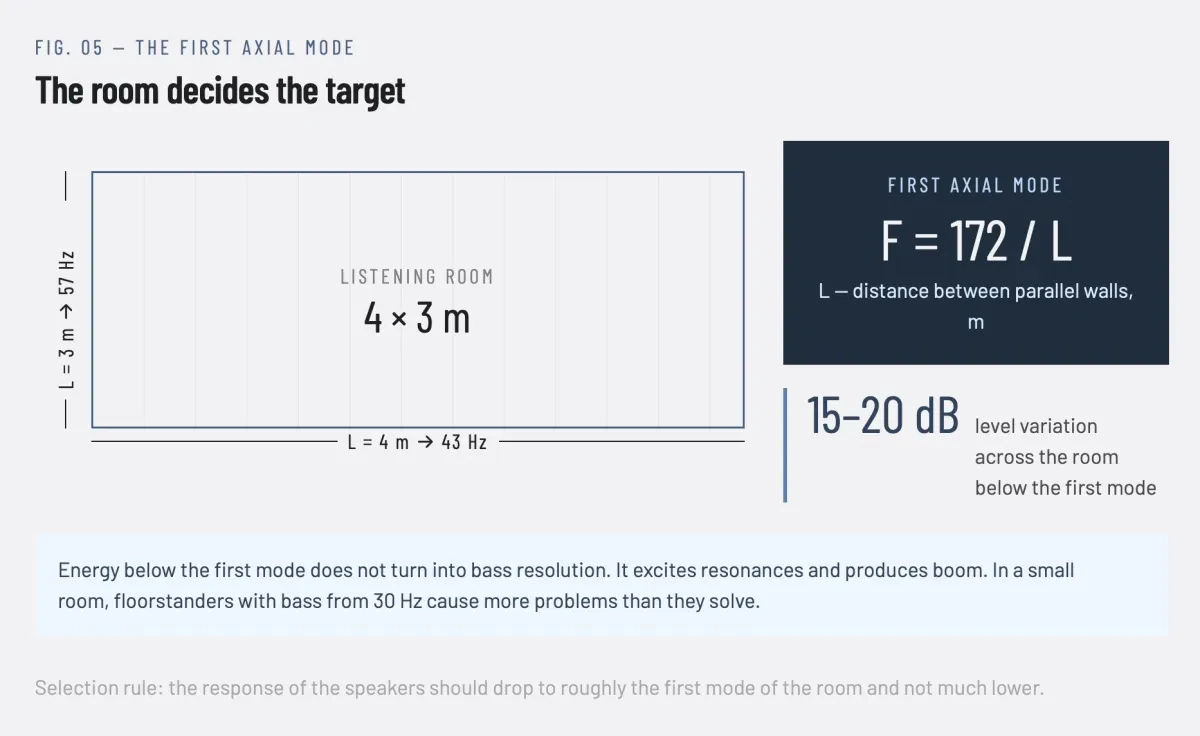
What follows from this? That in a small listening room, floorstanders with bass from 30 Hz will cause more problems than they bring advantages. Energy below the first mode will not turn into bass resolution; it will excite resonances and produce boom. The level variation across the room reaches 15-20 dB.
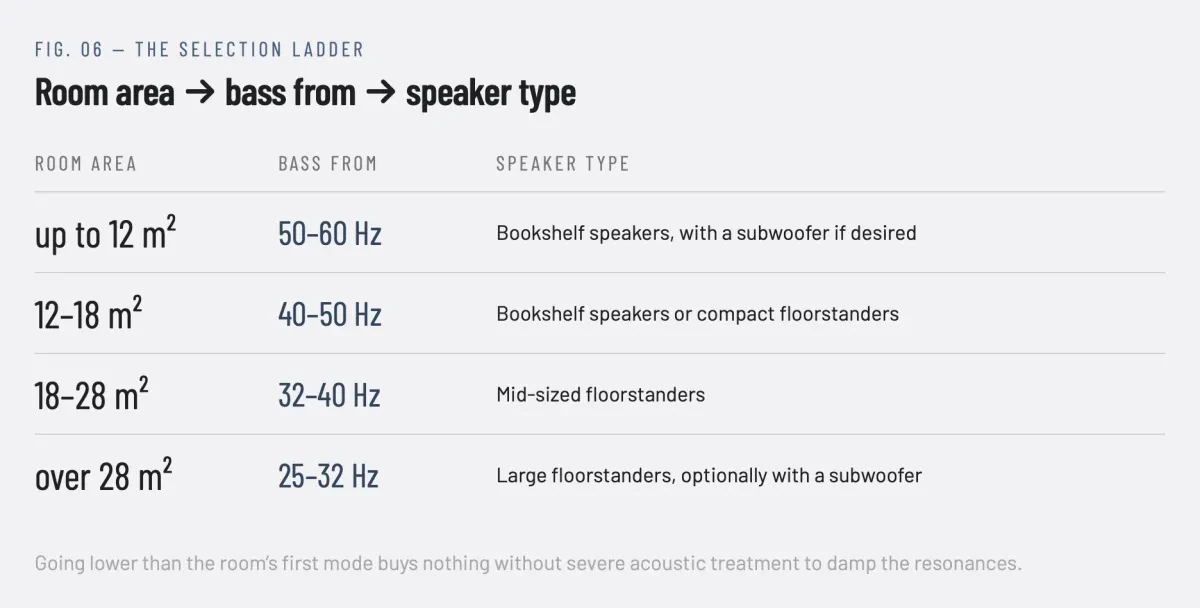
The selection rule: the response of the speakers you choose should drop to roughly the first mode of the room and not much lower. Otherwise you will need severe acoustic treatment of the room in order to damp the resonances.
Bookshelf speakers plus a subwoofer - the universal format
This configuration can surpass floorstanding speakers of comparable cost in sound quality, but only in the case of perfect integration between speakers and subwoofer.
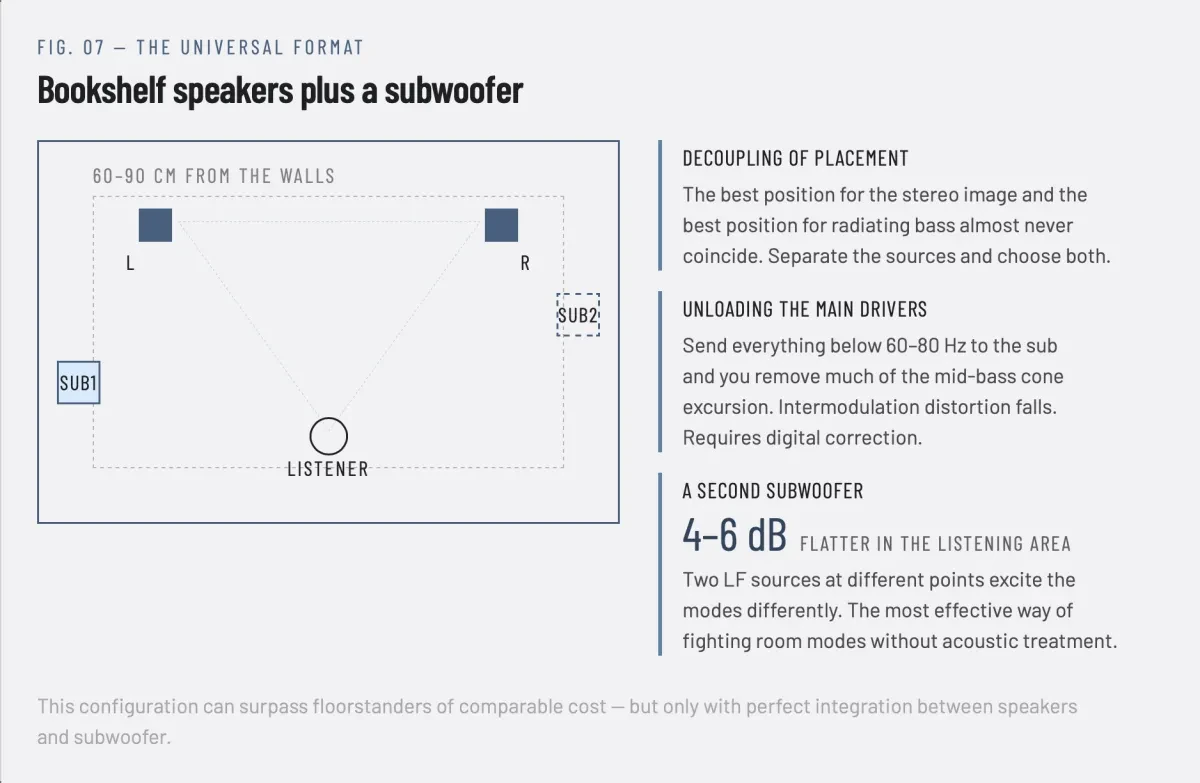
The advantages come from:
• Decoupling of placement. The optimal position for the main speakers (forming the stereo image) and for radiating bass into the room almost never coincide. By separating the sources, you can choose both placement positions optimally.
• Unloading the main drivers. This scheme will require digital correction, but if you redistribute bass from 60-80 Hz and below to the sub, you remove a significant part of the cone excursion from the mid-bass driver of the speakers. Which means intermodulation distortion will fall.
• The option of improving the bass further with a second subwoofer. Two LF sources at different points in the room excite the modes differently, and the summed response in the listening area evens out by 4-6 dB. This is the most effective way of fighting room modes that does not require acoustic treatment of the room.
The economics of the choice
When choosing speakers, do not forget to compare not only the retail price of the loudspeakers, but also the cost of stands for bookshelf models - because without stands you will lose a great deal in sound quality.
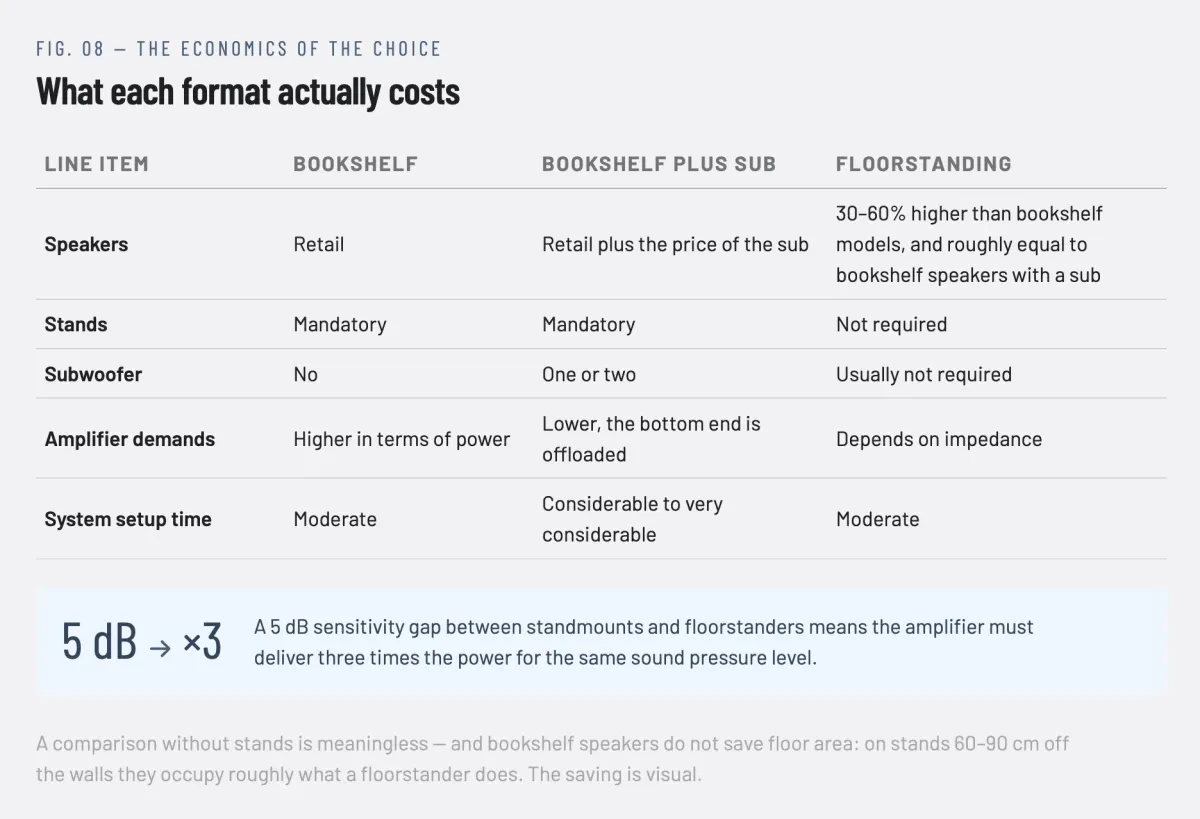
A point many people forget: bookshelf speakers with low sensitivity demand more power. A 5 dB difference in sensitivity between standmounts and floorstanders means that the amplifier will have to deliver three times the power for the same sound pressure level.
Scenarios
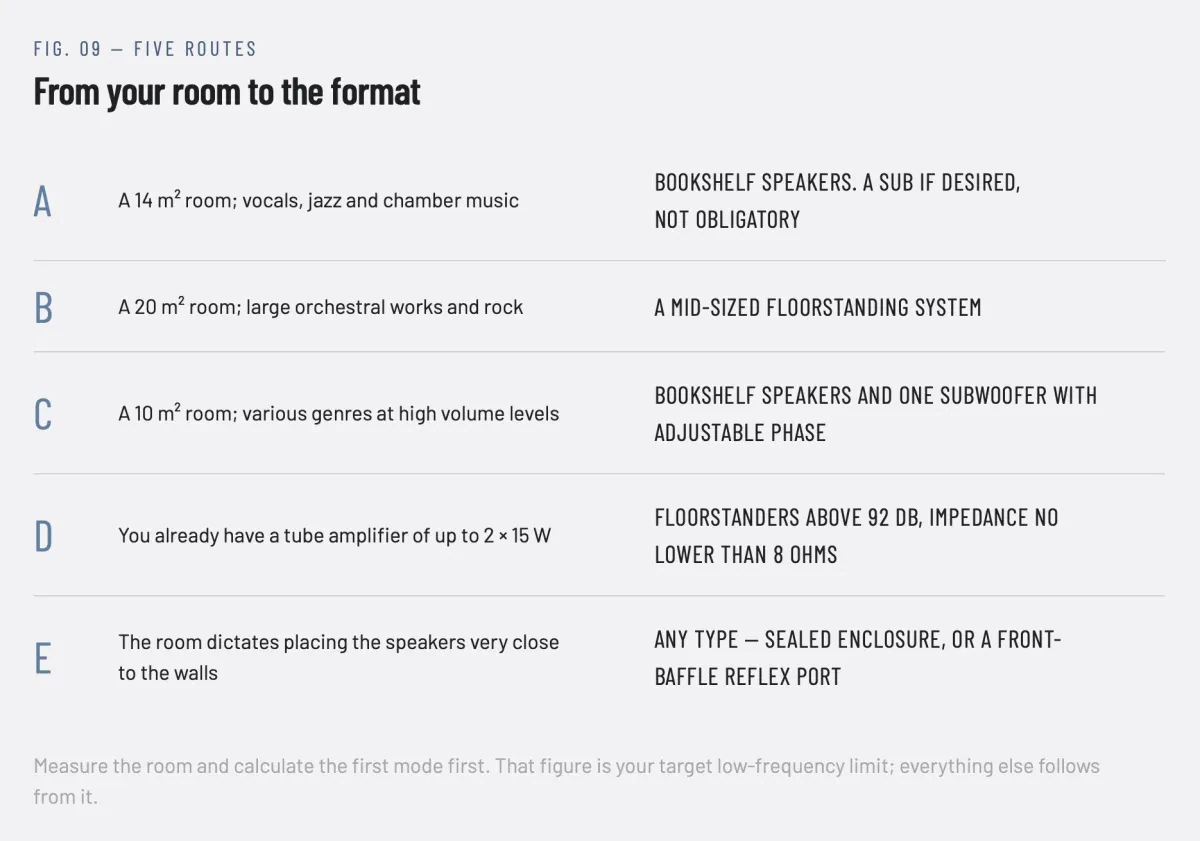
Requirements cheat sheet
1. Measure the room and calculate the first mode. This will be your target low-frequency limit.
2. Assess the musical genres you intend to listen to. Specifically, whether they contain bass below 50 Hz.
3. Assess your sound pressure level. Are moderate and low volume levels comfortable for you?
4. Check the amplifier requirements. Work out whether there is enough power, taking into account the sensitivity of the chosen speakers and the distance to the listening position.
5. Include stands in the budget for bookshelf speakers. A comparison without stands is meaningless.
6. Decide whether you are prepared to bother with a subwoofer. If not, that configuration is out.
Myths and mistakes
Floorstanding speakers play better than bookshelf models?
No. A large floorstanding system in a small room plays worse than good bookshelf speakers.
The bass of bookshelf speakers is limited?
Not significantly, but you have to remember the physics - either down to 45 Hz with low sensitivity, or down to 55 Hz with relatively normal sensitivity.
A subwoofer is only needed for home cinema?
No. Two correctly set up subwoofers in a stereo system solve the problem of room modes.
Bookshelf speakers are cheaper than floorstanders?
No. Taking stands and the additional demands on amplifier power into account, the final cost may turn out to be the same.
Pre-purchase checklist
• At what tolerance is the low-frequency limit of the speakers quoted, -3 dB or -6/-10 etc. dB? The difference between them can amount to an octave.
• What is the minimum impedance and the impedance phase angle of the chosen speakers - and not simply the nominal impedance figure.
• The enclosure type and the position of the port in reflex designs, if placement close to a wall is planned.
• The manufacturer's recommended distance from the speakers to the walls. For many floorstanders it starts at 80 cm.