10 Best Vintage Reel-to-Reel Tape Decks You Can Buy Today
2026 ranking

29.08.2026 08:59 | ~13 min read
The reel-to-reel recorders is the single component that delivers the highest sound quality in the system. Neither vinyl nor, still less, digital comes anywhere close to the resolution, density and sheer impact of a properly aligned tape deck running commercial master copies at 15 ips. The dynamic range is simply staggering, and even first-press vinyl starts to look like a pale shadow by comparison.
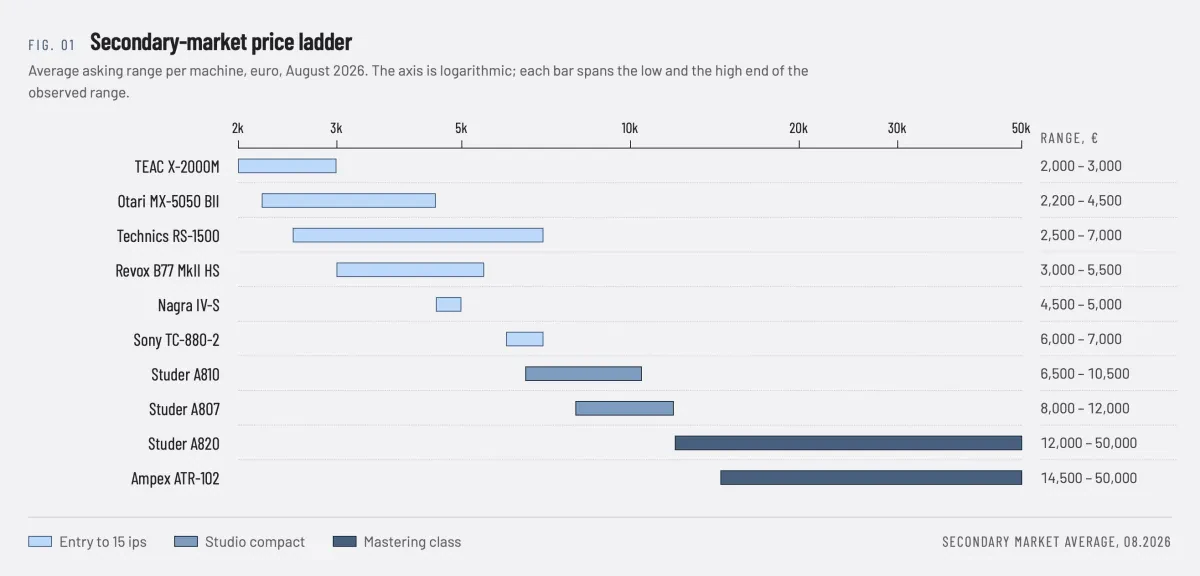
There is only one problem: new reel-to-reel machines are very expensive. So the lion's share of the R2R market sits in the vintage sector, helped by the fact that there are now plenty of specialist service shops around. In this new guide we have put together an exhaustive list of the best vintage reel-to-reel machines you can buy today. All prices reflect the current secondary market average as of August 2026.
TEAC X-2000M
€2,000 - 3,000
Production - 1984 to 1994 | Format - two-track, two-channel record and playback, switchable to four-track playback | Heads - four: erase, record, two-track playback and four-track playback, cobalt amorphous | Motors - three | Drive - closed loop with dual capstans | Reels - up to 10.5 in (26.5 cm) | Speeds - 7.5 and 15 ips (19 and 38 cm/s), deviation +/-0.5% | Wow and flutter - 0.02% WRMS at 15 ips, 0.03% at 7.5 ips | Frequency response - 30 Hz - 45 kHz +/-3 dB at 15 ips (40 Hz - 40 kHz at -20 VU), 30 Hz - 40 kHz +/-3 dB at 7.5 ips | Signal-to-noise ratio - 66 dB without dbx and 100 dB with dbx (referenced to 3% distortion) | Dynamic range - 115 dB with dbx engaged (1 kHz, peak level) | THD - 0.8% at 1 kHz | Noise reduction - dbx Type I | Inputs - line 60 mV / 50 kOhm, mic 0.25 mV / 200 Ohm | Outputs - line 0.45 V, headphones up to 100 mW | Rewind of 550 m - about 100 s | Dimensions - 432 x 456 x 268 mm, 472 x 486 x 268 mm in the wooden case | Weight - 21 kg, 25 kg cased | Power consumption - 115 W
Pros - affordable 15 ips, response out to 45 kHz
Verdict - cheap and cheerful
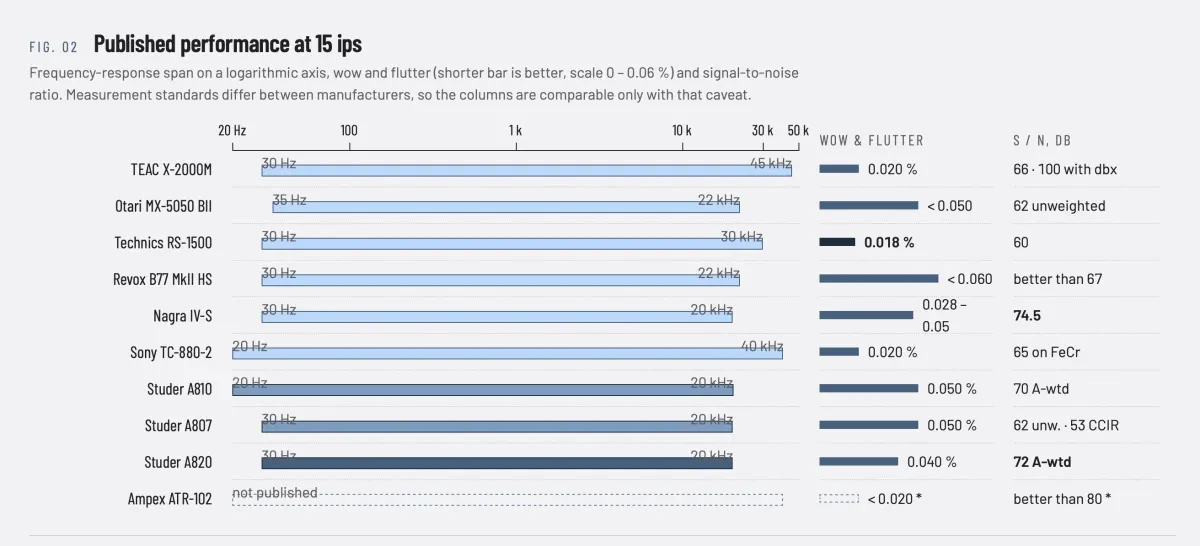
All three versions of the TEAC X-2000 share one chassis and broadly similar electronics, but the one that interests us is not the basic 7.5 ips model, it is the uprated master-release X-2000M. The machine does not pull stars out of the sky where resolution is concerned, yet it sounds rich and textured and lets you take the full measure of commercial master-tape copies. The specifications are excellent. Response to 45 kHz at 15 ips is the result of cobalt amorphous heads working with a reworked equalization amplifier, and on top of that the machine records two-track while also playing four-track tapes, so it covers both the master format and vintage recordings. One caveat: running at 15 ips consumes head life twice as fast as 7.5 ips, and cobalt amorphous heads wear considerably faster than Akai's glass and crystal ferrite GX designs. The main motor, too, attracts its share of complaints on reliability.
Otari MX-5050 BII
€2,200 - 4,500
Production - late 1970s | Format - two-track record, two- and four-track playback (switch under the head block cover) | Heads - four | Motors - three | Reels - up to 10.5 in | Speeds - 7.5 and 15 ips, switchable to 3.75 and 7.5 | Frequency response - 35 Hz - 22 kHz +/-2 dB at 15 ips, 30 Hz - 18 kHz at 7.5 ips | Wow and flutter - below 0.05% (NAB) | Signal-to-noise ratio - 62 dB unweighted | Inputs - XLR, mic and line | Built-in test tone oscillator, bias, equalization and level adjustment from the front panel | Weight - about 23 kg | US launch price - 1,450 dollars
Pros - a professional machine in a compact package
Verdict - the entry point into 15 ips
The Otari MX-5050 was the most compact professional machine of its day, portable enough to be carried to a session in the boot of a car. It has the prerogatives of a professional recorder, two-track recording at 15 ips, but the ability to play four-track releases has not been forgotten either. Built-in 1 kHz and 10 kHz oscillators and front-panel adjustment mean calibration for a given tape takes minutes rather than hours. When choosing one for a collection, keep the sonic character in mind: there is none of the cascade of detail you get from a Studer, although the Otari MX-5050 does put out a distinctly muscular sound. And bear in mind that the market currently holds an enormous number of worn machines, so thorough inspection before purchase is mandatory.
Technics RS-1500
€2,500 - 7,000
Production - 1977-1987 | Format - RS-1500US: two-track record and playback, four-track playback; RS-1506US mirrors this | Drive - Isolated Loop, a single 34 mm capstan with two pinch rollers, direct drive with quartz lock | Motors - three, all direct drive, brushless | Tape tension inside the loop - about 80 g | Reels - from 5 in to 10.5 in (12.7 to 26.5 cm) | Speeds - 3.75 / 7.5 / 15 ips | Wow and flutter - 0.018% WRMS (+/-0.035% DIN) | Frequency response - 30 Hz - 30 kHz at 15 ips | Signal-to-noise ratio - 60 dB | THD - 0.8% | Quartz reference frequency - 4,194,304 Hz
Pros - negligible wow and flutter, no mechanical noise on transport switching
Verdict - an engineering masterpiece
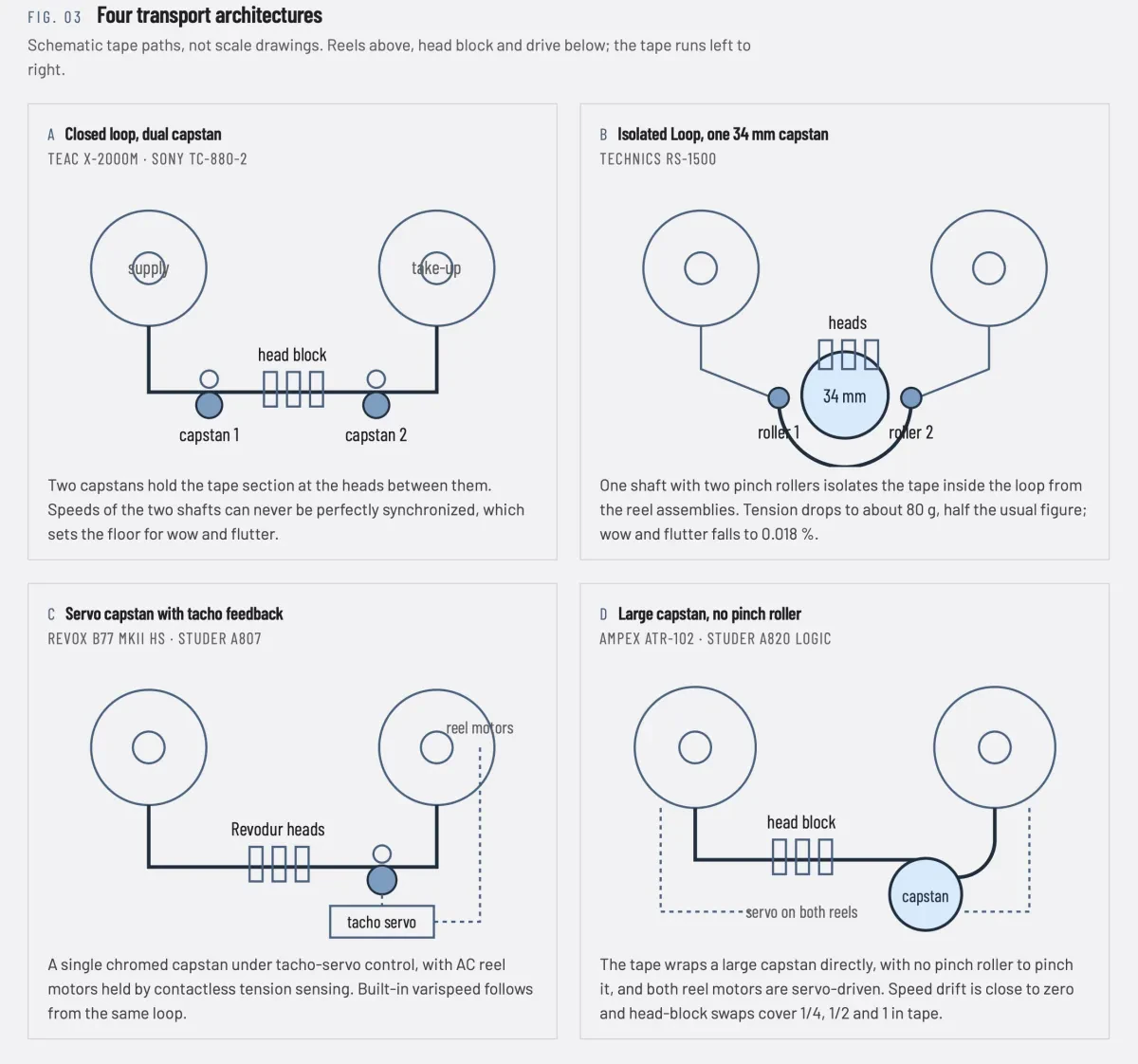
The Technics RS-1500 and its Isolated Loop transport represent a genuine engineering breakthrough. Instead of two capstans whose speeds can never be synchronized perfectly, Technics used a single 34 mm shaft with two rollers. The result? The section of tape between the rollers is physically isolated from the influence of the reel assemblies, and tension inside the loop comes out at 80 grams, half the usual figure. Hence the record 0.018% wow and flutter and a noticeably lower modulation noise floor than the competition. The flip side is that the machine does not like old tape with degraded edges. The sound is highly impressive, and the spread of asking prices is substantial, so if you find one cheap, think hard.
Revox B77 MkII HS
€3,000 - 5,500
Production - 1980-1998 | Format - two- or four-track | Motors - three: two AC reel motors and a tacho-servo capstan motor | Capstan - chromed, machined to thousandths of a millimetre | Heads - Revodur cores of Revox's own manufacture | Reels - up to 10.5 in | Speeds - 7.5 / 15 ips | Frequency response - 30 Hz - 22 kHz +2/-3 dB at 15 ips, 30 Hz - 20 kHz at 7.5 ips | Wow and flutter - below 0.06% at 15 ips, below 0.08% at 7.5 ips | Signal-to-noise ratio - better than 67 dB (two-track, 7.5 ips) | THD - about 0.5% | Varispeed - built in, +/-2 semitones | Line output - 1.55 V | Weight - 17 kg
Pros - outstanding parts and service availability, precise and neutral sound
Verdict - the optimum balance of price and quality
The Revox B77 MkII HS sounds monitor-precise and neutral. The company deliberately refused the 3 dB upper-bass lift in the 50-80 Hz region that dominated the market of the period. So be aware that there will be no particular warmth in the sound, but extended bass and spectacular dynamics are very much present. The MkII HS version of the B77 gained 15 ips support, built-in speed adjustment, revised pinch rollers and capstan bearings, plus a ready position with the head shield open. Prices have risen recently, but do not forget that the firm still produces spare parts and new machines of this class, so repair presents no difficulty at all.
Nagra IV-S
€4,500 - 5,000
Production - 1971 - 1980 | Format - portable stereo recorder, two 2 mm tracks plus a centre track for pilot tone or timecode | Tape - 1/4 in (6.35 mm) | Speeds - 3.75 / 7.5 / 15 ips | Equalization - NAB, CCIR, Nagramaster at 15 ips | Frequency response - 30 Hz - 20 kHz +/-1 dB (-20 dB signal, 15 ips) | Signal-to-noise ratio - 74.5 dB (NAB, Nagramaster, 15 ips) | Channel separation - 70 dB at 1 kHz | Inputs - two XLR, T-power 12 V or 48 V phantom | Power - twelve D cells or a battery pack | Dimensions - 333 x 242 x 113 mm | Weight - 6.4 kg with cells and tape
Pros - reference-grade microphone preamplifiers, Swiss mechanics
Verdict - R2R to go
The diminutive Nagra IV-S is one of the most recognizable recorders in history. Its miniature dimensions did not prevent Nagra from enabling 15 ips support, and on top of that there is the in-house Nagramaster equalization on board, which delivers a better result than NAB or CCIR. The machine can work entirely off grid, running on a dozen D cells, and weighs just 6.4 kg, which is simply fantastic. Wow and flutter at 15 ips is given variously between 0.028% and 0.05%, which is far from bad. The sound is lively and sharply defined. Downsides? Without the QGB adapter reel size is limited to 5 in, and the adapter itself is an expensive pleasure.
Sony TC-880-2
€6,000 - 7,000
Production - 1974-1980 | Format - two-track record, two- and four-track playback | Heads - four, ferrite | Drive - three direct-drive motors, closed loop with dual capstans | Reels - up to 10.5 in | Speeds - 7.5 and 15 ips | Wow and flutter - 0.02% WRMS at 15 ips, 0.03% at 7.5 ips | Frequency response - 20 Hz - 40 kHz +/-2 dB at 15 ips with FeCr tape | Signal-to-noise ratio - 65 dB (FeCr) | THD - 0.5% | Weight - 36.5 kg
Pros - direct drive on all three motors
Verdict - It's a Sony
The flagship reel-to-reel from the illustrious Japanese corporation. On its home market the Sony TC-880-2 was sold as the TC-8750-2 and cost 550,000 yen, three times the price of the cult TC-756-2 and twice that of the professional TC-9000F. Thirty-six and a half kilograms of mass are arranged on a rigid cast chassis, and every professional function is present, including LED metering with peak hold. The machine offers the widest bandwidth here, out to 40 kHz, although such extension is only attainable on ferrichrome tape in the low-bias position. On the debit side, ferrite heads are prone to chipping, so a candidate needs particularly careful checking before purchase. In return the sound is genuinely luxurious and dimensional.
Studer A810
€6,500 - 10,500
Production - 1982-1989 | Format - compact studio recorder for a 19 in rack, mono, stereo, two-track and four-channel versions | Tape - 1/4 in (6.35 mm) | Reels - up to 11.1 in (28.2 cm) | Speeds - 3.75 / 7.5 / 15 / 30 ips | Equalization - NAB and CCIR, switchable | Speed deviation - no more than +/-0.2%, tape slip no more than 0.1% | Wow and flutter - no more than 0.04% at 30 ips, 0.05% at 15 ips, 0.07% at 7.5 ips, 0.12% at 3.75 ips | Frequency response +/-2 dB - 40 Hz - 22 kHz at 30 ips, 20 Hz - 20 kHz at 15 ips | Frequency response +/-1 dB - 40 Hz - 20 kHz at 30 ips, 40 Hz - 18 kHz at 15 ips | Signal-to-noise ratio (NAB, 1/4 in tape, two 2 mm tracks, A-weighted) - 74 dB at 30 ips, 70 dB at 15 ips | Crosstalk - better than 65 dB (two-track) | Varispeed - +/-7 semitones | Playback tension - 0.75 N | Weight - 31 kg (portable version) | Power consumption - 80 W in stop, 160 W in record
Pros - all of the A820's digital logic in a relatively compact chassis, excellent parts availability
Verdict - your ticket into the world of Studer
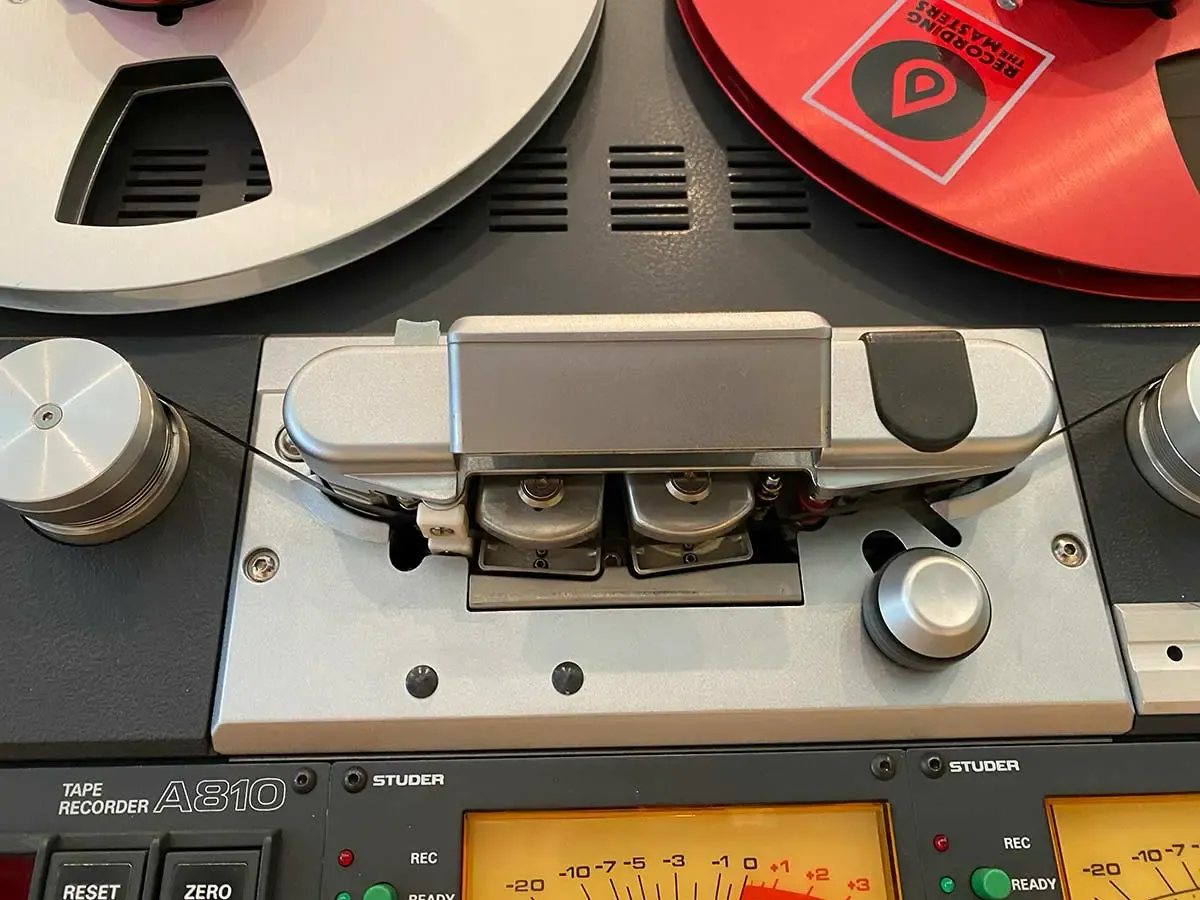
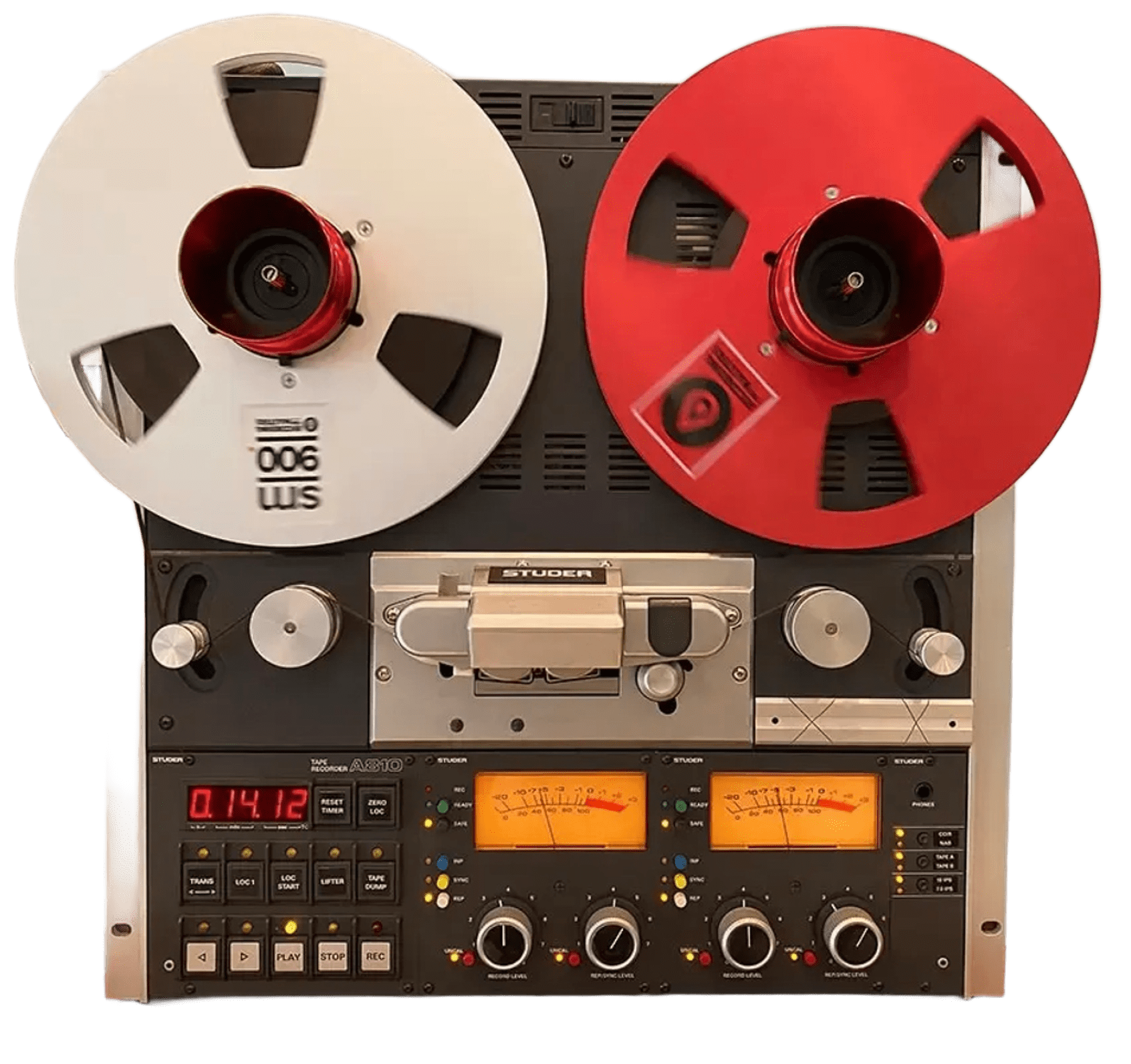
The Studer A810 is the junior version of the A820, packaged to 19 in rack dimensions. Parameters are entered with the buttons of the peripheral controller and stored in non-volatile memory; trimmer potentiometers do not exist here as a category. A value is set by an 8-bit converter in steps of 1/256 of the range and read out in hexadecimal on the counter display. The point of this is that a record or playback card can be swapped during servicing without repeating calibration from scratch, since all the settings are already in memory. The head block also comes off as a unit and goes back with azimuth and tape path geometry preserved. The mechanics are effectively indestructible, and the model's huge production run has left the market awash with spares. The price was and remains high, but once you have heard a Studer A810 there is no way back. Blacks turn ink-deep, the dynamics knock you flat, and the sound is sculpturally three-dimensional.
Studer A807
€8,000 - 12,000
Production - MkI 1986-1991, MkII 1992-2002 | Format - universal studio recorder, mono, stereo and two-track versions, a four-channel version for 1/2 in tape, timecode and playback-only versions | Tape - 1/4 in, optionally 1/2 in | Reel platters - 265 mm on the MkI, 300 mm on the MkII, handling 1,000 m tape lengths | Speeds - three of the four available: 3.75 / 7.5 / 15 / 30 ips | Drive - brushless DC with Hall commutation and a capacitive tacho sensor, two AC reel motors with photoelectric sensors and contactless tension sensing | Equalization - NAB and CCIR, switchable | Wow and flutter - no more than 0.05% at 15 ips per DIN 45507 | Frequency response at 15 ips - 30 Hz - 20 kHz +/-2 dB, 50 Hz - 18 kHz +/-1 dB | Signal-to-noise ratio at 15 ips (2.75 mm track, 510 nWb/m) - 62 dB unweighted and 53 dB weighted per CCIR 468-II | Start time at 15 ips - about 0.8 s | Rewind of 1,000 m - 120 s | Dolby HX Pro - standard | Microphone powering - 48 V phantom | Dimensions - 465 x 500 x 265 mm | Weight - about 30 kg | Power consumption - 100 W idle, 200 W in record
Pros - the summit of the company's engineering, the brand's last production tape machine, Dolby HX Pro on board
Verdict - the published numbers look modest because of a different measurement method, on sound there are few equals
The industry's final exhalation is the Studer A807. The machine stayed in production until the summer of 2001, and a limited batch was built later, in December 2002. The run exceeded ten thousand units, so finding a working example and parts for it is easier than for any other studio tape machine; the price of that convenience is a substantial figure on today's market. But there is something to pay for here. To the Studer A810's house style the A807 adds salt and pepper, resolution rises, although bass extension drops back a little. So do not go by the numbers on paper. The point is that the A807's 53 dB was obtained with the CCIR 468-II weighting curve, whereas the 72 and 75 dB of the A820 use the A-weighting curve of the NAB standard. Calibration is performed directly from the front panel, parameters are entered with the standard transport keys, and the ergonomics are ideal.
Studer A820
€12,000 - 50,000
Production - from 1985 | Format - professional master recorder, configurations from 1/4 in two-track to 2 in 24-track | Tape - 1/4 in and 1/2 in, converted with a single tool with automatic switching of tension and calibration | Reels - up to 14 in (35.5 cm) | Speeds - 3.75 / 7.5 / 15 / 30 ips | Motors - five: three DC for the transport and two synchronous for the pinch assembly | Speed deviation - no more than +/-0.2% | Wow and flutter - no more than 0.03% at 30 ips, 0.04% at 15 ips, 0.06% at 7.5 ips | Frequency response +/-2 dB - 40 Hz - 22 kHz at 30 ips, 30 Hz - 20 kHz at 15 ips | Signal-to-noise ratio (NAB, 1/4 in tape, two 2 mm tracks, A-weighted) - 75 dB at 30 ips, 72 dB at 15 ips | Crosstalk - better than 65 dB | Varispeed - +/-7 semitones | Weight - 91 kg | Power consumption - 80 W in stop, 130 W in playback
Pros - electronic calibration of every parameter, a reference transport
Verdict - high end in all its glory
The Studer A820 is a mastodon of the industry, a machine that demonstrates unique bass extension and texture, literally transforming recordings with shadings you have never heard before. Resolution is such that you can hear the differences between individual reels of tape from the same batch. The computing power, enormous for its day, is equally striking: every core function received its own processor, covering tension and reel motors, the capstan servo and communication with peripherals. The CPU determines the moment of inertia of the fitted reels by itself and calculates optimum acceleration and braking, while the capstan motor only starts once the tape is already touching the shaft, so handling of your recordings is supremely delicate. Calibration of the audio path is carried out through the menu and stored digitally with a resolution of 256 steps per range, so no screwdriver is required.
Ampex ATR-102
€14,500 - 50,000
Introduced - 1976 | Format - professional mastering recorder, two channels | Tape - 1/4, 1/2 or 1 in via interchangeable head blocks | Speeds - 3.75 / 7.5 / 15 / 30 ips | Drive - large capstan with no pinch roller, servo control of the capstan and both reel motors | Equalization - NAB, CCIR, AES, switchable | Wow and flutter - secondary sources give below 0.02%; the official Ampex specification has not been verified | Signal-to-noise ratio - better than 80 dB A-weighted at 30 ips (not confirmed against a primary source) | Third-harmonic THD - below 0.3% (not confirmed against a primary source)
Pros - pinch-roller-free transport, the status of a mastering standard
Verdict - the fattest sound in this selection, in the best sense
The list of albums mixed on the Ampex ATR-102 runs into the thousands, so if you want to hear the sound as it was originally intended, all roads lead to this model. You can argue at length about which machine sounds better, the Ampex ATR-102 or the Studer A820, but one thing is clear: in a domestic setting both are ultra high end, and both can overturn your ideas about sound altogether. The Ampex ATR-102 paints a fantastically expansive stage and builds a full wall of sound, the kind that raises goosebumps. The transport is unique, with a large capstan running without a pinch roller, servo control of both reel motors and almost zero speed drift. And you can switch the machine to 1 in tape without any trouble.
Which reel-to-reel tape recorder do we consider the best in terms of the balance between performance and price? The Studer A810 is the winner.